



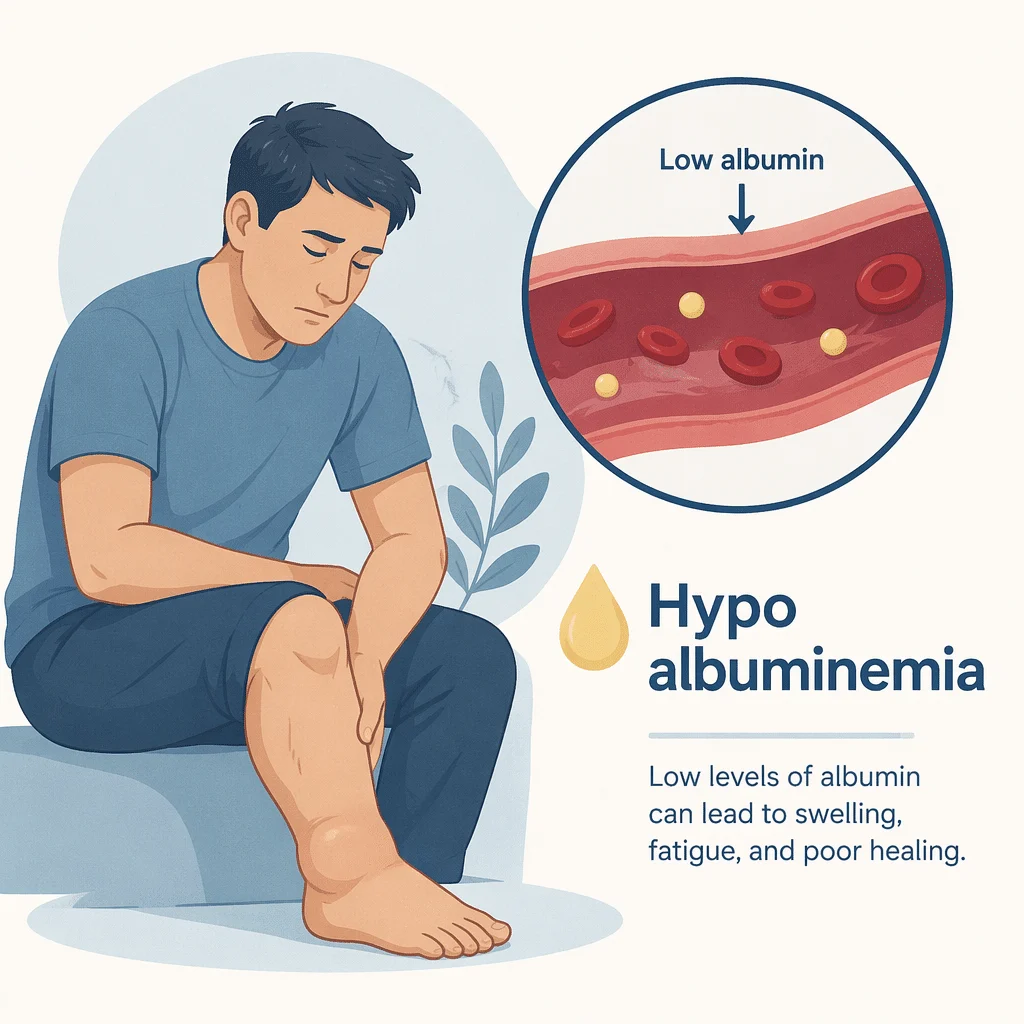
La hipoalbuminemia es el término médico para un nivel bajo de albúmina en la sangre, la principal proteína producida por el hígado. Es uno de los hallazgos más frecuentes en personas hospitalizadas o en estado crítico, y generalmente refleja una enfermedad subyacente del hígado, los riñones, el intestino, o un estado de inflamación importante, más que un problema con la albúmina en sí. Este artículo ofrece una visión clínica: cómo se clasifica la albúmina baja, los mecanismos que la causan, por qué predice peores desenlaces, cómo los médicos identifican la causa y cómo se trata. Si simplemente quieres entender un resultado bajo en tu propio reporte, comienza con nuestra guía para pacientes sobre un resultado de albúmina baja.
¿Qué es la hipoalbuminemia?
La albúmina es la proteína más abundante en el plasma sanguíneo, ya que representa aproximadamente la mitad de este, y el hígado es su única fuente. Su función principal es retener el líquido dentro de los vasos sanguíneos mediante la presión oncótica, y también transporta hormonas, calcio, medicamentos y ácidos grasos. Un nivel normal de albúmina sérica es de aproximadamente 3.5 a 5.5 g/dL. Cuando cae por debajo del rango de referencia, el diagnóstico es hipoalbuminemia. Es importante saber que la albúmina es un reactante negativo de fase aguda: durante la inflamación, señales como la interleucina-6 y el factor de necrosis tumoral reducen su producción, por lo que un valor bajo suele indicar la gravedad de una enfermedad. Para leer la albúmina junto con las demás proteínas en sangre, los médicos suelen revisar la relación albúmina-globulina.
¿Qué tan bajo es bajo? Clasificación de la hipoalbuminemia
No existe un sistema de clasificación universal único, pero los médicos suelen describir la caída en rangos, ya que la causa y las consecuencias varían entre ellos. Usa la tabla como guía general, siempre interpretándola con base en el rango de referencia del laboratorio’s propio.
| Albúmina sérica | Grado | Contexto típico |
|---|---|---|
| 3.5 a 5.5 g/dL | Normal | Rango de referencia, varía según el laboratorio |
| 3.0 a 3.4 g/dL | Leve | Frecuentemente asociado a enfermedad aguda o inflamación |
| 2.5 a 2.9 g/dL | Moderado | Sugiere una enfermedad subyacente significativa |
| Por debajo de 2.5 g/dL | Grave | Relacionado con edema y mayor riesgo clínico |
Los mecanismos detrás de la hipoalbuminemia
La albúmina baja se origina por cuatro vías principales, y muchos pacientes presentan más de una al mismo tiempo.
Producción reducida
Debido a que el hígado tiene capacidad de reserva, la síntesis disminuye de forma notable solo en enfermedad avanzada. La hipoalbuminemia es característica de la cirrosis avanzada, y la desnutrición proteico-energética grave (kwashiorkor) la reduce al privar al hígado de aminoácidos. Incluso en estos casos, la síntesis reducida suele combinarse con el aumento en la degradación que acompaña a las enfermedades graves. Las enzimas hepáticas elevadas en el mismo panel pueden apuntar hacia daño hepático, por lo que es útil leer la albúmina junto a la enzima hepática ALT.
Pérdida urinaria
Los riñones sanos casi no dejan escapar albúmina. Cuando el filtro glomerular está dañado, la albúmina se escapa hacia la orina. El ejemplo clásico es el síndrome nefrótico, definido por proteinuria importante (3.5 gramos o más de proteína por día) junto con albúmina baja, edema y colesterol elevado. La enfermedad renal crónica avanzada puede reducir la albúmina por una combinación de pérdida urinaria y síntesis disminuida.
Pérdida gastrointestinal
En la enteropatía perdedora de proteínas, la albúmina se filtra a través de la pared intestinal más rápido de lo que el hígado puede reponerla. Las causas incluyen afecciones con presión linfática elevada, enfermedad inflamatoria intestinal con ulceración de la mucosa y enfermedad celíaca.
Redistribución, dilución y aumento en la degradación
La sepsis, las quemaduras graves y las enfermedades críticas hacen que los capilares se vuelvan permeables, por lo que la albúmina sale del torrente sanguíneo hacia los tejidos; estos mismos estados también reducen su producción y aceleran su degradación, impulsados por citocinas inflamatorias. Los grandes volúmenes de líquidos intravenosos pueden diluir la albúmina restante, y la insuficiencia cardíaca la disminuye a través de varios de estos mecanismos a la vez. Por eso, una albúmina baja en un paciente muy enfermo se interpreta mejor como un indicador de la gravedad de su estado.
Por qué la hipoalbuminemia predice peores resultados
Tanto en hospitales como en unidades de cuidados intensivos, una albúmina baja es señal constante de mayor riesgo de complicaciones y muerte. Esto se debe principalmente a que refleja la gravedad de la enfermedad de base y la intensidad de la inflamación, no a que la albúmina baja por sí sola sea la causa directa. También tiene efectos prácticos: la caída de la presión oncótica permite que el líquido se acumule como hinchazón en las piernas (edema), líquido en el abdomen (ascitis) o hinchazón generalizada (anasarca); y como la albúmina transporta muchos medicamentos, un nivel bajo puede elevar la fracción libre y activa de un fármaco y modificar su efecto. La albúmina baja también se relaciona con una peor cicatrización de heridas y una mayor vulnerabilidad a las infecciones.
Cómo los médicos determinan la causa
El diagnóstico comienza con la medición de la albúmina sérica, generalmente dentro de un panel metabólico completo. A partir de ahí, el estudio se orienta según el mecanismo: los exámenes de orina (proteínas y la razón albúmina-creatinina en orina) buscan pérdida renal; las enzimas hepáticas y un panel completo de pruebas de función hepática evalúan el hígado; y pruebas especializadas, como la depuración de alfa-1-antitripsina en heces, pueden confirmar la pérdida intestinal. La electroforesis de proteínas séricas es especialmente útil, ya que el patrón orienta hacia la causa: la inflamación aguda muestra albúmina baja con globulinas alfa-1 y alfa-2 elevadas; la hepatopatía crónica muestra albúmina baja con globulinas gamma elevadas y puente beta-gamma; y el síndrome nefrótico muestra albúmina baja con alfa-2 elevada y gamma globulinas bajas.
Cómo se trata la hipoalbuminemia
El principio fundamental es tratar la enfermedad que está detrás de la albúmina baja, no el número en sí. Según la causa, esto puede significar controlar la presión arterial y la proteinuria en la enfermedad renal, manejar la insuficiencia cardíaca, tratar una infección, atender la enfermedad inflamatoria intestinal o brindar apoyo nutricional con un dietista. La albúmina intravenosa tiene un papel definido en situaciones específicas, como ciertas complicaciones de la cirrosis, el drenaje de grandes volúmenes de ascitis y las quemaduras, pero no es una solución general para un valor bajo y puede conllevar riesgos, por lo que se reserva para indicaciones basadas en evidencia. Como la albúmina tiene una vida media larga de aproximadamente tres semanas, los niveles se recuperan lentamente una vez que se controla la causa.
Signos físicos, incluidas las líneas de Muehrcke’s
Muchas personas con hipoalbuminemia leve no presentan signos externos. A medida que se agrava, aparecen signos relacionados con la retención de líquidos: hinchazón con fóvea en las piernas, ascitis o dificultad para respirar si el líquido se acumula alrededor de los pulmones. Un signo clásico en las uñas son las líneas de Muehrcke, pares de bandas horizontales pálidas que atraviesan las uñas, que desaparecen al presionar el lecho ungueal y que reflejan niveles bajos de albúmina. Estos signos complementan el cuadro de laboratorio, pero no lo reemplazan.
Avances científicos recientes
Investigaciones recientes han aclarado cuándo elevar la albúmina realmente ayuda y por qué los niveles bajos de albúmina son tan importantes en las infecciones. Aquí está el panorama práctico.
Un gran ensayo de 2021 publicado en el New England Journal of Medicine evaluó la administración de albúmina concentrada a pacientes hospitalizados con cirrosis avanzada, con el objetivo de elevar sus niveles. Reponer albúmina de esta manera no redujo las infecciones, los problemas renales ni las muertes en comparación con el tratamiento estándar, y causó más efectos secundarios graves. En términos sencillos, corregir el número no es lo mismo que corregir la enfermedad, por eso el tratamiento se enfoca en la causa. Una revisión de 2024 llegó a una conclusión similar y matizada para la cirrosis: la infusión de albúmina claramente ayuda en complicaciones específicas, pero no es un tratamiento universal, y las formas alteradas de albúmina incluso pueden servir como indicadores pronósticos. Una revisión de 2021 explicó el otro lado de la historia: la albúmina baja tanto señala como puede empeorar el riesgo de infección, ya que la albúmina apoya la defensa inmunológica y ayuda a transportar medicamentos antimicrobianos. Lo que esto significa para pacientes y médicos es que una albúmina baja merece una búsqueda cuidadosa de su causa y un seguimiento cercano, en lugar de simplemente infundir más albúmina de manera refleja. Estas conclusiones siguen refinándose conforme se publican nuevos ensayos.
Glosario
- Hipoalbuminemia: nivel de albúmina sérica por debajo del rango de referencia del laboratorio.
- Albúmina: la principal proteína del plasma, producida por el hígado, que retiene líquido en los vasos sanguíneos y transporta muchas sustancias.
- Presión oncótica: la fuerza que ejerce la albúmina para mantener el líquido dentro de los vasos sanguíneos.
- Reactante de fase aguda negativo: proteína cuyos niveles disminuyen durante la inflamación, como ocurre con la albúmina.
- Síndrome nefrótico: trastorno renal con pérdida importante de proteínas en la orina, albúmina baja y edema.
- Enteropatía perdedora de proteínas: pérdida excesiva de proteínas, incluida la albúmina, a través del intestino.
- Anasarca: hinchazón generalizada y severa por retención de líquidos.
- Líneas de Muehrcke: bandas horizontales pálidas y pareadas en las uñas asociadas a niveles bajos de albúmina.
Preguntas frecuentes
¿La hipoalbuminemia es peligrosa? Puede serlo, principalmente como indicador de una enfermedad subyacente grave. Una albúmina muy baja o en descenso se asocia con más complicaciones y mayor mortalidad en pacientes hospitalizados, por eso se investiga la causa de manera oportuna.
¿Puede la albúmina baja causar la muerte por sí sola? Una albúmina muy baja rara vez causa la muerte de forma directa, pero refleja y puede empeorar condiciones peligrosas como sepsis, cirrosis avanzada o síndrome nefrótico, por lo que se toma muy en serio.
¿Qué causa la hipoalbuminemia con mayor frecuencia? En el entorno hospitalario, la inflamación y las enfermedades críticas son los factores más comunes; a largo plazo, las causas frecuentes incluyen enfermedad hepática, síndrome nefrótico, pérdida de proteínas por el intestino y desnutrición.
¿Cómo se trata la hipoalbuminemia? Tratando la enfermedad de base. La albúmina intravenosa se usa solo para indicaciones específicas, como algunas complicaciones de la cirrosis y quemaduras, no como corrección de rutina.
¿Puedo subir la albúmina con dieta o suplementos? La dieta apoya la producción del hígado cuando la causa es una ingesta deficiente, pero no puedes reemplazar la albúmina en sangre con suplementos orales. El apoyo nutricional médico y tratar la causa son las vías efectivas.
¿Qué tan rápido se recupera la albúmina? Lentamente. Como la albúmina dura aproximadamente tres semanas en el cuerpo, los niveles suelen mejorar en semanas o meses una vez que el problema de base está controlado.
Lecturas recomendadas
- Albúmina baja: qué significa tu resultado
- Albúmina alta: causas e interpretación
- Relación albúmina-globulina explicada
- Panorama general de las pruebas de función hepática
- ALT alta: causas y señales de alerta
Fuentes
- Gounden V, Vashisht R, Jialal I. Hypoalbuminemia. StatPearls, NIH National Library of Medicine, 2023. https://www.ncbi.nlm.nih.gov/books/NBK526080/
- Cleveland Clinic. Hypoalbuminemia. https://my.clevelandclinic.org/health/diseases/22529-hypoalbuminemia
- MedlinePlus, NIH National Library of Medicine. Albumin Blood Test. https://medlineplus.gov/lab-tests/albumin-blood-test/
- China L, et al. A Randomized Trial of Albumin Infusions in Hospitalized Patients with Cirrhosis (ATTIRE). N Engl J Med, 2021. https://consensus.app/papers/details/1530a60c9bda5a6685d37c11a833e52f/
- Wiedermann CJ. Hypoalbuminemia as Surrogate and Culprit of Infections. Int J Mol Sci, 2021. https://consensus.app/papers/details/4e811775454a5af3acedd18152671028/
- Heybe MA, et al. Role of albumin infusion in cirrhosis-associated complications. Clin Exp Med, 2024. https://consensus.app/papers/details/e2c1db27cc6a5bd188aa17e5f9340c88/
Entiende tus resultados de laboratorio con AI DiagMe
Una albúmina baja es una señal que cobra más sentido junto con tus enzimas hepáticas, marcadores renales y proteínas totales. AI DiagMe lee el reporte de laboratorio que subas y te explica qué pueden significar tu albúmina y los resultados relacionados, en un lenguaje claro, para que puedas tener una conversación más enfocada con tu médico. Te ayuda a entender tus resultados; no diagnostica enfermedades ni reemplaza la atención médica.
Obtén la lectura de tus resultados en minutos