







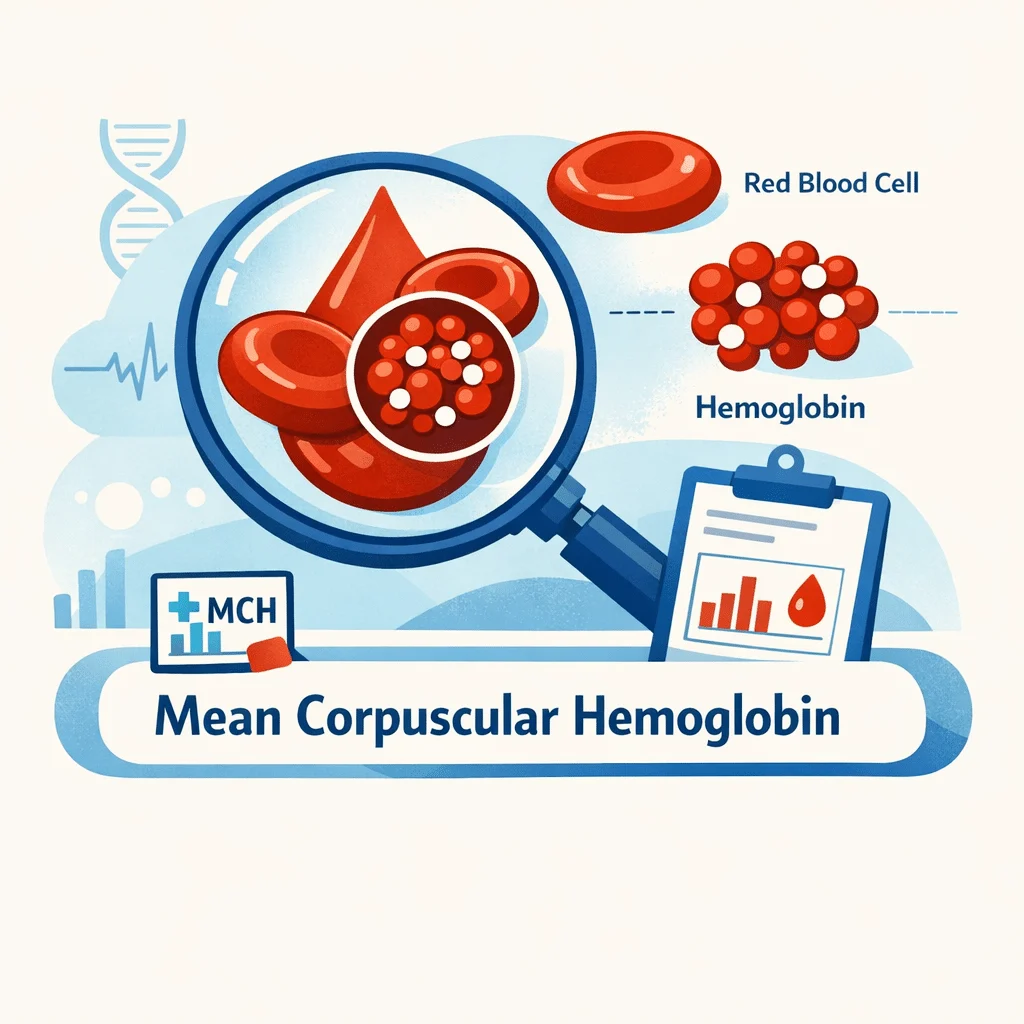
El análisis de HCM mide la cantidad promedio de hemoglobina dentro de cada uno de tus glóbulos rojos, un valor que los médicos llaman hemoglobina corpuscular media, o HCM. Es uno de varios índices de glóbulos rojos que se reportan automáticamente cada vez que te realizas una biometría hemática (BH). En este artículo aprenderás qué significa tu valor de HCM, qué puede indicar un resultado alto o bajo, cómo se compara con otros marcadores relacionados como el VCM y la CMHC, y cuándo un resultado amerita llamarle a tu médico en lugar de esperar a ver qué pasa.
¿Qué es la hemoglobina corpuscular media (HCM)?
La hemoglobina corpuscular media es el peso promedio de hemoglobina que contiene un solo glóbulo rojo, y generalmente se reporta en picogramos (pg), una unidad equivalente a una billonésima de gramo. La hemoglobina en sí es la proteína rica en hierro que le da al sangre su color rojo y se encarga de transportar el oxígeno de tus pulmones a cada tejido de tu cuerpo.
Tu médula ósea, el tejido blando que se encuentra dentro de tus huesos, produce glóbulos rojos nuevos las 24 horas del día y los carga con hemoglobina antes de liberarlos al torrente sanguíneo. El valor de MCH es básicamente una fotografía de qué tan bien está funcionando ese proceso de carga. Como refleja el contenido de hemoglobina de una célula promedio y no la hemoglobina total en tu sangre, se comporta de manera diferente a un conteo simple de hemoglobina y aporta su propia capa de información a la biometría hemática (BH).
Por qué importa tu resultado de MCH
Los glóbulos rojos y el oxígeno que transportan afectan casi todos los sistemas del cuerpo, por lo que un cambio en tu análisis de MCH puede ser una señal temprana mucho antes de que notes síntomas. Los médicos generalmente no actúan solo con base en el MCH. En cambio, lo interpretan junto con tu hemoglobina, hematocrito y los demás índices de glóbulos rojos para tener un panorama más completo de tu resultados de biometría hemática (BH).
En la práctica, un MCH bajo encontrado en un chequeo de rutina puede llevar al médico a preguntar sobre tu alimentación, cansancio o sangrados menstruales abundantes, mientras que un MCH alto puede dar pie a preguntas sobre el consumo de alcohol, medicamentos o la calidad de tu dieta. Usado de esta manera, el MCH se convierte en un punto de partida para una conversación, no en un diagnóstico por sí solo.
MCH vs. VCM y MCHC: ¿cuál es la diferencia?
El MCH se confunde con frecuencia con dos valores relacionados: el VCM y el MCHC, porque los tres describen los glóbulos rojos y suelen moverse juntos. Entender la diferencia entre ellos hace que tu reporte de laboratorio sea mucho más fácil de leer.
El VCM, o volumen corpuscular medio, mide el tamaño promedio de tus glóbulos rojos en fentolitros. La HCM mide la cantidad promedio de hemoglobina por célula en picogramos. La CHCM, o concentración de hemoglobina corpuscular media, mide qué tan concentrada está esa hemoglobina en relación con el volumen de la célula, expresada en gramos por decilitro; puedes leer más en nuestra guía sobre la prueba de CHCM en sangre y sus resultados. En la práctica, las células pequeñas suelen contener menos hemoglobina (VCM bajo y HCM bajo juntos), mientras que las células grandes suelen contener más (VCM alto y HCM alto juntos), por eso los tres valores frecuentemente cambian en la misma dirección.
| Marcador | Qué mide | Rango típico en adultos |
|---|---|---|
| VCM | Tamaño promedio de un glóbulo rojo | 80–100 fL |
| HCM | Cantidad promedio de hemoglobina por glóbulo rojo | 27–33 pg |
| CHCM | Concentración de hemoglobina dentro de la célula | 32–36 g/dL |
Cómo leer los resultados de tu prueba de HCM en sangre
Cuando recibas tu reporte, busca la línea de HCM, tu valor medido, su unidad (pg) y el rango de referencia que aparece junto a él. La mayoría de los laboratorios establece el rango normal para adultos entre 27 y 33 pg, aunque los límites exactos pueden variar ligeramente de un laboratorio a otro según el equipo y la población utilizados para determinarlos.
Los rangos de referencia se construyen estadísticamente para incluir aproximadamente el 95 por ciento de una población sana, lo que significa que un pequeño porcentaje de personas sanas puede quedar naturalmente fuera del rango impreso sin tener ningún problema de fondo. Un valor marcado con un asterisco, un color o una flecha simplemente indica que está fuera de ese intervalo estadístico, no que necesariamente haya algo malo. Solo tu médico, trabajando con tu historial completo y otros resultados de laboratorio, puede decirte qué significa tu número específico para ti.
Por qué los laboratorios usan rangos de referencia diferentes
Es posible que notes que el rango de MCH impreso en un reporte no coincide exactamente con el que encuentras en otro lugar. Esto es normal. Cada laboratorio calibra sus equipos y define su propia población de referencia, por lo que los rangos pueden variar ligeramente según la región, la marca del equipo, el grupo de edad e incluso la etnia. Por eso, comparar tu resultado con el rango impreso en tu propio laboratorio siempre es más confiable que compararlo con un número de otra fuente.
MCH bajo: qué puede significar
Un valor de MCH bajo, a veces llamado hipocromía, significa que tus glóbulos rojos contienen menos hemoglobina de lo normal. Por lo general, indica que el organismo tiene dificultades para producir o cargar suficiente hemoglobina en los nuevos glóbulos rojos.
Deficiencia de hierro
La deficiencia de hierro es, con mucho, la causa más común de un resultado bajo en el análisis de MCH, ya que el hierro es un componente esencial de la molécula de hemoglobina. Sin suficiente hierro, la médula ósea simplemente no puede producir una cantidad adecuada de hemoglobina, por lo que los glóbulos rojos recién formados terminan siendo más pequeños y pálidos de lo habitual. Las personas con deficiencia de hierro suelen reportar cansancio persistente que no mejora con el descanso, palidez inusual en la parte interna del párpado inferior, uñas quebradizas, adelgazamiento del cabello o mayor sensibilidad al frío. Si tu MCH está bajo, tu médico generalmente revisará tu ferritina, que refleja tus reservas de hierro y qué tan agotadas pueden estar, y puede solicitar un panel más amplio para interpretar los resultados del panel de estudios de hierro en conjunto.
Talasemia y otras causas hereditarias
Las talasemias son un grupo de trastornos sanguíneos hereditarios que afectan la capacidad del cuerpo para producir cadenas normales de hemoglobina, generando glóbulos rojos más pequeños con un MCH bajo desde el nacimiento, y no por una causa alimentaria. Las personas con rasgos de talasemia suelen tener un MCH persistentemente bajo que no responde a los suplementos de hierro, lo cual es una de las señales que lleva al médico a solicitar pruebas genéticas en lugar de estudios de deficiencia de hierro. Para confirmar este diagnóstico se utiliza un análisis de sangre específico llamado electroforesis de hemoglobina.
Inflamación crónica y enfermedades de larga duración
Las infecciones prolongadas, la enfermedad renal y algunas afecciones inflamatorias crónicas también pueden bajar el MCH, ya que la inflamación continua interfiere con la forma en que el cuerpo maneja y utiliza el hierro, incluso cuando las reservas totales de hierro no están agotadas. Este patrón, conocido a veces como anemia de enfermedad crónica, generalmente mejora una vez que se trata o controla la enfermedad de base.
MCH alto: qué puede significar
Un valor de MCH alto, que a veces se llama hipercromia, significa que tus glóbulos rojos son en promedio más grandes y contienen más hemoglobina de lo esperado. Este patrón con frecuencia coincide con lo que se describe como un MCV alto en el mismo reporte, ya que las células más grandes generalmente tienen espacio para más hemoglobina.
Deficiencia de vitamina B12 o folato
La causa principal de un MCH alto es la anemia megaloblástica, que se desarrolla por deficiencia de vitamina B12 o vitamina B9, también llamada folato. Ambas vitaminas son esenciales para la división y maduración normal de los glóbulos rojos en la médula ósea, y sin suficiente cantidad de alguna de ellas, la médula produce glóbulos rojos anormalmente grandes e inmaduros. Además de los síntomas habituales de la anemia, una deficiencia de B12 en particular puede provocar síntomas neurológicos como hormigueo o entumecimiento en manos y pies, problemas de equilibrio o dificultades de memoria, razón por la cual los médicos toman en serio un MCH alto en lugar de ignorarlo como un dato de laboratorio sin importancia. Confirmar la causa generalmente implica revisar directamente los niveles de vitamina B12 y qué indican los resultados anormales junto con un análisis de folato en sangre y sus rangos de referencia.
Consumo de alcohol, enfermedad hepática y otras causas
El consumo crónico y excesivo de alcohol puede elevar el MCH al afectar directamente las membranas de los glóbulos rojos y al interferir con la absorción de vitaminas del complejo B. Algunas enfermedades del hígado alteran la producción normal de glóbulos rojos por un mecanismo diferente y pueden producir el mismo resultado elevado. Con menos frecuencia, una tiroides poco activa (hipotiroidismo) y ciertos medicamentos, incluidos algunos anticonvulsivos que reducen la absorción de folato, se asocian con un valor de MCH más alto.
Una guía de decisión: qué hacer según tu HCM
Como el siguiente paso adecuado depende en gran medida de en qué dirección está alterado tu resultado de HCM en sangre y qué más aparece en tu reporte, una guía de decisión sencilla puede ayudarte a orientar la conversación con tu médico, sin reemplazarla.
| Tu resultado de HCM | Lo que suele seguir |
|---|---|
| Bajo, con ferritina baja | Estudio de deficiencia de hierro; revisión de la dieta y suplementación con hierro según lo indique tu médico |
| Bajo, con ferritina normal y sin respuesta al hierro | Posible rasgo de talasemia; puede considerarse una electroforesis de hemoglobina |
| Alto, con fatiga o síntomas neurológicos | Pruebas de vitamina B12 y folato; evaluación médica oportuna |
| Ligeramente fuera del rango, sin síntomas | Por lo general, solo se repite el estudio en unos meses para confirmar una tendencia |
Cuándo consultar a tu médico por los resultados de HCM
La mayoría de los resultados anormales en la prueba de HCM no son urgencias médicas, y muchos se resuelven una vez que se identifica y trata la causa subyacente, como la deficiencia de hierro. Aun así, hay situaciones que requieren atención más pronta que una consulta de seguimiento de rutina.
Comunícate con tu médico lo antes posible si tu HCM está muy por fuera del rango de referencia y no solo ligeramente alterada, ya que las desviaciones mayores tienen más probabilidad de reflejar un proceso subyacente real. También si tienes síntomas de anemia como fatiga intensa, falta de aire con actividades cotidianas, palidez inusual o latidos acelerados, porque los síntomas junto con un valor anormal tienen más peso que el número por sí solo. Si notas síntomas neurológicos como entumecimiento, hormigueo o problemas de equilibrio, que pueden acompañar una deficiencia de vitamina B12 y merecen evaluación oportuna. Si tu HCM ha cambiado significativamente en comparación con un estudio anterior, ya que una tendencia clara suele ser más informativa que una sola lectura. Si estás embarazada y notas que tu HCM va bajando, especialmente en el segundo o tercer trimestre, ya que las necesidades de hierro aumentan considerablemente durante este período.
Ante una alteración leve y aislada sin síntomas, tu médico puede simplemente sugerir revisar el valor nuevamente después de algunos meses en lugar de iniciar un tratamiento de inmediato. Ante una desviación más significativa, generalmente se recomienda un seguimiento más cercano o estudios adicionales; y ante una alteración grave o una condición subyacente confirmada, tu médico elaborará un plan de seguimiento personalizado.
Consejos de alimentación y estilo de vida para un HCM equilibrado
La nutrición juega un papel de apoyo importante una vez que tu médico ha identificado la causa detrás de un resultado anormal de HCM en sangre, aunque debe complementar la orientación médica y no reemplazarla.
Si tu HCM está bajo
Enfócate en alimentos ricos en hierro cuando un HCM bajo está relacionado con deficiencia de hierro. El hierro hemo, presente en carnes rojas magras, aves y mariscos, se absorbe con mayor eficiencia que el hierro no hemo que se encuentra en lentejas, garbanzos, tofu y espinacas. Combinar comidas ricas en hierro con una fuente de vitamina C, como cítricos, pimientos o brócoli, mejora considerablemente la cantidad de hierro que tu cuerpo absorbe. El té y el café contienen compuestos llamados taninos que pueden reducir la absorción de hierro, por lo que conviene evitarlos cerca de las comidas si estás trabajando activamente para aumentar tus reservas de hierro.
Si tu HCM está alto
Cuando una deficiencia de vitaminas está causando un MCH elevado, prioriza los alimentos ricos en vitamina B12, como las vísceras, el pescado graso como el salmón, los huevos y los lácteos; las personas que siguen una dieta vegana a menudo necesitan alimentos fortificados o un suplemento para alcanzar niveles adecuados de B12. Entre las opciones ricas en folato están las verduras de hoja oscura como la espinaca y la col rizada, junto con las lentejas, el espárrago y el aguacate. Como el alcohol interfiere con la forma en que el cuerpo absorbe y utiliza las vitaminas del complejo B, reducir su consumo puede apoyar la recuperación junto con cualquier tratamiento que tu médico recomiende.
Avances científicos recientes
Las investigaciones recientes siguen refinando la manera en que los médicos utilizan el MCH y los demás índices de glóbulos rojos en la práctica diaria. Una revisión sistemática y metaanálisis de 2025 reunió datos de doce estudios realizados en Arabia Saudita y encontró una variación considerable en los intervalos de referencia del MCH reportados entre distintas regiones y laboratorios, incluso después de ajustar por edad y sexo. Lo que esto significa para ti: los rangos normales no son iguales para todos, y el rango específico que aparece en tu propio reporte de laboratorio —no un número encontrado en internet— es el que debe guiar la lectura de tu resultado. Este hallazgo aún se está confirmando en otras poblaciones, por lo que debe interpretarse como un llamado a la interpretación específica por laboratorio, no como una nueva regla fija.
Un estudio de laboratorio realizado durante diez años analizó cómo se comporta el MCH cuando se combina con el conteo de glóbulos rojos y el ancho de distribución eritrocitaria (una medida de cuánto varían los tamaños de las células) para detectar formas raras y más difíciles de diagnosticar de talasemia que requieren confirmación genética. Los investigadores encontraron que agregar estos valores adicionales a un resultado bajo de MCH mejoró de manera significativa la detección de estos casos poco comunes en comparación con analizar el MCH por sí solo. Lo que esto significa para ti: si tu MCH se mantiene bajo a pesar de tener niveles normales de hierro, que tu médico evalúe varios índices eritrocitarios en conjunto, y no solo el valor del MCH, es un enfoque genuinamente respaldado por evidencia para detectar causas hereditarias de forma temprana. Como ocurre con la mayoría de los estudios de laboratorio realizados en un solo centro, estos resultados son preliminares y se beneficiarían de una confirmación en grupos de pacientes más amplios y diversos antes de modificar la práctica habitual de tamizaje.
Preguntas frecuentes sobre el análisis de sangre MCH
¿Puedes tener un MCH normal y aun así tener anemia?
Sí, esto es posible. La anemia se define por una cantidad total baja de hemoglobina en la sangre, lo cual es una medición diferente al promedio de hemoglobina por célula que mide el MCH. Podrías tener un MCH normal junto con un número reducido de glóbulos rojos, lo que puede ocurrir después de una pérdida súbita de sangre o con ciertas enfermedades crónicas. Por eso los médicos leen todos los valores de una biometría hemática (BH) en conjunto, en lugar de basarse en un solo dato.
¿Qué significa un MCH bajo en un análisis de sangre?
Un resultado bajo en un análisis de sangre de MCH significa que tus glóbulos rojos contienen menos hemoglobina de lo esperado para un adulto sano, lo cual ocurre con mayor frecuencia porque el cuerpo no tiene suficiente hierro para cargar completamente cada célula nueva. Los rasgos de talasemia, la inflamación crónica y algunas enfermedades crónicas pueden producir el mismo patrón. Tu médico generalmente revisará la ferritina y otros marcadores de hierro para identificar la causa específica antes de recomendar un tratamiento.
¿Qué significa un MCH alto en un análisis de sangre?
Un MCH alto generalmente significa que tus glóbulos rojos son más grandes de lo normal y contienen más hemoglobina de lo esperado, lo cual está relacionado con mayor frecuencia con una deficiencia de vitamina B12 o ácido fólico. El consumo crónico de alcohol, ciertas enfermedades del hígado y una tiroides poco activa también pueden elevar este valor. Dado que la deficiencia de vitamina B12 puede afectar el sistema nervioso si no se trata, un MCH alto generalmente vale la pena comentarlo con tu médico en lugar de solo observarlo indefinidamente.
¿Ciertos medicamentos pueden afectar tu análisis de sangre MCH?
Sí, algunos medicamentos pueden influir en tu resultado de MCH. Ciertos anticonvulsivos, por ejemplo, pueden reducir la absorción de folato y elevar el MCH con el tiempo. Siempre infórmale a tu médico sobre todos los medicamentos y suplementos que tomas, ya que este contexto les ayuda a interpretar con precisión un resultado anormal en el análisis de MCH, en lugar de atribuirlo a una causa equivocada.
¿Cómo se debe interpretar un MCH en el límite?
Un valor de MCH que se encuentra justo fuera del rango normal requiere atención, no alarma. Lo que suele importar más que el número en sí es la tendencia a lo largo del tiempo: un valor estable en el límite sin síntomas puede simplemente reflejar tu línea base personal, mientras que un valor que sigue alejándose de lo normal tiene más probabilidades de indicar un problema en desarrollo que vale la pena investigar. El contexto, incluyendo tus síntomas y otros valores en la sangre, siempre forma parte del panorama.
¿El embarazo influye en el MCH?
Durante el embarazo, el volumen total de sangre aumenta considerablemente, pero el valor de la HCM en sí suele mantenerse bastante estable. Sin embargo, los requerimientos de hierro aumentan de forma significativa para sostener el crecimiento del feto y la placenta, por lo que una HCM en descenso, especialmente en el segundo o tercer trimestre, puede indicar el desarrollo de una deficiencia de hierro. Los médicos generalmente ajustan la manera en que interpretan los índices de glóbulos rojos durante el embarazo, tomando en cuenta estos cambios fisiológicos normales.
Glosario
| Término | Definición |
|---|---|
| HCM (hemoglobina corpuscular media) | La cantidad promedio de hemoglobina contenida en un solo glóbulo rojo, medida en picogramos (pg). |
| Hemoglobina | La proteína rica en hierro que se encuentra dentro de los glóbulos rojos y que transporta el oxígeno desde los pulmones hacia el resto del cuerpo. |
| Hipocromía | Una condición en la que los glóbulos rojos contienen menos hemoglobina de lo normal, que se observa con frecuencia junto con un MCH bajo. |
| Hipercromía | Una condición en la que los glóbulos rojos contienen más hemoglobina de lo normal, que se observa con frecuencia junto con un MCH alto. |
| VCM (volumen corpuscular medio) | El tamaño promedio de un glóbulo rojo, medido en fentolitros (fL). |
| CHCM (concentración de hemoglobina corpuscular media) | La concentración promedio de hemoglobina dentro de los glóbulos rojos, en relación con su volumen. |
| Ferritina | Proteína que almacena hierro dentro de las células; su nivel en sangre refleja cuánto hierro tiene el cuerpo en reserva. |
| Talasemia | Grupo de trastornos sanguíneos hereditarios que afectan la producción normal de hemoglobina. |
| Anemia megaloblástica | Tipo de anemia causada por deficiencia de vitamina B12 o folato, caracterizada por glóbulos rojos anormalmente grandes. |
| Rango de referencia | El rango de valores considerados típicos para una población sana, establecido de forma individual por cada laboratorio. |
Fuentes
- Hemoglobina Corpuscular Media (HCM) — Cleveland Clinic
- Índices de Glóbulos Rojos — MedlinePlus, Biblioteca Nacional de Medicina (NIH)
- Anemia por Deficiencia de Vitamina B12 — Instituto Nacional del Corazón, los Pulmones y la Sangre (NIH)
- Naila Shaheen et al. — Hematological parameters’ reference intervals in apparently healthy individuals in Saudi Arabia: a systematic review and meta-analysis — Frontiers in Medicine, 2025 — https://doi.org/10.3389/fmed.2025.1522492
- Bente Fjeld et al. — Additional value of red blood cell parameters in predicting uncommon α-thalassemia; experience from 10 years of α-globin gene sequencing and copy number variation analysis — International Journal of Laboratory Hematology, 2022 — https://doi.org/10.1111/ijlh.14010
Lecturas recomendadas
- Aprende a leer tus resultados de análisis de sangre en general
- Entiende la hemoglobina y su relación con el MCH
- Explora un resultado alto de capacidad total de fijación de hierro
- Conoce qué incluye normalmente un panel de sangre completo
- Revisa los niveles altos de VCM y sus causas más comunes
Leer un resultado de MCH junto con tus valores de hemoglobina, VCM, ferritina y vitamina B12 puede sentirse como armar un rompecabezas sin ver la imagen de la caja. AI DiagMe te ayuda a traducir estos valores relacionados a un lenguaje sencillo para que puedas ver el patrón en tu reporte en lugar de enfocarte en una sola línea marcada. Está diseñado para ayudarte a entender tus resultados y preparar mejores preguntas para tu médico, no para diagnosticarte ni reemplazar su criterio.
Entiende tus resultados de laboratorio con AI DiagMe
Obtén la lectura de tus resultados en minutos