





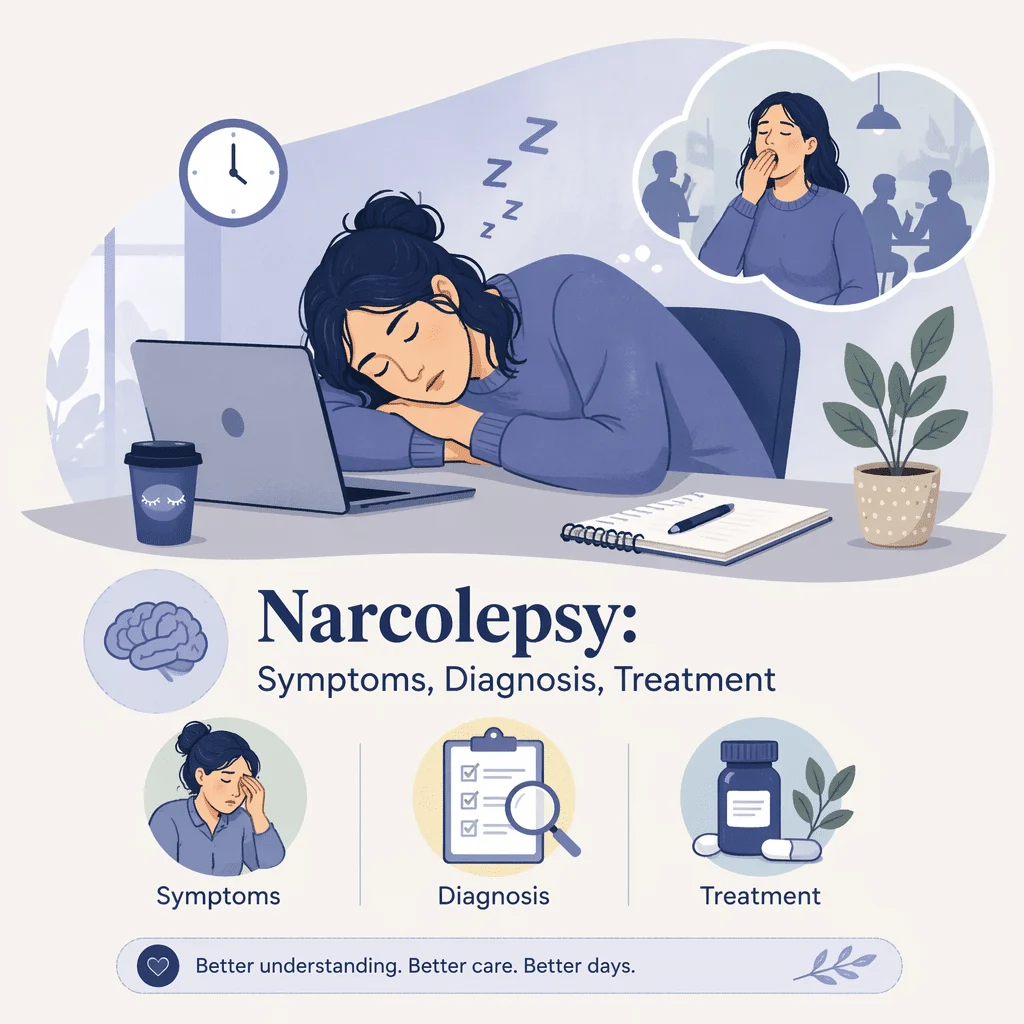
Narcolepsy is a lifelong neurological disorder that disrupts the brain’s control of sleep and wakefulness, leaving people with an overwhelming urge to sleep during the day no matter how much rest they get the night before. It is uncommon, affecting roughly 1 in 2,000 people, yet it is often missed or mistaken for ordinary tiredness, laziness, or depression for years before the right answer is found. Learning how the condition works, which signs set it apart, and how doctors confirm it can shorten that long road to a diagnosis. In this article you’ll learn what narcolepsy is, what causes it, how type 1 and type 2 differ, the sleep studies and blood tests used to diagnose it, the treatments available today, and the promising new therapies now emerging.
What is narcolepsy?
Narcolepsy is a chronic disorder of the central nervous system in which the brain cannot reliably hold the line between being asleep and being awake. As a result, fragments of sleep, including dreaming (REM) sleep, push into the daytime, whilst sleep at night becomes broken and restless. The hallmark is excessive daytime sleepiness: an irresistible need to sleep that returns day after day, even after a full night in bed.
This is not the same as feeling worn out after a bad week. In narcolepsy, sleep arrives suddenly and can be impossible to resist, sometimes during a meal, a conversation, or whilst driving. The condition usually begins in the teens or twenties, tends to be lifelong, and affects work, study, mood, and relationships when it is left unrecognised.
Narcolepsy type 1 versus type 2
Doctors separate narcolepsy into two forms. Narcolepsy type 1, once called narcolepsy with cataplexy, involves the loss of brain cells that make a wake-promoting chemical called orexin (also known as hypocretin). Narcolepsy type 2 causes similar daytime sleepiness but without cataplexy and usually with normal orexin levels. Type 2 is less well understood, and its long-term course is harder to predict. The table below summarises the main differences.
| Feature | Narcolepsy type 1 | Narcolepsy type 2 |
|---|---|---|
| Cataplexy (sudden muscle weakness) | Present | Absent |
| Orexin (hypocretin) level | Low or undetectable | Usually normal |
| Excessive daytime sleepiness | Yes | Yes |
| Typical severity | Often more pronounced | Often milder |
| Key diagnostic clue | Low spinal-fluid hypocretin-1 | Based on sleep studies |
| Understanding of the cause | Fairly well established | Still poorly understood |
What causes narcolepsy?
The loss of orexin (hypocretin) neurons
Deep in the brain sits a small cluster of nerve cells in the hypothalamus that produce orexin, a signalling chemical that keeps you awake and steadies the timing of REM sleep. In narcolepsy type 1, most of these cells are gone. With little orexin left, the brain struggles to sustain wakefulness during the day and to keep dreaming sleep in its proper place at night. That single shortage explains most of the symptoms, from sleep attacks to cataplexy.
Why those neurons are lost
The leading explanation is autoimmune: the body’s own immune system appears to attack and destroy the orexin-producing cells by mistake. This process is linked to a specific immune-system gene variant, HLA-DQB1*06:02, carried by nearly everyone with type 1. The gene raises susceptibility but does not guarantee the disease, which is why most carriers never develop it.
Environmental triggers can tip the balance in genetically susceptible people. The clearest example came from Europe during the 2009 to 2010 H1N1 influenza pandemic, when both the flu itself and one specific pandemic flu vaccine were followed by a rise in narcolepsy cases. The causes of narcolepsy type 2 are far less clear, and research is still working to define them.
Symptoms and signs of narcolepsy
Narcolepsy symptoms are often described as a classic group of five, sometimes called the pentad. Not everyone has all five, and they can appear months or years apart, which is one reason the condition is so easily overlooked.
The five core symptoms
- Excessive daytime sleepiness: the constant, overpowering need to sleep, and sudden sleep attacks that can strike during activities. This is usually the first and most disabling symptom.
- Cataplexy: a sudden, brief loss of muscle tone triggered by strong emotion such as laughter, surprise, or anger. It can range from a slight sag of the eyelids or jaw to buckling knees and a full collapse, all while the person stays fully aware. Cataplexy points specifically to type 1.
- Sleep paralysis: a temporary inability to move or speak whilst falling asleep or waking up, lasting seconds to a couple of minutes.
- Sleep-related hallucinations: vivid, often unsettling dreamlike images or sounds that occur as you drift off (hypnagogic) or wake up (hypnopompic).
- Disrupted night-time sleep: frequent awakenings that leave the night fragmented, despite the intense daytime sleepiness.
Sleep paralysis and sleep-related hallucinations happen because dreaming (REM) sleep intrudes at the wrong moments, a defining feature of the condition, documented across recent research. These experiences can be frightening but are not dangerous in themselves.
Beyond the five classic symptoms
Narcolepsy affects far more than the pentad. Many people also live with weight gain and other metabolic changes, memory and attention difficulties, anxiety, and low mood, and specialists increasingly stress that good care must address this whole 24-hour burden rather than sleepiness alone. Because that exhaustion blunts concentration and mood, the disorder is sometimes confused with other conditions. In children and teenagers it can resemble attention-deficit/hyperactivity disorder (ADHD); in adults, the low energy and flat affect can mimic depression. When neurological fatigue is prominent, clinicians may also consider multiple sclerosis. Sorting these apart is exactly why a careful, structured work-up matters.
How is narcolepsy diagnosed?
Diagnosis has two goals: to confirm narcolepsy with objective sleep testing, and to rule out other conditions that cause daytime sleepiness. It usually starts with a detailed history and a sleep diary kept over one to two weeks, often supported by a questionnaire that scores how sleepy you feel in everyday situations.
Sleep studies: polysomnography and the MSLT
The core narcolepsy test is a pair of overnight and daytime studies done in a sleep centre. Polysomnography records brain waves, breathing, heart rhythm, and muscle activity through the night, both to map your sleep and to check for other sleep disorders. The next day, the Multiple Sleep Latency Test measures how quickly you fall asleep across a series of short scheduled naps and whether REM sleep appears abnormally fast. In selected or unclear cases, doctors can measure hypocretin-1 directly in spinal fluid through a lumbar puncture; a very low level confirms type 1. Updated international criteria now let a rapid REM period on overnight recording stand in for part of the daytime test when clear cataplexy is present.
Blood tests that help rule out look-alike conditions
Narcolepsy has no blood test that can confirm it. Even so, blood work plays an important supporting role, because several common and treatable conditions produce the same heavy daytime tiredness. Before settling on the diagnosis, clinicians usually rule out obstructive sleep apnoea, the most frequent reason for unrefreshing sleep. They also order a panel to exclude hypothyroidism, since an underactive thyroid slows the whole body down. Thyroid screening starts with a TSH thyroid function test, and doctors may also measure serum iron levels and order a ferritin blood test to catch iron deficiency, which fragments sleep and deepens fatigue.
Doctors often request a vitamin D blood test to check nutritional status. They may add a vitamin B12 blood test, another quick way to rule out a correctable cause of low energy, and when the picture stays unclear some clinicians order a cortisol blood test to look for a hormonal problem. None of these results diagnose narcolepsy, but normal values help point the work-up back towards the sleep centre. The table below shows how the pieces fit together.
| Test | What it measures | Role in the narcolepsy work-up |
|---|---|---|
| Polysomnography (overnight) | Brain waves, breathing, and movement during sleep | Maps sleep and rules out sleep apnoea |
| Multiple Sleep Latency Test | How fast you fall asleep in daytime naps and whether REM appears | Main test used to confirm narcolepsy |
| Spinal-fluid hypocretin-1 | Orexin level in cerebrospinal fluid | Confirms type 1 when very low |
| TSH (thyroid) | Thyroid function | Rules out hypothyroidism as a cause of tiredness |
| Ferritin and serum iron | Iron stores and circulating iron | Rules out iron deficiency and restless sleep |
| Vitamin D and vitamin B12 | Nutritional status | Rules out common, easily treated causes of fatigue |
Treatment and management of narcolepsy
There is no cure for narcolepsy yet, so treatment aims to control symptoms and restore a workable daily life. The best results come from pairing medication with practical daily habits, and the plan is tailored to each person’s most troubling symptoms, age, and other health conditions.
Medications
Several drug classes are used, often in combination. Wake-promoting medicines such as modafinil, armodafinil, and solriamfetol reduce daytime sleepiness, while traditional stimulants like methylphenidate and amphetamines remain options for stubborn cases. Pitolisant works differently, boosting the brain’s own alerting histamine signals, and helps both sleepiness and cataplexy. Sodium oxybate, taken at night, improves disrupted sleep, daytime alertness, and cataplexy; newer versions include a lower-sodium formulation and a once-nightly dose that removes the old requirement to wake up for a second dose. Certain antidepressants are also prescribed to suppress cataplexy. Every one of these medicines has trade-offs, so a sleep specialist matches the choice to the person.
Everyday strategies
Habits matter as much as pills. Short planned naps of 15 to 20 minutes can restore alertness for a few hours and are a cornerstone of self-management. A steady sleep and wake schedule, a cool and dark bedroom, regular exercise, and careful timing of caffeine all help. Safety comes first with driving and machinery, which are dangerous when sleepiness is untreated but usually manageable once symptoms are controlled and naps are scheduled around trips. Telling teachers or employers, and arranging reasonable adjustments, eases the social and work strain that often accompanies the condition.
Latest scientific advances in narcolepsy
The past few years have brought real momentum, especially for type 1. Here is what is changing, in plain terms, and what it could mean for people living with the condition.
Drugs that target the root cause
For the first time, researchers are testing medicines designed to replace the missing orexin signal rather than only masking symptoms. The most advanced is oveporexton (also known as TAK-861), an oral orexin receptor 2 agonist, meaning a drug that switches on the same brain receptor that orexin normally activates. In a mid-stage (phase 2) trial published in 2025, people with narcolepsy type 1 who took it stayed awake far longer on standardised wakefulness tests, saw their daytime sleepiness fall towards normal levels, and had noticeably fewer cataplexy attacks over eight weeks. The most common side effect was trouble sleeping early on, which mostly settled within a week, and no liver toxicity was seen. What this means for you: if larger studies confirm these early findings, this could become the first treatment to address the underlying cause rather than just its symptoms. The drug is now being evaluated in larger, final-stage (phase 3) trials, and at least one other orexin-based medicine has entered testing, so results are still preliminary and need confirmation.
Simpler, steadier symptom control
Treatment that is already approved has also improved. A once-nightly form of sodium oxybate, cleared by the US Food and Drug Administration in 2023, lets people take a single bedtime dose instead of setting an alarm to take a second dose in the middle of the night. In its main trial, people who used it woke less often, moved less between light and deep sleep, and felt more refreshed in the morning. What this means for you: fewer interruptions and one less thing to manage overnight, which can make long-term treatment easier to stick with.
Towards faster, less invasive diagnosis
Because a very low orexin (hypocretin) level in spinal fluid is such a reliable marker of type 1, scientists are refining how it is measured and looking for ways to capture the same information with less invasive tools. Reviews of the field also highlight wearable sleep trackers and computer analysis of long recordings as promising aids that may one day shorten the years many people wait for answers. What this means for you: diagnosis is likely to become quicker and more precise, though these tools are still being studied and are not yet routine.
Living with narcolepsy
Narcolepsy is a lifelong condition, but with the right treatment and structure most people build full, productive lives. The practical goals are steady routines, planned naps, honest conversations with the people around you, and safety awareness on the road and at work. Support groups and counselling help with the emotional weight of a chronic, often invisible illness, and workplace or school accommodations can make a decisive difference.
When to see a doctor
Consider talking to a doctor, and asking for a referral to a sleep specialist, if you notice any of the following:
- Overwhelming daytime sleepiness that returns most days even after a full night's sleep.
- Sudden episodes of muscle weakness or collapse triggered by laughter, surprise, or other strong emotions.
- Falling asleep without warning during meals, conversations, work, or especially whilst driving.
- Regular sleep paralysis or vivid dreamlike hallucinations as you fall asleep or wake up.
- Daytime sleepiness that is disrupting your school, job, mood, or relationships.
Glossary
| Term | Definition |
|---|---|
| Narcolepsy | A chronic neurological disorder in which the brain cannot properly regulate sleep and wakefulness. |
| Cataplexy | A sudden, brief loss of muscle tone triggered by strong emotion, occurring whilst the person is awake and aware. |
| Orexin (hypocretin) | A brain chemical that promotes wakefulness and stabilises sleep; it is deficient in narcolepsy type 1. |
| Excessive daytime sleepiness | A constant, irresistible need to sleep during the day, often with sudden sleep attacks. |
| Polysomnography | An overnight sleep study that records brain waves, breathing, heart rhythm, and muscle activity. |
| Multiple Sleep Latency Test | A daytime test that measures how quickly you fall asleep across scheduled naps and whether REM sleep appears. |
| REM sleep | The dreaming stage of sleep; in narcolepsy it can intrude into wakefulness at the wrong times. |
| Sleep paralysis | A temporary inability to move or speak whilst falling asleep or waking up. |
| Hypnagogic hallucinations | Vivid dreamlike images or sounds experienced whilst drifting off to sleep. |
| Sodium oxybate | A nighttime medication used to improve disrupted sleep, daytime alertness, and cataplexy in narcolepsy. |
Frequently asked questions about narcolepsy
What is the main cause of narcolepsy?
Narcolepsy type 1 is caused by the loss of brain cells that produce orexin (hypocretin), a chemical that keeps you awake. Most evidence points to an autoimmune process, in which the immune system mistakenly destroys these cells in people who carry a specific gene variant, sometimes after a trigger such as an infection. Narcolepsy type 2, which occurs without cataplexy, is less well understood, and its causes are still being researched.
How do doctors test for narcolepsy?
There is no single blood test for narcolepsy. Doctors confirm it with sleep studies carried out in a sleep centre: an overnight polysomnography followed by a daytime Multiple Sleep Latency Test that measures how quickly you fall asleep and whether dreaming sleep appears abnormally quickly. In some cases, a very low orexin level in spinal fluid confirms type 1. Blood tests are used alongside these studies to rule out other causes of sleepiness, such as thyroid or iron problems.
What is the difference between narcolepsy and ADHD?
The two can look similar because both affect focus and behaviour, and narcolepsy in young people is sometimes mistaken for attention-deficit/hyperactivity disorder. The key difference is that narcolepsy is driven by an overwhelming need for sleep and, in type 1, by cataplexy, whereas ADHD centres on inattention, impulsivity, and restlessness without true sleep attacks. A sleep study helps tell them apart, and the two conditions can occasionally occur together.
Can you fall asleep randomly without having narcolepsy?
Yes. Falling asleep unexpectedly is far more often caused by simple sleep deprivation, shift work, obstructive sleep apnoea, certain medications, or other medical conditions than by narcolepsy, which is rare. What makes narcolepsy distinctive is the combination of daily irresistible sleepiness that persists despite adequate rest, and in type 1, cataplexy. If you regularly doze off against your will, a doctor can help identify the true cause.
How is narcolepsy treated?
Treatment combines medication with lifestyle measures. Wake-promoting drugs, stimulants, pitolisant, and sodium oxybate help control daytime sleepiness and cataplexy, and certain antidepressants can reduce cataplexy. Alongside these, short scheduled naps, a consistent sleep schedule, exercise, and safety planning around driving make a large difference. There is no cure, but with an individualised plan most people manage their symptoms well and lead full lives.
Is narcolepsy a lifelong condition?
Narcolepsy is generally a chronic, lifelong disorder. Symptoms often begin in adolescence or early adulthood and tend to persist, although their intensity can vary over time and usually improves with treatment. It is not a condition people simply outgrow, but ongoing care, medication, and daily strategies allow the great majority to keep working, studying, and living well.
Sources
- National Institute of Neurological Disorders and Stroke (NINDS) — Narcolepsy — ninds.nih.gov
- Mayo Clinic — Narcolepsy: Symptoms and causes — mayoclinic.org
- Cleveland Clinic — Narcolepsy: What It Is, Causes, Symptoms and Treatment — my.clevelandclinic.org
- American Academy of Sleep Medicine (Sleep Education) — Narcolepsy — sleepeducation.org
- Dauvilliers Y, et al. — Oveporexton, an Oral Orexin Receptor 2-Selective Agonist, in Narcolepsy Type 1 — New England Journal of Medicine, 2025 — doi.org/10.1056/NEJMoa2405847
- Barateau L, et al. — Narcolepsies, update in 2023 — Revue Neurologique, 2023 — doi.org/10.1016/j.neurol.2023.08.001
- Biscarini F, et al. — Present and Future of Central Disorders of Hypersomnolence — Journal of Sleep Research, 2025 — doi.org/10.1111/jsr.70118
- Morse AM, et al. — Narcolepsy: Beyond the Classic Pentad — CNS Drugs, 2025 — doi.org/10.1007/s40263-024-01141-9
- Thorpy MJ, et al. — REM sleep in narcolepsy — Sleep Medicine Reviews, 2024 — doi.org/10.1016/j.smrv.2024.101976
- Ortiz LE, et al. — Once-Nightly Sodium Oxybate Meets American Academy of Sleep Medicine Criteria for Treatment of Narcolepsy — Journal of Sleep Research, 2025 — doi.org/10.1111/jsr.70189
- ClinicalTrials.gov — Oveporexton (TAK-861) for Narcolepsy Type 1, Phase 3 — clinicaltrials.gov/study/NCT06470828
Further reading
- Normal thyroid levels and reference ranges
- Low ferritin: causes, symptoms, and treatment
- Low vitamin B12: symptoms, causes, and treatments
- Anxiety: understanding and managing it
- High TSH: symptoms, causes, and risks
Understand your lab results with AI DiagMe
Narcolepsy itself is confirmed with sleep studies, not a blood test, but bloodwork still matters, because conditions such as an underactive thyroid, low iron, or a vitamin deficiency can cause similar daytime tiredness and often show up first on a lab report. AI DiagMe helps you make sense of results such as TSH, ferritin, vitamin D, and vitamin B12 in plain language, so you can see which numbers fall outside the usual range and deserve a conversation with your doctor. It is built to help you understand your results, not to diagnose narcolepsy or replace the clinician who cares for you.
Get your results interpreted in minutes