




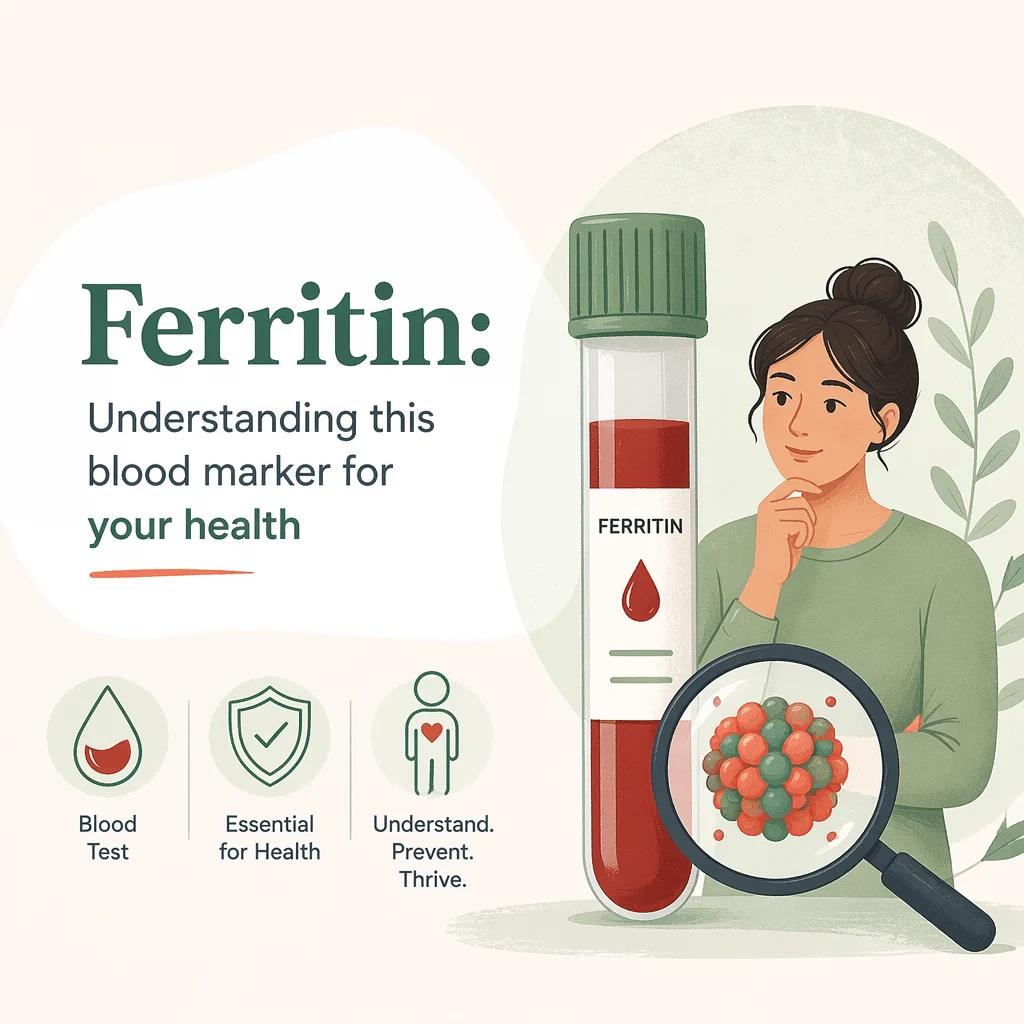
A ferritin blood test measures ferritin, the protein your body uses to store iron, and it is one of the clearest windows into how much iron you have in reserve. Seeing this word on a lab report can raise questions, especially when the value is flagged high or low. This guide explains, in plain language, what a ferritin blood test measures, why a doctor orders one, and how to make sense of your result. You will learn what high and low ferritin can mean, how ferritin fits with the other iron tests, what recent research says about the numbers, and when a result is worth discussing with your doctor. The aim is to help you read your report with more confidence, not to replace your doctor’s advice.
What is ferritin, and what does a ferritin blood test measure?
Ferritin is a protein that stores iron inside your cells and releases it when your body needs it. Think of it as your body’s iron warehouse: when stores are full, ferritin holds the surplus in a safe, non-toxic form; when demand rises, it hands iron back. Most ferritin sits inside the liver, spleen, bone marrow and muscles, but a small, steady amount circulates in the blood. That circulating amount is what a ferritin blood test measures, and it closely tracks your total iron reserves. This makes ferritin the single most useful marker of how much iron you have stored, which is why doctors rely on it so heavily when checking iron status.
The role of the iron that ferritin protects
Iron is essential for far more than avoiding tiredness. Your body uses it to build haemoglobin, the protein in red blood cells that carries oxygen from your lungs to every tissue. Iron also supports energy production inside cells, a healthy immune system, and normal brain development in children. Because loose iron can be harmful, the body keeps it tightly managed: iron is absorbed from food in the gut, then carried through the blood on the transport protein transferrin, stored by ferritin when it is not needed, and released again for tasks such as making new red blood cells. Ferritin sits at the storage step of this cycle, which is exactly what makes it such a good gauge of your reserves. The protein that moves iron between these steps is covered in our guide to transferrin.
Why ferritin also rises with inflammation
There is one important twist. Ferritin is also an acute-phase reactant, meaning its level climbs during inflammation, infection or liver stress, regardless of how much iron you actually have. The body raises ferritin partly to keep iron away from invading bacteria. The practical consequence is that a normal or even high ferritin can sometimes hide low iron stores. This is why a ferritin result is rarely read in isolation. When inflammation is suspected, doctors often check an inflammation marker such as C-reactive protein at the same time, so the ferritin can be interpreted correctly.
Why doctors order a ferritin blood test
A ferritin blood test is usually ordered for one of two reasons: to look for too little iron, or to look for too much. It is a simple blood draw, often added on after your doctor reviews a complete blood count that shows small or pale red cells, or when symptoms suggest an iron problem.
Common reasons to check ferritin include:
- Signs of low iron, such as ongoing tiredness, pale skin, breathlessness, dizziness or restless legs.
- Screening people at higher risk of deficiency, including those with heavy periods, pregnancy, a plant-based diet or frequent blood donation.
- Signs of iron overload, such as joint pain, abdominal pain, low sex drive, or a bronze or grey tint to the skin.
- Follow-up of a known condition, such as iron-deficiency anaemia or haemochromatosis, to see how treatment is working.
Because iron problems often develop quietly, ferritin can flag an imbalance well before obvious symptoms appear. That early warning is one of the main reasons the test is so widely used.
How to read your ferritin blood test results
On your report, your ferritin value sits next to a reference range, the span of values considered typical for a healthy population. If your number falls inside that range, it is usually reported as normal; outside it, the value is flagged high or low. Ferritin is measured in nanograms per millilitre (ng/mL) or micrograms per litre (µg/L). The two units are identical, so 30 ng/mL and 30 µg/L mean exactly the same thing.
Reference ranges vary with age, sex and, importantly, the individual laboratory. The table below shows representative adult ranges; always compare your result with the range printed on your own report.
| Group | Typical ferritin range (ng/mL, the same as µg/L) |
|---|---|
| Adult men | About 30 to 300, with some labs reporting up to 500 or more |
| Women before menopause | About 15 to 150 |
| Women after menopause | About 15 to 300 |
| Children | About 10 to 140 |
These figures are only a guide, and laboratories genuinely differ. Cleveland Clinic, for instance, lists roughly 30 to 566 ng/mL for men and 15 to 205 ng/mL for women, while Mayo Clinic uses about 24 to 336 ng/mL for men and 11 to 307 ng/mL for women. That gap is exactly why your own lab’s reference values matter more than any general table. Reference ranges and the uses of the test are also summarised by MedlinePlus, part of the US National Library of Medicine.
A flagged result is not a diagnosis. A number just outside the reference band is common and often harmless, and it carries far less weight than a value that is well outside the range or that keeps drifting in the same direction across several tests. Doctors read ferritin as part of a bigger picture that includes your symptoms, your history and the rest of your blood work before drawing any conclusion.
Ferritin within the iron studies panel
Ferritin is powerful, but it tells only part of the story, so it is usually interpreted alongside the other markers in an iron studies panel. That panel adds serum iron (the iron circulating right now), the carrier protein transferrin, your total iron-binding capacity, and transferrin saturation, which is the percentage of the carrier protein actually holding iron. Read together, these values separate the common patterns: low iron stores, iron locked away by inflammation, or genuine iron overload. The table below shows how ferritin and transferrin saturation usually line up.
| Ferritin | Transferrin saturation | Common interpretation |
|---|---|---|
| Low | Low | Iron deficiency, meaning low iron stores |
| Normal or high | Low or normal | Inflammation locking iron away in storage |
| High | High | Possible iron overload, such as haemochromatosis |
| Normal | Normal | Iron stores are likely adequate |
What high ferritin levels can mean
A high ferritin level means your blood holds more ferritin than the reference range, and telling apart its two broad explanations is the key task. The first is inflammation: because ferritin is an acute-phase reactant, infections, autoimmune conditions, obesity and liver problems can all push it up even when iron is normal. The second is genuine iron overload, where the body stores more iron than it should.
Frequent causes of a raised ferritin include:
- Inflammation or infection, from a short-lived illness to a chronic condition.
- Liver conditions, including fatty liver disease and alcohol-related liver damage.
- Hereditary haemochromatosis, a genetic condition that makes the gut absorb too much iron.
- Repeated blood transfusions or high-dose iron supplements.
- Metabolic factors such as obesity, type 2 diabetes or heavy alcohol use.
When ferritin is high because of true overload, iron can slowly build up in the liver, heart and pancreas, which is why persistent elevation is worth investigating. We explain the causes, symptoms and next steps in our guide to high ferritin levels.
What low ferritin levels can mean
A low ferritin level is the earliest and most reliable sign that your iron stores are running down, often appearing long before anaemia shows up on a blood count. Ferritin is usually the first iron marker to fall, which makes it valuable for catching a shortfall early, while there is still time to act.
Common causes of low ferritin include:
- Blood loss, from heavy menstrual periods or slow bleeding in the digestive tract.
- Not enough iron in the diet, which is more common with vegetarian or vegan eating.
- Poor absorption, from conditions such as coeliac disease or after some gut surgery.
- Higher demand, during pregnancy, childhood growth spurts or intense endurance training.
Low iron stores can cause fatigue, pale skin, brittle nails, hair thinning, breathlessness and sometimes unusual cravings such as a strong urge to chew ice. When a low ferritin appears without an obvious cause, doctors look for a hidden source of blood loss. We cover the symptoms, testing and treatment in our guide to low ferritin.
How a ferritin blood test is done and how to prepare
The test itself is quick and low-risk. A member of your healthcare team takes a small blood sample from a vein in your arm, usually in under five minutes, and sends it to a laboratory. You may feel a brief sting, and a little tenderness or bruising afterwards is normal.
Preparation is often minimal. For ferritin measured on its own, most people can eat and drink as usual. If the test is bundled with serum iron or a full iron panel, you may be asked to give the sample in the morning after an overnight fast, because those related values shift with food and with the time of day. Iron supplements can raise iron readings for a while, so labs sometimes ask you to pause them beforehand. Always follow the exact instructions from the team that requested the test, and mention any recent illness, since inflammation can lift ferritin. Results are usually available within a day or two.
Latest scientific advances
Ferritin has been measured for decades, but researchers are actively rethinking the numbers behind it, especially the cutoff used to diagnose iron deficiency. This is an area of live debate, so the points below reflect emerging evidence rather than settled rules your own doctor must follow.
For years, the World Health Organization defined iron deficiency in healthy adults as a ferritin below 15 ng/mL. A growing body of recent work argues that this bar is set too low and misses many people who are already short of iron. A 2025 review proposed that a threshold closer to 50 ng/mL better identifies adults with depleted iron, particularly women (Cançado and colleagues, Diagnostics, 2025). What this means for you: a ferritin in the low-normal range is not automatically reassuring, especially if you have symptoms.
Two further 2025 studies reached a similar conclusion from different angles. Laboratory scientists who re-examined their own patient records found that the usual lower limits were too low and suggested higher cutoffs for diagnosing iron deficiency, which sharply improved detection in women (Troike and McShane, Clinical Biochemistry, 2025). Separately, a large multinational study led by the US Centers for Disease Control and Prevention used physiological signals, the point at which the body starts to run short of usable iron, to place the true threshold nearer 25 ng/mL in women and about 22 ng/mL in young children (Addo and colleagues, The Lancet Global Health, 2025). In plain terms, more people appear to be iron-deficient than the older cutoffs suggested.
Because low iron is so common in women of reproductive age, researchers have also asked whether routine screening would be worthwhile. A 2025 US analysis modelled the costs and benefits and concluded that screening with a ferritin threshold around 25 ng/mL would be good value for the health system (Wang and colleagues, American Journal of Hematology, 2025). This is a modelling study rather than a new guideline, but it strengthens the case for looking harder for hidden iron deficiency.
Finally, research keeps underlining that ferritin can mislead when inflammation is present. In heart failure, for example, experts have argued that the usual ferritin-based definition of iron deficiency is unreliable and that transferrin saturation is a better guide in that setting (Packer and colleagues, Circulation, 2024). According to PubMed, the common thread across these studies is that ferritin is best read in context, together with your symptoms, your other iron markers and any inflammation, rather than against a single fixed number.
When to see a doctor about your ferritin
Most out-of-range ferritin results are manageable once the cause is clear, but some situations deserve prompt medical attention. Contact a healthcare professional if you notice any of the following:
- Marked tiredness, breathlessness, dizziness or a racing heartbeat that affects daily life.
- A very high ferritin, especially with joint pain, abdominal pain or a family history of haemochromatosis.
- Iron-deficiency signs that persist despite eating more iron-rich food, which can point to hidden blood loss.
- A low ferritin in a man or a postmenopausal woman, where the cause of loss should always be checked.
- Any abnormal ferritin alongside abnormal liver tests or unexplained weight loss.
Whatever your result, the next step is a conversation with your doctor rather than self-treatment. Iron supplements can be unhelpful or even harmful when iron is already normal or high, so any change is best guided by someone who can see your full picture.
Glossary
| Term | Definition |
|---|---|
| Ferritin | A protein that stores iron inside cells; its blood level reflects your iron reserves. |
| Serum ferritin | The ferritin measured in a blood sample, another name for the ferritin blood test. |
| Iron stores | The reserve of iron kept in the body, mainly in the liver, ready for future use. |
| Acute-phase reactant | A protein, such as ferritin, whose level rises during inflammation or infection. |
| Transferrin | The main protein that carries iron through the bloodstream. |
| Transferrin saturation | The percentage of transferrin currently carrying iron; a low value suggests deficiency. |
| Total iron-binding capacity | An estimate of how much iron your blood could carry if all transferrin were full. |
| Iron deficiency | A state in which the body lacks enough iron for its needs, often shown first by low ferritin. |
| Haemochromatosis | A condition in which the body absorbs and stores too much iron over time. |
| Reference range | The span of values considered typical for a healthy population, set by each lab. |
Frequently asked questions
What is a dangerously high ferritin level?
There is no single number that is automatically dangerous, because the meaning of a high ferritin depends on its cause. Many labs flag values above roughly 300 to 400 ng/mL, but mild elevations are often due to inflammation or a recent illness rather than iron overload. Levels that stay very high, for example above 1,000 ng/mL, are more concerning and usually prompt a search for iron overload, liver disease or another underlying condition. What matters is the trend, your transferrin saturation and your symptoms, so a persistently high ferritin should be reviewed by a doctor rather than judged on one reading.
What is a dangerously low ferritin level?
A ferritin below about 15 ng/mL almost always means iron stores are empty, and many clinicians now treat values under 30 ng/mL as low, especially when symptoms are present. A very low ferritin is rarely an emergency on its own, but it often causes fatigue, breathlessness and poor concentration, and it can lead to iron-deficiency anaemia if left uncorrected. A very low result usually prompts your doctor to start iron replacement and, in some cases, to look for a source of blood loss. The right target for you can depend on your age, sex and health, so discuss your number with your clinician.
How can you raise low ferritin levels?
Low ferritin is usually corrected by increasing iron intake and, where possible, treating the reason it fell. Diet helps: iron-rich foods such as lean red meat, beans, lentils and fortified cereals rebuild stores, and pairing plant sources with vitamin C improves absorption, while tea and coffee at mealtimes reduce it. When diet alone is not enough, doctors often prescribe oral iron supplements, sometimes taken on alternate days to improve tolerance and uptake. If tablets are poorly tolerated or stores are very low, intravenous iron is an option. Because too much iron can be harmful, supplements are best taken only when a test confirms you need them.
Can you have iron deficiency with a normal ferritin?
Yes, and it is a common source of confusion. Because ferritin rises with inflammation, infection or liver problems, it can sit within the normal range even when your true iron stores are low. In that situation, doctors look at the rest of the iron panel, particularly transferrin saturation, and at inflammation markers to see the fuller picture. A ferritin that is technically normal but on the low side can also be inadequate for some people, such as during pregnancy or with heavy periods. This is why a single normal ferritin does not always rule iron deficiency out.
Do you need to fast before a ferritin blood test?
For a ferritin test on its own, you usually do not need to fast, because ferritin is fairly stable and is not thrown off much by a recent meal. However, ferritin is often measured together with serum iron or a full iron panel, and those tests are affected by food and by the time of day. For that reason, labs frequently ask for a morning sample after an overnight fast when the wider iron panel is being checked. Iron supplements can also affect the results, so follow the specific instructions from the team that ordered your test.
Can exercise or the time of day change your ferritin?
Both can nudge the result. Very intense or prolonged exercise can temporarily raise ferritin, because it is an acute-phase reactant and hard training causes minor muscle inflammation, whilst endurance athletes can also have genuinely lower stores over time. To avoid a misleading reading, it is often suggested to wait a couple of days after a hard session before testing. Ferritin itself is steadier across the day than serum iron, but any recent infection or illness can push it up. If your result seems out of step with how you feel, repeating the test once you are well can clarify things.
Sources
- MedlinePlus, US National Library of Medicine — Ferritin Blood Test. https://medlineplus.gov/lab-tests/ferritin-blood-test/
- Mayo Clinic — Ferritin test. https://www.mayoclinic.org/tests-procedures/ferritin-test/about/pac-20384928
- Cleveland Clinic — Ferritin Test. https://my.clevelandclinic.org/health/diagnostics/17820-ferritin-test
- National Institutes of Health, Office of Dietary Supplements — Iron (Consumer Fact Sheet). https://ods.od.nih.gov/factsheets/Iron-Consumer/
- Cançado R, et al. — Defining Global Thresholds for Serum Ferritin — Diagnostics, 2025. https://consensus.app/papers/details/32785ff5bc705692951970c2c80915ff/
- Troike KM, McShane AJ — Re-evaluating ferritin thresholds to diagnose iron deficiency — Clinical Biochemistry, 2025. https://doi.org/10.1016/j.clinbiochem.2025.111020
- Addo OY, et al. — Physiologically based serum ferritin thresholds for iron deficiency (multinational study) — The Lancet Global Health, 2025. https://doi.org/10.1016/S2214-109X(25)00009-9
- Wang D, et al. — Cost-Effectiveness of Ferritin Screening Thresholds for Iron Deficiency in Reproductive-Age Women — American Journal of Hematology, 2025. https://doi.org/10.1002/ajh.27686
- Packer M, et al. — Redefining Iron Deficiency in Patients With Chronic Heart Failure — Circulation, 2024. https://doi.org/10.1161/CIRCULATIONAHA.124.068883
Further reading
- Serum iron: definition, analysis and interpretation
- Iron saturation explained: levels and causes
- Anaemia: symptoms, causes and blood tests
- Haemochromatosis treatments: a practical guide
- Iron-rich breakfast: benefits and sources
A ferritin blood test rarely stands alone. It is most useful when read together with your full blood count, serum iron, transferrin saturation and any inflammation markers, so the whole iron picture makes sense. AI DiagMe helps you understand these results in plain language and see how they fit together, within minutes. It is built to help you understand your report, not to diagnose you or replace your doctor.
Understand your lab results with AI DiagMe
Get your results interpreted in minutes