









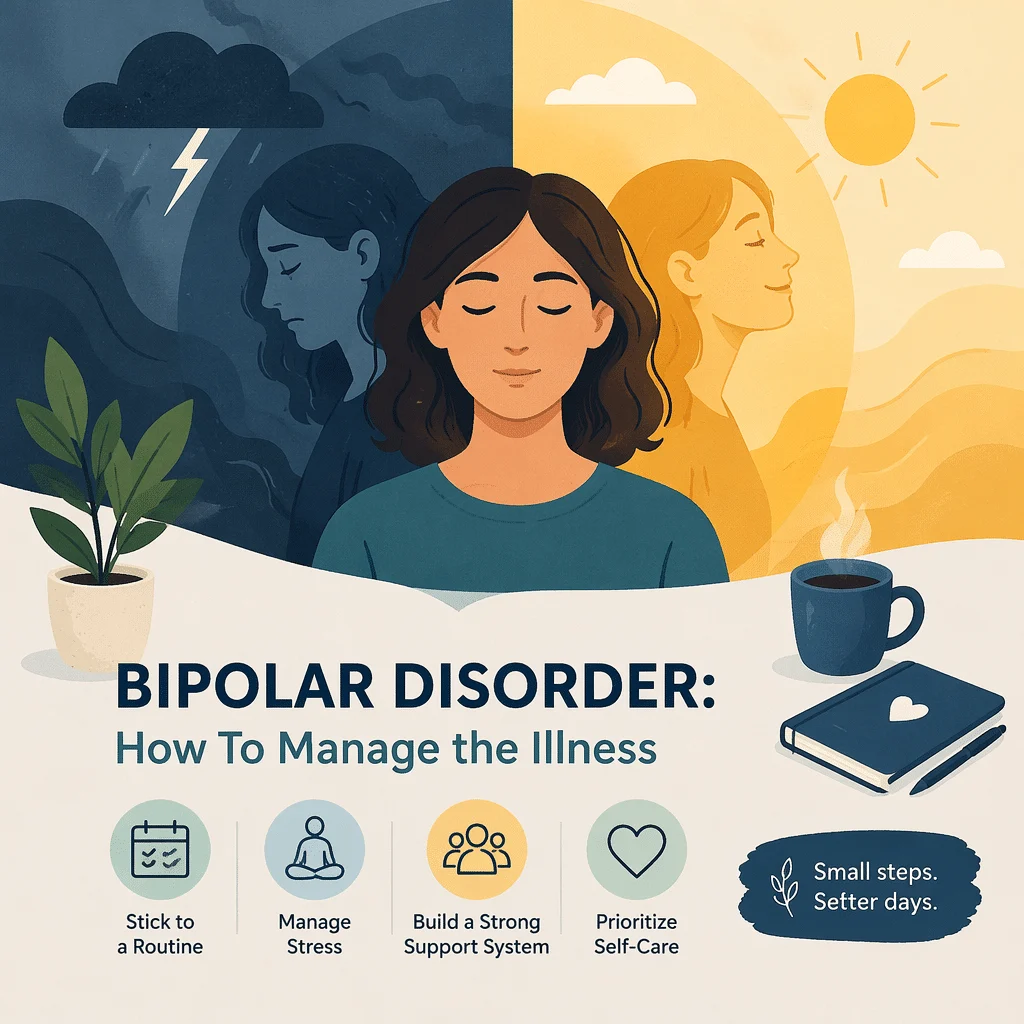
Bipolar disorder is a treatable brain condition that causes lasting shifts in mood, energy, and activity, moving between emotional highs and lows that reach well beyond ordinary ups and downs. It affects a little over 2 in 100 people worldwide, usually begins in the late teens or early twenties, and can be managed well once it is correctly identified. Many people who receive steady, informed care go on to live full and productive lives.
In this article you will learn what bipolar disorder is, how bipolar I and bipolar II differ, the signs of mania, hypomania, and depression, how the condition is diagnosed, and the treatments that help. You will also see how routine blood tests support safe treatment, even though no lab test can diagnose the condition on its own.
What is bipolar disorder?
Bipolar disorder is a mental health condition marked by episodes of unusually elevated mood, called mania or hypomania, and episodes of low mood, called depression. Between episodes, many people feel stable and function as usual. These mood states are not the same as everyday moodiness: they can last from days to weeks, change how a person thinks and behaves, and disturb sleep, work, relationships, and safety.
The exact biology is still being mapped, but researchers agree the condition involves differences in how certain brain circuits regulate mood and energy. It is nobody’s fault, and it does not reflect weakness or a lack of willpower. Understanding how bipolar disorder works is the first step towards managing it with confidence rather than fear.
Bipolar I, bipolar II, and cyclothymia
Clinicians recognise a few related types, and knowing which one applies helps guide treatment.
- Bipolar I involves at least one full manic episode, which may be intense enough to need hospital care. Depressive episodes are common but are not required for the diagnosis.
- Bipolar II involves at least one episode of hypomania, a milder high, together with one or more major depressive episodes. For many people the lows are the most disabling part.
- Cyclothymia is a milder, longer-lasting pattern of ups and downs that does not fully meet the criteria for mania or major depression.
People often search for the difference between bipolar 1 and bipolar 2. The simplest way to remember it: bipolar I includes full mania, while bipolar II pairs hypomania with depression. Both are real conditions, and both respond to treatment.
Recognising the symptoms of bipolar disorder
Symptoms tend to move in two broad directions, up and down, and some episodes blend features of both. The table below summarises what each state can look like. No two people experience it in exactly the same way, and symptoms can change over a lifetime.
| Episode type | What it can look like |
|---|---|
| Mania | Elevated or irritable mood, racing thoughts, little need for sleep, rapid speech, inflated confidence, and risky decisions; severe episodes can include a loss of touch with reality |
| Hypomania | Similar to mania but milder and shorter; the person may feel unusually productive and energised, whilst friends or family often notice the change first |
| Depressive episode | Lasting sadness or emptiness, loss of interest, fatigue, changes in sleep and appetite, trouble concentrating, and feelings of worthlessness |
| Mixed features | Symptoms of a high and a low at the same time, such as feeling restless and wired yet hopeless |
Mania and hypomania
Mania is a distinct period of abnormally high or irritable mood that lasts at least a week and clearly disrupts daily life. A person may sleep very little yet feel full of energy, talk quickly, jump between ideas, spend impulsively, or take risks that are out of character. Hypomania brings the same kind of changes in a gentler, shorter form that does not cause the same level of harm. Because hypomania can feel pleasant or even productive, it is easy to miss, which is one reason bipolar II is sometimes identified late.
Depressive episodes
The low phase can look much like other forms of depression: heavy sadness, loss of interest in things once enjoyed, low energy, sleep and appetite changes, and difficulty concentrating. From the outside, bipolar depression and ordinary unipolar depression can appear identical, yet they often need different medicines. If you want a fuller picture of low mood on its own, you can read our article on depression.
Mixed features and rapid cycling
Sometimes highs and lows overlap, so a person feels agitated and energised whilst also feeling hopeless. This is called an episode with mixed features, and it deserves careful attention because it can be especially distressing. When four or more mood episodes occur within a year, clinicians describe the pattern as rapid cycling, which may call for adjustments to the treatment plan.
What causes bipolar disorder?
There is no single cause. Bipolar disorder appears to arise from a mix of genetics, brain biology, and life circumstances. It runs in families, so having a parent or sibling with the condition raises the odds, though most relatives never develop it. Differences in how the brain manages mood and energy also play a part, and stressful events, disrupted sleep, or substance use can trigger episodes in someone already prone to them.
None of this means a person is to blame for their diagnosis. Bipolar disorder is one of the more heritable mental health conditions; for a plain-language primer, explore the National Institute of Mental Health overview of bipolar disorder.
How bipolar disorder is diagnosed
There is no blood test, brain scan, or single measurement that can diagnose bipolar disorder. The diagnosis is clinical, which means it rests on a careful conversation about symptoms, their timing, and their effect on daily life, guided by the criteria in the DSM-5, the manual clinicians use for mental health conditions. A clinician will ask about mood history, sleep, energy, and family history, and may speak with people close to the patient.
Blood and urine tests still play an important supporting role. Doctors order them to rule out other conditions that can imitate mood symptoms, such as an overactive or underactive thyroid, or certain medications and substances. Checking thyroid activity is a common early step, and you can read our guide to the TSH thyroid test. These diagnoses can share some features with related conditions, and to see how they differ you can read our overview of schizophrenia.
How bipolar disorder is treated
Bipolar disorder is a long-term condition, but it is very treatable. Most plans combine medication, talking therapy, and daily-rhythm strategies, adjusted over time in partnership with a clinician. The goal is to shorten episodes, prevent new ones, and protect quality of life.
Mood stabilisers
Mood stabilisers are the foundation of long-term care. Lithium is the best studied and remains a first-choice option for many people, helping to prevent both highs and lows and lowering the risk of suicide. Other stabilisers include valproate, lamotrigine, which is often used for the depressive side, and carbamazepine. The right choice depends on the type of bipolar disorder, past episodes, other health conditions, and personal preference.
Antipsychotic medicines
Several second-generation antipsychotics, such as quetiapine, olanzapine, and aripiprazole, treat mania and, in some cases, bipolar depression. They are sometimes continued for maintenance. These medicines can be very effective, and they are one reason certain blood values are checked over time, as explained in the next section.
Psychotherapy
Talk therapy works alongside medication. Approaches with good evidence include cognitive behavioural therapy, interpersonal and social rhythm therapy, which steadies daily routines, and family-focused therapy. Psychoeducation, simply learning how the condition works and how to spot early warning signs, helps people and their families respond sooner.
Daily rhythm and lifestyle
Steady habits support every treatment plan. Regular sleep, consistent daily routines, limiting alcohol and recreational drugs, managing stress, and staying connected to supportive people all reduce the chance of relapse. These steps do not replace medication, but they make it work better.
The blood tests that support safe bipolar treatment
Here is the key idea, and it is worth repeating: lab tests do not diagnose bipolar disorder. What they do is help a care team start and continue medication safely and catch side effects early. Several medicines used in bipolar disorder work best when a few blood values are measured before starting and then monitored over time.
| Blood test | How it supports safe care (it does not diagnose bipolar disorder) |
|---|---|
| Thyroid function (TSH) | Rules out a thyroid problem that can mimic mood symptoms, and tracks the thyroid because long-term lithium can affect it |
| Kidney function and lithium level | Checks that the kidneys are clearing lithium well and keeps the lithium level inside its narrow safe range |
| Fasting glucose and HbA1c | Watches blood sugar, because some antipsychotic medicines can raise it over time |
| Lipid panel | Follows cholesterol and triglycerides during treatment with certain medicines |
| Full blood count | Gives a baseline and helps monitor medicines such as carbamazepine and valproate |
Lithium is a good example of why monitoring matters. It has a narrow window between a helpful dose and a level that is too high, so clinicians measure the amount in the blood along with kidney function. To see what those markers mean, read our guide to the kidney function panel.
Metabolic monitoring matters for people taking certain antipsychotics, because these medicines can gradually raise blood sugar and cholesterol. Checking those values on a schedule helps protect long-term heart health. You can also read our explainer on the lipid panel and our guide to blood glucose levels.
Before treatment begins, a doctor may order a broad baseline set of tests. To follow those first results with confidence, review our walkthrough of the comprehensive metabolic panel. None of these tests replaces the clinical picture; they simply make treatment safer and more personal, which is exactly where a tool that helps you understand each value can ease the worry.
When to seek help
Reach out to a clinician if mood changes last more than a few days, disturb sleep, work, or relationships, or feel hard to control. Early help tends to shorten episodes and keeps them from escalating. Bipolar disorder does not usually improve on its own, and getting support is a sign of strength, not failure.
Some signs need prompt attention: thoughts of self-harm or suicide, reckless behaviour that puts safety at risk, or a break from reality. If you or someone you know is in crisis, contact a doctor right away, or call Samaritans free on 116 123 in the UK. In the US you can reach the 988 Suicide and Crisis Lifeline in the United States for free, confidential support available around the clock. In a life-threatening emergency, call your local emergency number. Help is available, and episodes pass with care.
Latest scientific advances in bipolar disorder
Research keeps refining how bipolar disorder is treated. Here are a few recent findings, translated into plain language. These describe general progress in the field, not personal medical advice.
Lithium still holds up. A 2022 systematic review, a study that pools the best earlier trials, confirmed that lithium works across the different phases of bipolar disorder and is about as effective as newer medicines, especially for preventing manic episodes. What this means for you: one of the oldest treatments remains a reliable first-choice option, and the regular blood tests that come with it are the trade-off for that dependability.
Clear treatment roadmaps exist. In 2023, two leading professional groups updated their joint bipolar disorder guidelines, ranking which treatments to try first, second, and third. What this means for you: your care team can work from an up-to-date, evidence-based playbook rather than guesswork, so options can be tried in a sensible order.
More than one medicine works. A 2024 overview that combined many studies found that valproate helps in acute mania, in bipolar depression, and for long-term prevention, performing similarly to lithium in several comparisons. What this means for you: if one medicine does not suit you, effective alternatives exist, so treatment can be tailored to your needs.
Planning ahead matters in pregnancy. A 2025 clinicians’ guide highlighted that careful medication planning before and during pregnancy sharply lowers the risk of relapse after birth, while some medicines such as valproate are avoided for people who could become pregnant. What this means for you: bipolar disorder can be managed through major life stages with a plan made in advance alongside your doctor.
Glossary
| Term | Definition |
|---|---|
| Bipolar I disorder | A form defined by at least one full manic episode, sometimes with depressive episodes as well. |
| Bipolar II disorder | A form with hypomania and one or more major depressive episodes, but no full mania. |
| Mania | A period of abnormally high or irritable mood, energy, and activity that can impair judgement. |
| Hypomania | A milder, shorter version of mania that causes noticeable changes but less disruption. |
| Mood stabiliser | A medicine, such as lithium, used to prevent both highs and lows over the long term. |
| Lithium level | A blood test that measures the amount of lithium, keeping it within a safe, effective range. |
| TSH (thyroid-stimulating hormone) | A blood test of thyroid activity, used to rule out thyroid causes of mood changes. |
| Metabolic monitoring | Regular checks of blood sugar and cholesterol during treatment with certain medicines. |
| DSM-5 | The manual clinicians use to define and diagnose mental health conditions. |
| Cyclothymia | A milder, long-lasting pattern of mood ups and downs. |
Frequently asked questions
Is there a blood test for bipolar disorder?
No. Bipolar disorder is diagnosed clinically, through a detailed assessment of symptoms and history rather than any single lab result. Blood and urine tests are still useful, though. They help rule out other causes of mood changes, such as thyroid problems, and they keep treatment safe by monitoring medicines over time. In other words, labs support the diagnosis and the care, but they do not make the diagnosis.
Can bipolar disorder be cured?
There is no cure yet, but bipolar disorder can be managed very effectively. With ongoing treatment, many people have long stretches of stability and lead full lives at work, at home, and in their relationships. Because it is a long-term condition, treatment usually continues even when someone feels well, which helps prevent new episodes.
What is the difference between bipolar disorder and depression?
Depression, sometimes called unipolar depression, involves low mood only. Bipolar disorder includes both lows and periods of elevated mood, which is mania or hypomania. The difference matters because some antidepressants used alone can destabilise mood in bipolar disorder. That is why an accurate history, including any past highs, is such an important part of getting the right treatment.
Why do I need regular blood tests whilst on bipolar medication?
Regular tests keep treatment safe and personal. For lithium, clinicians check the blood level along with kidney and thyroid function, because lithium has a narrow safe range. For certain antipsychotics, they monitor blood sugar and cholesterol to protect long-term heart health. These checks catch small changes early, before they become problems, and they help your doctor fine-tune your plan.
Does bipolar disorder get worse with age?
It varies from person to person. Untreated episodes can become more frequent over time, which is one reason consistent care matters. With steady treatment, healthy routines, and early attention to warning signs, many people find their condition becomes more predictable and easier to manage as the years go on.
Can someone with bipolar disorder live a normal life?
Yes. With the right combination of medication, therapy, and support, most people with bipolar disorder study, work, build relationships, and raise families. Stability often takes time and some adjustment of the treatment plan, but a fulfilling life is a realistic goal, not a distant hope.
Sources
- Mayo Clinic — Bipolar disorder: Symptoms and causes, 2024 — mayoclinic.org
- Cleveland Clinic — Bipolar Disorder: What It Is, Symptoms and Treatment, 2023 — clevelandclinic.org
- MedlinePlus, National Library of Medicine — Bipolar Disorder, 2023 — medlineplus.gov
- Fountoulakis KN, Tohen M, Zarate CA — Lithium treatment of bipolar disorder in adults: a systematic review of randomised trials and meta-analyses — European Neuropsychopharmacology, 2022 — doi.org/10.1016/j.euroneuro.2021.10.003
- Keramatian K, Chithra NK, Yatham LN — The CANMAT and ISBD guidelines for the treatment of bipolar disorder: a 2023 update of evidence — Focus (American Psychiatric Publishing), 2023 — doi.org/10.1176/appi.focus.20230009
- Mari J, Dieckmann LHJ, Prates-Baldez D, et al — The efficacy of valproate in acute mania, bipolar depression and maintenance therapy for bipolar disorder: an overview of systematic reviews with meta-analyses — BMJ Open, 2024 — doi.org/10.1136/bmjopen-2024-087999
- Bergink V, Suleiman M, Hennen MA, Robakis T — Management of bipolar disorder in pregnancy and postpartum: a clinicians’ guide — CNS Drugs, 2025 — doi.org/10.1007/s40263-025-01202-7
Further reading
- How to Read Your Blood Test Results: A Complete Guide
- Full Blood Count (FBC): How to Read Your Results
- A1C Conversion Chart: Turn Your A1C Into Average Glucose
- Hypothyroidism: Symptoms, Diagnosis, and Effective Treatments
- Anxiety: Understanding and Managing It
Understand your lab results with AI DiagMe
Bipolar disorder is diagnosed by a clinician, but the blood tests around treatment can raise a lot of questions. If you are trying to make sense of a thyroid result, a lithium level, a kidney panel, or your blood sugar and cholesterol, AI DiagMe explains what each value means in clear, everyday language. It helps you understand your results and prepare for your next appointment; it does not diagnose conditions and does not replace your doctor.
Get your results interpreted in minutes