











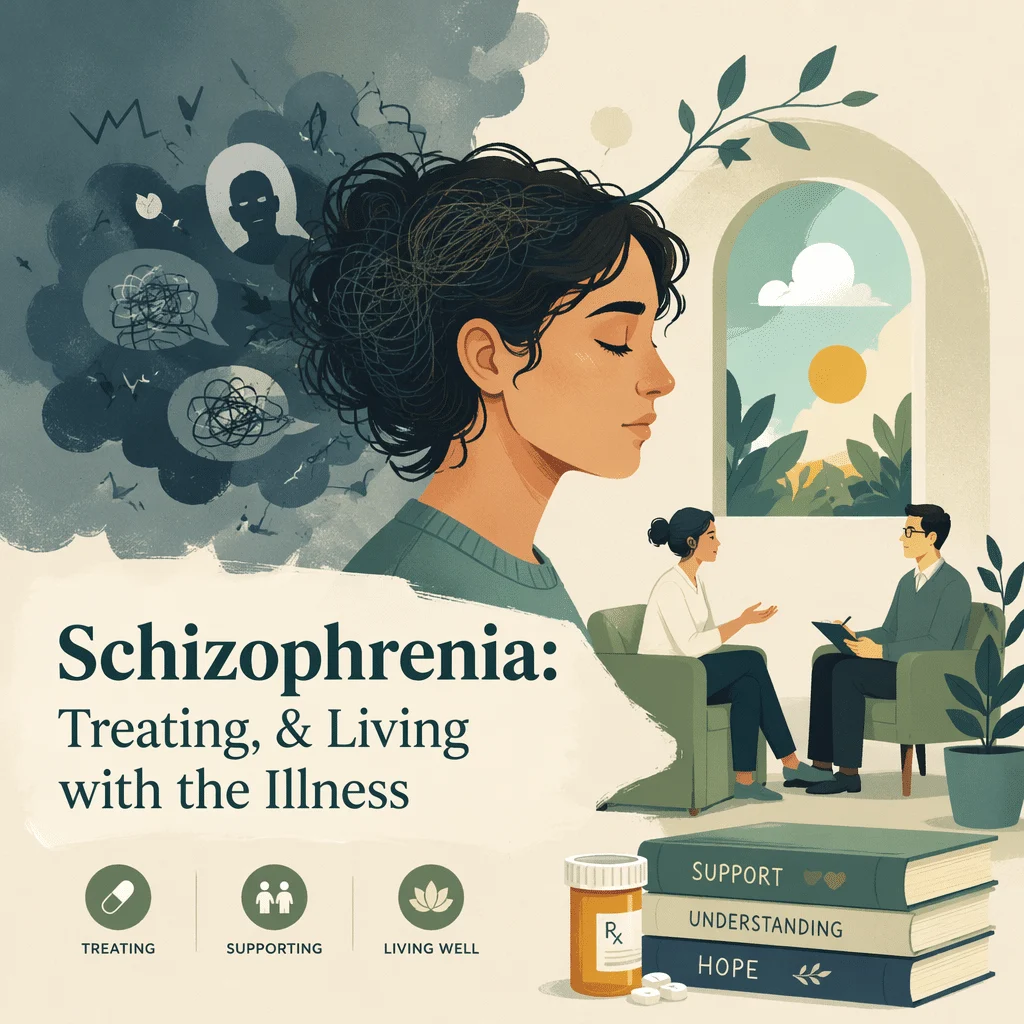
Schizophrenia is a long-term brain condition that changes how a person thinks, perceives reality, and connects with others. It is far more treatable than many people assume, and with the right support a large number of people manage their symptoms, work, study, and build meaningful lives. This article explains what schizophrenia is, how doctors recognise and diagnose it, and which treatments help most today. It also covers a practical point that is often overlooked: the blood tests used to start and monitor treatment safely. Those lab tests do not diagnose the condition, but they protect your physical health while medication does its work. In this article you will learn how symptoms, diagnosis, treatment, and everyday recovery fit together into a hopeful, realistic picture.
What is schizophrenia?
Schizophrenia is a mental health condition that affects thinking, emotions, and behaviour. During an episode, a person may lose contact with shared reality, a state doctors call psychosis. Between episodes, many people think clearly and function well, especially when they receive steady treatment.
It is not a “split personality,” and it is not the same as having a violent nature. Estimates vary with how it is measured, but schizophrenia affects on the order of 1 in 100 to 1 in 300 people over a lifetime, which makes it uncommon but not rare. Symptoms usually begin in the late teens to early thirties, and they often appear a little earlier in men than in women.
Schizophrenia sits on a spectrum of severity. Some people have a single episode with full recovery, while others live with ongoing symptoms that need long-term management. Understanding this range helps replace fear with a more accurate, hopeful view of the condition.
Recognising the symptoms and signs
Doctors group schizophrenia symptoms into three families. A person rarely has all of them, and the mix changes over time.
Positive symptoms
“Positive” means experiences that are added to normal perception, not that they are good. They include hallucinations, most often hearing voices that others do not hear; delusions, which are fixed beliefs that do not match reality; and disorganised thinking or speech that is hard to follow. These are the symptoms people most often picture, and they usually respond well to medication.
Negative symptoms
Negative symptoms are things that are reduced or missing: lower motivation, less emotional expression, quieter speech, and social withdrawal. They are easy to mistake for laziness or depression, yet they are often the most persistent and disabling part of the condition. Newer research is focused heavily on treating them better.
Cognitive symptoms
Cognitive symptoms affect attention, memory, and the ability to plan or process information quickly. They can make school, work, and daily organisation harder. Recognising them matters, because support like cognitive remediation and job coaching targets these specific challenges.
Before a first episode, many people go through a quieter “warning” period with subtle changes: pulling away from friends, a drop in performance at school or work, sleep problems, or unusual ideas. Noticing these early signs and seeking help sooner can meaningfully improve the road ahead.
What causes schizophrenia?
There is no single cause. Schizophrenia develops from a combination of factors that add up differently in each person, which is why two people can have very different stories.
Genetics play a real role. Having a close relative with schizophrenia raises the risk, but most people with a family history never develop it, and many people who do develop it have no known family history. Brain chemistry is also involved, especially the signalling systems that use dopamine and glutamate, two chemical messengers that help brain cells communicate.
Early brain development and environment matter too. Complications during pregnancy or birth, heavy cannabis use during the teenage years, and severe or prolonged stress can all raise vulnerability in people already predisposed. This “stress-vulnerability” model explains why symptoms often surface during demanding life transitions. Importantly, schizophrenia is not caused by bad parenting, personal weakness, or anything the person did wrong. Because some mood disorders can look similar at first, doctors also weigh conditions such as severe depression; for useful background you can read our guide to depression and its symptoms.
How schizophrenia is diagnosed
Schizophrenia is a clinical diagnosis. That means it is based on a careful psychiatric assessment: a detailed history, a conversation about symptoms and their timeline, and input from family when possible. Doctors use the criteria in the DSM-5, the standard diagnostic manual, which generally require symptoms to be present for at least six months and to affect daily functioning.
No blood test, brain scan, or genetic test can diagnose schizophrenia on its own. So why do doctors still order lab work at this stage? Because several medical problems can produce psychosis-like symptoms, and these need to be ruled out first. Thyroid disorders, infections, certain autoimmune conditions, vitamin deficiencies, and substance use can all mimic parts of the picture.
To check for these look-alikes, a clinician may order broad panels rather than a single test. To see what a broad blood chemistry check includes, you can read our overview of the comprehensive metabolic panel. Thyroid problems can affect mood and thinking too, so for that check you can see our guide to the TSH thyroid test. Telling schizophrenia apart from mood conditions with psychotic features is part of the process as well, and you can explore our guide to managing bipolar disorder.
Treatments that help most
Treatment works, and it usually combines medication with therapy and practical support. The goal is not only to reduce symptoms but to help a person live the life they want.
Antipsychotic medications
Antipsychotics are the cornerstone of treatment. Most of them work mainly by dampening dopamine signalling in the brain, and many newer “second-generation” options also act on serotonin. A few work differently: aripiprazole, for example, partially activates dopamine receptors rather than fully blocking them, which is why it is sometimes called a dopamine stabiliser. These medicines reduce positive symptoms and, just as importantly, lower the chance of relapse when taken consistently.
Long-acting injectable options
For some people, remembering a daily pill is the hardest part of staying well. Long-acting injectable antipsychotics are given as a shot every two to eight weeks by a nurse, which removes the daily decision and keeps medication levels steady. For many people this translates into fewer relapses and fewer hospital stays.
Clozapine for treatment-resistant schizophrenia
When symptoms do not improve after two adequate trials of other antipsychotics, doctors call this treatment-resistant schizophrenia. It affects a meaningful share of people, and for them clozapine is the most effective medication available. It does require regular blood tests to monitor the white blood cells, because in rare cases clozapine can lower the body’s infection-fighting cells. That monitoring is well established and manageable, and for many people clozapine works when nothing else has. To understand the test used to track this safely, you can read our guide to the complete blood count.
Therapy and psychosocial support
Medication works best alongside support. Cognitive behavioural therapy adapted for psychosis, family education, social skills training, and supported employment programmes all add real benefit. These approaches help people manage stress, rebuild routines, protect relationships, and return to work or study.
Early, coordinated care
Starting the right care soon after a first episode makes a lasting difference. Team-based programmes known as coordinated specialty care bring together medication, therapy, family support, and help with school or employment. The National Institute of Mental Health describes coordinated specialty care for early psychosis, an approach shown to improve real-world outcomes.
Lab tests that support safe treatment
Here is the part that often gets missed. Lab tests never diagnose schizophrenia, but they play a key supporting role: they help doctors start medication safely, catch side effects early, and keep the rest of the body healthy. Think of them as the maintenance checks that let treatment do its job.
Because some antipsychotics can raise blood sugar, cholesterol, and weight, metabolic monitoring is a standard part of good care. That usually includes fasting blood sugar and a cholesterol check. To understand what the sugar reading means, you can read our guide to glucose levels, and for the cholesterol side you can see our guide to the lipid panel.
A few other tests deserve a mention. For anyone taking clozapine, a regular white blood cell count is essential, and you can read our article on high neutrophil counts. Some antipsychotics can also raise a hormone called prolactin, which may cause side effects, so you can see our explainer on high prolactin levels. A baseline check of organ function is common too, and you can read our guide to the liver function tests.
The table below summarises the tests most often used to support treatment. Exact timing depends on the medication and your care team’s judgement.
| What is checked | Why it matters | Typical timing |
|---|---|---|
| Fasting glucose and A1c | Some antipsychotics can raise blood sugar over time | Baseline, then periodically |
| Lipid panel (cholesterol) | Helps track heart and metabolic health | Baseline, then yearly or as advised |
| White blood cell count (clozapine) | Detects a rare drop in infection-fighting cells | Regularly, on a set schedule |
| Prolactin (when relevant) | Certain medicines raise this hormone and cause side effects | If symptoms suggest it |
| Metabolic panel and thyroid | Sets a baseline and rules out look-alike conditions | At diagnosis and as needed |
Living well with schizophrenia
Recovery does not always mean the complete absence of symptoms. For many people it means living a full, connected life whilst keeping symptoms in check. Several habits support that goal.
Staying with treatment is the single most protective step, and it is worth discussing options openly with a clinician if side effects are a problem. Steady sleep, regular routines, and limiting alcohol and recreational drugs all help reduce relapses. Strong support from family, friends, and peers who understand the condition makes a large difference, as does looking after physical health, since heart and metabolic care matter for long-term wellbeing.
Stigma remains one of the hardest parts of schizophrenia, and it is often based on myths. The evidence is clear that people with schizophrenia are far more likely to be victims of violence than to harm anyone else. Replacing fear with facts helps people seek help sooner and stay connected to their communities.
When to seek help
Early support leads to better outcomes, so it is worth reaching out at the first signs rather than waiting. Consider contacting a doctor or mental health professional if you or someone you care about notices:
- Hearing or seeing things others do not, or holding strong beliefs that others cannot make sense of
- A clear drop in functioning at work, school, or home over weeks or months
- Growing social withdrawal, confusion, or disorganised thinking
- Trouble telling what is real, especially after little sleep or substance use
If a person has thoughts of harming themselves or others, treat it as an emergency and seek immediate help by calling your local emergency number or a crisis line. Acting early is a sign of strength, not weakness.
Latest scientific advances
Research on schizophrenia has moved quickly in the past few years, and the direction is encouraging. Here are some of the most useful developments, explained in plain terms.
Long-acting injectable antipsychotics keep improving relapse prevention. A large 2022 network meta-analysis, a study that pools many trials to compare treatments side by side, confirmed that these injections help maintain stability. What this means for you: if daily pills are hard to keep up with, an injection every few weeks may keep symptoms steadier.
Clozapine remains the standout for treatment-resistant schizophrenia. A 2025 pooled analysis of individual patient data found it generally outperforms other second-generation antipsychotics when earlier medicines have not worked, and a 2023 review confirmed that treatment resistance is common enough to matter for many families. What this means for you: if two medications have not helped, it is worth asking a specialist about clozapine.
Getting help early pays off. A 2024 analysis showed that early, coordinated care after a first episode improves quality of life, employment, and relapse rates, and a separate 2024 review found that early intervention services roughly cut the risk of suicide by about a third. A 2022 overview of many trials also confirmed that therapy and family programmes add real benefit on top of medication. What this means for you: acting at the first signs genuinely changes the outlook.
A genuinely new type of medicine has arrived. In 2024 the U.S. Food and Drug Administration approved the first antipsychotic in decades that works through a different target, activating muscarinic receptors in the brain instead of blocking dopamine the way older drugs do. In trials it eased symptoms without the weight gain or movement side effects often seen with older medicines. This is promising, though still new, and doctors are gathering longer-term data. What this means for you: the toolbox of options is expanding.
Side effects are becoming easier to manage. Because some antipsychotics raise blood sugar and weight, a 2026 randomised trial tested semaglutide, a GLP-1 medicine also used for diabetes and weight management, and found it improved early metabolic changes in people with schizophrenia spectrum conditions. What this means for you: metabolic side effects can increasingly be treated, not just tolerated.
Glossary
| Term | Definition |
|---|---|
| Schizophrenia | A long-term brain condition that affects thinking, perception, emotions, and behaviour. |
| Psychosis | A state of losing contact with shared reality, such as hearing voices or holding false beliefs. |
| Positive symptoms | Experiences added to normal perception, including hallucinations and delusions. |
| Negative symptoms | Reductions in motivation, emotional expression, speech, or social contact. |
| Cognitive symptoms | Difficulties with attention, memory, and processing information. |
| Antipsychotic | A medication that reduces psychotic symptoms, mainly by adjusting dopamine signalling. |
| Long-acting injectable | An antipsychotic given as a shot every few weeks instead of a daily pill. |
| Treatment-resistant schizophrenia | Schizophrenia that has not improved after two adequate antipsychotic trials. |
| Clozapine | A highly effective antipsychotic for treatment-resistant cases that requires blood monitoring. |
| Coordinated specialty care | A team-based programme combining medication, therapy, and support early in the illness. |
Frequently asked questions
What are the first signs of schizophrenia?
Early signs are often subtle and build over weeks or months. They can include social withdrawal, a drop in performance at school or work, sleep changes, trouble concentrating, and unusual or suspicious thinking. These signs are not proof of schizophrenia on their own, since many conditions share them. Still, a noticeable and lasting change in someone’s thinking or functioning is a good reason to talk with a doctor, because starting care early leads to better outcomes.
Can a blood test diagnose schizophrenia?
No. There is no blood test, scan, or genetic test that can diagnose schizophrenia. The diagnosis is made clinically, through a psychiatric evaluation and a review of symptoms over time. Lab tests still have two important jobs: ruling out other medical conditions that can imitate psychosis, and monitoring the body once treatment begins. In other words, blood work supports safe care rather than making the diagnosis.
What antipsychotic medications are used for schizophrenia?
Doctors choose from several antipsychotics, including newer second-generation options such as risperidone, olanzapine, and aripiprazole, and older first-generation medicines. When two options have not worked, clozapine is considered for treatment-resistant schizophrenia. Some medicines also come as long-acting injections given every few weeks. The best choice depends on symptoms, side effects, and personal preference, so it is a decision to make together with a clinician over time.
Can you live a normal life with schizophrenia?
Many people with schizophrenia live full, meaningful lives, especially with steady treatment and support. That can include working or studying, maintaining relationships, and pursuing goals. Recovery looks different for each person, and it does not always mean the total absence of symptoms. Consistent care, strong support networks, healthy routines, and attention to physical health all help people do well over the long term.
Is schizophrenia hereditary?
Genetics contribute to the risk, but schizophrenia is not directly inherited like eye colour. Having a close relative with the condition raises the chance somewhat, yet most people with a family history never develop it, and many who do have no known family history. Genes appear to interact with brain development and environmental factors, so heredity is only one part of a larger picture.
Why do people on antipsychotics need regular blood tests?
Regular blood tests keep treatment safe. Some antipsychotics can affect blood sugar, cholesterol, or a hormone called prolactin, and monitoring catches these changes early so they can be managed. Clozapine specifically requires scheduled white blood cell checks to guard against a rare side effect. These tests do not diagnose schizophrenia; they simply protect the rest of your health while medication does its work.
Sources
- National Institute of Mental Health (NIMH) — Schizophrenia — nimh.nih.gov
- Mayo Clinic — Schizophrenia: Symptoms and causes — mayoclinic.org
- MedlinePlus, U.S. National Library of Medicine — Schizophrenia — medlineplus.gov
- Comparative efficacy and tolerability of 32 oral and long-acting injectable antipsychotics for maintenance treatment of schizophrenia — a systematic review and network meta-analysis, The Lancet, 2022 — doi.org
- Efficacy of clozapine versus second-generation antipsychotics in treatment-resistant schizophrenia — a systematic review and individual patient data meta-analysis, The Lancet Psychiatry, 2025 — doi.org
- Treatment resistance in schizophrenia — a meta-analysis of prevalence and correlates, Brazilian Journal of Psychiatry, 2023 — doi.org
- Duration of untreated psychosis and outcomes in first-episode psychosis — systematic review and meta-analysis, Schizophrenia Bulletin, 2024 — doi.org
- Impact of early intervention for early psychosis on suicidal behaviour — a meta-analysis, Acta Psychiatrica Scandinavica, 2024 — doi.org
- Efficacy and acceptability of psychosocial interventions in schizophrenia — systematic overview of meta-analytic evidence, Molecular Psychiatry, 2022 — doi.org
- Physical health monitoring for people with schizophrenia, Australian Prescriber, 2023 — doi.org
- Efficacy and safety of the muscarinic agonist xanomeline-trospium (KarXT) in schizophrenia (EMERGENT-2), The Lancet, 2023 — doi.org
- Xanomeline-trospium — a novel therapeutic for the treatment of schizophrenia (review of FDA-approved KarXT), Annals of Pharmacotherapy, 2025 — doi.org
- Semaglutide and early-stage metabolic abnormalities in individuals with schizophrenia spectrum disorders — a randomised clinical trial, JAMA Psychiatry, 2026 — doi.org
Further reading
- Learn the basics with our guide to reading your blood test results at How to Read Your Blood Test Results
- Understand blood sugar screening in our overview of diabetes blood tests at Diabetes Blood Tests
- See how longer-term sugar control is measured in our A1c conversion guide at A1C Conversion Chart
- See what high blood fats can mean in our article on high triglycerides at High Triglyceride
- Read about a common overlapping concern in our article on anxiety at Anxiety
Understand your lab results with AI DiagMe
Living well with schizophrenia includes looking after your whole body, and that is where clear lab results help. AI DiagMe explains everyday tests in plain language, such as fasting glucose, an A1c, a lipid panel, or the white blood cell count used during clozapine treatment, so you can see what each number means. It helps you understand your results and prepare better questions for your care team; it does not diagnose conditions and does not replace your doctor.
Get your results interpreted in minutes