










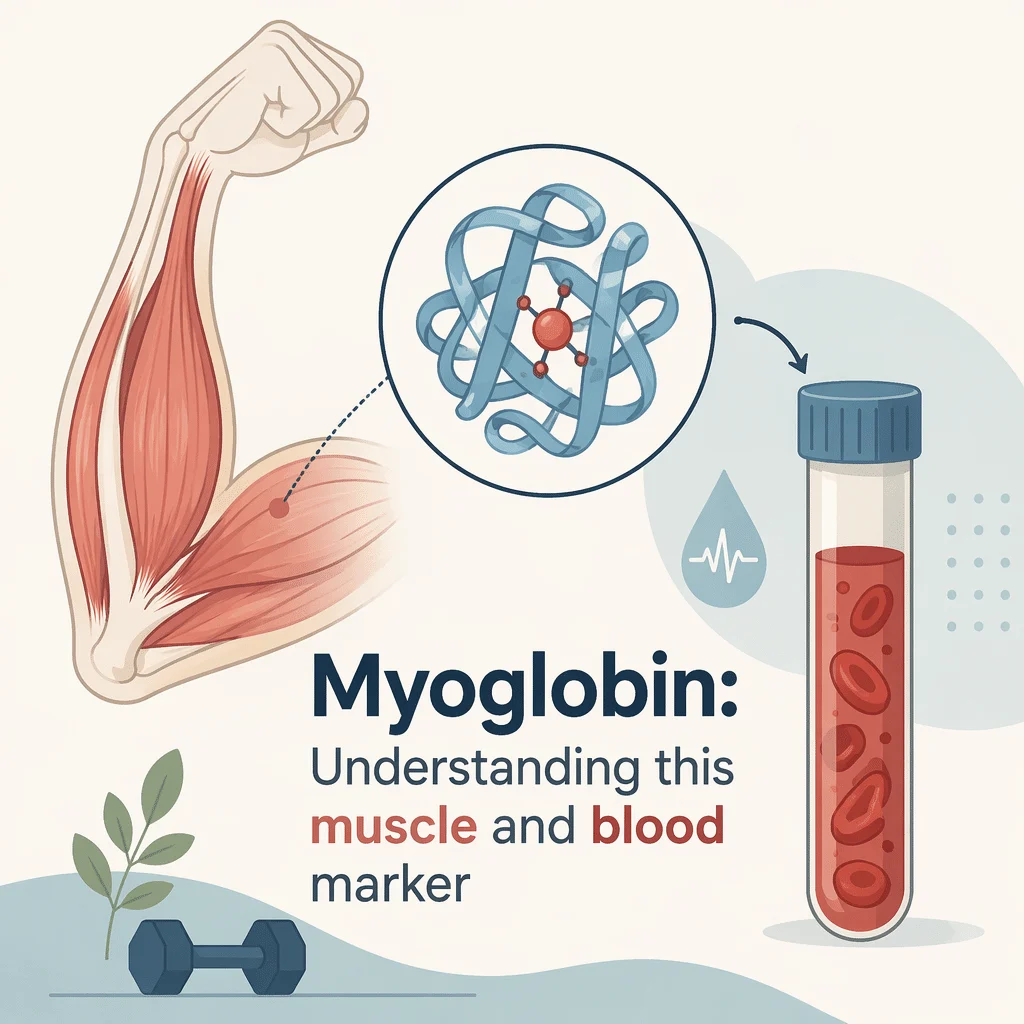
A myoglobin blood test measures a protein that leaks out of muscle cells when those cells are damaged. It rises faster than almost any other muscle marker, often within one to three hours of an injury. It is also one of the least specific results on your report, because every muscle in your body contains myoglobin — not only your heart.
That single fact explains most of what follows. Myoglobin was once used to look for heart attacks; it no longer is. Today it belongs to a different conversation: muscle breakdown, and the strain that broken-down muscle places on your kidneys.
In this article you’ll learn what myoglobin does, why troponin replaced it as a cardiac marker, how to read a raised result, why creatine kinase is usually preferred for rhabdomyolysis, and which symptoms mean you should stop reading and get help now. Those red flags come first, because they are the one thing here you might need to act on today.
Red flags: get help now, not later
Call 999 immediately if you have chest pain or pressure, discomfort spreading to your arm, back, neck or jaw, shortness of breath, cold sweats, or nausea. Do not wait for any blood test, and do not drive yourself.
Go to an emergency department now if severe or unusual muscle pain comes together with dark urine — brown, tea-coloured or cola-coloured — especially after intense or unaccustomed exercise, a crush injury, a fall followed by a long period on the floor, a seizure, or heat exposure. That combination can mean rhabdomyolysis, which can injure the kidneys within hours.
Seek urgent care too if you are passing very little urine, or if severe muscle pain arrives with confusion, marked weakness, or vomiting.
Ordinary soreness two days after a hard workout, with normal-coloured urine, is a different situation — worth a call to your doctor, not a trip to the emergency department.
What myoglobin is and what it does
Myoglobin, sometimes written “Mb” on a lab report, is a small iron-containing protein packed inside muscle cells. Its job is to hold oxygen. Haemoglobin ferries oxygen through your bloodstream; myoglobin takes delivery of it inside the muscle and stores it until needed. It is also what makes muscle red — the dark meat of a chicken leg comes from myoglobin, not leftover blood.
Two kinds of muscle contain it in quantity. Skeletal muscle — the muscle you move on purpose — holds the large majority of the myoglobin in your body. Cardiac muscle, your heart, contains it as well. That overlap is the source of every difficulty in this article.
Normally myoglobin stays inside the cell and only a trace escapes into the blood. When muscle cells are crushed, starved of oxygen, poisoned, or simply overworked, their membranes fail and the contents spill out. Myoglobin is among the first to appear in the circulation, because it is a small molecule and moves quickly. Speed is its one real advantage — and it explains the central weakness too, because it disappears just as quickly.
Why myoglobin is measured now — and why not for heart attacks
For roughly two decades, emergency departments used myoglobin as an early warning of a heart attack. The reasoning was sound for its time: heart muscle contains myoglobin, a heart attack kills heart muscle, and myoglobin showed up sooner than the alternatives then available.
It failed on one word — specificity. A raised myoglobin tells you that muscle has been damaged. It cannot tell you which muscle. A bruised thigh, a hard gym session, a seizure and a heart attack can all push the number up. In a chest pain unit, a test that cannot separate a heart attack from a weekend of garden work is not much help on its own.
How troponin replaced myoglobin as a cardiac marker
Cardiac troponin solved the specificity problem. Troponin I and troponin T exist in forms essentially unique to heart muscle, so a rise points at the heart and nowhere else. High-sensitivity assays then closed the speed gap, detecting very small amounts within a few hours of injury — and, in many hospital protocols, ruling injury out quickly too.
Once troponin was both fast enough to act on and specific to the heart, myoglobin had no remaining niche. The 2021 chest pain guideline issued by the American Heart Association and the American College of Cardiology, with several partner societies, states it directly: high-sensitivity cardiac troponins are the preferred standard for establishing a biomarker diagnosis of acute myocardial infarction. That guideline reports that comparative studies confirmed the superiority of troponin over CK-MB and myoglobin, and adds that giving CK-MB or myoglobin alongside troponin in patients with chest pain is not beneficial.
So if you arrived here after reading that myoglobin is a heart attack test, treat that page as out of date. If you are worried about your heart right now, call 999; do not go hunting for a myoglobin result. Afterwards, your doctor may discuss the cardiac marker troponin. In some situations they also order a broader cardiac markers panel, which may still mention the older marker CK-MB or the heart failure marker BNP.
Reading a raised myoglobin: which muscle, and what happened?
A raised myoglobin is a starting point, not a conclusion. The question your doctor asks next is rarely “how high?” It is “what happened to you?”
Context does most of the work. A value that would worry a clinician in someone lying still for two days may be entirely expected in someone who ran a marathon yesterday. Laboratories report myoglobin in nanograms per millilitre (ng/mL), and ranges differ between them — the MedlinePlus encyclopaedia gives roughly 0 to 72 ng/mL for men and 0 to 58 ng/mL for women — so read your value against your own report.
The table below sets out the common reasons myoglobin rises, and what usually follows.
| Cause of raised myoglobin | Why the level rises | What usually happens next |
|---|---|---|
| Intense or unaccustomed exercise | Hard or novel effort damages muscle fibres, especially in heat | Your clinician asks about urine colour and checks CK and kidneys |
| Crush injury, trauma, or a long lie after a fall | Sustained pressure cuts off blood supply and destroys muscle | Treated as an emergency; hospital assessment of kidneys and potassium |
| Prolonged immobility or long surgery | Body weight presses on the same muscles for hours | Monitoring of CK and kidney markers |
| Seizures or severe agitation | Violent, sustained muscle contraction injures fibres | The underlying cause is investigated alongside muscle and kidney bloods |
| Statins and certain other medicines | A few people develop drug-related muscle toxicity, sometimes from a drug interaction | Report new muscle pain to your prescriber, who reviews your medicines and checks CK. Never stop a prescribed medicine on your own |
| Heat stroke or severe heat illness | Extreme core temperature damages muscle directly | A medical emergency; assessed in hospital |
| Muscle disease (myositis, muscular dystrophy, inherited myopathy) | Ongoing inflammation or a genetic fault causes steady fibre breakdown | Specialist referral; antibody tests, imaging, sometimes biopsy or genetic testing |
| Reduced kidney function | The kidneys clear myoglobin, so a level can look high when clearance is poor | Interpreted next to creatinine and eGFR rather than read alone |
| Minor muscle events (intramuscular injection, recent biopsy) | A small local injury releases a little myoglobin | Explained by the history; the level settles within a day or two |
| Heart attack (historical use only) | Dying heart muscle releases myoglobin, but so does any injured muscle | Troponin and an ECG answer this; myoglobin is not used to diagnose it |
Rhabdomyolysis and the risk to your kidneys
Rhabdomyolysis is the reason myoglobin still appears on laboratory menus at all. The word describes rapid breakdown of skeletal muscle: cells rupture and empty their contents — myoglobin, creatine kinase, potassium — into the circulation at once.
Small amounts of circulating myoglobin are mopped up by a carrier protein called haptoglobin. When that system saturates, free myoglobin passes into the kidneys, and this is where the danger lies. Myoglobin harms the kidney’s filtering tubules by several routes at once: it forms pigment casts that block them, it releases iron that drives oxidative damage, and it constricts the small vessels feeding the kidney. The outcome has a name — pigment-induced acute kidney injury.
Myoglobin in the urine is called myoglobinuria, and it is what turns urine tea-coloured, brown or cola-coloured. NIOSH, the occupational safety institute within the CDC, lists dark tea- or cola-coloured urine alongside severe muscle cramps and unusual weakness as the classic warning signs of rhabdomyolysis at work, and advises affected workers to ask to be checked with a creatine kinase test.
One caveat cuts against intuition: dark urine does not appear in everyone. The StatPearls chapter on rhabdomyolysis notes that reddish-brown urine shows up in only about half of cases, so normal-coloured urine does not rule the condition out. After a crush injury, a long lie, a seizure or an extreme effort, severe muscle pain alone is reason enough to be assessed.
Muscle breakdown also floods the blood with potassium, which can disturb heart rhythm. This is why rhabdomyolysis is never assessed with a single test. Alongside muscle markers, your clinician typically checks a potassium blood test and reviews a full electrolyte panel. To judge the kidneys they order a creatinine blood test and calculate an estimated filtration rate, or eGFR.
Serum myoglobin, urine myoglobin, and why CK is usually preferred
Myoglobin can be measured in blood, reported as serum myoglobin, or in urine. Blood gives the earlier signal, since myoglobin appears in the circulation before the kidneys have filtered enough to register in urine. Urine testing confirms myoglobinuria and explains dark urine.
A practical wrinkle is worth knowing. A standard urine dipstick cannot distinguish myoglobin from haemoglobin, because both react with the pad designed to detect blood. A dipstick positive for blood, in urine showing no red blood cells under the microscope, is a classic clue to myoglobinuria — and a good reason your clinician may request a complete urinalysis instead of relying on the strip alone. If urine colour is what brought you here, we cover the causes of changes in urine colour separately.
Despite all that, creatine kinase — CK, often reported as CPK — is the marker clinicians actually reach for in suspected rhabdomyolysis. Two reasons explain this, and both concern myoglobin’s behaviour rather than any flaw in the idea.
First, myoglobin clears fast. Its half-life in blood is roughly two to four hours, so someone reaching hospital a day after a collapse may show a normal myoglobin even though a great deal of muscle was destroyed. CK climbs over one to four days and falls back over one to two weeks. It is still there when the patient arrives.
Second, myoglobin is comparatively unstable, and assays are not well standardised between laboratories, so results are hard to compare and thresholds hard to agree on. CK is inexpensive, robust, and has widely accepted diagnostic cutoffs.
The consequence shows up in the definitions: the numbers defining rhabdomyolysis are CK numbers, not myoglobin numbers. If a clinician is chasing muscle breakdown, expect a CPK blood test to lead the workup, with myoglobin playing a supporting part at best. You may also see the general tissue marker LDH raised on the same report, since damaged muscle releases that too.
What a normal myoglobin result means — and what it doesn’t
A normal myoglobin means that, at the moment the needle went in, no large quantity of myoglobin was circulating. That is genuinely reassuring in some situations and close to meaningless in others.
Because of the short half-life, a normal result cannot exclude muscle injury from yesterday or last week. Timing is everything, and this is the single most important limitation to carry away: a normal myoglobin rarely ends an investigation on its own.
It also says nothing dependable about your heart. Chest pain is answered by troponin and an ECG, not by a marker that any sore muscle can move.
Low myoglobin, finally, is not a recognised clinical problem. Nobody screens for it.
Emergency red flags you should never wait out
Severe muscle pain together with dark, tea- or cola-coloured urine is a medical emergency, particularly after extreme exertion, a crush injury, a fall followed by hours on the floor, a seizure, or heat exposure. Go to an emergency department. Rhabdomyolysis can damage kidneys within hours.
Chest pain, pressure or tightness — with or without pain in the arm, jaw, neck or back, breathlessness, sweating or nausea — means calling 999 straight away. Myoglobin has nothing to offer you in that moment.
Passing little or no urine, or severe muscle pain with confusion or vomiting, also warrants urgent assessment. None of this requires you to interpret a number first.
Latest scientific advances in myoglobin testing
Research since 2023 has reinforced myoglobin’s narrower modern role rather than expanded it. According to PubMed, the work below is the most relevant recent evidence.
An international expert workshop convened by the European Neuromuscular Centre, reported by Kruijt and colleagues in 2025, brought 21 specialists together to agree how rhabdomyolysis should be diagnosed. The group settled on a definition built around symptoms plus creatine kinase levels and their time course — not around myoglobin. What this means for you: if your report shows CK rather than myoglobin, that reflects international expert consensus, not an oversight.
A 2026 clinically oriented review in the journal Chest, by Richert and colleagues, noted that a precise consensus definition still does not exist. What this means for you: even specialists disagree on exact thresholds, so a single myoglobin value is not something to self-interpret. Reliability nuance: a narrative review reflects expert reading of the field rather than a pooled, definitive answer.
Lim reviewed the prediction of kidney injury in acute rhabdomyolysis in 2025, describing real uncertainty around the traditional biomarkers, creatine kinase and myoglobin included, and noting that differences between study populations limit how well any model transfers between hospitals. What this means for you: no single number, myoglobin least of all, predicts kidney damage by itself. Risk is judged from the whole picture.
On the exercise side, Bäcker and colleagues pooled twenty-five studies of exertional rhabdomyolysis in athletes. Those affected were mostly young men, and most were runners, with marathons the commonest setting. The authors concluded the condition is probably underestimated, and that anyone presenting with muscle soreness and dark urine after a heavy endurance event should be screened. What this means for you: dark urine after a big effort is a recognised reason to get checked, not a badge of a good session. Reliability nuance: the pooled studies varied in design, so they describe who tends to be affected rather than your personal odds.
Finally, Nguyen and colleagues reviewed in 2025 how this risk varies between groups, highlighting sickle cell trait as a recognised risk factor, particularly among African American athletes and military personnel, alongside dehydration, obesity and some medicines. What this means for you: if you carry sickle cell trait and train hard, raise it with a doctor. Reliability nuance: this narrative review draws on mixed evidence, and its authors are explicit that gaps remain.
Glossary
| Term | Definition |
|---|---|
| Myoglobin | An iron-containing protein inside muscle cells that stores oxygen. It leaks into the blood when muscle is damaged. |
| Rhabdomyolysis | Rapid breakdown of skeletal muscle, releasing myoglobin, enzymes and electrolytes into the bloodstream. |
| Myoglobinuria | Myoglobin in the urine. It can turn urine tea-coloured, brown or cola-coloured. |
| Creatine kinase (CK or CPK) | An enzyme released by damaged muscle. It is the marker most used to diagnose and monitor rhabdomyolysis. |
| Cardiac troponin | A protein found almost only in heart muscle. It is the preferred blood marker for diagnosing a heart attack. |
| Acute kidney injury | A sudden drop in kidney function over hours or days. It is the main complication of rhabdomyolysis. |
| Half-life | The time it takes for half of a substance to leave the blood. Myoglobin’s is short, at roughly two to four hours. |
| Haptoglobin | A carrier protein that binds small amounts of free myoglobin and haemoglobin before the kidneys are exposed to them. |
| Pigment cast | A plug formed in the kidney’s tubules when filtered myoglobin comes out of solution, blocking normal flow. |
| Exertional rhabdomyolysis | Muscle breakdown triggered by intense or unaccustomed exercise, often in heat or in someone who is poorly conditioned. |
Frequently asked questions
My urine is dark after a workout. What should I do?
Take it seriously. Dark brown, tea-coloured or cola-coloured urine after intense or unaccustomed exercise, particularly alongside severe muscle pain, swelling or weakness, is the classic presentation of exertional rhabdomyolysis. Go to an emergency department or urgent care the same day rather than waiting to see whether it clears. Clinicians can check creatine kinase and kidney function quickly, and the reason for urgency is that kidney injury can develop within hours. Do not try to manage this at home. If your urine is merely a darker yellow, you have no muscle pain, and it lightens normally, that is a different and far more common picture — but if you are unsure, ask a clinician rather than guessing.
What is a normal myoglobin range?
Ranges vary between laboratories because assays differ. The MedlinePlus encyclopaedia gives approximately 0 to 72 ng/mL for men and 0 to 58 ng/mL for women as a typical blood reference range. Your own report will print the range your laboratory uses, and that is the one that applies to your result. Comparing your value against a range you found online can mislead you in either direction. Remember too that a normal myoglobin does not exclude muscle injury from a day or more ago, because the protein clears from the blood within hours.
Does a high myoglobin mean I had a heart attack?
No. On its own, a raised myoglobin means muscle has been damaged somewhere, and skeletal muscle is by far the likelier source. Myoglobin cannot distinguish heart muscle from any other muscle, which is precisely why it is no longer used to diagnose heart attacks. That question is answered by cardiac troponin, an ECG and a clinical assessment. If you have chest pain or other heart attack symptoms right now, call 999 rather than waiting on any laboratory result.
Can statins raise myoglobin?
Yes, in a small number of people. Statins can cause muscle toxicity, and the risk rises with certain drug combinations. This is uncommon, and most people take statins without any muscle problem at all. What matters is reporting new, unexplained or persistent muscle pain to the doctor who prescribed the medicine, so they can review your prescriptions and check creatine kinase. Do not stop a prescribed statin on your own; that decision belongs with your prescriber, who will weigh it against your cardiovascular risk.
How long does myoglobin stay elevated after exercise?
Not long. Myoglobin has a half-life of roughly two to four hours in blood, so after an isolated bout of hard exercise it typically rises within a few hours and settles within a day or so, assuming the kidneys are clearing it normally. Creatine kinase behaves quite differently, peaking one to four days afterward and taking one to two weeks to return to baseline. This difference explains why a blood draw’s timing changes what you see, and why clinicians investigating muscle damage rely on creatine kinase rather than myoglobin.
Can I have rhabdomyolysis if my urine looks normal?
Yes. This is a common and important misunderstanding. The StatPearls chapter on rhabdomyolysis notes that reddish-brown urine appears in only around half of cases, so normal-coloured urine does not rule the condition out. Severe muscle pain, swelling or weakness after a crush injury, a long period lying immobile, a seizure, heat exposure or an extreme effort deserves medical assessment regardless of what your urine looks like. The blood tests, not the colour, settle the question.
Sources
- MedlinePlus Medical Encyclopedia (U.S. National Library of Medicine) — Myoglobin blood test
- CDC / NIOSH — Rhabdomyolysis and Work
- Adigun R. Rhabdomyolysis. StatPearls, NCBI Bookshelf
- Gulati M, Levy PD, Mukherjee D, et al. 2021 AHA/ACC/ASE/CHEST/SAEM/SCCT/SCMR Guideline for the Evaluation and Diagnosis of Chest Pain. Circulation
- National Heart, Lung, and Blood Institute (NIH) — Heart Attack Symptoms
- Kruijt N, Laforet P, Vissing J, Bhai S, Stemmerik MG, Kleefeld F, Voermans NC. 276th ENMC International Workshop: recommendations on optimal diagnostic pathway and management strategy for patients with acute rhabdomyolysis worldwide. Neuromuscular Disorders. 2025;50:105344
- Richert Q, Miller N, Cameron S, Barr B, Nkosi J, Sharma A. Updates on Rhabdomyolysis: A Clinically Oriented Narrative Review. Chest. 2026;170(1):128-136
- Lim AKH. Predicting Acute Kidney Injury in Acute Rhabdomyolysis. Journal of Clinical Medicine. 2025;14(19):6892
- Bäcker HC, Richards JT, Kienzle A, Cunningham J, Braun KF. Exertional Rhabdomyolysis in Athletes: Systematic Review and Current Perspectives. Clinical Journal of Sport Medicine. 2023;33(2):187-194
- Nguyen A, Thomassen A, MacDonald EM, Rodriguez VA, Brown JM, Shekoohi S, Kaye AD. Ethnicity Risk and Exertional Rhabdomyolysis: A Narrative Review. Advances in Therapy. 2025;42(9):4131-4142
Further reading
- CPK (creatine phosphokinase) blood test analysis
- Troponin: cardiac marker analysis and results
- Creatinine: the blood marker of kidney function
- Urinalysis results: an interpretation guide
- The kidney function panel explained
Understand your lab results with AI DiagMe
Myoglobin rarely travels alone on a report. It usually sits beside CK, creatinine and potassium, and reading those four together is what makes any of them meaningful. AI DiagMe turns that cluster of numbers into plain language you can bring to your doctor. It helps you understand your results; it does not diagnose you, and it is not for emergencies — if you have severe muscle pain with dark urine, or any heart attack symptom, seek urgent care instead.
Get your results interpreted in minutes