



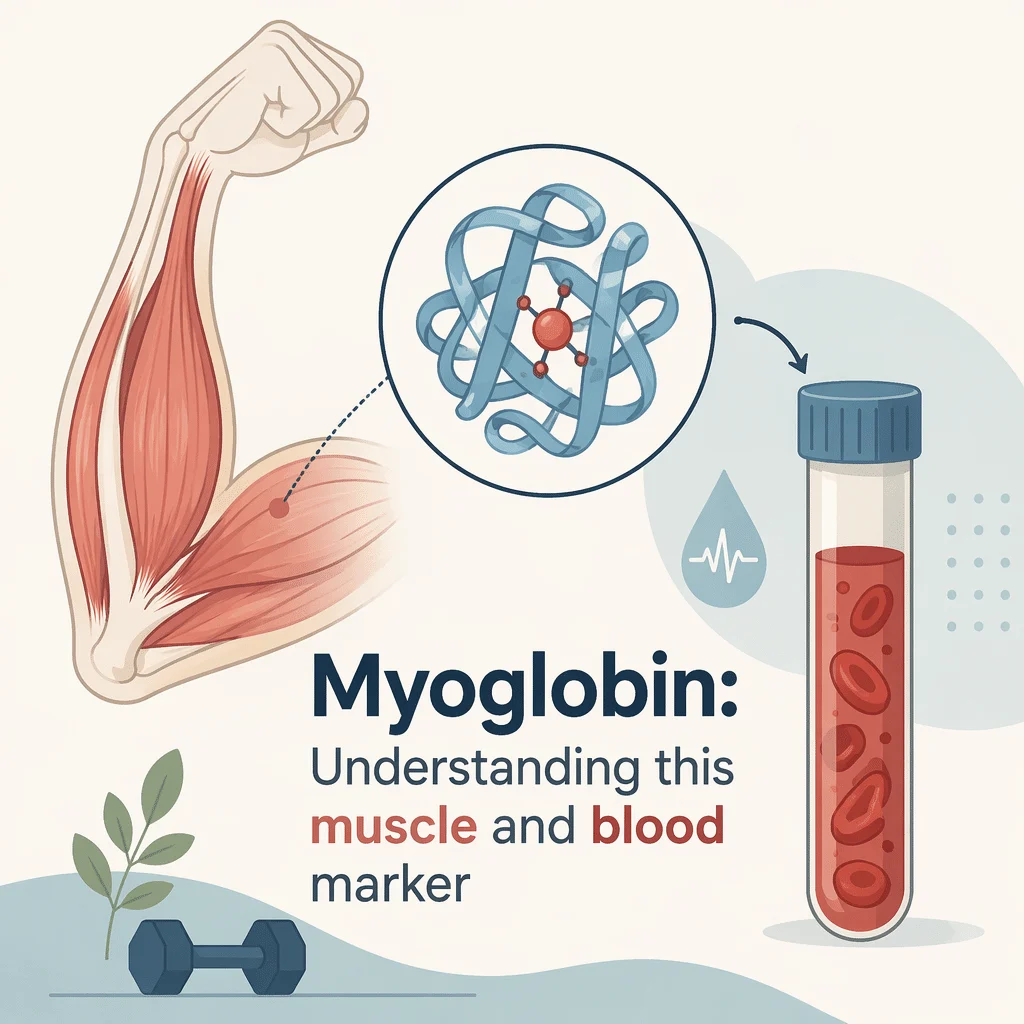
Un análisis de mioglobina en sangre mide una proteína que se libera de las células musculares cuando estas se dañan. Sus niveles suben más rápido que casi cualquier otro marcador muscular, generalmente entre una y tres horas después de una lesión. También es uno de los resultados menos específicos de tu reporte, porque todos los músculos de tu cuerpo contienen mioglobina, no solo el corazón.
Ese único dato explica casi todo lo que verás a continuación. La mioglobina se usaba antes para detectar infartos; ya no es así. Hoy forma parte de una conversación diferente: la descomposición muscular y el daño que los músculos lesionados pueden causar en los riñones.
En este artículo aprenderás qué hace la mioglobina, por qué la troponina la reemplazó como marcador cardíaco, cómo interpretar un resultado elevado, por qué la creatina cinasa (CK) suele preferirse para la rabdomiólisis, y qué síntomas indican que debes dejar de leer y buscar ayuda de inmediato. Las señales de alerta van primero, porque son lo único aquí en lo que podrías necesitar actuar hoy.
Señales de alerta: busca ayuda ahora, no después
Llama al 911 de inmediato si tienes dolor u opresión en el pecho, molestia que se extiende al brazo, la espalda, el cuello o la mandíbula, dificultad para respirar, sudoración fría o náuseas. No esperes ningún análisis de sangre y no manejes solo.
Ve a urgencias ahora si un dolor muscular intenso o inusual aparece junto con orina oscura —de color café, té o refresco de cola—, especialmente después de ejercicio intenso o poco habitual, una lesión por aplastamiento, una caída seguida de un largo período en el suelo, una convulsión o exposición al calor. Esa combinación puede indicar rabdomiólisis, que puede dañar los riñones en cuestión de horas.
Busca atención urgente también si estás orinando muy poco, o si el dolor muscular intenso aparece junto con confusión, debilidad marcada o vómito.
El dolor muscular común dos días después de un entrenamiento intenso, con orina de color normal, es una situación diferente: vale la pena llamar a tu médico, pero no ir a urgencias.
Qué es la mioglobina y qué función cumple
La mioglobina, que a veces aparece como “Mb” en un reporte de laboratorio, es una pequeña proteína que contiene hierro y se encuentra dentro de las células musculares. Su función es almacenar oxígeno. La hemoglobina transporta el oxígeno por el torrente sanguíneo; la mioglobina lo recibe dentro del músculo y lo guarda hasta que se necesita. También es la responsable del color rojo del músculo: la carne oscura del muslo de pollo se debe a la mioglobina, no a restos de sangre.
Dos tipos de músculo la contienen en grandes cantidades. El músculo esquelético —el que mueves de manera voluntaria— concentra la mayor parte de la mioglobina en tu cuerpo. El músculo cardíaco, es decir, el corazón, también la contiene. Esa coincidencia es la raíz de todas las dificultades que se abordan en este artículo.
En condiciones normales, la mioglobina permanece dentro de la célula y solo una pequeña cantidad escapa hacia la sangre. Cuando las células musculares se aplastas, se quedan sin oxígeno, se intoxican o simplemente se sobrecargan de trabajo, sus membranas fallan y su contenido se derrama. La mioglobina es una de las primeras en aparecer en la circulación, porque es una molécula pequeña y se desplaza rápido. Esa velocidad es su única ventaja real, aunque también explica su principal limitación: desaparece igual de rápido.
Por qué se mide la mioglobina hoy en día —y por qué ya no se usa para infartos
Durante aproximadamente dos décadas, los servicios de urgencias usaron la mioglobina como señal de alerta temprana de un infarto. El razonamiento tenía sentido en su momento: el músculo cardíaco contiene mioglobina, un infarto destruye músculo cardíaco, y la mioglobina aparecía en la sangre antes que las otras alternativas disponibles en esa época.
Falló en una sola cosa: la especificidad. Una mioglobina elevada indica que hubo daño muscular, pero no puede decirte qué músculo fue. Un golpe en el muslo, una sesión intensa en el gimnasio, una convulsión y un infarto pueden elevar el valor por igual. En una unidad de dolor torácico, una prueba que no puede distinguir un infarto de un fin de semana de trabajo en el jardín no es de mucha utilidad por sí sola.
Cómo la troponina reemplazó a la mioglobina como marcador cardíaco
La troponina cardíaca resolvió el problema de la especificidad. La troponina I y la troponina T existen en formas prácticamente exclusivas del músculo cardíaco, por lo que un aumento apunta directamente al corazón y a ningún otro lugar. Los análisis de alta sensibilidad cerraron después la brecha en velocidad, detectando cantidades muy pequeñas pocas horas después de la lesión —y, en muchos protocolos hospitalarios, también descartando daño de forma rápida.
Una vez que la troponina fue lo suficientemente rápida para actuar y específica del corazón, la mioglobina dejó de tener un lugar. La guía de dolor torácico de 2021 emitida por la Asociación Americana del Corazón y el Colegio Americano de Cardiología, junto con varias sociedades asociadas, lo establece directamente: las troponinas cardíacas de alta sensibilidad son el estándar preferido para establecer un diagnóstico bioquímico de infarto agudo de miocardio. Esa guía señala que los estudios comparativos confirmaron la superioridad de la troponina sobre la CK-MB y la mioglobina, y agrega que administrar CK-MB o mioglobina junto con troponina en pacientes con dolor en el pecho no aporta ningún beneficio.
Así que si llegaste aquí después de leer que la mioglobina es una prueba de infarto, considera esa información desactualizada. Si en este momento te preocupa tu corazón, llama al 911; no te pongas a buscar un resultado de mioglobina. Después, tu médico puede hablar contigo sobre el marcador cardíaco troponinaEn algunas situaciones también solicitan un panel más amplio de marcadores cardíacosque puede mencionar también el marcador más antiguo CK-MB o el marcador de insuficiencia cardíaca BNP.
Cómo interpretar una mioglobina elevada: ¿qué músculo y qué pasó?
Una mioglobina elevada es un punto de partida, no una conclusión. La pregunta que tu médico hace a continuación rara vez es “¿qué tan alta?” Es “¿qué te pasó?”
El contexto hace la mayor parte del trabajo. Un valor que preocuparía a un médico en alguien que ha estado acostado sin moverse durante dos días puede ser completamente esperado en alguien que corrió un maratón ayer. Los laboratorios reportan la mioglobina en nanogramos por mililitro (ng/mL), y los rangos varían entre ellos — la enciclopedia MedlinePlus indica aproximadamente de 0 a 72 ng/mL para hombres y de 0 a 58 ng/mL para mujeres — así que compara tu valor con el rango de tu propio reporte.
La tabla a continuación muestra las causas más comunes por las que sube la mioglobina y lo que suele ocurrir después.
| Causa de la mioglobina elevada | Por qué sube el nivel | Qué suele pasar después |
|---|---|---|
| Ejercicio intenso o no habitual | El esfuerzo intenso o poco habitual daña las fibras musculares, especialmente con calor | Tu médico pregunta sobre el color de la orina y revisa la CK y la función renal |
| Aplastamiento, trauma o tiempo prolongado en el suelo tras una caída | La presión sostenida corta el suministro de sangre y destruye el músculo | Se trata como urgencia; evaluación hospitalaria de riñones y potasio |
| Inmovilidad prolongada o cirugía larga | El peso corporal presiona los mismos músculos durante horas | Monitoreo de CK y marcadores renales |
| Convulsiones o agitación severa | La contracción muscular violenta y sostenida daña las fibras | Se investiga la causa de fondo junto con estudios de músculo y riñón |
| Estatinas y ciertos otros medicamentos | Algunas personas desarrollan toxicidad muscular relacionada con medicamentos, a veces por una interacción entre fármacos | Reporta cualquier dolor muscular nuevo a tu médico, quien revisará tus medicamentos y verificará la CK. Nunca dejes de tomar un medicamento recetado por tu cuenta |
| Golpe de calor o enfermedad grave por calor | La temperatura corporal extrema daña el músculo directamente | Es una emergencia médica; se evalúa en el hospital |
| Enfermedad muscular (miositis, distrofia muscular, miopatía hereditaria) | La inflamación continua o un defecto genético provoca una degradación constante de las fibras musculares | Referencia a especialista; pruebas de anticuerpos, estudios de imagen y, en algunos casos, biopsia o pruebas genéticas |
| Función renal reducida | Los riñones eliminan la mioglobina, por lo que el nivel puede parecer elevado cuando la depuración renal es deficiente | Se interpreta junto con la creatinina y la TFGe, no de forma aislada |
| Lesiones musculares menores (inyección intramuscular, biopsia reciente) | Una pequeña lesión local libera una cantidad mínima de mioglobina | Se explica por el historial clínico; el nivel se normaliza en uno o dos días |
| Infarto de miocardio (uso histórico únicamente) | El músculo cardíaco que muere libera mioglobina, pero también lo hace cualquier músculo lesionado | La troponina y un electrocardiograma (ECG) responden a esa pregunta; la mioglobina no se usa para diagnosticarlo |
Rabdomiólisis y el riesgo para tus riñones
La rabdomiólisis es la razón por la que la mioglobina sigue apareciendo en los paneles de laboratorio. La palabra describe la descomposición rápida del músculo esquelético: las células se rompen y vacían su contenido —mioglobina, creatina cinasa, potasio— en la circulación de golpe.
Las pequeñas cantidades de mioglobina circulante son captadas por una proteína transportadora llamada haptoglobina. Cuando ese sistema se satura, la mioglobina libre llega a los riñones, y ahí está el peligro. La mioglobina daña los túbulos filtrantes del riñón por varias vías a la vez: forma cilindros pigmentados que los obstruyen, libera hierro que provoca daño oxidativo y contrae los pequeños vasos que irrigan el riñón. El resultado tiene nombre: lesión renal aguda inducida por pigmentos.
La mioglobina en la orina se llama mioglobinuria, y es lo que le da a la orina un color té, marrón o cola. El NIOSH, el instituto de seguridad ocupacional dentro de los CDC, señala la orina de color té oscuro o cola junto con calambres musculares intensos y debilidad inusual como las señales de alerta clásicas de la rabdomiólisis en el trabajo, y recomienda a los trabajadores afectados que soliciten una prueba de creatina cinasa.
Hay algo que va en contra de la intuición: la orina oscura no aparece en todos los casos. El capítulo de StatPearls sobre rabdomiólisis indica que la orina rojiza o marrón se presenta en apenas la mitad de los casos, por lo que una orina de color normal no descarta la enfermedad. Después de una lesión por aplastamiento, un período prolongado en el suelo, una convulsión o un esfuerzo extremo, el dolor muscular intenso por sí solo es razón suficiente para hacerse evaluar.
La descomposición muscular también inunda la sangre de potasio, lo que puede alterar el ritmo cardíaco. Por eso la rabdomiólisis nunca se evalúa con un solo estudio. Junto con los marcadores musculares, tu médico generalmente solicita un análisis de potasio en sangre y revisa un panel completo de electrolitos. Para evaluar los riñones, ordena un análisis de creatinina en sangre y calcula la tasa de filtración estimada, o TFGe.
Mioglobina sérica, mioglobina en orina y por qué la CK suele ser la prueba preferida
La mioglobina puede medirse en sangre, reportándose como mioglobina sérica, o en orina. La sangre ofrece la señal más temprana, ya que la mioglobina aparece en la circulación antes de que los riñones hayan filtrado suficiente cantidad como para detectarse en la orina. El análisis de orina confirma la mioglobinuria y explica la orina oscura.
Vale la pena conocer un detalle práctico importante. Una tira reactiva de orina estándar no puede distinguir la mioglobina de la hemoglobina, porque ambas reaccionan con el área diseñada para detectar sangre. Una tira reactiva positiva para sangre en una orina que no muestra glóbulos rojos al microscopio es una señal clásica de mioglobinuria, y una buena razón por la que tu médico puede solicitar un examen general de orina (EGO) completo en lugar de basarse únicamente en la tira reactiva. Si el color de la orina es lo que te trajo aquí, cubrimos las causas de los cambios en el color de la orina por separado.
A pesar de todo esto, la creatina cinasa —CK, que frecuentemente se reporta como CPK— es el marcador al que los médicos recurren en casos de sospecha de rabdomiólisis. Dos razones lo explican, y ambas tienen que ver con el comportamiento de la mioglobina, no con ninguna falla en el concepto.
Primero, la mioglobina se elimina rápidamente. Su vida media en sangre es de aproximadamente dos a cuatro horas, por lo que alguien que llega al hospital un día después de un colapso puede mostrar una mioglobina normal aunque se haya destruido una gran cantidad de músculo. La CK sube en uno a cuatro días y regresa a niveles normales en una a dos semanas. Todavía está presente cuando el paciente llega.
Segundo, la mioglobina es comparativamente inestable y los métodos de análisis no están bien estandarizados entre laboratorios, lo que dificulta comparar resultados y establecer umbrales de referencia. La CK es económica, confiable y cuenta con valores de corte diagnósticos ampliamente aceptados.
Esta diferencia se refleja en las definiciones: los valores que definen la rabdomiólisis son valores de CK, no de mioglobina. Si un médico está investigando una destrucción muscular, es de esperar que un análisis de sangre de CPK encabece el estudio, con la mioglobina desempeñando un papel secundario en el mejor de los casos. También es posible que veas el marcador general de daño tisular LDH elevado en el mismo reporte, ya que el músculo dañado también lo libera.
Qué significa un resultado normal de mioglobina — y qué no significa
Un resultado normal de mioglobina indica que, en el momento en que se tomó la muestra, no había una cantidad elevada de mioglobina circulando en la sangre. Eso es genuinamente tranquilizador en algunas situaciones, pero casi no tiene valor en otras.
Debido a su vida media corta, un resultado normal no puede descartar una lesión muscular de ayer o de la semana pasada. El momento en que se toma la muestra lo es todo, y esta es la limitación más importante que debes recordar: una mioglobina normal rara vez cierra una investigación por sí sola.
Tampoco dice nada confiable sobre tu corazón. El dolor de pecho se evalúa con troponina y un electrocardiograma (ECG), no con un marcador que cualquier músculo adolorido puede alterar.
Una mioglobina baja, por último, no es un problema clínico reconocido. Nadie hace estudios para detectarla.
Señales de alarma urgentes que nunca debes ignorar
El dolor muscular intenso junto con orina oscura, de color té o refresco de cola, es una emergencia médica, especialmente después de un esfuerzo físico extremo, una lesión por aplastamiento, una caída seguida de horas en el suelo, una convulsión o exposición al calor. Ve a urgencias de inmediato. La rabdomiólisis puede dañar los riñones en cuestión de horas.
Dolor, presión u opresión en el pecho — con o sin dolor en el brazo, la mandíbula, el cuello o la espalda, falta de aire, sudoración o náuseas — significa llamar al 911 de inmediato. La mioglobina no tiene ningún papel en ese momento.
Orinar muy poco o nada, o tener dolor muscular intenso con confusión o vómito, también requiere atención urgente. Nada de esto exige que primero interpretes un número.
Avances científicos recientes en las pruebas de mioglobina
Las investigaciones publicadas desde 2023 han reforzado el papel más limitado que tiene hoy en día la mioglobina, en lugar de ampliarlo. Según PubMed, los estudios que se presentan a continuación son la evidencia reciente más relevante.
Un taller internacional de expertos convocado por el Centro Europeo Neuromuscular, publicado por Kruijt y colaboradores en 2025, reunió a 21 especialistas para acordar cómo debe diagnosticarse la rabdomiólisis. El grupo adoptó una definición basada en síntomas más los niveles de creatina cinasa (CK) y su evolución en el tiempo — no en la mioglobina. Lo que esto significa para ti: si tu reporte muestra CK en lugar de mioglobina, eso refleja el consenso internacional de expertos, no un error.
Una revisión clínica de 2026 publicada en la revista Chest, por Richert y colaboradores, señaló que aún no existe una definición de consenso precisa. Lo que esto significa para ti: incluso los especialistas no se ponen de acuerdo en los umbrales exactos, por lo que un solo valor de mioglobina no es algo que debas interpretar por tu cuenta. Nota sobre la confiabilidad: una revisión narrativa refleja la lectura experta del campo, no una respuesta definitiva basada en datos combinados.
Lim revisó en 2025 la predicción de daño renal en la rabdomiólisis aguda, describiendo la incertidumbre real en torno a los biomarcadores tradicionales — incluyendo la creatina cinasa y la mioglobina — y señalando que las diferencias entre las poblaciones de los estudios limitan qué tan bien se puede aplicar cualquier modelo entre distintos hospitales. Lo que esto significa para ti: ningún número por sí solo, y la mioglobina menos que ninguno, predice el daño renal de forma independiente. El riesgo se evalúa a partir del cuadro completo.
En cuanto al ejercicio, Bäcker y sus colegas analizaron en conjunto veinticinco estudios sobre rabdomiólisis de esfuerzo en atletas. La mayoría de los afectados eran hombres jóvenes, principalmente corredores, y los maratones fueron el contexto más frecuente. Los autores concluyeron que la condición probablemente está subestimada, y que cualquier persona que presente dolor muscular y orina oscura después de un evento de resistencia intenso debería hacerse una revisión. Lo que esto significa para ti: la orina oscura después de un gran esfuerzo es una razón reconocida para ir a revisarte, no una señal de que entrenaste bien. Matiz sobre la confiabilidad: los estudios analizados variaron en diseño, por lo que describen quiénes tienden a verse afectados, no tus probabilidades personales.
Por último, Nguyen y sus colegas revisaron en 2025 cómo varía este riesgo entre distintos grupos, destacando el rasgo de células falciformes como un factor de riesgo reconocido, especialmente entre atletas y personal militar afroamericano, junto con la deshidratación, la obesidad y algunos medicamentos. Lo que esto significa para ti: si tienes el rasgo de células falciformes y entrenas fuerte, coméntaselo a tu médico. Matiz sobre la confiabilidad: esta revisión narrativa se basa en evidencia mixta, y sus autores reconocen explícitamente que aún quedan vacíos de información.
Glosario
| Término | Definición |
|---|---|
| Mioglobina | Una proteína que contiene hierro dentro de las células musculares y almacena oxígeno. Se filtra hacia la sangre cuando el músculo sufre daño. |
| Rabdomiólisis | Descomposición rápida del músculo esquelético que libera mioglobina, enzimas y electrolitos al torrente sanguíneo. |
| Mioglobinuria | Mioglobina en la orina. Puede darle a la orina un color a té, café o refresco de cola. |
| Creatina cinasa (CK o CPK) | Una enzima que libera el músculo dañado. Es el marcador más utilizado para diagnosticar y dar seguimiento a la rabdomiólisis. |
| Troponina cardíaca | Una proteína que se encuentra casi exclusivamente en el músculo cardíaco. Es el marcador sanguíneo preferido para diagnosticar un infarto. |
| Lesión renal aguda | Una caída repentina en la función renal que ocurre en horas o días. Es la principal complicación de la rabdomiólisis. |
| Vida media | El tiempo que tarda en eliminarse la mitad de una sustancia de la sangre. En el caso de la mioglobina, ese tiempo es corto: aproximadamente de dos a cuatro horas. |
| Haptoglobina | Una proteína transportadora que se une a pequeñas cantidades de mioglobina libre y hemoglobina antes de que los riñones queden expuestos a ellas. |
| Cilindro pigmentado | Un tapón que se forma en los túbulos del riñón cuando la mioglobina filtrada precipita, bloqueando el flujo normal. |
| Rabdomiólisis de esfuerzo | Descomposición muscular desencadenada por ejercicio intenso o al que el cuerpo no está acostumbrado, frecuentemente en condiciones de calor o en personas con poca condición física. |
Preguntas frecuentes
Tengo la orina oscura después de entrenar. ¿Qué debo hacer?
Tómalo en serio. La orina de color marrón oscuro, té o refresco de cola después de ejercicio intenso o poco habitual, especialmente si va acompañada de dolor muscular intenso, inflamación o debilidad, es la presentación clásica de la rabdomiólisis por esfuerzo. Ve a urgencias o a una clínica de atención inmediata ese mismo día, sin esperar a ver si mejora solo. Los médicos pueden revisar la creatina cinasa y la función renal rápidamente, y la razón de la urgencia es que el daño renal puede desarrollarse en cuestión de horas. No intentes manejarlo en casa. Si tu orina es simplemente un amarillo más oscuro, no tienes dolor muscular y aclara con normalidad, se trata de algo diferente y mucho más común — pero si tienes dudas, consulta a un médico en lugar de adivinar.
¿Cuál es el rango normal de mioglobina?
Los rangos varían entre laboratorios porque los métodos de análisis difieren. La enciclopedia MedlinePlus indica aproximadamente de 0 a 72 ng/mL para hombres y de 0 a 58 ng/mL para mujeres como rango de referencia típico en sangre. Tu propio reporte imprimirá el rango que usa tu laboratorio, y ese es el que aplica a tu resultado. Comparar tu valor con un rango que encontraste en internet puede llevarte a conclusiones equivocadas en cualquier sentido. Recuerda también que una mioglobina normal no descarta una lesión muscular ocurrida hace un día o más, ya que esta proteína se elimina de la sangre en cuestión de horas.
¿Una mioglobina alta significa que tuve un infarto?
No. Por sí sola, una mioglobina elevada indica que hubo daño muscular en alguna parte, y el músculo esquelético es, con mucho, la fuente más probable. La mioglobina no puede distinguir entre el músculo cardíaco y cualquier otro músculo, que es precisamente la razón por la que ya no se usa para diagnosticar infartos. Esa pregunta se responde con la troponina cardíaca, un electrocardiograma (ECG) y una evaluación clínica. Si en este momento tienes dolor en el pecho u otros síntomas de infarto, llama al 911 en lugar de esperar cualquier resultado de laboratorio.
¿Las estatinas pueden elevar la mioglobina?
Sí, en un número reducido de personas. Las estatinas pueden causar toxicidad muscular, y el riesgo aumenta con ciertas combinaciones de medicamentos. Esto es poco frecuente, y la mayoría de las personas toman estatinas sin ningún problema muscular. Lo importante es reportarle al médico que te recetó el medicamento cualquier dolor muscular nuevo, inexplicable o persistente, para que pueda revisar tus medicamentos y verificar la creatina cinasa. No dejes de tomar una estatina recetada por tu cuenta; esa decisión le corresponde a quien te la prescribió, quien evaluará los riesgos considerando también tu riesgo cardiovascular.
¿Cuánto tiempo permanece elevada la mioglobina después del ejercicio?
Poco tiempo. La mioglobina tiene una vida media de aproximadamente dos a cuatro horas en sangre, por lo que después de un episodio intenso de ejercicio suele subir en pocas horas y volver a la normalidad en un día más o menos, siempre que los riñones la estén eliminando con normalidad. La creatina cinasa se comporta de manera muy diferente: alcanza su pico entre uno y cuatro días después y tarda de una a dos semanas en regresar a su valor basal. Esta diferencia explica por qué el momento en que se toma la muestra de sangre cambia lo que se observa, y por qué los médicos que investigan daño muscular se basan en la creatina cinasa y no en la mioglobina.
¿Puedo tener rabdomiólisis si mi orina se ve normal?
Sí. Este es un malentendido común e importante. El capítulo de StatPearls sobre rabdomiólisis señala que la orina de color marrón rojizo aparece solo en aproximadamente la mitad de los casos, por lo que una orina de color normal no descarta la enfermedad. Un dolor muscular intenso, inflamación o debilidad después de una lesión por aplastamiento, un período prolongado de inmovilidad, una convulsión, exposición al calor o un esfuerzo extremo merece una evaluación médica sin importar cómo se vea tu orina. Los análisis de sangre, no el color, son los que resuelven la pregunta.
Fuentes
- Enciclopedia Médica MedlinePlus (Biblioteca Nacional de Medicina de EE. UU.) — Análisis de mioglobina en sangre
- CDC / NIOSH — Rabdomiólisis y el trabajo
- Adigun R. Rhabdomyolysis. StatPearls, NCBI Bookshelf
- Gulati M, Levy PD, Mukherjee D, et al. 2021 AHA/ACC/ASE/CHEST/SAEM/SCCT/SCMR Guideline for the Evaluation and Diagnosis of Chest Pain. Circulation
- Instituto Nacional del Corazón, los Pulmones y la Sangre (NIH) — Síntomas del infarto
- Kruijt N, Laforet P, Vissing J, Bhai S, Stemmerik MG, Kleefeld F, Voermans NC. 276th ENMC International Workshop: recommendations on optimal diagnostic pathway and management strategy for patients with acute rhabdomyolysis worldwide. Neuromuscular Disorders. 2025;50:105344
- Richert Q, Miller N, Cameron S, Barr B, Nkosi J, Sharma A. Updates on Rhabdomyolysis: A Clinically Oriented Narrative Review. Chest. 2026;170(1):128-136
- Lim AKH. Predicting Acute Kidney Injury in Acute Rhabdomyolysis. Journal of Clinical Medicine. 2025;14(19):6892
- Bäcker HC, Richards JT, Kienzle A, Cunningham J, Braun KF. Exertional Rhabdomyolysis in Athletes: Systematic Review and Current Perspectives. Clinical Journal of Sport Medicine. 2023;33(2):187-194
- Nguyen A, Thomassen A, MacDonald EM, Rodriguez VA, Brown JM, Shekoohi S, Kaye AD. Ethnicity Risk and Exertional Rhabdomyolysis: A Narrative Review. Advances in Therapy. 2025;42(9):4131-4142
Lecturas recomendadas
- Análisis de sangre de CPK (creatina fosfocinasa)
- Troponina: análisis e interpretación de este marcador cardíaco
- Creatinina: el marcador sanguíneo de la función renal
- Resultados del examen general de orina (EGO): guía para entenderlos
- El panel de función renal explicado
Entiende tus resultados de laboratorio con AI DiagMe
La mioglobina rara vez aparece sola en un reporte. Por lo general, viene junto con la CK, la creatinina y el potasio, y leer esos cuatro valores en conjunto es lo que les da sentido a cada uno. AI DiagMe convierte ese grupo de números en un lenguaje claro que puedes llevar con tu médico. Te ayuda a entender tus resultados; no te diagnostica y no es para emergencias — si tienes dolor muscular intenso con orina oscura, o cualquier síntoma de infarto, busca atención urgente de inmediato.
Obtén la lectura de tus resultados en minutos