








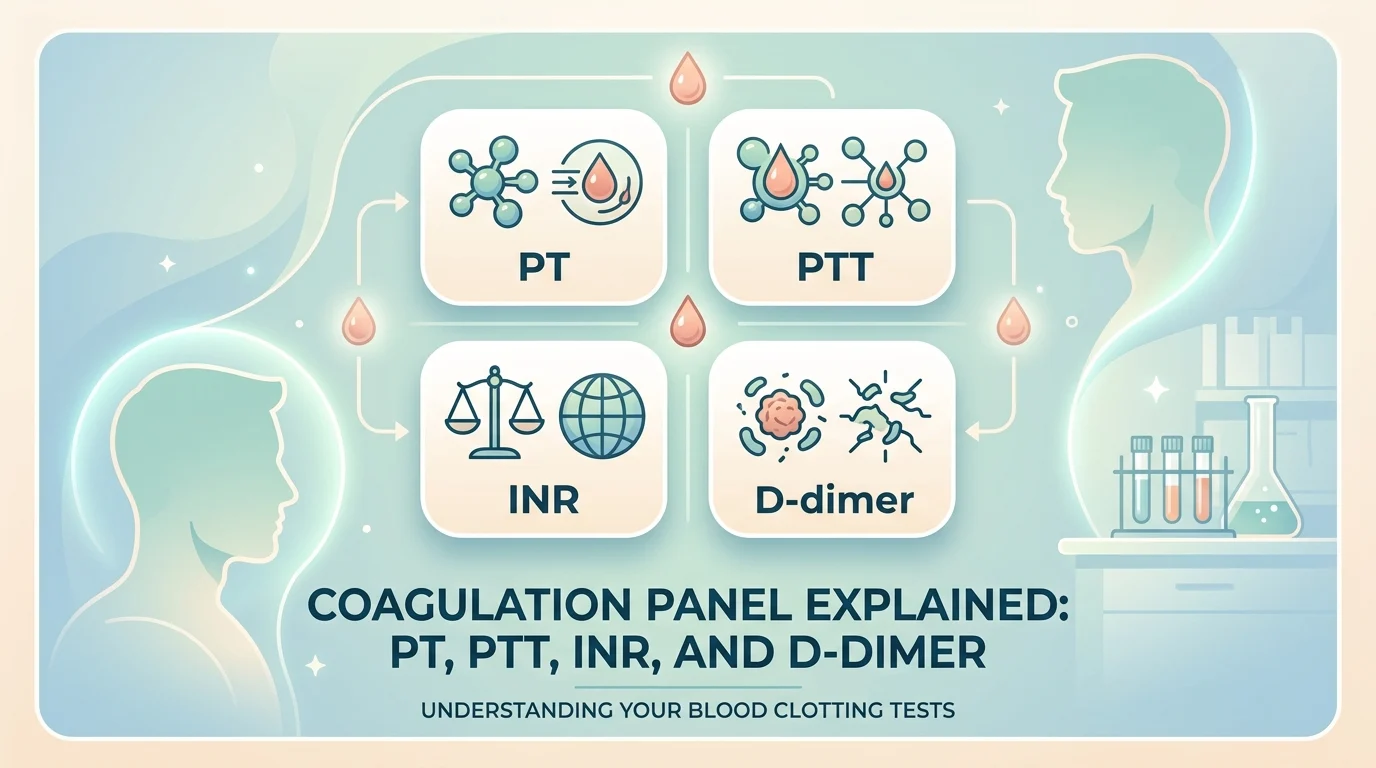
A coagulation panel is a group of blood tests that show how well your body forms and breaks down blood clots. If your report lists abbreviations like PT, INR, PTT, or D-dimer next to numbers and reference ranges, it can be hard to know what is normal and what needs attention. This guide explains, in plain language, what each test measures, what a high or low result can mean, and when an abnormal value should prompt a conversation with a doctor. You will also find a side-by-side comparison of the four main tests, a simple guide to common result patterns, and a clear list of warning signs. The goal is to help you read your results with more confidence before your next appointment.
What is a coagulation panel?
A coagulation panel (sometimes called a clotting screen or coagulation profile) is a set of blood tests that measure how quickly and how well your blood clots. Clotting, also called coagulation, is the process your body uses to stop bleeding after an injury. It relies on a chain of proteins known as clotting factors, plus tiny cell fragments called platelets.
The panel checks whether that chain is working at the right speed. If clotting is too slow, you may bruise or bleed easily. If clotting is too fast or happening when it should not, you may be at higher risk of a dangerous clot. A coagulation panel does not diagnose a single disease on its own; it gives clues that your doctor reads alongside your symptoms, history, and other results.
Most panels include a small core set of tests. The four you are most likely to see are prothrombin time (PT), the international normalised ratio (INR), partial thromboplastin time (PTT), and D-dimer. Many panels also report fibrinogen and a platelet count. To see how these tests fit into a full report, our guide on how to read blood test results walks through reference ranges and the “H” and “L” flags step by step.
Why a doctor may order one
A coagulation panel is commonly requested before surgery, to check for a bleeding or clotting problem, to monitor blood-thinning medicine, or to look at liver function, since the liver makes most clotting factors. It may also be ordered when someone has unexplained bruising, heavy bleeding, or a suspected clot.
The four main tests at a glance
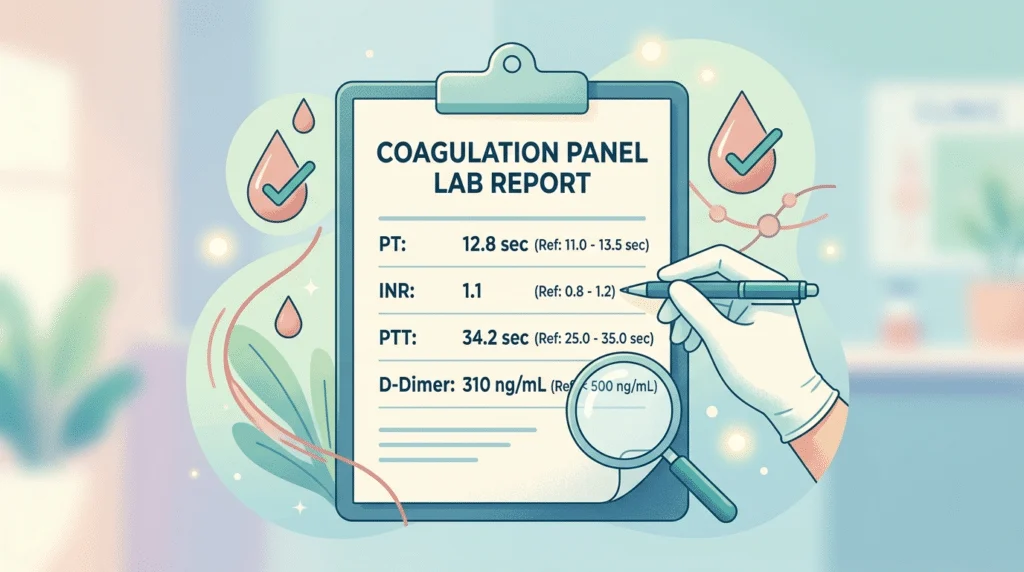
Each test in a coagulation panel looks at a slightly different part of the clotting process. The table below summarises what they measure and why they are used. Reference ranges differ between laboratories and methods, so always read your result against the range printed on your own report.
| Test | What it mainly measures | Typical reference range | Often used to |
|---|---|---|---|
| PT (prothrombin time) | Speed of the “extrinsic” and common clotting pathway | About 9–13 seconds | Monitor warfarin, check liver function and vitamin K |
| INR | A standardised version of the PT | About 0.8–1.2 (not on blood thinners) | Compare PT results between labs; guide warfarin dosing |
| PTT / aPTT | Speed of the “intrinsic” and common clotting pathway | Roughly 25–35 seconds | Monitor heparin, investigate unexplained bleeding |
| D-dimer | A fragment left when a clot dissolves | Usually below 500 ng/mL | Help rule out a blood clot such as a DVT or PE |
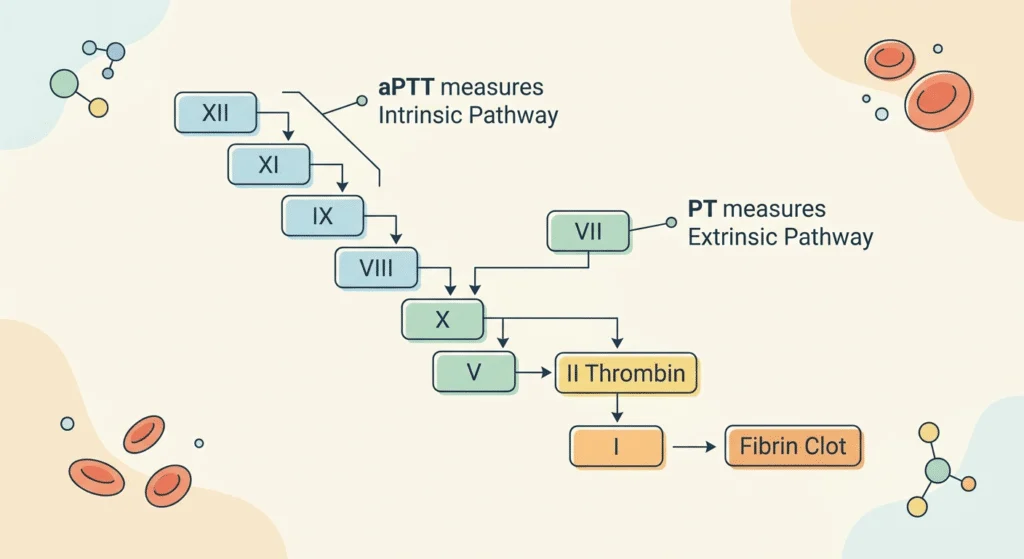
The PT and PTT work as a pair: between them, they cover almost all of the clotting factors. When a doctor reads them together, the pattern of which one is abnormal helps point to where the problem lies. The INR is simply a way of expressing the PT so results mean the same thing everywhere. D-dimer sits slightly apart, because it does not measure clotting speed; it signals whether clots are actively being broken down somewhere in the body.
Prothrombin time (PT) and INR explained
Prothrombin time, usually shortened to PT, measures how many seconds it takes for a clot to form in a sample of your blood after a clotting trigger is added. It mainly reflects the “extrinsic” and common pathway of clotting, which depends on several factors made by the liver.
Because PT results can vary depending on the laboratory’s equipment and chemicals, the result is converted into the INR (international normalised ratio). The INR is a calculation that standardises the PT, so a value measured in one lab means the same thing as the same value measured elsewhere. According to the National Library of Medicine, a PT/INR test can check the reason for unusual bleeding, look for liver problems, screen for vitamin K deficiency, and confirm clotting ability before surgery.
PT, INR, and blood thinners
The PT/INR is the standard test for monitoring warfarin (a common brand name is Coumadin), a tablet that slows clotting to prevent dangerous clots. Warfarin works by blocking vitamin K, which the body needs to make several clotting factors. People taking warfarin usually aim for an INR target set by their doctor, often around 2.0 to 3.0, though the exact range depends on the reason for treatment.
A higher INR means the blood is clotting more slowly, which raises the risk of bleeding; a lower INR means clotting is faster, which raises the risk of a clot. Because diet and other medicines affect vitamin K levels, our article on the vitamin K blood test and PT/INR explains how this nutrient links to your clotting results.
What a high or low PT can suggest
A prolonged (high) PT or INR can point to warfarin effect, low vitamin K, liver disease, or a shortage of certain clotting factors. A short PT is less common and is rarely a cause for concern on its own. Newer blood thinners, such as direct oral anticoagulants, are usually not monitored with the PT/INR, so the test is not used to guide their dose.
Partial thromboplastin time (PTT and aPTT) explained
Partial thromboplastin time, or PTT, measures how long your blood takes to clot through the “intrinsic” and common pathway. You will often see it written as aPTT (activated partial thromboplastin time), because the laboratory adds a substance to activate clotting and make the result more reliable. PTT and aPTT refer to essentially the same test.
The PTT checks a different group of clotting factors than the PT. As Cleveland Clinic explains, a PTT test looks at most of your clotting factors, while a PT test checks some that the PTT does not, which is why the two are often run together. Reading them side by side gives a clearer picture of which part of the clotting chain may not be working.
PTT and heparin
The PTT is the usual test for monitoring heparin, a fast-acting blood thinner given by injection or drip, often in hospital. While someone is on heparin, doctors aim to keep the PTT within a target range so the medicine is strong enough to prevent clots but not so strong that it causes bleeding.
What a high or low PTT can suggest
A prolonged (high) PTT can be caused by heparin, a clotting-factor deficiency such as haemophilia, liver disease, or von Willebrand disease, a common inherited bleeding condition. It can also reflect a “lupus anticoagulant,” an antibody that, despite its name, is sometimes linked to clotting rather than bleeding. A shorter-than-normal PTT is usually not a concern by itself. Our detailed aPTT guide covers how these results are interpreted in more depth.
D-dimer: the test used when a clot is suspected
D-dimer is different from the other tests in the panel. It does not measure how fast you clot. Instead, it measures a small protein fragment that appears in the blood when a clot is forming and then breaking down. A very low or undetectable D-dimer suggests little clot activity, whilst a raised level suggests clots are being made and dissolved somewhere in the body.
Doctors most often use D-dimer to help rule out a blood clot. Mayo Clinic notes that nearly everyone with a significant deep vein thrombosis (DVT) has raised D-dimer, and that the test can help exclude a pulmonary embolism (PE), a clot in the lungs. The test’s strength is its high “negative predictive value”: when D-dimer is normal and the clinical suspicion is low, a clot is unlikely. Our full D-dimer blood test guide explains the result in more detail.
Why a high D-dimer does not always mean a clot
This is one of the most confusing parts of the test. A raised D-dimer is not specific: it simply shows clot turnover, which has many harmless or unrelated causes. D-dimer can rise with pregnancy, recent surgery or injury, infection, inflammation, liver disease, cancer, and increasing age. For this reason, a high D-dimer rarely confirms a clot on its own. It usually leads to an imaging test, such as an ultrasound for a leg clot or a special CT scan for a lung clot, to look for the clot directly. In other words, a high D-dimer is a prompt for more testing, not a diagnosis.
Fibrinogen and other clotting tests
Some coagulation panels include extra tests that round out the picture.
- Fibrinogen is the protein that thrombin turns into fibrin, the mesh that holds a clot together. A typical range is around 200–400 mg/dL. Low fibrinogen can occur in severe liver disease or in a serious condition called disseminated intravascular coagulation (DIC); high fibrinogen often reflects inflammation.
- Platelet count measures the cell fragments that plug a wound. It is usually reported on a complete blood count rather than the clotting screen, but platelets are essential to normal clotting.
- Specialised clotting-factor tests may be added if a deficiency is suspected. These include natural “brakes” on clotting such as Protein C, Protein S, and antithrombin III. A shortage of any of these can raise the risk of clotting.
These tests are usually ordered as a follow-up, after the core panel suggests where to look more closely.
Making sense of abnormal results
Reading a coagulation panel is about patterns, not single numbers. Because the PT and PTT cover different clotting factors, the combination that is abnormal helps a clinician narrow down the cause. The table below shows common patterns and what a doctor might consider. It is a general guide only, not a diagnosis.
| Pattern on the panel | What a clinician may consider |
|---|---|
| PT/INR high, PTT normal | Warfarin effect, low vitamin K, or a liver problem |
| PTT high, PT/INR normal | Heparin effect, haemophilia, von Willebrand disease, or a lupus anticoagulant |
| Both PT/INR and PTT high | Severe liver disease, DIC, vitamin K deficiency, or strong blood-thinning effect |
| D-dimer high | Possible clot, but also pregnancy, surgery, infection, or age — needs imaging to confirm |
| Low fibrinogen with high D-dimer and prolonged PT/PTT | A pattern that can be seen in DIC, a medical emergency |
A second key idea is the difference between a bleeding problem and a clotting problem. Slow clotting (prolonged PT or PTT, low platelets, low fibrinogen) tends to cause bruising and bleeding. Overactive clotting, or a shortage of the body’s natural anticoagulants, tends to raise the risk of clots in the veins or lungs. Many results sit close to the edge of the reference range and turn out to be harmless, especially if you have no symptoms.
When to see a doctor
A coagulation panel is interpreted by a healthcare professional, so any abnormal result should be discussed with the doctor who ordered it. Some symptoms, however, deserve prompt medical attention regardless of your test numbers.
Seek urgent or emergency care if you notice signs of a possible clot:
- Swelling, pain, redness, or warmth in one leg, which can suggest a DVT.
- Sudden shortness of breath, chest pain, or coughing up blood, which can suggest a pulmonary embolism. Call the emergency services straight away.
- Sudden weakness, numbness, drooping on one side of the face, or trouble speaking, which can suggest a stroke.
Contact your doctor promptly if you have signs of a bleeding problem:
- Frequent nosebleeds or bleeding gums.
- Easy or unusually large bruising.
- Blood in your urine or stool, or very heavy periods.
- Bleeding from small cuts that takes a long time to stop.
These warning signs matter even if your last coagulation panel looked normal, because results reflect a single moment in time.
How a coagulation panel is done and how long results take
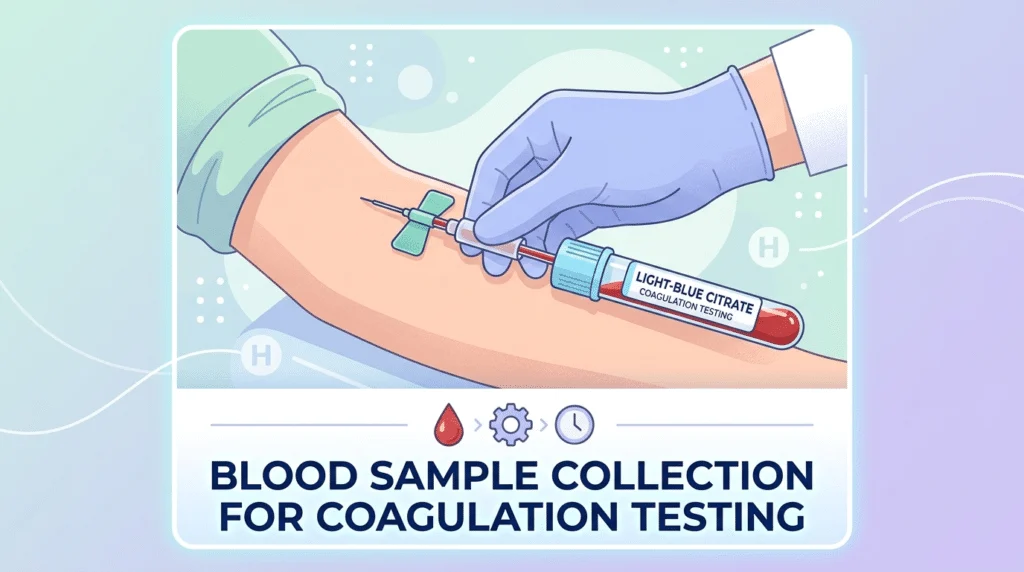
A coagulation panel uses a standard blood draw, usually from a vein in your arm. The sample is collected into a tube with a light-blue cap that contains a substance to stop the blood clotting before it reaches the laboratory. Most people do not need to fast for a clotting screen, but you should always follow the specific instructions from your clinic, and tell the team about any blood thinners, supplements, or other medicines you take, as these can affect the results.
Turnaround time depends on the test and the laboratory. Basic clotting tests such as PT/INR and PTT are often available within hours to a day, while specialised factor tests can take longer. For a fuller picture of timing by test type, see our guide on how long blood test results take. If you take warfarin, your clinic will tell you how often to repeat the INR to keep your dose on target.
Glossary
- Anticoagulant: A medicine that slows blood clotting to help prevent dangerous clots; warfarin and heparin are common examples.
- aPTT (activated partial thromboplastin time): A version of the PTT in which the lab adds an activator to make the result more reliable. The terms PTT and aPTT are used for essentially the same test.
- Coagulation cascade: The step-by-step chain of clotting factors that work together to form a blood clot.
- D-dimer: A protein fragment released when a clot is broken down. A raised level signals clot activity but does not, by itself, confirm a clot.
- DIC (disseminated intravascular coagulation): A serious condition in which clotting and bleeding happen throughout the body at the same time.
- Fibrinogen: A protein in the blood that is converted into fibrin to build the mesh of a clot.
- Heparin: A fast-acting injectable blood thinner, often monitored with the PTT.
- INR (international normalised ratio): A standardised way of reporting the prothrombin time so results can be compared between laboratories.
- Platelets: Tiny cell fragments that gather at a wound to help form a clot.
- Warfarin: A tablet blood thinner that blocks vitamin K and is monitored with the PT/INR.
Frequently asked questions
Do I need to fast before a coagulation panel?
For most clotting tests, fasting is not required, and you can usually eat and drink normally. However, instructions vary by clinic and by which tests are bundled together, so the safest step is to follow the guidance you are given when the test is booked. It is also important to tell the laboratory about any blood thinners, supplements such as vitamin K or fish oil, and other medicines you take, because several of these can change your results. If you are ever unsure, a quick call to the clinic before your appointment will confirm whether any preparation is needed.
What is the difference between PT and PTT?
Both tests measure how long your blood takes to clot, but they look at different clotting factors. The PT (with its standardised INR) mainly reflects the extrinsic and common pathway and is used to monitor warfarin and check liver function. The PTT reflects the intrinsic and common pathway and is used to monitor heparin and investigate unexplained bleeding. Because each test covers part of the clotting chain, doctors usually read them together: the pattern of which one is abnormal helps point to where a clotting problem may lie.
Does a normal D-dimer rule out a blood clot?
A normal D-dimer is reassuring, especially when a doctor already thinks a clot is unlikely. In that situation, a normal result helps safely rule out a deep vein thrombosis or pulmonary embolism without further scans. It is not a guarantee on its own, though. If your symptoms strongly suggest a clot, your doctor may still arrange imaging even with a normal D-dimer, because the test is used alongside a clinical assessment rather than as a stand-alone answer.
Is a coagulation panel the same as a full blood count?
No. A coagulation panel checks how well your blood clots by measuring clotting times and clot-related proteins. A full blood count (FBC) counts your red cells, white cells, and platelets, and looks at their size and health. The two tests overlap only on platelets, which matter for clotting and appear on the FBC. They answer different questions and are often ordered together to give a broader view of your blood.
How long do coagulation panel results take?
Routine clotting tests such as PT/INR and PTT are frequently ready within a few hours to a day, depending on the laboratory and how the sample is processed. Specialised tests, such as individual clotting-factor assays, can take longer because they are run less often. Timing also depends on how your results are returned to you, whether through a patient portal, your clinic, or a follow-up appointment. If your results seem delayed beyond what you were told to expect, it is reasonable to contact the clinic for an update.
Can a coagulation panel diagnose a specific condition?
On its own, a coagulation panel does not diagnose a single disease. It shows whether your clotting is faster or slower than expected and which part of the process may be affected. A clinician combines the results with your symptoms, medical history, medicines, and often further tests, such as imaging or specialised factor assays, to reach a diagnosis. Think of the panel as a signpost that guides the next steps rather than a final answer in itself.
Sources
- Prothrombin Time Test and INR (PT/INR) — MedlinePlus, U.S. National Library of Medicine
- Partial Thromboplastin Time (PTT) Test — Cleveland Clinic
- Deep Vein Thrombosis (DVT): Diagnosis & Treatment, including the D-dimer blood test — Mayo Clinic
Further reading
- Read blood test results: a simple guide
- D-dimer blood test: a comprehensive guide to your results
- aPTT blood test: understanding your levels
- Vitamin K blood test and PT/INR results
- Full blood count: read your results
Understand your lab results with AI DiagMe
Seeing a prothrombin time (PT/INR), a partial thromboplastin time (PTT), or a D-dimer outside the reference range can leave you with questions long before your next appointment. AI DiagMe reads your blood-clotting results in context, explains what each value means in plain language, and helps you prepare focused questions for your doctor. It is built to help you understand your results, not to diagnose you, and it never replaces a medical consultation. Upload your report to see your coagulation panel explained clearly.
➡️ Get your results interpreted in minutes