





































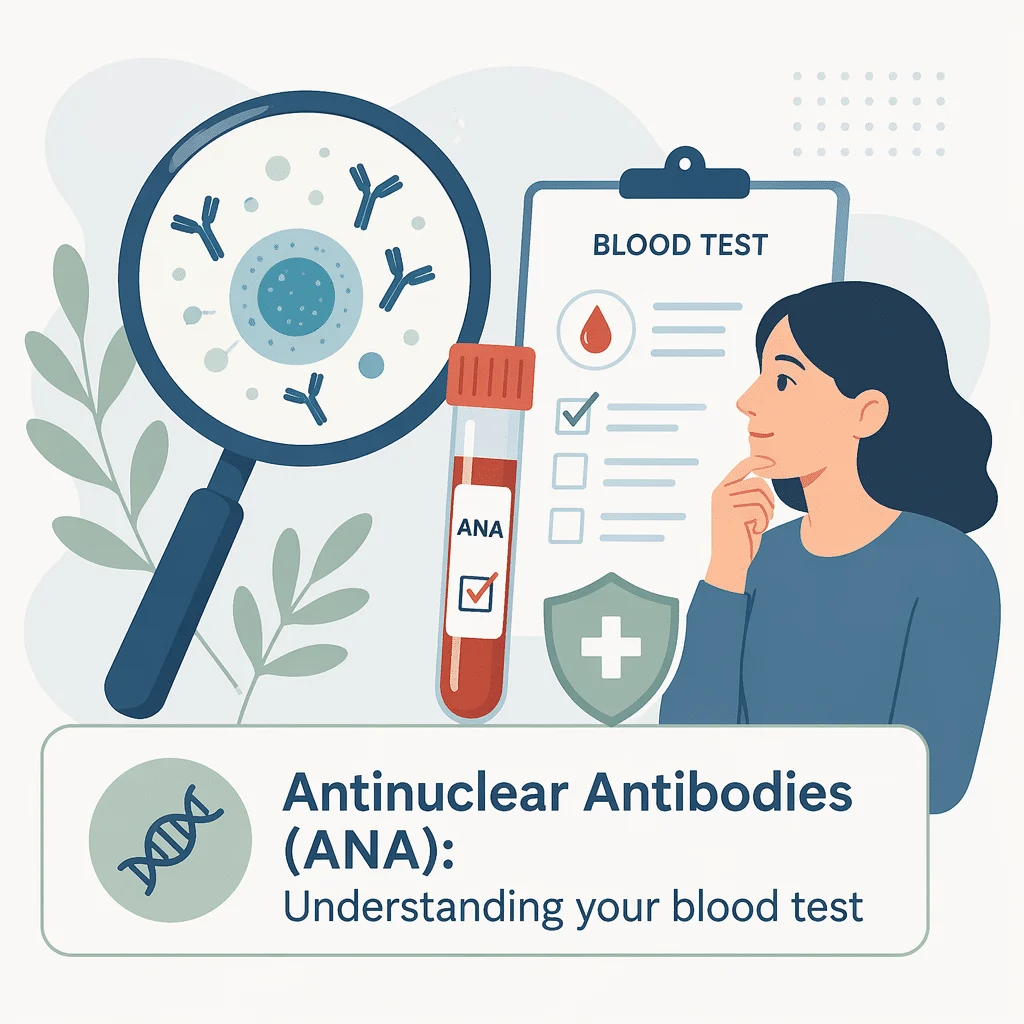
Antinuclear antibodies (ANA) are proteins the immune system makes that, by mistake, target the body’s own cell nuclei instead of germs. An ANA blood test looks for these antibodies, and it is used mainly as a first-line screen for autoimmune conditions such as lupus. A positive result is common and is not, on its own, a diagnosis — plenty of healthy people carry low levels. In this article you will learn what antinuclear antibodies are, why the test is ordered, how to read the titre and pattern on your report, what a positive ANA can and cannot mean, which follow-up tests usually come next, when to see a doctor, and what recent research adds. The aim is to turn a confusing line on a report into clear, calm understanding.
What are antinuclear antibodies (ANA)?
Antinuclear antibodies, usually shortened to ANA, are a family of autoantibodies. An antibody is a protein your immune system normally makes to recognise and help destroy invaders such as viruses and bacteria. An autoantibody is one that has turned inward and reacts against a part of your own body. With ANA, the target is the nucleus of your cells — the central compartment that stores DNA and other genetic material. Their presence suggests the immune system may be reacting against the body’s own tissues rather than only against outside threats.
How the immune system mistakes “self” for “foreign”
A healthy immune system is very good at telling “self” from “non-self.” It tolerates your own cells and attacks only outside dangers. Sometimes that tolerance slips, and the system starts producing antibodies against normal structures inside the nucleus. This can drive inflammation aimed at the body’s own tissues, which is the hallmark of an autoimmune process. That is why a clearly raised level of antinuclear antibodies is treated as a possible signal of autoimmune activity — though, as we will see, it can also be completely harmless.
What the ANA test measures
The ANA test does two jobs. First, it detects whether these antibodies are present at a meaningful level, giving a positive or negative result. Second, when the test is positive, the laboratory measures how concentrated the antibodies are (the titer) and describes how they light up cells under the microscope (the pattern). The long-standing reference method is indirect immunofluorescence on HEp-2 cells: a sample of your blood is layered over human cells, and any antibodies that bind are made to glow. Newer automated methods exist, but immunofluorescence remains the benchmark that most laboratories rely on.
Why the ANA blood test is ordered
Doctors order an antinuclear antibodies test when something in your symptoms or examination raises the possibility of an autoimmune connective tissue disease. It is a screening test: good at flagging people who might have such a condition, and especially valuable for helping to rule one out. Because almost everyone with lupus has a positive ANA, a negative result makes that particular diagnosis much less likely.
Common reasons to run the test include:
- Persistent joint pain, stiffness, or swelling
- A rash across the cheeks and nose, or skin that reacts strongly to sunlight
- Unexplained, lasting fatigue
- Recurrent fever with no clear infection
- Dry eyes and a dry mouth
- Muscle weakness or aching that does not settle
An ANA test is not a routine check for people who feel well. Testing without symptoms tends to turn up positive results that cause worry without changing anything, which is why it is reserved for situations where an autoimmune disease is genuinely being considered.
How to read your ANA test results: titer and pattern
Two extra pieces of information turn a bare “positive” into something a specialist can actually use: the titer and the pattern. Reading them together with your symptoms is the entire point of the test.
The titer: how concentrated the antibodies are
If your ANA test is positive, the laboratory reports a titer — the result of repeatedly diluting your blood to see how far it can be thinned before the antibodies can no longer be detected. It is written as a ratio such as 1:80, 1:160, or 1:320. A higher second number means the antibodies were still visible in a more diluted sample, so they are more concentrated. As a rough guide, many laboratories read the titer along these lines:
| ANA titre | How it is often read |
|---|---|
| Below 1:80 | Usually considered negative |
| 1:80 to 1:160 | Weakly positive; often seen in healthy people |
| 1:320 or higher | Strongly positive; more likely to be clinically meaningful |
Thresholds vary between laboratories, and some report any titre at or above 1:160 as positive. A low titre with no symptoms is often simply monitored, whilst a high titre usually prompts more specific testing.
The pattern: a visual clue
Under the microscope, antibodies attach to different parts of the cell and create distinct glowing patterns. The pattern hints at which antibodies are present and, in turn, which conditions are more or less likely. This is what helps the doctor choose the next, more targeted tests.
| Fluorescence pattern | What it can point toward |
|---|---|
| Homogeneous (even glow across the nucleus) | Often linked to lupus |
| Speckled (scattered bright dots) | Seen in lupus, Sjögren’s syndrome, and mixed connective tissue disease |
| Centromere (discrete, evenly spaced dots) | Suggestive of limited scleroderma |
| Nucleolar (glow within the nucleoli) | Associated with scleroderma and some muscle diseases |
| Dense fine speckled (DFS) | Common in healthy people; rarely signals disease |
No pattern is a diagnosis in itself; each is a signpost that guides the rest of the work-up.
Positive versus negative results
A negative ANA means no antinuclear antibodies were found at a meaningful level, which makes a connective tissue disease less likely but does not completely exclude it. A positive ANA means antibodies were detected — no more, no less. What it means for you depends on your titre, your pattern, and above all your symptoms. To see how the ANA sits alongside other autoantibody tests, explore our guide to the autoimmune panel.
What a positive ANA can mean
Because the ANA test is sensitive but not specific, a positive result opens a list of possibilities rather than pointing to one answer. Some are autoimmune diseases; many are not.
Systemic lupus erythematosus (SLE)
Lupus is the condition most strongly linked to antinuclear antibodies. According to the American College of Rheumatology, more than 95% of people with lupus test positive for ANA, so a negative result is a strong argument against the diagnosis. Lupus can inflame the skin, joints, kidneys, blood cells, and other organs, and typical clues include a butterfly-shaped facial rash, sun sensitivity, joint pain, and deep fatigue. A positive ANA is only the starting point; the diagnosis is confirmed with more specific antibodies and other findings, as detailed in our guide to systemic lupus erythematosus.
Other autoimmune conditions
Several other autoimmune diseases frequently show a positive ANA:
- Sjögren’s syndrome, which mainly attacks the glands that produce tears and saliva
- Scleroderma, which causes hardening of the skin and sometimes internal organs
- Polymyositis and dermatomyositis, which inflame the muscles
- Mixed connective tissue disease, which blends features of several conditions
- Autoimmune hepatitis, a form of liver inflammation
- Rheumatoid arthritis, where a positive ANA can flag overlapping autoimmunity — explained in our guide to rheumatoid arthritis
In each of these, the ANA is an early clue that points toward more specific tests rather than a stand-alone answer.
A positive ANA in healthy people
This is the part that reassures most readers: a positive ANA is common in people with no disease at all. The American College of Rheumatology estimates that up to 15% of completely healthy people have a positive ANA, and that only around 11 to 13% of people with a positive result actually have lupus or another autoimmune or connective tissue disease. ANA also becomes more common with age, especially after 65, and is more frequent in women. A short-lived positive result can follow a viral infection, and certain medicines — including some drugs for blood pressure, heart rhythm, and epilepsy — can trigger these antibodies too. This is why a positive ANA, on its own and without symptoms, is usually not a reason to worry.
Follow-up tests after a positive ANA
A positive ANA rarely travels alone. When the result and your symptoms warrant it, the laboratory or your doctor adds more specific tests — often automatically, through a process called reflex testing — to work out what is driving the antibodies.
- Anti-dsDNA and anti-Sm antibodies, which are far more specific for lupus
- An extractable nuclear antigen (ENA) panel, a group of antibodies such as anti-Ro/SSA and anti-La/SSB that help identify Sjögren’s syndrome and related diseases
- Immune proteins that are used up when lupus is active, namely complement C3 and complement C4
- Rheumatoid factor, together with anti-CCP antibodies
- Inflammation markers and a complete blood count, which show how the body is responding overall
Seeing these names appear on a report can be unsettling, but they are simply the logical next questions after a positive screen. To make sense of the numbers and ranges you will see, read our guide to reading blood test results.
When to see a doctor
A positive ANA should always be interpreted by a doctor, who will weigh it against your symptoms, examination, and other tests. Arrange a prompt review, especially if a raised titre comes with any of the following:
- Joint pain or swelling that lasts more than a few weeks
- A new or spreading rash, particularly across the cheeks and nose
- Skin that is unusually sensitive to sunlight
- Persistent, unexplained fatigue
- Recurrent fever without an obvious infection
- Dry eyes and mouth, or unexplained muscle weakness
If you have a positive ANA but feel well and have no symptoms, it usually means watchful monitoring rather than treatment. Only a doctor can decide what, if anything, needs to happen next.
Latest scientific advances
Research on antinuclear antibodies keeps refining how the ANA test is interpreted. The summary below reflects recent studies indexed in PubMed and Consensus; it describes progress in careful interpretation, not new treatments, and none of it replaces your doctor’s judgement.
A 2025 narrative review of everyday ANA interpretation reinforced a message that runs through this whole article: the antibody must always be read alongside the clinical picture. Its authors note that low titres often carry little diagnostic weight, while results above roughly 1:160 are better at separating true positives from the background positivity seen in healthy people. What this means for you is that the number beside your result matters, but it is the combination of titre, pattern, and symptoms — not any single figure — that a specialist actually uses (Kądziela and colleagues, Journal of Clinical Medicine, 2025).
A 2026 systematic review that pooled sixteen studies focused on one specific antibody, anti-DFS70, which produces the dense fine speckled pattern. It found these antibodies appear only slightly more often in people with lupus than in healthy individuals, so on their own they cannot reliably confirm or exclude the disease. In plain terms, a dense fine speckled result is frequently a benign finding, but it still needs to be read in context rather than treated as an automatic all-clear (Hung and colleagues, Lupus, 2026).
Two further studies show how much the titre and pattern shape meaning. In a 2023 study of children, higher titres — around 1:640 and above — were far more likely to reflect a genuine autoimmune disease, while the dense fine speckled pattern again pointed away from disease (Park and colleagues, Clinical Pediatrics, 2023). And a 2025 registry of adults with rheumatoid arthritis found a positive ANA in roughly four in ten patients, with an uncommon nucleolar pattern linked to lung involvement (Nakano and colleagues, Journal of Clinical Medicine, 2025). Taken together, these findings are reassuring rather than alarming: they help doctors avoid over-reading a mildly positive result whilst still catching the ones that matter.
Glossary
| Term | Definition |
|---|---|
| Antinuclear antibodies (ANA) | Antibodies that target the nucleus of the body’s own cells; a positive test can occur in autoimmune disease and in healthy people. |
| Autoantibody | An antibody that mistakenly reacts against the body’s own tissues instead of germs. |
| Titer | A measure of how concentrated the antibodies are, written as a ratio such as 1:160; higher numbers are generally more meaningful. |
| Pattern | The way antibodies glow on cells under the microscope, which hints at the conditions involved. |
| Indirect immunofluorescence (HEp-2) | The reference laboratory method for detecting ANA, using human cells so that bound antibodies glow. |
| Connective tissue disease | A group of autoimmune conditions, including lupus and Sjögren’s syndrome, that affect supporting tissues such as joints and skin. |
| ENA panel | A set of more specific antibody tests, often run after a positive ANA, that help identify the exact condition. |
| Reflex testing | A laboratory process in which a positive first result automatically triggers follow-up tests, without a new blood draw. |
| Complement (C3 and C4) | Immune proteins that are used up when the immune system is very active, so low levels can point to active lupus. |
Frequently asked questions
Does a positive ANA test mean I have a serious illness?
Not necessarily. A positive antinuclear antibodies test only shows that these antibodies are present, not that they are causing harm. Up to about 15% of healthy people test positive, and the chance rises with age and is higher in women. Many people with a positive ANA never develop an autoimmune disease. What matters is whether you also have symptoms, how high the titre is, and what more specific tests show. A doctor puts these together before drawing any conclusion, so a positive result on its own is rarely a cause for alarm.
What can cause a false positive ANA test?
A positive ANA without an autoimmune disease is common enough that “false positive” can be misleading — the antibodies really are there, they just are not causing illness. Ordinary triggers include increasing age, recent viral infections, and some long-term conditions. Several medicines can also raise ANA, including certain drugs for blood pressure, heart rhythm, and epilepsy; this is sometimes called drug-induced positivity and often fades after the medicine is stopped. Because of this, your doctor will review your age, health, and medications before deciding whether a positive result means anything.
Can a positive ANA mean cancer?
On its own, a positive ANA is not a cancer test and is a poor way to look for cancer. Antinuclear antibodies can occasionally appear in people with certain cancers, but they show up far more often in healthy people, with ageing, and in autoimmune conditions. A positive result does not point to cancer unless there are other specific reasons to look for it. If you are worried, the useful step is to discuss your full symptoms with your doctor, who can decide whether any further testing is appropriate rather than reading a cancer risk into the ANA alone.
Does a positive ANA with joint pain mean I have lupus?
Not by itself. Joint pain is common and has many causes, and a positive ANA is common too, so the combination does not confirm lupus. It does, however, make the pairing worth investigating. A doctor will look at which joints are affected, whether you have a rash, fatigue, or other clues, and will usually order more specific tests such as anti-dsDNA antibodies and complement levels. Lupus is diagnosed from the whole picture, not from a positive ANA and sore joints alone, so try not to jump to conclusions before the work-up is complete.
Can the ANA titre change over time?
Yes, the titre can go up or down when the test is repeated. In people who are being monitored for an autoimmune disease, these swings are not a reliable measure of how active the disease is, so doctors do not usually track the ANA titre the way they follow some other markers. A change in titre alone, without new symptoms, rarely means much. If your titre shifts between tests, it is best interpreted alongside how you feel and what more specific antibody tests show.
Can children have a positive ANA?
Yes, and it needs to be interpreted carefully. Children can have a positive ANA after an ordinary viral infection, with no lasting significance. Research in children suggests that higher titres are more likely to reflect a real autoimmune disease, whilst a dense fine speckled pattern usually points away from one. A positive ANA in a child is not a diagnosis on its own; a paediatrician or specialist weighs it against symptoms and, if needed, more specific tests before deciding whether anything further is required.
Sources
- ANA (Antinuclear Antibody) Test — MedlinePlus, National Library of Medicine (NIH). https://medlineplus.gov/lab-tests/ana-antinuclear-antibody-test/
- ANA test — Mayo Clinic. https://www.mayoclinic.org/tests-procedures/ana-test/about/pac-20385204
- Antinuclear Antibodies (ANA) — American College of Rheumatology. https://rheumatology.org/patients/antinuclear-antibodies-ana
- Kądziela M, et al. — The Art of Interpreting Antinuclear Antibodies (ANAs) in Everyday Practice — Journal of Clinical Medicine, 2025. https://doi.org/10.3390/jcm14155322
- Hung YC, et al. — Diagnostic performance of anti-DFS70 antibodies in excluding systemic lupus erythematosus diagnosis: an updated systematic review and meta-analysis — Lupus, 2026. https://doi.org/10.1177/09612033261442792
- Nakano K, et al. — Clinical Significance of Antinuclear Antibodies in Patients with Rheumatoid Arthritis (SETOUCHI-RA Registry) — Journal of Clinical Medicine, 2025. https://consensus.app/papers/details/ed31996c2ea95940a9d48eb59522f3e9/
- Park M, et al. — Differences in the Clinical Significance of Antinuclear Antibodies According to Titers and Patterns in Children — Clinical Pediatrics, 2023. https://consensus.app/papers/details/b72cf236dcd352a584408f455a58db0d/
Further reading
- Autoimmune disease: symptoms, causes, and treatments
- Complete blood count: how to read your results
- C-reactive protein (CRP): understanding this inflammation marker
- Erythrocyte sedimentation rate (ESR): understanding this marker
- Anti-TPO antibodies: understanding this thyroid marker
A positive ANA usually arrives with a string of other results — anti-dsDNA, an ENA panel, complement C3 and C4, and a full blood count — that can be hard to piece together on your own. AI DiagMe reads your blood, urine, and stool results and explains what each value means in clear, everyday language, with analysis reviewed by a panel of doctors. It is built to help you understand your report and prepare for your appointment, not to diagnose you or replace your doctor.
Understand your lab results with AI DiagMe
Get your results interpreted in minutes