


A raised AST on a blood test is one of the most common reasons people go looking for reassurance, and most of the time reassurance is where the story ends. The AST normal range is narrower than many people expect, and a result sitting just above it can follow something as ordinary as a hard gym session two days earlier. It can also, occasionally, be the first quiet sign of liver disease, which is why an elevation that persists deserves proper follow-up rather than worry. In this article you’ll learn what AST actually measures, why the normal range differs from one laboratory to another, what pushes the number up, how AST and ALT are read together, and which symptoms mean you should be seen quickly.
What AST is, and where it comes from
AST stands for aspartate aminotransferase. Older reports and older doctors may still call it SGOT (serum glutamic-oxaloacetic transaminase); it is the same enzyme with an older name. Its job inside a cell is to move an amino group between molecules, a routine step in the way your body handles amino acids and energy.
Because AST lives inside cells, very little of it circulates in blood while those cells are intact. When cells are damaged, stressed or simply turning over faster than usual, AST leaks out and the blood level rises. That is the whole logic of the test: it is a leak detector, not a measure of how well your liver is working.
Not a liver-only enzyme
AST is abundant in liver cells, which is why it appears on liver panels. But it is also present in heart muscle, skeletal muscle, the kidneys, the brain, the pancreas and red blood cells. Any of those tissues can contribute to the number on your report.
This is the single most useful thing to understand about AST, and the reason it is never interpreted alone. ALT (alanine aminotransferase) is far more concentrated in the liver than anywhere else, so it is the more liver-specific of the two. A doctor looking at a raised AST is immediately asking a second question: is ALT raised too, and by how much? You can read more about that partner enzyme in our guide to ALT levels and what they mean.
Why AST and ALT are read together
A single enzyme rarely tells a story; a pattern often does. If both AST and ALT are mildly raised together, the liver is usually the source, and the question becomes which liver process is responsible. If AST is raised while ALT sits comfortably in range, attention shifts towards muscle, or towards a problem with the sample itself. If ALT is clearly higher than AST, that pattern is common in fatty liver disease and in many chronic hepatitis infections.
Doctors then widen the view. GGT and alkaline phosphatase point towards the bile ducts rather than the liver cells themselves. Bilirubin, albumin and clotting tests say something about function rather than damage. If muscle is suspected, creatine phosphokinase (CPK) and LDH settle the question quickly. A low AST is a different topic with its own explanations, covered separately in our article on what a low AST means.
The AST normal range, and why laboratories disagree
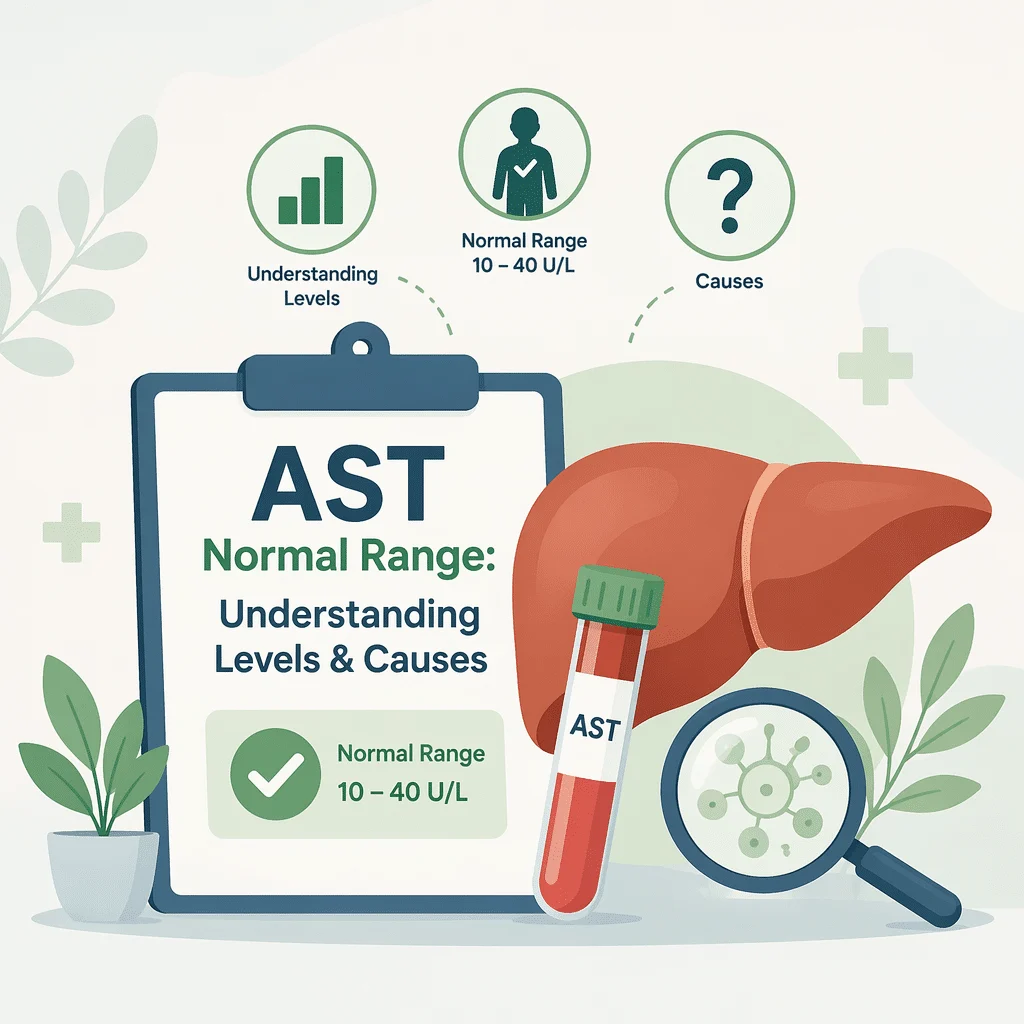
Most adult laboratories in the United States report an AST reference range somewhere in the region of 10 to 40 units per liter (U/L), often with a slightly higher upper limit for men than for women. Some report up to 48 U/L; some stop at 33. None is wrong.
Reference ranges are not universal biological truths. Each laboratory builds or adopts one for the specific analyzer and reagents it uses, and different assay methods genuinely produce different numbers from the same sample. Two labs measuring the same blood can report values that differ by several units, so comparing your result against a range printed by another clinic is a reliable way to frighten yourself for no reason. Always read your number against the range beside it on your own report.
Sex, age and the honest caveat about upper limits
Men typically run a little higher than women, partly because of greater muscle mass. Newborns and infants have considerably higher values than adults, and pediatric labs use their own ranges. Beyond that, hepatology has been quietly uncomfortable with conventional upper limits for years. Many of the ranges in routine use were derived decades ago from blood donors who were assumed to be healthy but who, by today’s standards, included people with undiagnosed fatty liver. Studies in carefully screened, metabolically healthy populations keep producing upper limits lower than the ones printed on lab slips.
The practical consequence is not that you should panic about a result inside the range. It is that a value sitting right at the top of the range, repeatedly, is a legitimate thing to mention to your doctor rather than something to file away as “normal”. For a broader look at how the whole panel fits together, see our overview of liver function tests.
Common causes of a raised AST
The list below is long, which is precisely the point: a high AST narrows things down far less than people assume.
Alcohol
Alcohol is one of the most frequent explanations for a persistently raised AST, and it does not require heavy or daily drinking to show up on a blood test. This is stated here as a fact rather than a lecture, and for a practical reason: being candid with your doctor about how much you actually drink changes the workup. It determines which tests come next and how the enzyme pattern is interpreted. Doctors are not scoring you; they are trying to avoid ordering the wrong investigations.
Metabolic dysfunction-associated steatotic liver disease (MASLD)
Fat accumulating in the liver is now the most common chronic liver condition worldwide. The name changed recently: what used to be called non-alcoholic fatty liver disease (NAFLD) is now metabolic dysfunction-associated steatotic liver disease, or MASLD, and the inflamed form once called NASH is now MASH. The rename was deliberate, replacing a definition based on what the condition is not with one based on the metabolic features that actually accompany it. If your report or your doctor uses either term, they are describing the same territory.
Viral hepatitis and other liver diseases
Chronic hepatitis B and hepatitis C commonly raise aminotransferases and often cause no symptoms at all for years, which is why testing for them is a standard early step. Autoimmune hepatitis, celiac disease, thyroid disease and inherited conditions such as hemochromatosis (iron overload), Wilson disease and alpha-1 antitrypsin deficiency all appear on the differential. Gallstones, pancreatitis, heart failure and a period of low blood pressure that briefly starved the liver of oxygen can each raise AST too.
Hemolysis of the sample
Red blood cells contain AST. If they rupture during or after the blood draw, AST spills into the serum and the analyzer dutifully reports a high result that has nothing to do with you. Laboratories usually flag hemolyzed samples, but not always. If a high AST arrives out of nowhere, without any other abnormality, a repeat draw is often the first and most sensible response.
Muscle and exercise: the most common false alarm
Skeletal muscle is packed with AST, and muscle is very easy to damage in ordinary life.
A hard weights session, a first marathon, an unaccustomed hike, a long cycling event or simply returning to the gym after a break can all raise AST for several days. The same is true after a fall, a crush injury, a seizure, surgery or an intramuscular injection, including a vaccination in the arm. Chronic muscle conditions such as the muscular dystrophies keep AST persistently raised without any liver involvement at all.
Rhabdomyolysis, the breakdown of muscle on a larger scale, sits at the severe end of this spectrum and typically comes with muscle pain, weakness and dark, tea-colored urine. That combination needs urgent assessment rather than watchful waiting.
If you exercised strenuously in the few days before your blood test, say so. Repeating the test after a genuinely quiet week, with CPK measured alongside, usually resolves the question without any further investigation.
Medicines and supplements, and one rule that matters
Many medicines can raise aminotransferases. Paracetamol (acetaminophen) is the classic example, dangerous in overdose but also capable of nudging enzymes up at the top of the recommended dose in some people. Statins raise AST or ALT modestly in a minority of users. Methotrexate, some antibiotics, antifungals, antiepileptics, isoniazid, amiodarone and a number of cancer treatments all appear on the list.
Supplements belong on that same list, not in a separate, gentler category. Green tea extract in concentrated form and anabolic androgenic steroids are both well-documented causes of liver injury. Kratom, garcinia cambogia, high-dose turmeric preparations, ashwagandha and multi-ingredient bodybuilding or weight-loss blends have all been implicated. Products marketed as “liver detox” or “liver cleanse” deserve particular skepticism: there is no evidence they lower AST, and some of the ingredients that appear in them are precisely the ones associated with liver damage.
Here is the rule that matters most, and it is not negotiable: do not stop, reduce or change any prescribed medicine because of a blood test result. That includes statins, which people abandon on their own more often than any other drug after seeing a raised liver enzyme. Whether a medicine is the cause, whether it should be paused, whether the dose should change and whether a repeat test is enough is a decision for the prescriber who knows your full history. Bring the result to them, along with a complete list of everything you take, including supplements bought without a prescription.
Reading the pattern: the ratio and the size of the rise
The AST:ALT ratio, read honestly
Divide AST by ALT and you get a ratio clinicians have used for decades. A ratio above 2 has long been associated with alcohol-related liver disease, and a raised ratio also tends to appear as liver scarring advances, because ALT falls away faster than AST in a fibrotic liver.
Both associations are real. Neither is proof. Plenty of people with alcohol-related liver disease have a ratio below 2, and plenty of people with a ratio above 2 have nothing of the sort. The ratio is also close to meaningless when both enzymes are within the normal range, where small fluctuations produce large swings in the arithmetic, and it is easily distorted by a muscle source that has pushed AST up on its own. Treat it as one hint among several rather than a verdict; our guide to the AST:ALT ratio and its interpretation goes into more detail.
What the size of the elevation suggests
Magnitude carries information, even though it never delivers a diagnosis on its own. Mild elevations, roughly up to two or three times the upper limit, are extremely common and have a long list of benign explanations. Very large elevations, in the hundreds or thousands of units, point towards a much shorter list: acute viral hepatitis, a significant drug or toxin exposure, a sudden interruption of blood supply to the liver, or extensive muscle breakdown. The table below is a way of orienting yourself before a conversation with your doctor, not a scoring system to apply to your own result.
| Pattern | What it usually points to | Usual next step |
|---|---|---|
| AST mildly raised after hard exercise, ALT normal | A muscle source rather than the liver | Repeat after a quiet week, often with CPK |
| AST and ALT both mildly raised | A liver process such as MASLD, alcohol, a medicine or viral hepatitis | Medication and alcohol review, hepatitis testing, metabolic bloods, often an ultrasound |
| AST:ALT ratio above 2 | A pattern seen with alcohol-related liver disease and with advanced scarring, but not diagnostic | Full assessment, fibrosis estimation, honest discussion about alcohol |
| AST markedly raised, in the hundreds or higher | Acute hepatitis, drug or toxin injury, reduced blood flow to the liver, or major muscle breakdown | Prompt medical review, usually the same day |
| Raised AST with jaundice or dark urine | Active liver injury or a blocked bile duct | Urgent assessment |
Red flags and when to see a doctor
Most raised AST results are followed up calmly, with a repeat test in a few weeks. Some are not, and it is worth knowing the difference.
Seek urgent medical assessment if you have any of the following:
- Yellowing of the skin or the whites of the eyes (jaundice)
- Dark urine together with pale stools
- Swelling of the abdomen
- Confusion, unusual drowsiness or difficulty staying awake
- Vomiting blood, or black tarry stools
- Severe pain in the upper right side of the abdomen
A markedly raised AST also needs prompt review, even if you feel well.
Book a routine appointment if your AST stays above the range on a repeat test, if it is rising over successive tests, or if you have unexplained fatigue, weight loss, itching or abdominal discomfort. Significant liver disease can be silent for a long time, and the point of following up a persistent elevation is to catch the small number of people for whom it matters, early enough to make a difference.
Latest scientific advances in AST testing
Laboratory upper limits may be higher than a healthy liver justifies
A 2024 study in Clinical Gastroenterology and Hepatology re-derived the upper reference limit for ALT, AST’s partner enzyme, in several thousand potential living liver donors with no fat visible in liver tissue and no metabolic abnormalities. The limit that emerged was substantially lower than conventional values, and clearly lower in women than in men. What this means for you: a result near the top of your lab’s printed range is not automatically reassuring, and it is reasonable to ask whether the trend over time matters more than a single number.
Fatty liver disease has a new name and new criteria
A multisociety Delphi consensus published in the Journal of Hepatology in 2023 replaced non-alcoholic fatty liver disease (NAFLD) with metabolic dysfunction-associated steatotic liver disease (MASLD), under an umbrella term of steatotic liver disease. It also created a category called MetALD for people who have metabolic risk factors and drink more than the MASLD threshold. What this means for you: your report may use either the old or the new label, and a change of wording does not mean your condition has changed.
AST is now an ingredient in the scores used to estimate scarring
A 2026 review in JAMA describing MASLD in adults sets out how liver fibrosis is staged in practice: the FIB-4 index, which combines age, AST, ALT and platelet count, alongside vibration-controlled transient elastography, a scanner that measures liver stiffness. What this means for you: your AST is increasingly read as one component of a calculated risk estimate rather than as a standalone verdict.
Newer scores aim to find fibrosis risk earlier in primary care
A 2024 validation study in Gastroenterology introduced the MAF-5 score, which combines waist circumference, body mass index, diabetes status, AST and platelet count, and tested it across population and hospital cohorts in several countries. It performed well at identifying people who warranted further liver assessment, including in age groups where older scores struggle. What this means for you: AST contributes useful information, but no single enzyme decides anything on its own.
Supplements are a growing cause of drug-induced liver injury
A 2024 review in Liver International reported that herbal and dietary supplements now account for a substantial and rising share of the drug-induced liver injury cases recorded by the United States network that tracks them, and named anabolic steroids, green tea extract, garcinia cambogia, kratom, ashwagandha, turmeric and multi-ingredient nutritional supplements among the main culprits. What this means for you: list everything you take, including products bought over the counter, when a raised AST is being investigated.
Glossary of key terms
| Term | Definition |
|---|---|
| AST (aspartate aminotransferase) | An enzyme found in liver, heart, skeletal muscle, kidney and red blood cells that leaks into the blood when those cells are damaged. |
| SGOT | Serum glutamic-oxaloacetic transaminase, the older name for exactly the same enzyme as AST. |
| ALT (alanine aminotransferase) | The companion enzyme, far more concentrated in the liver than elsewhere, which makes it the more liver-specific of the two. |
| U/L | Units per liter, the measure of enzyme activity used on most laboratory reports. |
| Reference range | The band of values a particular laboratory considers expected for its own analyzer and method, printed beside your result. |
| Upper limit of normal | The top value of that band; results are often described as multiples of it rather than as raw numbers. |
| AST:ALT ratio | AST divided by ALT, used as a pattern clue rather than as a diagnostic test. |
| MASLD | Metabolic dysfunction-associated steatotic liver disease, the current name for what was previously called NAFLD. |
| Hemolysis | Rupture of red blood cells in the sample tube, which releases AST and can produce a falsely high result. |
| Rhabdomyolysis | Large-scale breakdown of skeletal muscle, which releases AST, CPK and other cell contents into the blood. |
Frequently asked questions
Can exercise raise AST?
Yes, and it is one of the most common innocent explanations for a mildly high result. Skeletal muscle is rich in AST, so a heavy weights session, a long run, an unfamiliar hike or a return to training after a break can push the number up for several days. The rise often peaks a day or two after the effort and settles over about a week. If ALT stays normal while AST is up, a muscle source is especially likely. Tell whoever ordered the test what you did beforehand, and expect a repeat sample after a genuinely quiet week rather than a scan.
Should I stop my statin because my AST is high?
No. Do not stop or change a statin, or any other prescribed medicine, on the basis of a blood test result. Statins raise liver enzymes modestly in a minority of people, and in most of those cases the medicine is continued because the cardiovascular benefit outweighs a small enzyme change. Sometimes the statin turns out to have nothing to do with it. Your prescriber is the person who can weigh your particular result against your particular risks and decide whether to repeat the test, adjust the dose or change nothing at all. Bring them the result and let them make that call.
What is a dangerously high AST?
There is no single threshold that separates safe from dangerous, and applying one to yourself is not useful. What clinicians actually assess is the combination: how high the value is relative to your lab’s upper limit, how fast it has changed, what ALT, bilirubin and clotting tests are doing alongside it, and above all how you are. A very large elevation accompanied by jaundice, confusion, vomiting blood or severe abdominal pain is an emergency regardless of the exact figure. A very large elevation in someone who feels entirely well still needs prompt review, but usually as an urgent appointment rather than an ambulance.
Can dehydration cause a high AST?
Dehydration on its own is not a recognized cause of a meaningfully raised AST. It can concentrate the blood slightly and nudge several results up a little, but it does not produce the kind of elevation that prompts investigation. What sometimes creates the impression of a link is that the situations causing dehydration, such as intense exercise in heat, a vomiting illness or heavy alcohol use, are themselves associated with raised enzymes. If you have been unwell and your AST is up, the illness is the more likely explanation than the fluid balance.
Can high AST and ALT levels come back down?
Often, yes. When the cause is removable or reversible, the enzymes usually follow. Elevations caused by exercise settle within days. Those caused by a medicine or supplement typically fall once the responsible product is identified and stopped by a clinician. Enzymes linked to alcohol or to fat in the liver frequently improve over weeks to months when the underlying driver changes. Some causes, such as chronic viral hepatitis or established scarring, need specific treatment rather than time. That is exactly why identifying the cause matters more than chasing the number itself.
What does a raised AST in pregnancy mean?
Pregnancy does not normally raise AST, so a value above the range is investigated rather than attributed to the pregnancy itself. Most of the usual explanations still apply. A few conditions specific to pregnancy, including pre-eclampsia and related syndromes, intrahepatic cholestasis of pregnancy and severe pregnancy sickness, can raise liver enzymes and are actively looked for. If you are pregnant and your AST is raised, contact your maternity team promptly, particularly if you also have headache, upper abdominal pain, itching, visual changes or swelling.
Sources
- MedlinePlus (US National Library of Medicine) — AST Test
- National Institute of Diabetes and Digestive and Kidney Diseases (NIDDK) — Definition & Facts of NAFLD & NASH
- LiverTox: Clinical and Research Information on Drug-Induced Liver Injury (NIDDK, NCBI Bookshelf)
- Centers for Disease Control and Prevention — Viral Hepatitis
- Choi J, Jo C, Kim S, et al. Updated Reference Intervals for Alanine Aminotransferase in a Metabolically and Histologically Normal Population. Clinical Gastroenterology and Hepatology, 2024.
- Rinella ME, Lazarus JV, Ratziu V, et al. A multisociety Delphi consensus statement on new fatty liver disease nomenclature. Journal of Hepatology, 2023.
- Tilg H, Petta S, Stefan N, Targher G. Metabolic Dysfunction-Associated Steatotic Liver Disease in Adults: A Review. JAMA, 2026.
- van Kleef LA, Francque SM, Prieto-Ortiz JE, et al. Metabolic Dysfunction-Associated Fibrosis 5 (MAF-5) Score Predicts Liver Fibrosis Risk and Outcome in the General Population With Metabolic Dysfunction. Gastroenterology, 2024.
- Halegoua-DeMarzio D, Navarro V. Challenges in herbal-induced liver injury identification and prevention. Liver International, 2024.
Further reading
- AST (SGOT) test: demystifying liver enzyme results
- Albumin blood test: understanding what the levels mean
- Iron saturation explained: levels and causes
- High ferritin levels: causes, symptoms and risks
- Red blood cells (RBCs) explained: understanding your key health indicators
Understand your lab results with AI DiagMe
A liver panel rarely comes as a single number. AST, ALT, GGT and bilirubin are read as a pattern, and that pattern is hard to make sense of on a printout alone. AI DiagMe turns those values into plain language and suggests the questions worth asking at your next appointment. It helps you understand your results; it does not diagnose anything and it does not replace your doctor.
Get your results interpreted in minutes