





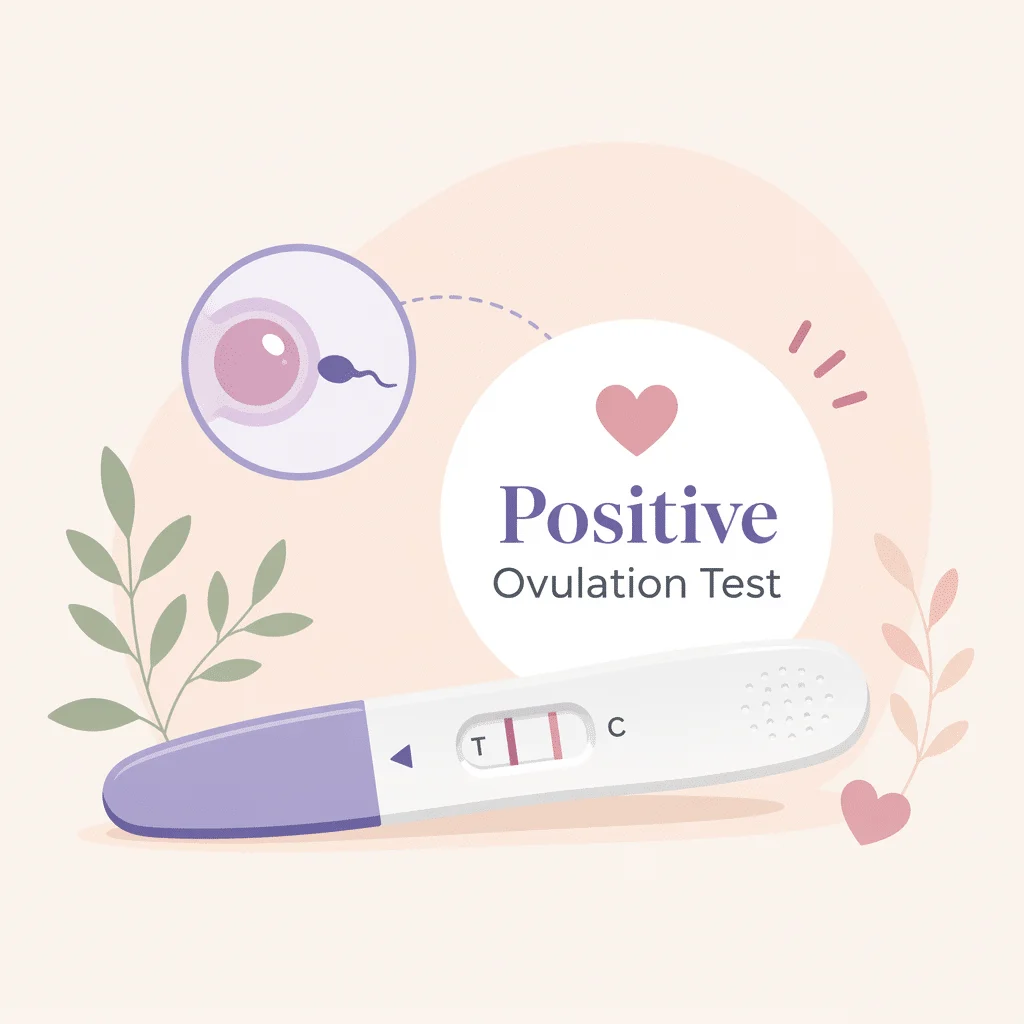
A positive ovulation test is one of the few moments in a cycle that feels like plain information: the second line is dark, or the digital screen changes, and it seems as though your body has finally said something clear. What the result actually tells you is narrower than the box suggests. It says that luteinizing hormone (LH) has risen in your urine. It does not say that an egg has been released.
That distinction is the single most common misunderstanding about these kits, and it explains a great deal of the frustration people describe after months of testing.
In this article you’ll learn what an ovulation predictor kit measures, why the test line has to be as dark as the control line, what a positive does and does not confirm, how to time intercourse around the fertile window, why some people get positives that never line up with ovulation, how ovulation is actually confirmed, and when it is reasonable to stop testing and ask for an evaluation.
What an ovulation test actually measures
An ovulation predictor kit, usually shortened to OPK, is a urine test for luteinizing hormone. LH is released by the pituitary gland at the base of the brain. Through most of the cycle it sits at a low background level. Shortly before ovulation it rises sharply, and that rise is what the strip is designed to catch.
Two consequences follow, and both shape how your results should be read.
First, an OPK measures a signal sent from the brain, not an event in the ovary. The surge is an instruction. Whether the ovary carries it out is a separate question that a urine strip cannot answer.
Second, because LH is always present at some level, a faint line is normal and expected. That is why ovulation tests are read differently from pregnancy tests, and why so many of them are misread.
If LH has also been measured in your blood as part of a workup, that is a different test, with laboratory units and reference ranges that shift across the cycle. Our guide to the luteinizing hormone blood test covers those numbers in detail. This article stays with the strip in your bathroom.
How to read a positive ovulation test: the control line rule
On a pregnancy test, any visible test line counts, however faint, because the hormone it detects should not be there at all outside pregnancy.
An ovulation test works the other way round. LH is always present, so a visible line on its own means nothing. The test line has to be as dark as the control line, or darker, before the result counts as positive.
A line that is present but lighter than the control is a negative result. It is not almost positive, and it is not a reason to stop testing. It usually means the surge has not started yet, or has already passed.
Digital kits make that comparison internally and show a symbol instead, which removes the judgment call but also hides how close you were.
Where readings commonly go wrong
Reading the strip outside the time window printed in the leaflet. Lines darken as a test dries, and a result read an hour later is not the result.
Testing with very dilute urine. Drinking a lot of fluid in the hours beforehand can weaken the line enough to hide a real surge. Many people find late morning to early evening more reliable than first thing.
Testing once a day when the surge is short. Some surges last well under a day, and once-daily testing can step straight over them.
Comparing photographs. Lighting and camera processing change how dark a line looks. Judge the strip in daylight, in your hand.
| What you are seeing | What it usually means | What to do |
|---|---|---|
| Test line clearly lighter than the control line | Background LH only; the surge has not started, or has already passed | Keep testing at the same time each day; add a second daily test around the expected surge |
| Test line as dark as, or darker than, the control line | An LH surge has been detected | Treat the past few days and the next two as your best window; ovulation usually follows within about 12 to 36 hours |
| Positive several days in a row | A long or stepped surge, a second LH peak, or a persistently raised baseline | Note the first positive day and use it; if this repeats every cycle, mention it at your next appointment |
| Positives most days, every cycle, with no change in your periods | Often chronically raised LH, as in PCOS; the strip is not tracking ovulation for you | Ask for an assessment rather than buying more strips; OPKs are unreliable in this situation |
| A positive ovulation test with a late period | Possible cross-reaction with hCG in early pregnancy | Take a pregnancy test; if it is negative and your period stays away, speak to a clinician |
| No positive at any point across a full cycle | The surge was missed, was short, or did not occur | Widen the testing window for one or two more cycles, then ask for an evaluation |
What a positive ovulation test does and does not confirm
This is the part most packaging leaves out, and it is the most useful thing on this page.
A positive ovulation test confirms one thing: an LH surge has been detected in your urine. Ovulation usually follows roughly 12 to 36 hours later.
The word usually is doing real work in that sentence. An LH surge can happen without an egg being released. The follicle can respond to the signal, produce the hormones of the second half of the cycle, and still fail to rupture, a pattern known as a luteinized unruptured follicle. From the outside, and on a strip, that cycle can look entirely ordinary.
A positive also cannot tell you that the egg was mature, that a tube was open, or that anything downstream went as it should.
None of this makes ovulation tests useless. Predicting the fertile window before it closes is exactly what they are for, and no other home method does that as directly. But prediction and confirmation are different jobs, and the strip only does the first. Confirmation comes from a sustained basal body temperature rise or a mid-luteal progesterone blood test, covered further down this page.
One more thing follows, and it is worth stating plainly: ovulation tests are not a method of contraception. They cannot tell you which days are safe, they miss short surges, and sperm survive in the reproductive tract for several days before any surge is detected. If you are trying to avoid pregnancy, use a method designed for that purpose.
Timing intercourse and the fertile window
The fertile window is roughly the five days before ovulation plus the day of ovulation itself. It is lopsided for a simple biological reason: sperm can survive in the reproductive tract for several days, while the egg is viable for less than a day after release.
That asymmetry has a practical consequence which often gets lost. Waiting for a positive before starting to try removes most of the window. By the time the test turns positive, the most fertile days are already partly behind you.
In practice, the highest-yield approach is intercourse every day or two through the days leading up to the expected surge, continuing on the day of the positive and the day after.
Two or three cycles of testing usually show roughly when your surge arrives. After that, many people stop testing daily and simply cover the same stretch of the cycle, which costs less and takes up less of the month.
Other signs move with the same window. Cervical mucus typically becomes clearer and more stretchy in the days beforehand, and some people notice light mid-cycle spotting or mid-cycle nausea. These are supporting information, not proof.
When ovulation tests mislead
Some of the most distressing testing experiences come from situations where the strip is working exactly as designed and still tells you nothing useful.
PCOS
Polycystic ovary syndrome is the most common reason for ovulation tests that never quite make sense. In PCOS, baseline LH is often chronically raised. The strip compares your LH against a fixed threshold, so a high baseline can produce a positive, or a run of positives, in cycles where no egg is released.
People describe testing positive for a week, or positive nearly every day, and then nothing happening. That is a common experience, it is not a mistake you made, and more strips will not resolve it. Related markers include testosterone in women and 17-OH progesterone, and our guide to PCOS symptoms, causes and tests sets out how the diagnosis is usually approached.
Perimenopause and reduced ovarian reserve
As ovarian reserve falls, the pituitary pushes harder, and baseline LH and FSH both drift upward. A higher baseline crosses the strip’s threshold more easily, producing positives that do not correspond to ovulation. Cycles in this phase are also less predictable from one month to the next.
Pregnancy and trigger injections
LH and human chorionic gonadotropin (hCG) are structurally similar, and ovulation tests can cross-react with hCG. An ovulation test can therefore turn positive in early pregnancy, and it will turn positive after a trigger injection given during fertility treatment.
If you have a positive ovulation test and your period is late, take a pregnancy test. An OPK is not a substitute for one. Our article on a period that is five days late goes through the other possibilities.
Multiple peaks, short surges and dilute urine
Some cycles produce more than one LH peak, only one of which precedes ovulation, so a positive followed days later by another positive is not necessarily a contradiction. Short surges can be missed entirely by once-daily testing. And heavy fluid intake dilutes urine enough to soften a genuine positive into a near-miss.
How ovulation is actually confirmed
Confirmation always comes after the fact, because it depends on what the ovary does once the egg has gone.
Basal body temperature
After ovulation, progesterone from the corpus luteum raises resting body temperature slightly. Taken at the same time each morning before getting up, a small rise sustained for about three days suggests ovulation occurred. It tells you nothing in advance, which is why temperature charts and OPKs are often used together rather than instead of one another.
Mid-luteal progesterone
The more definitive test is a blood progesterone level drawn around seven days after presumed ovulation. That is often called a day 21 test, but what matters is seven days before your next period is due, which is a different day if your cycles are longer or shorter than 28 days. A clearly raised level indicates that a corpus luteum formed, and a corpus luteum forms after an egg is released.
When ovulation is being investigated, this is usually taken alongside markers such as estradiol, TSH and prolactin, because thyroid disease and raised prolactin are treatable causes of absent ovulation. Ultrasound tracking in a clinic can also show a follicle present on one scan and gone on the next.
Interpretation belongs with your clinician, because the timing relative to your own cycle changes what a number means. The MedlinePlus entry on ovulation home tests makes the same point about home kits.
What it means if you never get a positive
A full cycle of negatives is not a verdict, and that is worth saying before anything else.
The most likely explanations are practical. You may have started testing too late, stopped too early, tested once a day and stepped over a short surge, or tested with very dilute urine. Cycles vary in length between people and within the same person, and a surge that arrives on day 12 one month may arrive on day 19 the next.
A reasonable next step is to widen the window: start a few days earlier than you think you need to, and test twice a day around the expected time for one or two cycles.
If several cycles pass with no positive at all, that is useful information rather than a failure. Absent or very irregular ovulation has causes that are identifiable and often treatable, including thyroid disease, raised prolactin and PCOS. A fertility blood panel is usually where that conversation starts.
Testing indefinitely, month after month, rarely adds information at that point. It mostly adds cost and strain.
When to seek help
The usual thresholds, as set out by the US Office on Women’s Health and consistent with ACOG and ASRM guidance, are straightforward.
If you are under 35 and have been trying to conceive for 12 months without success, that is the point at which an evaluation is recommended. If you are 35 or over, the threshold is 6 months, because time carries more weight.
Those figures are not a judgment about anything you have or have not done. They are simply the points at which an assessment is more useful than more waiting.
Earlier assessment is appropriate if your periods are absent or very irregular, if you have known endometriosis, if you have had pelvic surgery or a pelvic infection, if periods are severely painful, if there have been repeated miscarriages, or if there is a known male-factor issue.
You are also allowed to ask sooner simply because the not knowing is hard to carry. That is a legitimate reason to be seen.
| When to speak to a clinician |
|---|
| You are under 35 and have been trying to conceive for 12 months, or you are 35 or over and have been trying for 6 months |
| Your periods are absent, very irregular, or have changed noticeably |
| You get positive ovulation tests repeatedly, cycle after cycle, with no sign that ovulation has occurred |
| Period pain is severe, or you have known endometriosis, previous pelvic surgery, or a previous pelvic infection |
| There is a known male-factor issue, or a history of testicular surgery, injury or infection in your partner |
| You have a positive ovulation test and a late period: take a pregnancy test first, then seek advice |
Latest scientific advances in ovulation testing
According to studies indexed in PubMed, research since 2023 has focused on how well home tests match what is happening in the body, and on who the current tests were never designed for.
A prospective study at a Boston fertility center compared five widely available one-step ovulation predictor kits against daily blood LH measurements in monitored cycles. The kits agreed closely with the blood results and performed similarly to one another, regardless of price, although some were slightly better than others at catching a surge that was present.
What this means for you: an expensive kit is not buying you accuracy. If surges are being missed, when and how often you test is the more likely explanation.
A feasibility study run through Massachusetts General Hospital and Harvard set out to develop a saliva-based, AI-read ovulation test for people with irregular cycles and PCOS. Its starting premise is telling: most over-the-counter kits rely on urinary LH and were optimized for people with regular cycles and a predictable mid-cycle surge. The researchers also noted that some participants stepped away from the study because of the distress of watching cycles without ovulation.
What this means for you: if your cycles are irregular or you have PCOS, standard OPKs were not built around your situation. That is a limitation of the tool, not a shortcoming on your part.
A validation study in North American women compared two quantitative at-home urinary hormone monitors, which measure LH and an estrogen metabolite as numbers rather than lines, during the postpartum and perimenopausal transitions. The two devices identified the day of the LH surge consistently with each other.
What this means for you: quantitative monitors can follow a surge through these less predictable phases, but they still identify a surge, not a released egg.
A review in Seminars in Reproductive Medicine surveyed the wider field of digital ovulation detection, including cycle apps, wearables that track temperature and heart rate, and urine or saliva hormone devices. It frames ovulation as a health sign in its own right, shaped by thyroid hormones, prolactin and androgens.
What this means for you: when no surge ever appears, checking thyroid, prolactin and androgen markers is usually more informative than another box of strips.
Finally, a study using data from thousands of natural cycles built a machine-learning model to schedule insemination or timed intercourse. It performed well precisely because it combined estradiol, progesterone and LH rather than relying on the LH surge alone.
What this means for you: even in clinics with daily blood tests, the surge is one input among several. That is a good reason not to treat a single home positive as the whole story.
Glossary of key terms
| Term | Definition |
|---|---|
| Anovulation | A cycle in which no egg is released, even though bleeding may still occur |
| Basal body temperature | Resting body temperature taken at the same time each morning before getting up |
| Control line | The reference line on a test strip that shows the test ran correctly, and against which the test line is compared |
| Corpus luteum | The structure left behind after an egg is released, which produces progesterone |
| Fertile window | The roughly five days before ovulation plus the day of ovulation itself |
| hCG | Human chorionic gonadotropin, the pregnancy hormone, which is similar enough to LH to cross-react with some ovulation tests |
| LH surge | The sharp rise in luteinizing hormone that normally precedes ovulation by about 12 to 36 hours |
| Luteinized unruptured follicle | A follicle that responds to the LH surge and produces luteal hormones but does not release the egg |
| Mid-luteal progesterone | A blood test taken about seven days after presumed ovulation, used to check whether ovulation occurred |
| Trigger injection | An hCG or LH-based injection used in fertility treatment to prompt ovulation, which turns ovulation tests positive |
Frequently asked questions
Does a positive ovulation test mean I ovulated?
No. A positive means an LH surge was detected in your urine, and ovulation usually follows within about 12 to 36 hours. It is not confirmation that an egg was released. A surge can occur without rupture of the follicle, and the strip has no way of telling the difference. If you need to know whether ovulation actually happened, the two usual methods are a sustained basal body temperature rise afterwards, or a progesterone blood test taken about seven days after the presumed ovulation. Both look backwards, which is why they complement ovulation tests rather than replacing them.
Can an ovulation test be positive if I am pregnant?
Yes. LH and hCG are structurally similar, and ovulation tests can cross-react with hCG. That means an ovulation test may turn positive in early pregnancy, and it will turn positive after a trigger injection used in fertility treatment. An ovulation test is not a pregnancy test and should never be used as one, because it is not designed for that hormone and the result cannot be interpreted reliably. If your period is late and an ovulation test is positive, take a proper pregnancy test.
Why do I get positive ovulation tests almost every day?
The most common reason is a chronically raised baseline of LH, which is characteristic of PCOS. Because the strip compares your LH against a fixed threshold rather than against your own normal, a high baseline can register as positive repeatedly in cycles where no egg is released. Rising baseline LH in perimenopause or with reduced ovarian reserve can do the same. This is frustrating and it is not something you are doing wrong. If it happens cycle after cycle, an assessment will tell you more than continuing to test.
Can I use ovulation tests to avoid getting pregnant?
No, and this is important. Ovulation predictor kits are not a contraceptive method and are unreliable for avoiding pregnancy. Sperm can survive for several days, so the fertile window opens well before any surge is detectable. Surges can also be short, missed, or mistimed. By the time a test turns positive, the days on which conception was most likely may already have passed. If you are trying to avoid pregnancy, speak to a clinician or pharmacist about a method designed for that purpose.
What does a faint line on an ovulation test mean?
A faint line is a negative result. LH is present in urine throughout the cycle, so a light line simply reflects that background level. It means the surge has not begun, or has already finished. It is worth continuing to test, ideally twice a day around the time you expect the surge, because the change from faint to fully dark can happen within hours. Very dilute urine also lightens lines, so avoid drinking large amounts of fluid in the hours before testing.
How many days after a positive should we have intercourse?
The day of the positive and the following day are the highest-value days after a positive appears. But the window opened before that. Because sperm survive several days and the egg does not, intercourse every day or two through the days leading up to the expected surge covers more of the fertile window than waiting for the test to change. If you have been timing everything precisely around a positive and it has not worked, that timing pattern is worth revisiting with a clinician rather than tightening further.
Sources
- MedlinePlus, US National Library of Medicine. Ovulation home test. https://medlineplus.gov/ency/article/007062.htm
- Office on Women’s Health, US Department of Health and Human Services. Infertility. https://womenshealth.gov/a-z-topics/infertility
- Eunice Kennedy Shriver National Institute of Child Health and Human Development (NICHD). What are some possible causes of female infertility? https://www.nichd.nih.gov/health/topics/infertility/conditioninfo/causes/causes-female
- Vanderhoff AC, Lanes A, Waldman I, Ginsburg E. Similar accuracy and patient experience with different one-step ovulation predictor kits. Fertility and Sterility, 2025. https://doi.org/10.1016/j.fertnstert.2024.09.031
- Peebles E, Finlay W, Nguyen TM, Barrett S, Thirumalaraju P, Kanakasabapathy MK, Kandula H, Sarcione C, James KE, Shafiee H, Mahalingaiah S. Digitally enabled AI-interpreted salivary ferning-based ovulation prediction: feasibility study. Journal of Medical Internet Research, 2025. https://doi.org/10.2196/73028
- Bouchard TP, Doyle-Baker PK, Yong PJ, Fehring R, Schneider M. Validating at-home urinary hormone measurements in postpartum and perimenopause fertility transitions. Women’s Health Reports, 2025. https://doi.org/10.1089/whr.2024.0157
- Shkodzik K. Innovative approaches to digital health in ovulation detection: a review of current methods and emerging technologies. Seminars in Reproductive Medicine, 2024. https://doi.org/10.1055/s-0044-1793829
- Youngster M, Luz A, Baum M, Hourvitz R, Reuvenny S, Maman E, Hourvitz A. Artificial intelligence in the service of intrauterine insemination and timed intercourse in spontaneous cycles. Fertility and Sterility, 2023. https://doi.org/10.1016/j.fertnstert.2023.07.008
Further reading
- Luteinizing hormone (LH): understanding your blood results
- PCOS: symptoms, causes, diagnosis and tests
- Fertility blood test: what is measured and why
- FSH (follicle-stimulating hormone) blood test
- Ovulation spotting: causes and symptoms
Understand your lab results with AI DiagMe
If ovulation is being investigated, you may end up holding a page of numbers: LH, FSH, progesterone, TSH, prolactin. AI DiagMe turns those results into plain language so you can see what each marker is measuring and what questions to bring to your appointment. It helps you understand your results. It does not diagnose infertility, it does not confirm that ovulation occurred, and it does not replace your doctor.
Get your results interpreted in minutes