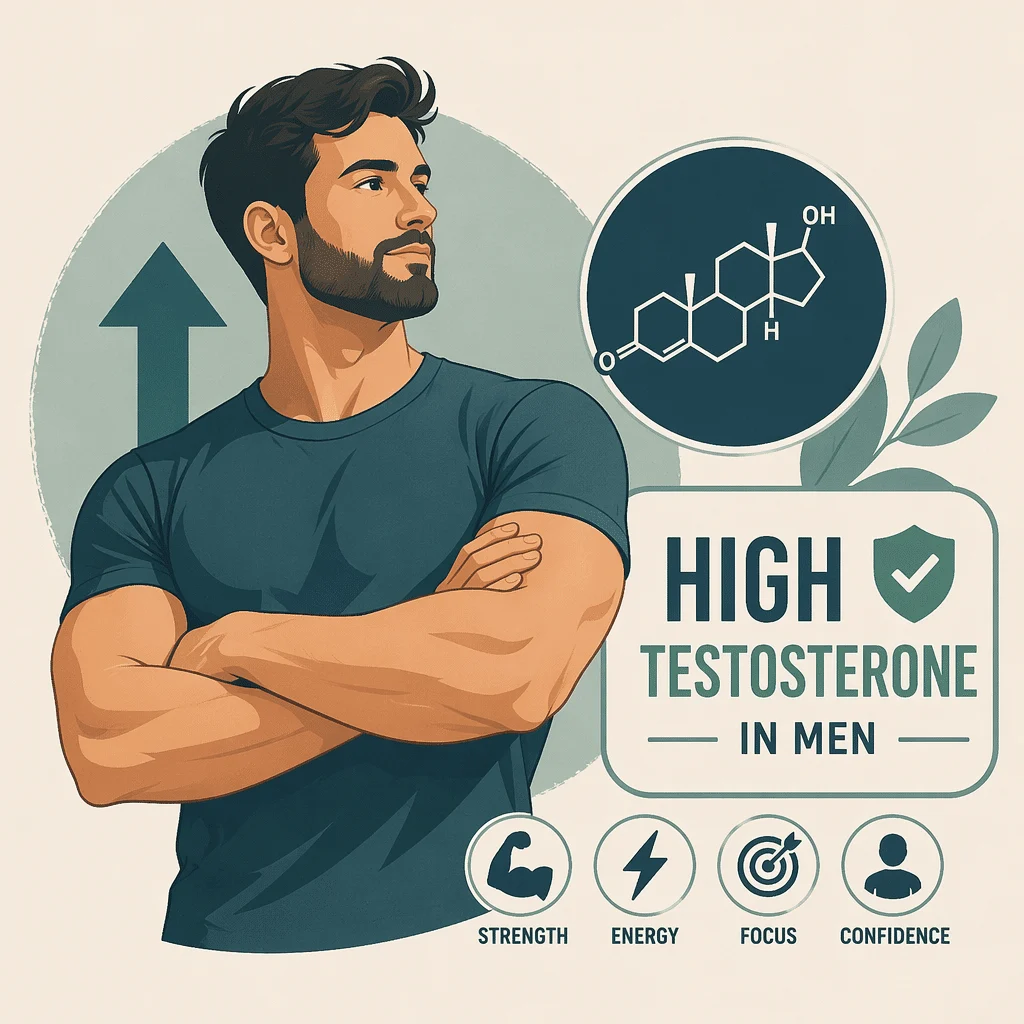
Ett förhöjt testosteronvärde kommer som en överraskning för de flesta män. Högt testosteron hos män är ovanligt när man inte tar något utifrån, och det enda faktum formar allt som följer. När en mans testosteron verkligen ligger över referensintervallet beror det i överväldigande majoritet av fallen på att androgen har tillförts utifrån: ett recept, en klinik för mäns hälsa eller ett preparat köpt för träning. Orsaker som kommer inifrån kroppen finns, men de är sällsynta.
I den här artikeln får du lära dig vad ett högt värde faktiskt innebär på ett provsvar, hur två andra hormoner berättar var testosteronet kommer ifrån, vilka effekter som är viktigast och varför fertiliteten kommer i första hand, vad som händer om man slutar abrupt, och hur du kan ha ett rakt samtal med din läkare.
Vad testosteron gör, och vad ett “högt” värde på ditt provsvar innebär
Testosteron är det viktigaste androgenhormonet hos män. Det produceras främst av Leydigcellerna i testiklarna, på instruktion från hjärnan, och det stödjer muskler och skelett, produktionen av röda blodkroppar, sexuell lust och utvecklingen av manliga könskaraktäristika under puberteten. Ett vanligt blodprov för testosteron mäter totalt testosteron, det vill säga allt som cirkulerar i blodet – både bundet och fritt.
“Högt” betyder helt enkelt att värdet ligger över den övre gräns som ditt laboratorium skriver ut bredvid resultatet. Den gränsen är inte universell. Referensintervall skiljer sig åt mellan laboratorier och metoder, och ett värde som flaggas på ett lab kan ligga inom normalintervallet på ett annat. Ett resultat som ligger lite över gränsen betyder i sig långt mindre än vad de flesta män tror.
Varför ett enstaka högt värde sällan är hela historien
Testosteron följer en tydlig daglig rytm – det når sin topp tidigt på morgonen och sjunker sedan under dagen. MedlinePlus rekommenderar att provet tas mellan kl. 07.00 och 10.00, och ett resultat som inte stämmer med den kliniska bilden upprepas normalt en andra morgon innan någon åtgärd vidtas.
Könshormonbindande globulin, eller SHBG, komplicerar siffran ytterligare. Det binder merparten av testosteronet i blodet, så allt som höjer SHBG ökar det totala testosteronet utan att förändra hur mycket hormon dina vävnader faktiskt kan använda. Det är därför fritt eller biotillgängligt testosteron ibland beräknas parallellt med det totala. Metoden spelar också roll: äldre immunoassays är mindre noggranna vid extremvärden än masspektrometri, som vanligtvis anges som LC-MS/MS i provsvaret.
Allt detta gäller även i den andra riktningen, och skälen till varför ett lågt värde behöver bekräftas tas upp separat i vår guide om lågt testosteron hos män.
Hur LH och FSH visar var testosteronet kommer ifrån
Det här är den del som nästan ingen konsumentartikel förklarar, och det är det enskilt mest användbara att förstå om ett högt resultat.
Dina testiklar producerar inte testosteron på eget initiativ. De får en signal om att göra det, av luteiniserande hormon (LH) från hypofysen, med follikelstimulerande hormon (FSH) som driver spermieproduktionen parallellt. Systemet styrs av återkoppling: när testosteronet är högt dämpar hjärnan LH och FSH.
Om testosteron tillförs utifrån svarar hypofysen med att stänga av sina egna signaler. Det ger ett omöjligt att missa mönster. Högt testosteron med lågt, supprimerat LH och FSH innebär att hormonet kommer från en annan källa än dina egna testiklar. Högt testosteron med LH som är högt eller fortfarande normalt innebär att din egen kropp producerar det, vilket i stället pekar mot testiklarna, binjurarna eller hypofysen.
När du vet det brukar en förvirrande uppsättning siffror förklara sig själv.
| Mönster i dina provsvar | Vad det vanligtvis betyder | Vad man ska göra |
|---|---|---|
| Högt testosteron med lågt (supprimerat) LH och FSH | Testosteronet kommer utifrån: förskriven behandling, en klinikprodukt eller ett anabolt steroid | Berätta för läkaren exakt vad du har tagit, och sluta inte med något på egen hand |
| Högt testosteron med högt eller normalt LH | Din egen kropp producerar det, vilket pekar mot testiklarna, binjurarna eller hypofysen | Förvänta dig ett nytt morgonprov och ofta bilddiagnostik eller remiss till endokrinolog eller urolog |
| Högt testosteron med stigande hematokrit | Blodet blir mer koncentrerat, vilket ökar risken för blodpropp | Be om att hematokritet kontrolleras om och granskas av den som förskriver eller övervakar behandlingen |
| Högt testosteron med ömhet eller svullnad i brösten | En del av testosteronet omvandlas till östrogen | Be om en bröstundersökning och ett estradiolprov; varje ny ensidig knöl behöver utredas |
| Högt testosteron hos en pojke | Möjlig tidig (för tidig) pubertet, eller en hormonsecernerande tumör | Kräver barnläkarbedömning utan dröjsmål – inte ett avvakta-och-se-förhållningssätt |
De externa källorna: recept, kliniker, steroider och kosttillskott
Att gruppera dessa tillsammans är inget moraliskt ställningstagande. De gör alla samma sak med hormonaxeln och ger alla samma mönster med sänkt LH.
Förskriven testosteronbehandling
Testosteronbehandling höjer nivån avsiktligt. Ett resultat över referensintervallet under pågående behandling beror vanligtvis på ett av två saker: nivån är genuint högre än målvärdet, eller provet togs vid fel tidpunkt i doseringsintervallet, vilket kan ge ett toppvärde som ser alarmerande ut men inte är det. Oavsett vilket är svaret ett samtal med den som förskriver behandlingen – inte en förändring du gör på egen hand. The US Food and Drug Administration konstaterar att testosteronpreparat är godkända för män med lågt testosteron i kombination med ett associerat medicinskt tillstånd, och att uppföljning är en del av behandlingen snarare än ett valfritt tillägg.
Direktkliniker och hormon“optimering”
Nätbaserade hälsotjänster för män och “optimeringskliniker” har gjort testosteron betydligt lättare att få tag på än tidigare. Vissa är noggranna. Andra förskriver utifrån ett enda provsvar, eller enbart utifrån symtom, och följer upp löst efteråt. Om ditt testosteron är högt och du får behandling via en tjänst som varken har upprepat dina grundläggande prover eller kontrollerat ditt blodvärde, är det värt att ta upp med din egen läkare, som kan se hela bilden.
Anabola androgena steroider, SARM och hCG köpta online
Anabola androgena steroider är syntetiska släktingar till testosteron som används för träning, styrka eller kroppsform. The National Institute on Drug Abuse grupperar dem med andra prestations- och utseendeförbättrande preparat och beskriver det breda spektrum av effekter de ger i kroppen. Selektiva androgenreceptormodulatorer (SARM) och humant koriongonadotropin (hCG) säljs också i stor utsträckning online.
Två praktiska punkter är viktigare än något varumärke. För det första är dessa produkter inte reglerade, och analyser visar upprepade gånger att innehållet inte stämmer överens med etiketten. För det andra, oavsett vad etiketten säger, om ämnet verkar som ett androgen kommer det att hämma LH och FSH, och de konsekvenser som beskrivs nedan följer.
Receptfria “testosteronhöjare”
Bevisen för att receptfria testosteronhöjare verkligen ökar testosteronet är svaga. Det mer konkreta problemet är föroreningar: FDA har konstaterat att vissa produkter som marknadsförs för muskelbyggande olagligt innehåller steroider eller steroidliknande ämnen, ibland utan att det nämns på etiketten, och har kopplat dem till rapporter om allvarliga leverskador. En man kan därför få en verkligt undertryckt hormonaxel utan att medvetet ha tagit en steroid.
De ovanliga orsakerna, när kroppen själv producerar för mycket
När LH inte är undertryckt riktas sökningen inåt, och listan är kort.
Androgensekretoriska tumörer i testiklarna, oftast Leydigcelltumörer, kan producera testosteron oberoende av hypofysen; en knöl eller asymmetri i en testikel är det vanliga tecknet och behöver alltid undersökas. Binjuretumörer kan utsöndra androgener på samma sätt, vilket är anledningen till att binjureröntgen och relaterade hormontester ibland följer.
Kongenital binjurehyperplasi är ett ärftligt enzymproblem som styr binjurens steroidproduktion in på androgenvägen. Mildare former kan gå oupptäckta in i vuxen ålder, och 17-OH-progesteron är det test som vanligtvis väcker frågan. Hos kvinnor yttrar sig samma tillstånd på ett annat sätt, vilket tas upp i vår artikel om högt testosteron hos kvinnor.
Hos pojkar är ett testosteronvärde i vuxenintervallet en helt annan sak. Tillsammans med tidig pubesbehåring, kroppsdoft, tillväxtacceleration eller förstoring av testiklarna tyder det på förtidig pubertet och kräver barnläkarbedömning snarare än lugnande besked.
Vad högt testosteron gör med kroppen, med start i fertiliteten
Fertilitet: den risk som män sällan varnas för
Testosteron som tillförs utifrån fungerar som ett manligt preventivmedel. Genom att stänga av LH och FSH sänker det testosteronkoncentrationen inne i testikeln, vilket är det som faktiskt driver spermieproduktionen. Spermieantalet sjunker, ofta till noll. Det här är inte en sällsynt biverkning – det är den förväntade farmakologin.
Spermieproduktionen återupptas vanligtvis efter avslutad behandling, men tidsförloppet räknas i månader snarare än veckor, varierar enormt mellan individer och är inte garanterat. Många män får aldrig veta något av detta och upptäcker det under fertilitetsutredningar år senare. Om barn är en möjlighet nu eller i framtiden hör det samtalet hemma innan det första receptet skrivs ut – inte efter ett nedslående FSH resultat och spermieanalys.
Stigande hematokrit och risken för blodproppar
Testosteron stimulerar produktionen av röda blodkroppar. När det går för långt uppstår erytrocytos, och det praktiska måttet på det är hematokrit, andelen av ditt blod som består av röda blodkroppar. Tjockare blod flödar sämre och ökar risken för blodproppar i vener och lungor. Det är just därför hematokrit kontrolleras vid ett fullständig blodstatus före och under testosteronbehandling, och det är ett av de mest användbara värdena att titta på vid sidan av ett högt testosteron.
Andra effekter värda att känna till
Testiklarna krymper, eftersom signalen som säger åt dem att arbeta har dragits tillbaka. Akne och oljig hud är vanligt. En del testosteron omvandlas till östrogen av enzymet aromatas, vilket kan orsaka ömhet i brösten och gynekomasti. Befintlig sömnapné kan förvärras. Irritabilitet, humörsvängningar och störd sömn rapporteras ofta, och ärftligt håravfall kan accelerera hos män som redan är predisponerade för det.
Vid de högre exponeringsnivåer som ses vid användning av anabola steroider breddas bilden. Hjärtmuskeln kan förtjockas och försvagas, en förändring som kallas kardiomyopati. Blodfetterna förändras på ett ogynnsamt sätt, vilket är anledningen till att ett kolesterolförhållandet är värt att följa upp. Orala 17-alfa-alkylerade föreningar är i synnerhet förknippade med leverskada, så leverfunktionstester ingår i en förnuftig uppföljning. Intensiv träning höjer också CPK, vilket kan försvåra tolkningen om inte läkaren vet vad du har gjort.
Att sluta, och varför det måste ske under medicinsk tillsyn
Det här är den viktigaste säkerhetsraden i den här artikeln: sluta inte abrupt på egen hand.
Efter en längre period med exogena androgener har din egen produktion stängts av, och den slår inte på igen i samma ögonblick som tillförseln upphör. Det som följer är en hypogonadal krasch: nedstämdhet, svår trötthet, minskad sexlust och dålig sömn, ofta under många månader. Det är genuint svårt att ta sig igenom, och det är ett av de vanligaste skälen till att män börjar igen. FDA varnar specifikt för abstinensproblem vid snabbt avslutande av sådana produkter.
Läkare har sätt att hantera detta. Övervakad utsättning, uppföljning av symtom och hormonnivåer, och i utvalda fall läkemedel ur klasserna gonadotropiner och selektiva östrogenreceptormodulatorer används för att stödja återhämtningen av kroppens egen produktion eller fertilitet. Hur det ser ut i praktiken beror helt på individen, och att välja dessa åtgärder är ett medicinskt beslut – inte ett som du fattar på egen hand. Det viktigaste att ta med sig är helt enkelt att det finns en plan och att det är värt att fråga om den.
Att prata med din läkare, och när du ska söka hjälp omedelbart
De flesta män som använder anabola steroider vet precis hur läkaren troligtvis kommer att reagera, så de säger ingenting. Den tystnaden är den verkliga faran, eftersom den tar bort den enda information som förändrar hur ett provsvar tolkas och hur säkert någon kan följas upp.
En läkare som vet vad du tar kontrollerar rätt saker: hematokrit, leverenzymer, blodfetter, blodtryck och ett spermaprov om fertiliteten är viktig för dig. En läkare som inte vet det tvingas utreda ett oförklarat hormonvärde, vilket slösar månader och missar de risker som faktiskt finns. Du har rätt till ett sakligt samtal, och det kan du säga rakt ut. Om en läkare svarar med en föreläsning i stället för en plan är det ett skäl att byta läkare – inte ett skäl att sluta berätta.
Ta med en tidslinje: vad du har tagit, hur länge, när du senast tog det och var i förhållande till det provtagningen gjordes.
Varningssignaler: sök hjälp omedelbart – vänta inte på ett vanligt besök.
- Bröstsmärta, plötslig andnöd eller smärta och svullnad i ena vaden: ring 112, eftersom det kan vara tecken på en blodpropp.
- Plötslig svår huvudvärk, synförändringar eller svaghet eller domning på ena sidan av kroppen.
- En ny knöl, hårdhet eller svullnad i en testikel: detta behöver bedömas skyndsamt.
- Gulfärgning av ögon eller hud, mörk urin eller svår buksmärta.
- Tankar på att skada dig själv, eller en kraftig förändring i humöret: kontakta en läkare eller ring Självmordslinjen på 90101, dygnet runt.
- Tecken på tidig pubertet hos en pojke, till exempel könshår, kroppsdoft eller en tillväxtspurt långt före förväntad ålder.
Senaste vetenskapliga framsteg inom testosteronprovtagning
Följande studier har identifierats via PubMed. Varje studie sammanfattas på ett lättförståeligt sätt, med vad den betyder för dig.
En dansk registerstudie publicerad i Circulation 2025 följde män som sanktionerades för anabolasteoidanvändning på gym under ungefär elva år och jämförde dem med matchade män från befolkningen i övrigt. Steroidanvändarna hade markant högre förekomst av hjärtinfarkt, venösa blodproppar, arytmier och hjärtsvikt, med den största skillnaden av alla för kardiomyopati – en försvagning av hjärtmuskeln. Vad detta betyder för dig: hjärteffekterna är inte teoretiska eller begränsade till extremfall. Tillförlitlighetsnotering: sanktionerade användare representerar kanske inte alla som använder dessa preparat, och en registerstudie visar samband snarare än bevis på orsakssamband.
En genomgång från 2025 i Endocrine Connections undersökte erytrocytos orsakad av testosteron. Den konstaterar att de män som i dag oftast ordineras testosteron är äldre och mer benägna att ha fetma, högt blodtryck, diabetes eller njursjukdom, och att flera andra vanligt förskrivna läkemedel också höjer hematokritet i samma riktning. Vad detta betyder för dig: om ditt hematokrit stiger är svaret att en läkare gör en samlad genomgång av hela läkemedelsbilden – inte en förändring du gör på egen hand – och regelbunden åderlåtning är inte standardsvaret.
En klinikervägledning från 2025 i Asian Journal of Andrology behandlade azoospermi – det vill säga avsaknad av spermier i sädesvätskan – orsakad av exogent testosteron eller anabola steroider. Den bekräftar att dessa medel hämmar hormonaxeln och sänker testosteronnivåerna inne i testiklarna, att spontan återhämtning är vanlig efter utsättning och mer sannolik vid kortare exponering, samt att gonadotropin- och selektiv östrogenreceptormodulator-behandlingar används av specialister när återhämtningen stannar av. Vad detta innebär för dig: tillståndet är ofta reversibelt, men tidsförloppet är oförutsägbart – vilket är precis varför fertilitet bör diskuteras tidigt.
En genomgång från 2025 i Frontiers in Endocrinology undersökte män vars egen hormonproduktion inte återhämtar sig efter att de slutat med androgener. De flesta män återhämtar sig, men en del förblir hypogonadala i månader eller år, och författarna föreslår ett formellt namn och en definition för detta mönster så att det kan diagnostiseras och studeras på rätt sätt. Vad detta innebär för dig: en lång, platt period efter utsättning är ett erkänt kliniskt tillstånd snarare än ett personligt misslyckande, och det är ett skäl att följas upp av en läkare i stället för att börja om på egen hand.
En genomgång från 2024 i Annals of the New York Academy of Sciences sammanfattade hälsoeffekterna av androgenanvändning hos män med avseende på hjärta, fertilitet, hormonaxel, lever och psykisk hälsa. Den lyfter fram att män ofta söker vård för konsekvenser år efter utsättning, att information om användningen ofta undanhålls, och att produkter från oreglerade källor kan vara förfalskade. Vad detta innebär för dig: att berätta exakt vad du har tagit för klinikern förändrar vad som testas och följs upp – och är det enskilt mest användbara du kan ta med dig till besöket.
Vanliga frågor
Kan testosteron göra mig infertil?
Ja. Testosteron som tillförs utifrån hämmar de signaler från hypofysen som driver spermieproduktionen, och spermieantalet sjunker ofta till noll. Det är tillräckligt effektivt för att ha studerats som manligt preventivmedel. Fertiliteten återkommer vanligtvis efter att man slutat, men återhämtningen tar månader, varierar mycket mellan män och är inte garanterad. Anabola steroider gör samma sak. Om du någon gång kan tänka dig att skaffa barn, ta upp det innan du påbörjar behandlingen snarare än efteråt, så att fertilitetsskyddande alternativ kan diskuteras och ett grundläggande spermaanalys övervägas.
Vad betyder högt testosteron med lågt LH?
Det betyder nästan alltid att testosteronet kommer utifrån, det vill säga från en extern källa. Din hypofys frisätter LH för att instruera testiklarna att producera testosteron, och den dämpar den signalen när testosteronet redan är rikligt. Så ett högt testosteron i kombination med ett lågt LH tyder på att hormonet inte har sitt ursprung i dina egna testiklar. I praktiken pekar det på förskriven testosteronbehandling, en produkt från en manshälsoklinik, eller ett anabolt steroid eller liknande preparat. Det ärliga svaret vid det besöket sparar en hel del onödig utredning.
Fungerar testosteronhöjande kosttillskott?
Bevisen för att receptfria testosteronhöjare ger någon kliniskt meningsfull effekt är svaga. Det större orosmomentet är vad de faktiskt innehåller. FDA har hittat produkter marknadsförda för muskelbyggande som olagligt innehåller steroider eller steroidliknande ämnen som inte deklareras på etiketten, och har kopplat dem till rapporter om allvarliga leverskador. Det innebär att ett sådant preparat kan ge ett genuint avvikande hormonvärde och verklig skada hos någon som trodde sig ta ett kosttillskott. Om du tar ett sådant preparat, ta med förpackningen till ditt läkarbesök.
Är naturligt högt testosteron hos män ett problem?
Genuint högt testosteron med normalt eller högt LH är ovanligt och utreds snarare än att antas vara ofarligt, eftersom orsakerna kan inkludera androgensekreterande tumörer i testiklar eller binjurar samt kongenital binjurebarkshyperplasi. Det sagt visar sig ett måttligt förhöjt värde hos en frisk man utan symtom, taget vid fel tidpunkt på dagen eller vid förhöjt SHBG, ofta vara utan betydelse när det upprepas korrekt. Skillnaden fastställs genom att upprepa provet och kontrollera LH – inte utifrån hur du mår.
Orsakar högt testosteron håravfall?
Det kan påskynda håravfall hos män som redan är genetiskt predisponerade. Testosteron omvandlas i hårbotten till dihydrotestosteron, eller DHT, vilket är det androgen som krymper känsliga hårfolliklar. Mer cirkulerande testosteron innebär mer substrat för den omvandlingen, vilket gör att manligt håravfall kan fortskrida snabbare. Män utan den genetiska känsligheten tappar i allmänhet inte hår på grund av ett högt värde. Håravfall är därför en ledtråd snarare än en diagnos, och det är värt att nämna tillsammans med allt du har tagit.
Kommer min nivå att återgå till det normala om jag slutar?
Vanligtvis, men inte omedelbart – och det är just det som överraskar många män. När det yttre tillskottet upphör måste den egna produktionen starta om från ett avstängt läge, och mellanperioden innebär trötthet, nedstämdhet och låg libido som kan pågå i många månader. En minoritet förblir hypogonadala under betydligt längre tid. Det är precis därför som ett avslut bör planeras tillsammans med en läkare som kan följa dig och stödja återhämtningen, snarare än att göras abrupt på egen hand.
Ordlista med nyckeltermer
| Kalla | Definition |
|---|---|
| Exogent testosteron | Testosteron som tillförs utifrån – antingen via recept eller på annat sätt – i stället för att produceras av testiklarna |
| LH (luteiniserande hormon) | Det hypofyshormon som signalerar till testiklarna att producera testosteron; det sjunker när testosteron tillförs utifrån |
| FSH (follikelstimulerande hormon) | Det hypofyshormon som stödjer spermieproduktionen; det hämmas av exogena androgener tillsammans med LH |
| SHBG | Könshormonbindande globulin – det protein som binder merparten av det cirkulerande testosteronet och påverkar totalvärdet uppåt eller nedåt |
| Erytrocytos | En alltför stor ökning av röda blodkroppar som gör blodet tjockare; mäts i praktiken med hematokrit |
| Azoospermi | Frånvaro av spermier i ejakulatet – en vanlig följd av exogent testosteron eller anabola steroider |
| Aromatisering | Omvandlingen av testosteron till östrogen via aromatasenzymet, vilket kan orsaka ömhet i brösten eller gynekomasti |
| Anabola androgena steroider | Syntetiska föreningar besläktade med testosteron, som används för att öka muskelmassa och styrka, och som hämmar kroppens egna hormonsignaler |
| Kongenital binjurebarkshyperplasi | En ärftlig enzymstörning som styr binjurarnas hormonproduktion mot androgener, och som ibland inte upptäcks förrän i vuxen ålder |
| LC-MS/MS | Vätskekromatografi med tandem-masspektrometri, den referensmetod som laboratorier använder för att mäta testosteron noggrant |
Källor
- National Institute on Drug Abuse. Anabola steroider och andra preparat för utseende och prestandaförbättring (APEDs)
- US Food and Drug Administration. Testosterone Information
- US Food and Drug Administration. Caution: Bodybuilding Products Can Be Risky
- MedlinePlus Medical Encyclopedia, US National Library of Medicine. Testosteron
- Windfeld-Mathiasen J, Heerfordt IM, Dalhoff KP, et al. Cardiovascular Disease in Anabolic Androgenic Steroid Users. Circulation. 2025;151(12):828-834. Identified via PubMed
- Tramontana F, Mohammed A, Mamoojee YH, Quinton R. Testosterone-induced erythrocytosis: addressing the challenge of metabolic syndrome and widely prescribed SGLT2-inhibitor drugs. Endocrine Connections. 2025;14(6). Identified via PubMed
- Al Hashimi M, Pinggera GM, Shah R, Agarwal A. Clinician’s guide to the management of azoospermia induced by exogenous testosterone or anabolic-androgenic steroids. Asian Journal of Andrology. 2025;27(3):330-341. Identified via PubMed
- van Os J, Smit DL, Bond P, de Ronde W. Prolonged post-androgen abuse hypogonadism: potential mechanisms and a proposed standardized diagnosis. Frontiers in Endocrinology. 2025;16:1621558. Identified via PubMed
- Grant B, Hyams E, Davies R, Minhas S, Jayasena CN. Androgen abuse: Risks and adverse effects in men. Annals of the New York Academy of Sciences. 2024;1538(1):56-70. Identified via PubMed
Vidare läsning
- Manlig hormonpanel: vilka hormoner mäts tillsammans och varför
- Högt prolaktin: orsaker, symtom och prover
- Höga kortisolnivåer: symtom och orsaker
- Sömnapné: hur det diagnostiseras och behandlas
- Blodprov för fertilitet: vad de mäter
Förstå dina labresultat med AI DiagMe
Ett testosteronvärde säger sällan något på egen hand. Det tolkas tillsammans med LH, FSH, hematokrit och levervärden – och i ljuset av vad du faktiskt har tagit. AI DiagMe läser dessa värden tillsammans och förklarar på ett enkelt sätt vad mönstret vanligtvis tyder på och vad som kan vara värt att fråga om. Det hjälper dig att förstå dina provsvar; det ställer inte diagnos på en hormonrubbning och ersätter inte din läkare.
Få dina resultat tolkade på några minuter