





















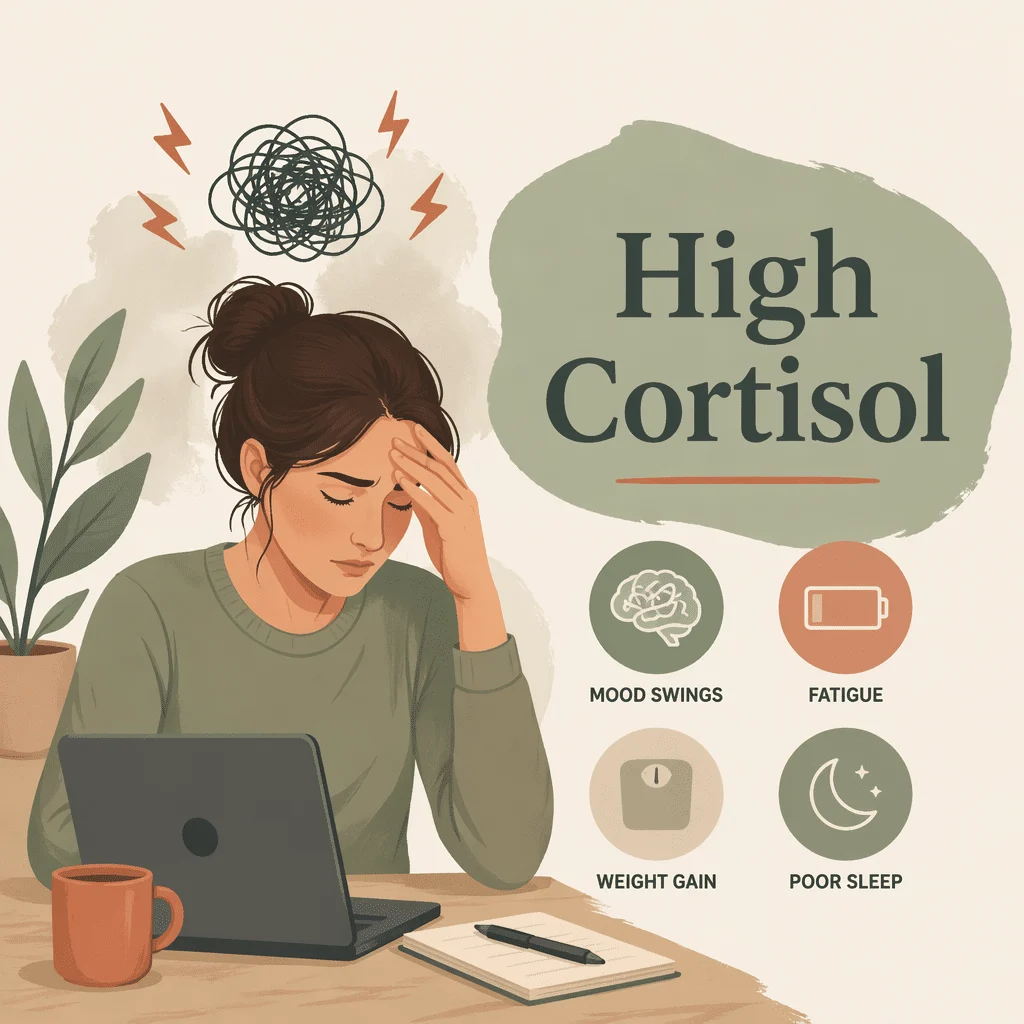
Höga kortisolnivåer är ett av de mest sökta hälsoämnena just nu, och ett av de mest missförstådda. Kortisol är det hormon som dina binjurar frisätter för att hjälpa dig hantera stress, hålla blodsockret stabilt och dämpa inflammation. När ett provsvar kommer tillbaka över referensintervallet är det ordet Cushings som de flesta tänker på. I praktiken är det sällan svaret.
Den vanligaste orsaken till att någon utvecklar tecken på kortisolöverskott är ett steroidläkemedel, inte en tumör. Och ett enstaka förhöjt värde innebär nästan aldrig Cushings syndrom i sig.
I den här artikeln får du lära dig vilka läkemedel och situationer som verkligen höjer kortisol, vilka tecken som faktiskt pekar mot Cushings syndrom och vilka som inte gör det, hur diagnosen bekräftas, samt hur du ska tänka kring "kortisolansiktet", kortisoldetoxar och salivtester för hemmabruk.
Steroidläkemedel: den överlägset vanligaste orsaken
Glukokortikoider är syntetiska kopior av kortisol: prednison, prednisolon, dexametason, budesonid, flutikason, triamcinolon och deras släktingar. De används för att behandla astma, eksem, reumatoid artrit, inflammatorisk tarmsjukdom, lupus och ledvärk.
Om de tas tillräckligt länge, eller i tillräckligt hög dos, kan de ge hela bilden av kortisolöverskott: ett rundare ansikte, fettansamling vid nackens bas och mellan skuldrorna, tunnare hud, lätta blåmärken, förhöjt blodsocker och förhöjt blodtryck. Läkare kallar detta exogent eller iatrogent Cushings syndrom, vilket innebär att det beror på behandlingen snarare än på kroppen själv.
National Institute of Diabetes and Digestive and Kidney Diseases beskriver detta som den vanligaste orsaken till Cushings syndrom totalt sett, och noterar att mer än 10 miljoner amerikaner tar glukokortikoider varje år. Den form som orsakas av en tumör uppskattas till ungefär 40 till 70 personer per miljon.
Administreringssättet spelar mindre roll än vad många tror. Tabletter är den vanligaste boven, men inhalerade steroider, starka krämer som används över stora hudytor, ledinjektioner, nässpray och ögondroppar kan alla absorberas i tillräcklig mängd för att ha betydelse – särskilt i kombination.
Den farmakologiska ironin: ditt kortisolresultat kan se lågt ut
Här är det som förvirrar nästan alla. De flesta analyser mäter kortisol i sig. Syntetiska steroider som dexametason och prednisolon är olika molekyler, så de är i stort sett osynliga för dessa analyser – ändå verkar de på samma receptorer och stänger av hjärnans signal till binjurarna.
Resultatet blir en obalans: personen ser ut att ha för mycket kortisol, men värdet är normalt eller lågt. Det är inte ett laboratoriefel, och det är därför din läkare frågar om alla steroider du har tagit – krämer och injektioner inkluderade. Vår guide till lågt morgonkortisol tar upp den andra sidan av den suppression.
Sluta aldrig med eller minska en steroid på egen hand
Detta är den viktigaste säkerhetspunkten på den här sidan. Långvarig behandling med glukokortikoider hämmar din egen binjureproduktion. Om de avslutas plötsligt kan kroppen bli oförmögen att producera det kortisol den behöver, vilket kan utlösa en binjurekris. Det är ett medicinskt nödläge och kan vara livshotande.
Nedtrappning sker alltid under läkarens ledning. Om du känner igen dig i beskrivningen ovan, boka en tid i stället för att hoppa över en dos. Din förskrivare kan bedöma om dosen kan sänkas på ett säkert sätt, om det finns ett icke-steroidalt alternativ, och hur man bör följa upp blodsockret, blodtrycket och benhälsan.
Situationer och tillstånd som höjer kortisol utan någon sjukdom i körteln
Kortisol är ett stresshormon, så det gör precis vad man kan förvänta sig: det stiger när kroppen är under belastning. Ett förhöjt provsvar är ofta en korrekt avläsning av ett tillfälligt tillstånd snarare än en hormonell störning.
Det är vanligt att kortisolet är högt vid akut sjukdom, efter operation, vid kraftig smärta och på sjukhus. Det är också förhöjt i mer långvariga situationer, som tidigare kallades pseudo-Cushings och nu benämns icke-neoplastisk eller fysiologisk hyperkortisolism:
- Svår depression och kraftig ångest
- Alkoholberoende
- Dåligt kontrollerad diabetes, där fasteglukos och glykerat hemoglobin ligger över målvärdet
- Fetma och metabolt syndrom
- Obstruktiv sömnapné, som dämpar det normala nattliga fallet
- Ätstörningar, mycket hård träningsbelastning, skiftarbete och kronisk sömnbrist
Graviditet och östrogen orsakar en annan typ av falskt alarm. Östrogen – oavsett om det kommer från graviditet, kombinerade p-piller eller hormonbehandling – höjer ett bärarprotein som kallas kortisol-bindande globulin. Det totala kortisolet stiger med det, men den fria, aktiva fraktionen gör det inte. Värdet är genuint högre; hormonexponeringen är det inte. Detta är en av de vanligaste anledningarna till att en frisk person får besked om att deras kortisol är högt.
Fysiologisk hyperkortisolism är mycket vanligare än äkta Cushings syndrom, och det brukar normaliseras när det bakomliggande tillståndet behandlas. Det är därför en endokrinolog ofta ber dig upprepa provtagningen vid ett senare tillfälle.
Vad som verkligen talar för Cushings syndrom
Endogent Cushings syndrom är ovanligt. Det uppstår från en av tre ställen: en godartad hypofystumör som producerar för mycket adrenokortikotropt hormon, kallad Cushings sjukdom och som står för de flesta fall; en tumör i binjuren som producerar kortisol direkt; eller en tumör på annan plats, oftast i lungan, som producerar ACTH där det inte ska finnas, känt som ektopiskt ACTH-syndrom.
De tecken som faktiskt skiljer ut sig
Läkare lägger störst vikt vid symtom som är svåra att förklara på annat sätt, eftersom dessa speglar den nedbrytning av muskler, hud och ben som orsakas av långvarig kortisolöverskott:
- Proximal muskelsvaghet: svårt att resa sig från en låg stol, gå i trappor eller lyfta armarna över huvudet, eftersom de stora musklerna i låren och axlarna drabbas först
- Breda lila eller röda bristningar, mer än en centimeter breda, på magen, överarmarna eller låren
- Lätt att få blåmärken med synligt tunn och skör hud
- Ansiktsplethora: ett ihållande rött, rodnande ansikte
- En fraktur efter ett litet slag, eller oförklarlig benförtunning i ung ålder
- Nydebuterad diabetes eller högt blodtryck som är ovanligt svårt att kontrollera hos en ung person
Symtomen som liknar allt annat
Viktuppgång, trötthet, nedstämdhet, sömnproblem, oregelbunden mens och ett rundare ansikte är verkliga symtom som förtjänar uppmärksamhet. De är också extremt vanliga hos personer som inte har Cushings syndrom, och de kan inte på egen hand skilja en hormonell störning från stress, sköldkörtelsjukdom, depression, perimenopaus eller viktförändring. Det är ingen avfärdning – det är därför bedömningen tittar på hela bilden snarare än ett enskilt värde.
Andra provsvar kontrolleras tillsammans med kortisol när bilden är oklar, bland annat TSH, prolaktin och, hos kvinnor med oönskad hårväxt, androgener. Lågt kalium tillsammans med svåra högt blodtryck leder till ytterligare binjuretestning, bland annat aldosteron.
Hur förhöjt kortisol faktiskt bekräftas
Bekräftelse sker i steg, inte med ett enda test. Screening börjar vanligtvis med kortisol i saliv sent på kvällen, ett 24-timmarsprov för fritt kortisol i urinen, eller ett kortisol-suppressionstest med låg dos dexametason över natten. Vår guide till kortisol blodprov förklarar vad varje test mäter och varför tidpunkten påverkar svaret.
Inget enskilt screeningtest är tillräckligt bra på egen hand. Endocrine Societys kliniska riktlinje för diagnostik av Cushings syndrom rekommenderar att ett avvikande resultat bekräftas med ett andra, annorlunda test, eftersom falskt positiva resultat är vanliga och en felaktig diagnos kan få verkliga konsekvenser.
Först när ett kortisolöverskott är fastställt inleds det andra steget. Mätning av ACTH skiljer möjligheterna åt: ett supprimerat ACTH pekar mot binjuren, ett normalt eller förhöjt ACTH mot hypofysen eller en ektopisk tumör. Bilddiagnostik följer, vanligtvis ett CT av binjurarna eller ett MRI av hypofysen.
En snabb guide till vad ett förhöjt kortisol vanligtvis innebär
| Din situation | Vad det vanligtvis betyder | Vad man ska göra |
|---|---|---|
| Du tar steroidtabletter, inhalatorer, krämer eller injektioner | Eventuella tecken på kortisolöverskott beror troligen på läkemedlet, även om uppmätt kortisol är normalt eller lågt | Lista alla steroider för din förskrivare. Justera aldrig dosen på egen hand |
| Kortisol mättes under sjukdom, efter operation eller på sjukhus | En normal stressreaktion, inte ett körtelproblem | Fråga om det räcker att upprepa testet efter tillfrisknandet |
| Enbart trötthet och viktuppgång, utan förändringar i hud, muskler eller skelett | Cushings syndrom är osannolikt; andra orsaker är betydligt mer troliga | Be om en bred utredning: sköldkörtel, blodsocker, sömn, järn, mående |
| Du är gravid, tar kombinerade p-piller eller östrogenbehandling | Totalt kortisol höjs av ett bärarprotein; fritt kortisol är vanligtvis normalt | Berätta för den som beställde testet så att rätt metod används |
| Proximal svaghet med breda lila bristningar, tunn hud, lätt att få blåmärken | Ett mönster som ger anledning att ta Cushings syndrom på allvar | Be om remiss till en endokrinolog |
“Kortisolansiktet”, kortisoldetoxer och salivtester för hemmabruk
Kortisol har blivit en diagnos i sociala medier. “Kortisolansiktet”, “kortisolmagen” och “kortisoldetox” lockar nu hundratusentals sökningar i månaden, tillsammans med de kosttillskott och testkits som säljs i anslutning till dem.
Vad som är sant: kronisk stress är inte ofarlig. Dålig sömn, ständigt arbetstryck och obehandlad ångest påverkar verkligen blodtrycket, blodsockret, aptiten och hur du mår. Om du är utmattad, går upp i vikt utan förklaring och letar efter ett svar – då märker du något verkligt.
Varför "kortisolansiktet" inte är en diagnos
Det rundade ansiktet vid verkligt kortisolöverskott, ibland kallat månansiktet, är ett kliniskt tecken som uppträder tillsammans med tunn hud, lila bristningar, proximal muskelsvaghet och en fettansamling i nacken. Det är inget du kan bedöma själv i spegeln, och ett foto före och efter kan inte fastställa det.
Ansiktet förändras av många vanliga orsaker: vätskeretention, salt, alkohol, dålig sömn, viktförändring, allergi, tandproblem, menscykeln, åldrande. Inget av detta är “kortisolansiktet”, eftersom “kortisolansiktet” inte är en erkänd medicinsk diagnos. Om ditt ansikte har förändrats och det oroar dig, ta upp det med en läkare. Det är inte ett skäl att köpa ett protokoll.
Salivtester för hemmabruk som säljs direkt till konsumenter
Kortisol i saliv sent på natten är ett legitimt kliniskt test, men dess värde beror på sammanhanget: rätt indikation, rätt tidpunkt, ett validerat analysförfarande, ett laboratoriespecifikt gränsvärde och en läkare som bekräftar ett avvikande resultat. Ett kit köpt online ger dig provet – men inget av det övriga.
Problemet är inte att siffran saknar mening. Det är att ett isolerat avvikande resultat hos någon utan tydliga tecken är mycket mer sannolikt ett falskt alarm än en diagnos, medan ett normalt resultat hos någon som faktiskt har tecken ger falsk trygghet. Hur som helst tenderar kitet att leda till en produkt snarare än en bedömning.
Kosttillskott som marknadsförs för att sänka kortisol
Ashwagandha, fosfatidylserin, rosenrot och andra adaptogener säljs i stor utsträckning med påståenden om att de sänker kortisol. Den ärliga sammanfattningen är mer begränsad än marknadsföringen.
Randomiserade studier av ashwagandha visar mätbara minskningar av kortisol i blodet jämfört med placebo. Vad de inte har visat är att detta på ett tillförlitligt sätt leder till att människor känner sig mindre stressade, och inget av detta har med behandling av en kortisolrubbning att göra.
Ytterligare två punkter förtjänar ärlighet. Kosttillskott i USA godkänns inte av Food and Drug Administration innan de säljs, så styrka och innehåll varierar. Och “naturligt” betyder inte verkningslöst: National Center for Complementary and Integrative Health noterar sällsynta rapporter om leverskador med ashwagandha, avråder från det under graviditet och amning, och listar interaktioner med läkemedel mot sköldkörtelsjukdom, diabetes, högt blodtryck och immunsuppression. Ett kosttillskott kan inte krympa ett hypofysadenom, och det finns inget sådant som en kortisoldetox.
Vad som faktiskt hjälper när stress är det verkliga problemet
Om din utredning inte visar någon kortisolrubbning är det goda nyheter, och det betyder inte att ingenting kan göras. De åtgärder som hjälper är oansenliga och ingen marknadsför dem.
Sömnen kommer först: regelbundna tider, tillräckligt många timmar och behandling av allt som stör natten. Att diagnostisera och behandla obstruktiv sömnapné förbättrar dagtrötthet, blodtryck och blodsocker på ett sätt som inget kosttillskott kan matcha. Att minska alkoholintaget spelar större roll än de flesta tror, eftersom hög konsumtion både höjer kortisol och stör sömnen. Att behandla depression och ångest på rätt sätt åtgärdar direkt en erkänd orsak till fysiologisk hyperkortisolism, och att få blodsockret under kontroll gör detsamma.
Detta beskriver var bevisen befinner sig snarare än vad du personligen bör göra, och är en utgångspunkt för ett samtal med din egen läkare.
Varningstecken som kräver ordentlig utredning – inte ett kosttillskott
Boka ett läkarbesök och fråga om endokrin utredning om du har något av följande:
- Snabbt tilltagande svaghet i låren eller axlarna, till exempel svårigheter att resa sig från en stol utan att ta stöd med armarna
- Breda lila bristningar som uppträder på magen, armarna eller låren
- Lätt att få blåmärken med tunn, skör hud
- Nydebuterad diabetes, eller blodsocker och blodtryck som är svåra att kontrollera
- Ett brott efter ett litet slag, eller oförklarlig benförtunning
- Allvarliga humörförändringar, psykotiska symtom eller snabb personlighetsförändring
Om du tar ett kortisonläkemedel och mår dåligt, svimmar eller får kräkningar eller svår svaghet, sök akut vård och sluta inte med medicinen på egen hand.
Senaste vetenskapliga framstegen inom bedömning av högt kortisol
Forskning publicerad mellan 2023 och 2026 har fokuserat på två frågor som är direkt relevanta för dig som läsare: vem som överhuvudtaget bör screenas, och hur man skiljer äkta Cushings syndrom från den betydligt vanligare fysiologiska varianten.
Italienska endokrinologisällskapet publicerade ett ställningstagande 2025 som beskriver vem som bör screenas och vilket förstahandstest som ska användas – det gäller personer med typ 2-diabetes eller fetma, högt blodtryck, osteoporos, humörsjukdomar, menstruationsrubbningar och tillfälliga fynd vid bilddiagnostik. Vad detta innebär för dig: screening är riktad, inte universell. Att vara trött eller ha lite extra vikt är i sig inte en indikation för kortisolprovtagning, och att en läkare väljer att inte testa är ofta i linje med evidensen snarare än ett tecken på att du inte tas på allvar.
En systematisk översikt och metaanalys i Pituitary jämförde andrahandstester som används för att skilja Cushings syndrom från icke-neoplastisk hyperkortisolism: dexametason-CRH-testet, desmopressintest, midnattskortisol i serum och kortisol i saliv sent på natten. De presterade i stort sett likvärdigt, med salivkortisol som det minst tillförlitliga, till stor del eftersom analysmetoder och gränsvärden skiljer sig åt mellan laboratorier. Vad detta betyder för dig: även i specialistens händer krävs mer än ett test för att skilja dessa två tillstånd åt, och salivresultat är laboratorieberoende – vilket är precis varför ett hemtest inte kan ge ett säkert svar.
Europeiska endokrinologisällskapets riktlinje från 2023 om binjureincidentalom – det vill säga förändringar som råkar hittas vid undersökningar gjorda av en annan anledning – formaliserade begreppet mild autonom kortisolsekretion för ett överskott som är verkligt men för subtilt för att ge den klassiska bilden. Den rekommenderar ett dexametasonhämningstest över natten för de flesta patienter, följt av screening för relaterade tillstånd som högt blodtryck och typ 2-diabetes. Vad detta innebär för dig: kortisolöverskott är ett spektrum snarare än ett ja-eller-nej, och milda former hittas vanligtvis via bilddiagnostik gjord av en annan anledning – inte genom symtomstyrd egentestning.
En systematisk översikt och metaanalys från 2025 i Nutrition and Health sammanställde randomiserade studier om ashwagandha och fann en sänkning av kortisol i blodet men ingen signifikant förbättring av upplevd stress. En metaanalys från 2026 i Planta Medica fann likaså sänkt kortisol, plus effekter på andra hormoner, däribland testosteron hos män och en liten förändring av tyroxin. Vad detta betyder för dig: ett kosttillskott kan förändra ett hormolvärde utan att du mår bättre, och förändrade hormolvärden är inte automatiskt något positivt. Inget av fynden stöder användning av ashwagandha för att behandla en kortisolrubbning, och de bredare hormonella effekterna är ett skäl att berätta för din läkare om du tar det.
Ordlista med nyckeltermer
| Kalla | Definition |
|---|---|
| Kortisol | Det viktigaste glukokortikoidhormonet som produceras av binjurarna, involverat i stressresponsen, blodsockerreglering, blodtryck och inflammation |
| Glukokortikoid | Den klass av steroider som inkluderar kortisol och dess syntetiska motsvarigheter som prednison och dexametason |
| Hyperkortisolism | Den allmänna termen för för hög kortisolaktivitet, oavsett bakomliggande orsak |
| Cushings syndrom | Det kliniska tillståndet som orsakas av långvarigt kortisolöverskott, antingen från läkemedel eller från en tumör |
| Cushings sjukdom | Den specifika formen som orsakas av en hypofystumör som producerar för mycket ACTH; det är en orsak till Cushings syndrom, inte en synonym för det |
| Iatrogen | Orsakad av medicinsk behandling; iatrogent Cushings syndrom uppstår av kortisonläkemedel snarare än av kroppen själv |
| ACTH | Adrenokortikotropt hormon, hypofysens signal som talar om för binjurarna att frisätta kortisol |
| Dexametasonhämningstest | Ett test där ett syntetiskt steroid tas och kortisol mäts efteråt; ett värde som inte sjunker tyder på kortisolöverskott |
| Proximal muskelsvaghet | Svaghet som drabbar de stora musklerna närmast bålen, som lår och axlar, snarare än händer och fötter |
| Kortisolbindande globulin | Det bärarprotein som transporterar kortisol i blodet; östrogen höjer dess nivå, vilket höjer det totala kortisolet utan att höja den aktiva fria fraktionen |
Vanliga frågor
Är "kortisolansiktet" verkligt?
Inte som en diagnos. Verkligt kortisolöverskott kan ge ett rundare ansikte, men det tecknet uppträder tillsammans med andra symtom som tunn hud, breda lila bristningar och svaghet i lår och axlar – och det bedöms av en läkare, inte utifrån ett fotografi. "Kortisol-ansikte" som det används online är ett marknadsföringsbegrepp, inte ett medicinskt. Det sagt: om ditt ansikte har förändrats synligt och det oroar dig är förändringen i sig värd att ta upp med en läkare. Ansiktet påverkas av vätskebalans, salt, alkohol, sömn, allergi, tandproblem, vikt och ålder – och flera av dessa faktorer går att behandla.
Fungerar kosttillskott som sänker kortisol?
Det mest studerade tillskottet, ashwagandha, sänker faktiskt uppmätt kortisol i blodet i randomiserade studier jämfört med placebo. Vad som däremot inte har visats är att människor konsekvent känner sig mindre stressade till följd av detta, och inget av dessa bevis gäller behandling av en kortisolrubbning. Kosttillskott i USA granskas inte av Food and Drug Administration innan de säljs, så styrkan varierar, och ashwagandha har kända försiktighetsvarningar – bland annat sällsynt leverskada och interaktioner med läkemedel mot sköldkörtelsjukdom, diabetes och högt blodtryck. Om du tar ett sådant tillskott, berätta det för din läkare – särskilt inför eventuella hormonprover.
Kan stress orsaka Cushings syndrom?
Nej. Cushings syndrom orsakas av steroidläkemedel eller av en tumör i hypofysen, binjurarna eller på annan plats. Stress höjer kortisolet, och långvarig stress, depression, alkoholmissbruk eller dålig sömn kan hålla det förhöjt tillräckligt länge för att synas på ett prov. Det tillståndet har ett eget namn – fysiologisk eller icke-neoplastisk hyperkortisolism – och det är betydligt vanligare än Cushings syndrom. Det är ett allvarligt tillstånd som förtjänar uppmärksamhet, men det utvecklas inte till Cushings syndrom och behandlas inte på samma sätt.
Kan högt kortisol orsaka viktuppgång runt magen?
Långvarigt kortisolöverskott omfördelar faktiskt fett mot bål, ansikte och nacke, medan armar och ben ofta blir tunnare. Men central viktuppgång är ett av de minst specifika fynden inom medicinen, och den överväldigande majoriteten av dem som drabbas har inget kortisolproblem. Det som får läkare att ta det på allvar är kombinationen av symtom: tunna extremiteter, skör hud, breda lila bristningar och svårighet att resa sig från en stol. Viktuppgång i sig är värt att utreda – men det är sällan en kortisolhistoria.
Jag känner mig utmattad hela tiden. Bör jag be om ett kortisoltest?
Be om en bedömning snarare än ett specifikt test. Ihållande trötthet förtjänar att tas på allvar, och en rimlig första utredning brukar titta på sköldkörtelfunktion, blodvärden och järn, blodsocker, njur- och leverfunktion, sömnkvalitet och mående. Kortisoltest läggs till när något i din sjukhistoria eller undersökning pekar i den riktningen – till exempel steroidanvändning, svårkontrollerad diabetes eller högt blodtryck, eller de hud- och muskelförändringar som beskrivs ovan. Att testa utan en tydlig indikation ger förvirrande resultat oftare än användbara sådana.
Om mitt kortisol är högt – kan det gå ner igen?
Vanligtvis ja, när orsaken har åtgärdats. Kortisol som höjts av akut sjukdom, operation eller smärta sjunker när du återhämtar dig. Kortisol som höjts av alkohol, obehandlad sömnapné, depression eller dåligt kontrollerad diabetes förbättras när dessa tillstånd behandlas. Kortisol som höjts av ett läkemedel med steroider följer den plan din förskrivare sätter upp, enligt ett schema de styr. När en tumör är orsaken är behandlingen vanligtvis operation, ibland i kombination med strålbehandling eller kortisolsänkande läkemedel, och det kan ta många månader efteråt innan kroppens egna rytm återhämtar sig.
Källor
- National Institute of Diabetes and Digestive and Kidney Diseases. Cushing’s Syndrome
- MedlinePlus, National Library of Medicine. Cushing syndrome
- National Cancer Institute. Pituitary Tumors Treatment
- National Center for Complementary and Integrative Health. Ashwagandha: Usefulness and Safety
- Ceccato F, Terzolo M, Gatto F, et al. Who and how to screen for Cushing’s syndrome: the position statement of the Italian Society of Endocrinology. Journal of Endocrinological Investigation, 2025. https://doi.org/10.1007/s40618-025-02758-3
- Hinojosa-Amaya JM, González-Colmenero FD, Alvarez-Villalobos NA, et al. The conundrum of differentiating Cushing’s syndrome from non-neoplastic hypercortisolism: a systematic review and meta-analysis. Pituitary, 2024. https://doi.org/10.1007/s11102-024-01408-w
- Fassnacht M, Tsagarakis S, Terzolo M, et al. European Society of Endocrinology clinical practice guidelines on the management of adrenal incidentalomas. European Journal of Endocrinology, 2023. https://doi.org/10.1093/ejendo/lvad066
- Albalawi AA. Dual impact of Ashwagandha: significant cortisol reduction but no effects on perceived stress. A systematic review and meta-analysis. Nutrition and Health, 2025. https://doi.org/10.1177/02601060251363647
- Fornalik M, Malkiewicz A, Adamczak D, et al. Hormonal modulation with Withania somnifera: systematic review and meta-analysis of randomized-controlled trials. Planta Medica, 2026. https://doi.org/10.1055/a-2802-8363
Vidare läsning
- 17-OH progesteron blodprov: en guide till ditt provsvar
- Högt testosteron hos kvinnor: orsaker och risker
- Kalcium i blodet och benpanelen
- Högt TSH – symtom förklarade: orsaker och risker
- Kortisolrytmer och utmattning
Förstå dina labresultat med AI DiagMe
Ett kortisolsvar står sällan ensamt. Det tolkas tillsammans med ACTH, glukos, kalium och övriga värden i ditt provpanel – och i ljuset av vad som händer i ditt liv och vilka läkemedel du tar.
AI DiagMe omvandlar de här siffrorna till ett begripligt språk så att du kommer till ditt läkarbesök redo att ställa rätt frågor. Tjänsten hjälper dig förstå dina provsvar – den ställer ingen diagnos och ersätter inte din läkare.
Få dina resultat tolkade på några minuter