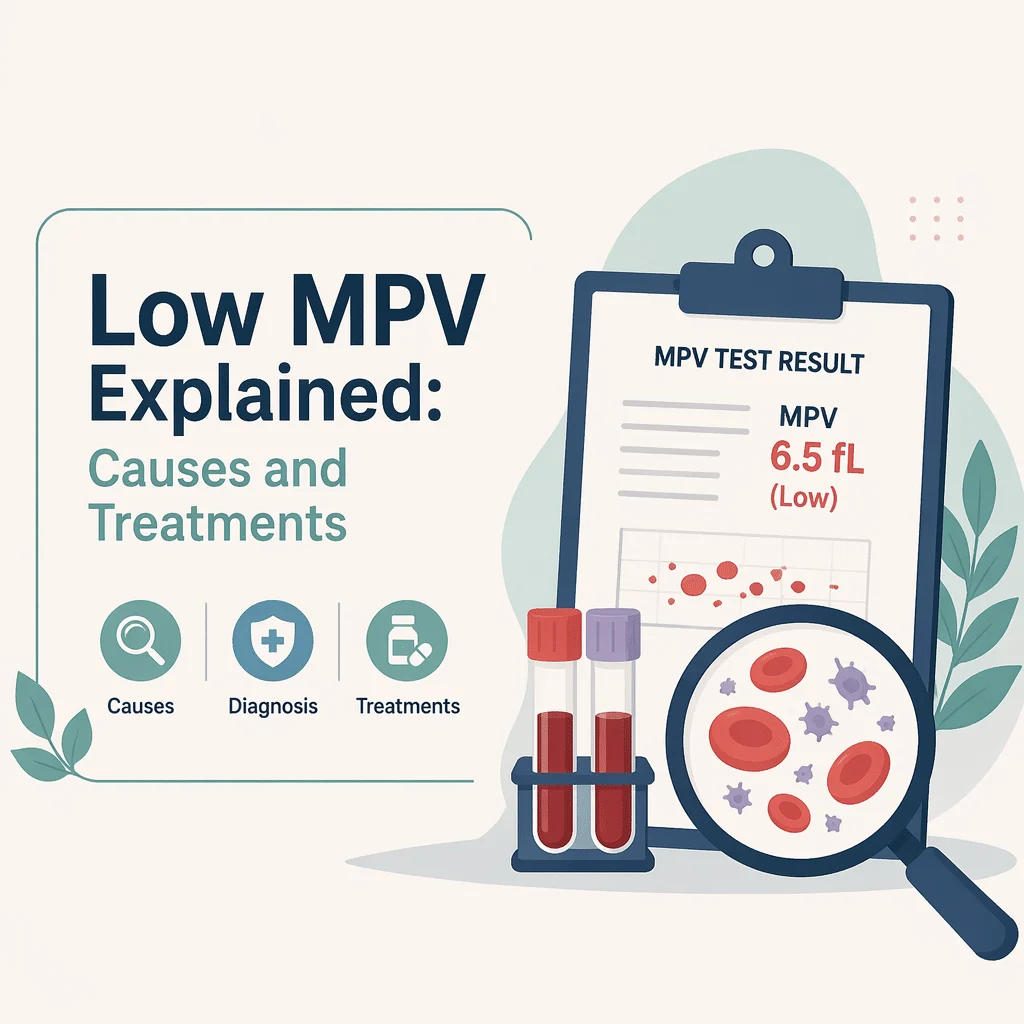
Un MPV scăzut pe o hemoleucogramă completă înseamnă că dimensiunea medie a trombocitelor tale este mai mică decât intervalul pe care laboratorul tău îl consideră tipic. Acesta descrie dimensiunea trombocitelor. Nu este un diagnostic și, în sine, rareori explică prea multe. Ceea ce face ca această valoare să fie utilă este contextul în care apare: numărul de trombocite tipărit alături de ea, restul analizelor de sânge și ceea ce medicul tău știe deja despre sănătatea ta. În acest articol vei afla ce reflectă de fapt dimensiunea trombocitelor, care afecțiuni și tratamente tind să scadă MPV-ul, cum să interpretezi un MPV scăzut în raport cu un număr de trombocite scăzut, normal sau crescut, de ce același eșantion de sânge poate produce două valori MPV ușor diferite și ce fac de obicei medicii în continuare.
Ce măsoară de fapt un MPV scăzut
Trombocitele sunt cele mai mici celule din sângele circulant, iar rolul lor este să astupe micile breșe din pereții vaselor de sânge. O hemoleucogramă completă raportează câte trombocite ai, dar și cât de mari sunt în medie. Această medie reprezintă volumul mediu trombocitar, notat MPV și măsurat în femtolitri (fL). Un rezultat sub intervalul de referință spune un singur lucru: trombocitul mediu din acea probă a fost mai mic decât de obicei.
De unde vine dimensiunea trombocitelor
Trombocitele nu sunt produse una câte una. Ele se desprind ca fragmente din megakariocite, celulele mari din măduva osoasă care eliberează trombocite în fluxul sangvin. Trombocitele nou-eliberate tind să fie mai mari; pe măsură ce circulă timp de aproximativ o săptămână până la zece zile, se micșorează. Astfel, dimensiunea medie a trombocitelor tale reflectă parțial cât de activ a eliberat măduva altele noi. Când producția este rapidă, amestecul circulant conține mai multe trombocite tinere și mari, iar MPV crește. Când producția este lentă sau suprimată, rezerva devine mai veche și mai mică, iar volumul mediu scade.
Intervale tipice și de ce două laboratoare pot da rezultate diferite
Majoritatea intervalelor de referință pentru MPV la adulți se situează undeva între aproximativ 7,5 și 12 fL, însă valorile tipărite pe buletinul tău aparțin laboratorului tău și analizorului său, nu MPV-ului în general. Instrumente diferite măsoară dimensiunea trombocitelor prin metode fizice diferite, iar fiecare laborator își stabilește propriul interval. O valoare marcată ca scăzută la un laborator poate fi perfect în interval la altul. Poți verifica valorile tipice pentru adulți în tabelul nostru de referință cu valorile normale ale analizelor de sânge, dar citește mai întâi intervalul din propriul tău raport.
Ce scade MPV-ul
Un MPV scăzut este un semnal secundar, așa că întrebarea utilă nu este niciodată cum să crești această valoare, ci ce anume face trombocitele mici. Mai multe mecanisme foarte diferite produc același rezultat.
Producție trombocitară încetinită sau redusă
Cea mai directă explicație este că măduva osoasă eliberează mai puține trombocite noi decât de obicei. Deoarece trombocitele tinere sunt cele mai mari, o măduvă care funcționează la un ritm redus trimite proporțional mai puține dintre ele, iar dimensiunea medie scade. Afecțiunile care suprimă activitatea măduvei se pot manifesta în acest fel, inclusiv anemia aplastică, în care măduva nu reușește să producă suficiente celule din toate cele trei tipuri sanguine. În acest context, constatarea aproape niciodată nu apare izolat: numărul de trombocite, leucocitele și hemoglobina se modifică de obicei și ele.
Inflamația cronică și afecțiunile autoimune
Inflamația de lungă durată scade frecvent MPV-ul, iar acest tipar este cel mai bine documentat în bolile inflamatorii intestinale. Explicația probabilă este că inflamația determină măduva să elibereze un număr mare de trombocite, multe dintre ele mici, în timp ce trombocitele mai mari și activate sunt consumate la nivelul țesutului inflamat. Inflamația intestinală cronică este un exemplu, pe care îl abordăm în articolul nostru despre boala Crohn. Medicii asociază adesea indicii trombocitari cu un marker de inflamație, explicat în ghidul nostru despre proteina C reactivă, deoarece cei doi împreună spun mai mult decât fiecare în parte.
Medicamente și tratamente care afectează măduva osoasă
Chimioterapia citotoxică, mai multe medicamente imunosupresoare și iradierea oaselor bogate în măduvă reduc producția de trombocite pentru o perioadă, iar MPV-ul scade frecvent în acest timp. Acest lucru este de obicei anticipat, monitorizat și temporar, și este urmărit alături de numărul de trombocite, nu separat. Dacă urmezi un tratament care afectează măduva, echipa ta medicală citește deja aceste valori în succesiune, iar o singură citire de trombocite mici în acest context adaugă puține informații noi.
Cauze ereditare ale trombocitelor mici
Un număr mic de afecțiuni genetice produc trombocite cu adevărat mici încă de la naștere. Sindromul Wiskott-Aldrich și tulburările înrudite legate de cromozomul X sunt exemplele clasice, și sunt rare. De asemenea, nu sunt silențioase: se manifestă de obicei în copilărie prin infecții repetate, eczemă sau sângerări, nu ca o descoperire izolată de laborator la un adult care se simte bine. O dimensiune medie mică a trombocitelor descoperită la o hemogramă de rutină la un adult este foarte puțin probabil să fie ereditară.
Factori nutriționali și din viața de zi cu zi
Deficitul de fier este adesea menționat ca o cauză a trombocitelor mici, iar statusul fierului merită verificat ori de câte ori o hemogramă pare neobișnuită. Efectul său asupra dimensiunii trombocitelor este însă inconsistent: deficitul de fier apare atât cu valori scăzute, normale, cât și crescute ale MPV. Fierul este de obicei verificat primul, iar noi explicăm valorile în ghidul nostru despre feritina scăzută. Medicul tău poate solicita o evaluare mai amplă, descrisă în prezentarea noastră generală a panelului de studii ale fierului. Trombocitele mici apar și alături de modificări ale globulelor roșii, pe care le descriem în ghidul nostru despre simptomele și testele pentru anemie.
Cum să interpretezi un MPV scăzut în raport cu numărul de trombocite
Acesta este cel mai util lucru pe care îl poți face cu acest rezultat și durează aproximativ zece secunde. Găsește numărul de trombocite pe același buletin de analize, de obicei notat PLT sau număr de trombocite, și citește cele două valori împreună. Asocierea restrânge posibilitățile mult mai mult decât o face oricare dintre cifre luată separat. Tabelul de mai jos prezintă cele trei combinații și ce urmăresc de obicei clinicienii în fiecare caz.
| MPV scăzut combinat cu | Ce sugerează de obicei | Ce analizează de obicei un medic în continuare |
|---|---|---|
| Un număr scăzut de trombocite | Producția redusă de trombocite este principala considerație, deoarece atât numărul, cât și dimensiunea indică în aceeași direcție. Chimioterapia recentă, bolile măduvei osoase și unele infecții virale se încadrează aici. | O repetare a analizei pentru a confirma că rezultatul este real, valorile leucocitelor și hemoglobinei din același buletin, o trecere în revistă a medicamentelor actuale, examinarea unui frotiu de sânge la microscop și trimiterea la un hematolog dacă situația persistă. |
| Un număr normal de trombocite | Cea mai frecventă situație în practică și de obicei cea mai puțin îngrijorătoare. Producția este evident adecvată, deoarece numărul de trombocite este normal. Manipularea probei și variația biologică normală explică multe dintre aceste rezultate. | Simptomele și medicamentele tale și, adesea, nimic mai mult decât o repetare a numărătorii la următorul test de rutină. Dacă te simți bine și restul analizei este normal, investigațiile suplimentare sunt frecvent inutile. |
| Un număr crescut de trombocite | Indică o creștere reactivă a trombocitelor, adică măduva osoasă produce multe trombocite ca răspuns la altceva: inflamație, infecție, deficit de fier, intervenție chirurgicală recentă sau pierdere de sânge. | Markeri inflamatori precum proteina C reactivă, studii ale fierului și identificarea cauzei de fond. Atenția se îndreaptă spre cauză, nu spre valoarea MPV în sine. |
De ce contează cel mai mult rândul din mijloc
Majoritatea persoanelor care caută acest rezultat se regăsesc în rândul din mijloc: MPV este semnalat, tot restul buletinului de analize este normal și se simt bine. Această combinație este liniștitoare prin propria sa logică internă. Dacă măduva ar fi în incapacitate de a produce trombocite, numărul acestora ar fi și el scăzut. Un număr normal înseamnă că producția funcționează. Ceea ce rămâne este o dimensiune medie mică, care reprezintă o descriere a populației de trombocite, nu o dovadă de boală.
De ce același sânge poate da două valori MPV diferite
MPV are o slăbiciune neobișnuită printre analizele de sânge de rutină: se modifică chiar în eprubetă. Sângele pentru hemoleucogramă completă este recoltat într-o eprubetă cu EDTA, un anticoagulant care împiedică coagularea probei. Trombocitele aflate în EDTA se umflă treptat, astfel că valoarea MPV măsurată crește ușor cu cât proba așteaptă mai mult înainte de a fi analizată. Studiile de laborator pe această temă au arătat că stabilitatea MPV depinde de anticoagulantul folosit, de temperatura de depozitare și de intervalul dintre recoltare și analiză. O comparație separată din 2023 pe probe de rutină a constatat că MPV depășea limitele acceptabile ale laboratorului atunci când analiza era întârziată cu o zi.
Consecința practică este modestă, dar merită știută. Un MPV la limită — puțin sub sau puțin peste intervalul de referință tipărit — poate reflecta parțial cât timp a stat proba în tranzit, nu neapărat ceva legat de tine. O eprubetă recoltată la o clinică și transportată la un laborator central poate fi analizată cu câteva ore mai târziu decât una procesată pe loc, iar cele două pot da rezultate diferite. Acesta este unul dintre motivele principale pentru care MPV nu este folosit ca test de sine stătător și de ce medicii îl interpretează alături de numărul de trombocite, nu separat.
Ce înseamnă asta pentru tine: nu acorda prea multă importanță unei variații mici a MPV între două recoltări, mai ales dacă probele au ajuns la laboratoare diferite sau au fost recoltate la ore diferite din zi. Dacă o valoare contează din punct de vedere clinic, răspunsul este o probă repetată, gestionată în condiții constante, nu căutarea unui sens într-o fracțiune de femtolitru. Cititorii care vor o imagine de ansamblu pot consulta ghidul nostru complet despre rezultatele hemoleucogramei.
Ce nu înseamnă un MPV scăzut
Câteva îngrijorări apar în mod previzibil, și cele mai multe pot fi lămurite.
- Nu este un test de sângerare. Dimensiunea trombocitelor nu prezice sângerarea de una singură; numărul de trombocite și testele de coagulare fac această treabă. Coagularea se măsoară separat, iar noi explicăm acele teste în ghidul nostru despre panelul de coagulare.
- Nu este un test de screening pentru cancer. Unele boli ale măduvei osoase pot scădea MPV, dar această descoperire este mult prea frecventă și mult prea nespecifică pentru a servi ca test de screening, iar o dimensiune mică izolată a trombocitelor la o persoană care se simte bine nu este un semnal de cancer.
- Nu este o valoare care se tratează. Nu există un tratament pentru un MPV scăzut în sine. Acolo unde este nevoie de tratament, acesta vizează cauza din spatele acestuia.
- Nu este o caracteristică personală fixă. MPV se modifică odată cu inflamația, medicamentele, o boală recentă și modul de prelucrare a probei, astfel că o singură valoare este o imagine de moment, nu un verdict.
Dacă buletinul tău arată modelul opus, cu trombocite mai mari decât media, consultă articolul nostru despre MPV crescut.
Ce urmăresc de obicei medicii în continuare
Analize recomandate de obicei împreună
Atunci când un MPV scăzut necesită cu adevărat urmărire, pașii următori sunt obișnuiți și accesibili. O hemoleucogramă completă repetată confirmă rezultatul și arată tendința de evoluție. Formula leucocitară și valorile hemoglobinei relevă dacă sunt afectate și alte linii celulare. Studiile pentru fier, vitamina B12 și folat acoperă cauzele nutriționale frecvente. Un marker inflamator este util atunci când se suspectează o afecțiune cronică. Frotiul de sânge periferic, în care un tehnician examinează celulele la microscop, poate identifica trombocite neobișnuit de mici sau aglomerate pe care un analizor le poate citi greșit. Alte linii celulare pot scădea în același timp, după cum descriem în ghidul nostru despre limfocite scăzute.
Când să consulți un medic
Un MPV scăzut în sine nu este un motiv pentru a solicita îngrijiri urgente. Următoarele merită aduse prompt în atenția unui medic, indiferent de ce arată MPV-ul tău:
- Vânătăi care apar fără nicio lovitură sau vânătăi care continuă să se extindă
- Puncte mici, plate, roșii sau violacee pe piele, adesea grupate pe gambe
- Sângerări nazale sau gingivale care sunt noi, frecvente sau greu de oprit
- Sângerare care nu se oprește după o tăietură minoră sau menstruații care au devenit neobișnuit de abundente
- Infecții repetate, transpirații nocturne abundente sau scădere în greutate inexplicabilă
- Un număr de trombocite care scade la teste repetate, indiferent de valoarea VPM
Adu buletinul de analize tipărit la consultație. Să ai în față cifrele reale și intervalele de referință ale laboratorului tău economisește mult timp și îi permite medicului să compare rezultatul de azi cu cele anterioare.
Cele mai recente progrese științifice
Cercetările privind dimensiunea trombocitelor s-au îndepărtat de tratarea VPM ca test de sine stătător și s-au orientat spre interpretarea lui în context. Patru recenzii recente arată unde se situează dovezile în prezent. Toate patru sunt observaționale, adică descriu tipare în rândul unor grupuri de persoane, fără a demonstra că un lucru l-a cauzat pe altul.
Inflamația cronică a intestinului este asociată în mod constant cu trombocite mai mici
Ce s-a descoperit: o recenzie sistematică din 2024 a adunat date din 79 de studii care acopereau peste 8.000 de persoane cu boală inflamatorie intestinală și peste 13.000 de participanți fără această afecțiune. Cei cu boala aveau valori ale numărului de trombocite clar mai ridicate și valori ale VPM clar mai scăzute. Diferența de dimensiune era constantă, dar mică, în medie sub un femtolitru.
Ce înseamnă asta pentru tine: dacă trăiești cu boala Crohn sau cu colita ulcerativă, un VPM scăzut în hemoleucogramă este o parte recunoscută a tabloului clinic, nu o surpriză. Reflectă inflamația și nu reprezintă o problemă separată care să necesite un tratament propriu.
VPM tinde să scadă mai mult când inflamația este activă
Ce s-a descoperit: o recenzie sistematică din 2026 a 18 studii efectuate pe aproximativ 2.160 de persoane cu boală inflamatorie intestinală a comparat puseele active cu perioadele de acalmie. În timpul bolii active, numărul de trombocite era mai mare, iar VPM mai scăzut față de perioadele de remisiune. Autorii sugerează că urmărirea valorilor trombocitelor în timp oferă informații utile despre gradul de activitate al bolii.
Ce înseamnă asta pentru tine: evoluția propriilor rezultate de-a lungul lunilor poate spune mai mult decât orice valoare izolată. Un VPM scăzut care revine treptat la normal pe măsură ce un puseu se liniștește este exact ceea ce observă cercetătorii — și acesta este un motiv să compari analizele în timp, nu să te fixezi pe una singură.
VPM este studiat din ce în ce mai mult ca raport, nu ca număr izolat
Ce s-a descoperit: o recenzie sistematică din 2025 a examinat valorile trombocitelor ca markeri accesibili ca preț în sepsis — o reacție periculoasă a întregului organism la infecție — pe baza a 14 studii. Cercetătorii nu au evaluat VPM în sine, ci VPM împărțit la numărul de trombocite. Chiar și așa, acuratețea a fost cel mult moderată, iar autorii descriu această abordare ca promițătoare, nu dovedită, necesitând în continuare confirmare.
Ce înseamnă asta pentru tine: acesta este același principiu ca și citirea VPM alături de numărul de trombocite din propria ta analiză, și este direcția pe care a luat-o întregul domeniu. Arată, de asemenea, că chiar și în mediul de cercetare, VPM singur nu este suficient de precis pentru a sta la baza unor decizii.
Unde VPM nu s-a dovedit util
Ce s-a descoperit: o analiză din 2025 a 35 de studii, care a inclus aproximativ 7.940 de persoane cu cancer oral, a testat dacă mai mulți indici uzuali din sânge pot prezice evoluția bolii. Două rapoarte care implică globulele albe și trombocitele au arătat asocieri consistente. MPV nu a arătat nicio asociere. Rezultatele între studii au variat atât de mult, încât autorii nu au putut combina datele deloc.
Ce înseamnă asta pentru tine: este mai degrabă un motiv de liniște, nu de îngrijorare. MPV-ul tău nu este un scor prognostic ascuns. Astfel de rezultate sunt tocmai motivul pentru care ghidurile medicale nu recomandă medicilor să acționeze pe baza MPV-ului izolat, și motivul pentru care o hemogramă repetată și o discuție cu medicul lămuresc de obicei situația.
Glosar de termeni cheie
| Termen | Definiție |
|---|---|
| Volumul mediu trombocitar (VMT) | Dimensiunea medie a trombocitelor dintr-o probă de sânge, exprimată în femtolitri în cadrul hemogramei complete. |
| Trombocite | Cea mai mică celulă din sângele circulant. Trombocitele se adună la nivelul leziunilor pereților vaselor de sânge și ajută la sigilarea acestora. |
| Megacariocit | O celulă mare din măduva osoasă care eliberează fragmente din ea însăși în fluxul sanguin. Acele fragmente sunt trombocitele. |
| Hemoleucogramă completă (HLG) | O analiză de sânge frecventă care numără globulele roșii, globulele albe și trombocitele și raportează mai multe măsurători de dimensiune și volum, inclusiv VPM. |
| Femtolitru (fL) | Unitatea de măsură folosită pentru volumul celulelor în hemogramă. Este un volum extrem de mic, motiv pentru care diferențele de MPV par nesemnificative. |
| Trombocitopenie | Un număr de trombocite sub intervalul de referință al laboratorului. Descrie câte trombocite există, nu cât de mari sunt. |
| Lățimea distribuției trombocitelor (PDW) | O măsură a variației dimensiunilor trombocitelor dintr-o probă. Este adesea raportată alături de VPM. |
| Tub EDTA | Tubul de recoltare a sângelui folosit pentru hemograma completă. Conține un anticoagulant care împiedică coagularea probei înainte de analiză. |
| Interval de referință | Intervalul de valori pe care un anumit laborator îl consideră tipic, stabilit în funcție de aparatura și populația proprie. Intervalele de referință diferă de la un laborator la altul. |
| Frotiu de sânge | O picătură de sânge întinsă pe o lamă de sticlă și examinată la microscop, folosită pentru a verifica ce a raportat un analizor automat. |
Întrebări frecvente
Poate un VPM scăzut cauza oboseală?
Nu. Dimensiunea trombocitelor nu are nicio legătură cunoscută cu nivelul de energie, iar un MPV scăzut nu produce în sine simptome. Dacă ești obosit și hemograma ta arată un MPV scăzut, explicația este mult mai probabil să se afle în altă parte pe același buletin de analize. Hemoglobina scăzută, rezervele scăzute de fier, vitamina B12 scăzută sau o tiroidă hipoactivă sunt cauze frecvente de oboseală și pot fi toate măsurate. Merită să îi ceri medicului tău să analizeze acele valori, nu MPV-ul. Oboseala persistentă, care se agravează sau este însoțită de dificultăți de respirație merită evaluată în sine, indiferent ce arată indicii trombocitari.
Ce înseamnă un MPV scăzut dacă restul analizelor de sânge sunt normale?
În cele mai multe cazuri, înseamnă foarte puțin. Un număr normal de trombocite îți arată că măduva osoasă produce trombocite în mod adecvat, iar globulele albe și hemoglobina normale indică faptul că celelalte linii celulare funcționează normal. Ce rămâne este o dimensiune medie mică a trombocitelor, care se încadrează în variația obișnuită dintre persoanele sănătoase și poate fi influențată de modul în care a fost manipulată proba. Medicii răspund de obicei prin reverificarea numărului la următoarea analiză de rutină, fără a investiga mai departe. Dacă te simți bine și nimic altceva din buletin nu este semnalat, un VPM scăzut izolat este tratat în general ca o observație, nu ca un rezultat care necesită urmărire.
Un VPM scăzut înseamnă că am cancer?
Un VPM scăzut nu este un test pentru cancer și nu poate indica cancer prin el însuși. Unele afecțiuni ale măduvei osoase, inclusiv anumite cancere de sânge, pot scădea VPM, dar acestea perturbă aproape întotdeauna și alte componente ale hemogramei, în special numărul de trombocite, numărul de globule albe și hemoglobina. Un VPM scăzut cu un număr altfel normal la o persoană care se simte bine îndepărtează de acel scenariu, nu îl sugerează. Cercetările susțin și ele acest lucru: studiile care au încercat să lege VPM de rezultatele oncologice au găsit rezultate prea inconsistente pentru a fi combinate. Dacă ai pierdere inexplicabilă în greutate, transpirații nocturne sau ganglioni persistenți, menționează aceste simptome direct medicului tău.
Ce valoare este considerată normală pentru MPV și se modifică odată cu vârsta?
Intervalele de referință pentru adulți se situează de obicei între aproximativ 7,5 și 12 fL, dar numărul care contează cu adevărat este cel tipărit lângă rezultatul tău, deoarece fiecare laborator își stabilește propriul interval pentru propriul analizor. Dimensiunea trombocitelor variază modest de-a lungul vieții și de la o persoană la alta, iar nou-născuții și copiii mici pot diferi față de adulți. Diferențele legate de sex și de populație sunt mici. Deoarece intervalele de referință nu sunt interschimbabile între laboratoare, compararea unui MPV de la un laborator cu un MPV de la altul nu este fiabilă. Mult mai utilă este compararea rezultatelor obținute în timp la același laborator.
Ar trebui să repet analizele dacă MPV-ul meu este doar ușor sub intervalul de referință?
De obicei, nu este nevoie să repeți analizele devreme doar din cauza unui MPV marginal. Măsurătorile dimensiunii trombocitelor sunt sensibile la timpul de așteptare al probei înainte de analiză, astfel că o valoare ușor sub interval poate reflecta logistica, nu biologia. Abordarea obișnuită este să lași următoarea hemogramă de rutină să răspundă la această întrebare. Repetă mai devreme dacă numărul de trombocite este și el anormal, dacă ai început un medicament nou care afectează măduva osoasă sau dacă apar vânătăi ușoare ori sângerări neobișnuite. În aceste situații, repetarea se face pentru numărul de trombocite și simptome, nu pentru MPV.
Poate un MPV scăzut să fie moștenit?
Există cauze ereditare ale trombocitelor cu adevărat mici, dar sunt rare și de obicei nu trec neobservate. Afecțiuni precum sindromul Wiskott-Aldrich combină trombocite mici cu un număr scăzut de trombocite și se manifestă de regulă în copilăria timpurie prin infecții repetate, eczeme sau sângerări. Un adult care a avut întotdeauna analize normale și prezintă brusc un MPV ușor scăzut este foarte puțin probabil să aibă o tulburare ereditară a trombocitelor. Dacă mai mulți membri ai familiei au număr scăzut de trombocite, vânătăi ușoare sau o tulburare de coagulare cunoscută, menționează acest istoric medicului tău, deoarece tiparul familial este cel care justifică o evaluare genetică.
Surse
- MedlinePlus, National Library of Medicine — MPV Blood Test, 2024 — medlineplus.gov
- Mayo Clinic — Thrombocytopenia (low platelet count): symptoms and causes, 2025 — mayoclinic.org
- National Heart, Lung, and Blood Institute — Platelet Disorders: Thrombocytopenia, 2025 — nhlbi.nih.gov
- Xu C, Song Z, Hu LT, Tong YH, Hu JY, Shen H — Abnormal platelet parameters in inflammatory bowel disease: a systematic review and meta-analysis — BMC Gastroenterology, 2024 — doi.org/10.1186/s12876-024-03305-9
- Wang H, Shao R, Wu S, Zhu Y, Zhang Z, Cui M, Xiang M, Li S, Fan F, Li X, Tao Y — The value of platelet-associated parameters as biomarkers in evaluating the disease activity of inflammatory bowel disease: a systematic review and meta-analysis — BMC Gastroenterology, 2026 — doi.org/10.1186/s12876-026-04603-0
- Tong X, Yang S, Sun J, Jia Q, Fan H, Li Z — Platelet parameters as potential biomarkers for sepsis: a systematic review and meta-analysis — Systematic Reviews, 2025 — doi.org/10.1186/s13643-025-02979-w
- Alshahrani AM, Kaur K, Saini RS, Heboyan A — Hematological parameters as predictors of oral cancer prognosis: a systematic review and meta-analysis — Journal of Cancer Research and Clinical Oncology, 2025 — doi.org/10.1007/s00432-025-06394-5
- Buttarello M, Mezzapelle G, Plebani M — Effect of preanalytical and analytical variables on the clinical utility of mean platelet volume — Clinical Chemistry and Laboratory Medicine, 2018 — doi.org/10.1515/cclm-2017-0730
- Maroto-Garcia J, Deza S, Fuentes-Bullejos P, Fernandez-Tomas P, Martinez-Espartosa D, Marcos-Jubilar M, Varo N, Gonzalez A — Analysis of common biomarkers in capillary blood in routine clinical laboratory: preanalytical and analytical comparison with venous blood — Diagnosis, 2023 — doi.org/10.1515/dx-2022-0126
Lectură suplimentară
- Cum să-ți citești rezultatele analizelor de sânge
- Rezultate anormale la analizele de sânge și ce înseamnă
- CBC versus CMP: înțelegerea celor două analize
- MCHC scăzut: cauze, simptome și tratament
- Vitamina B12 scăzută: simptome, cauze și tratamente
Înțelege-ți rezultatele analizelor cu AI DiagMe
Un MPV scăzut capătă sens abia alături de restul hemogramei tale, iar tocmai această comparație este cea pe care majoritatea oamenilor nu o pot face singuri. AI DiagMe îți citește buletinul de analize în ansamblu, punând dimensiunea trombocitelor tale alături de numărul de trombocite, hemoglobina, analizele de fier și markerii de inflamație, și îți explică pe înțeles ce reflectă de obicei acest tipar. Este conceput să te ajute să îți înțelegi rezultatele și să ajungi la consultație cu întrebări mai bune. Nu pune diagnostice și nu înlocuiește medicul tău.
Obține interpretarea rezultatelor în câteva minute