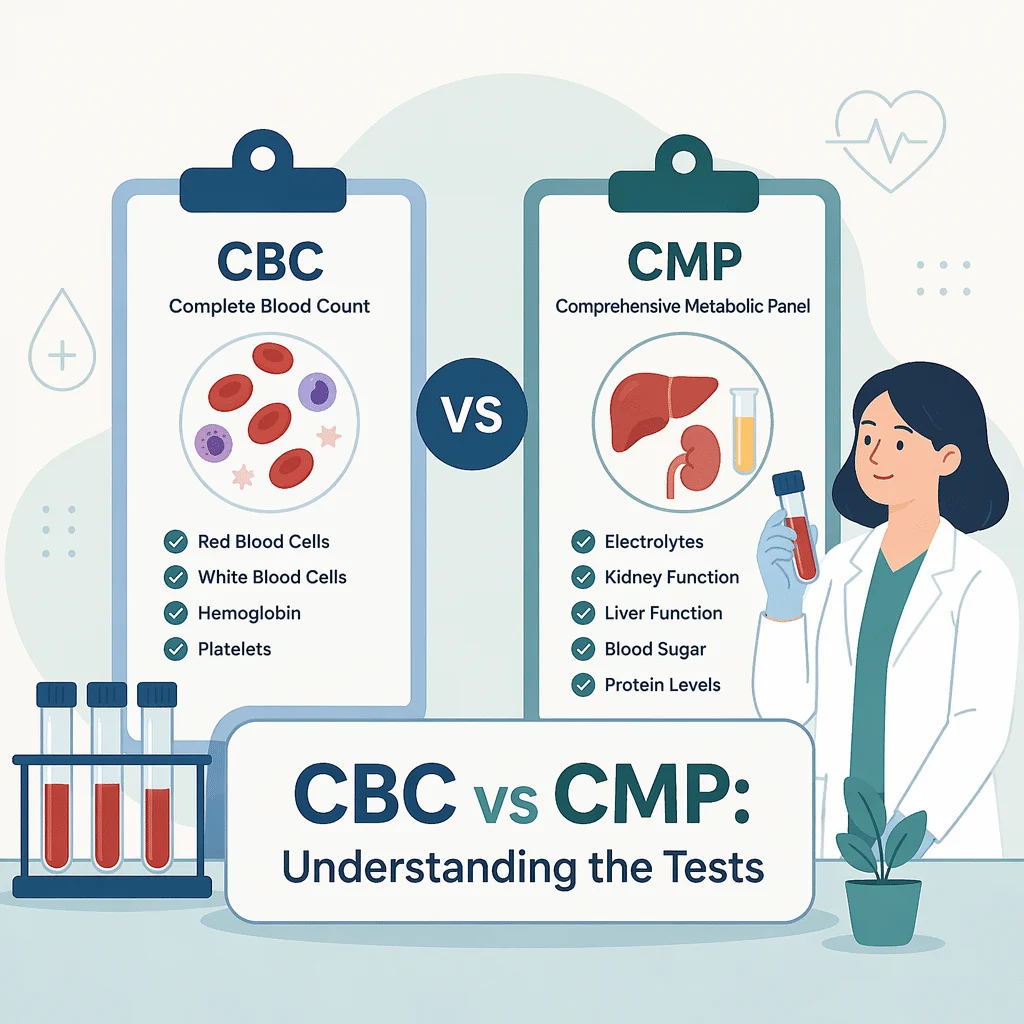
CBC vs CMP este una dintre cele mai frecvente întrebări pe care și le pun oamenii când se uită la un buletin de analize și văd două abrevieri alăturate. Pe scurt, hemoleucograma completă (CBC) examinează celulele care circulă în sângele tău, în timp ce panelul metabolic complet (CMP) examinează chimia lichidului în care plutesc aceste celule. Ele răspund la întrebări diferite, tocmai de aceea medicii le solicită atât de des împreună, ca analize de bază, în loc să aleagă una dintre ele.
În acest articol vei afla ce măsoară fiecare panel, la ce întrebare răspunde fiecare, cum diferă panelul metabolic complet de panelul metabolic de bază (mai scurt), de ce se solicită uneori să fii pe stomacul gol pentru unul și nu pentru celălalt, ce poate și ce nu poate să îți spună fiecare analiză, și ce să faci atunci când o valoare iese în afara intervalului normal.
CBC vs CMP: răspunsul pe scurt
Ambele analize încep la fel. O singură recoltare de sânge, de obicei dintr-o venă de la plica cotului, care umple adesea două eprubete de culori diferite din același ac. Ceea ce se întâmplă mai departe în laborator este ceea ce le diferențiază.
Hemoleucograma completă numără și măsoară celulele. Panelul metabolic complet măsoară substanțele dizolvate în partea lichidă a sângelui tău: zaharuri, săruri, produse de deșeu, enzime și proteine. Niciuna dintre ele nu este mai bună decât cealaltă. Pur și simplu, fiecare analizează o altă parte a aceluiași eșantion, iar un rezultat normal la una nu spune nimic despre cealaltă.
| Criteriu de comparație | Hemoleucogramă completă (HLG) | Panou metabolic complet (CMP) |
|---|---|---|
| Ce măsoară | Celulele din sângele tău: globule roșii, globule albe, trombocite, plus indici eritrocitari calculați | Chimia sângelui tău: glucoză, electroliți, produse de deșeu renale, enzime hepatice, proteine și calciu |
| Întrebarea la care răspunde | Cum sunt celulele tale sanguine? | Cum funcționează rinichii, ficatul, glicemia și echilibrul electrolitic? |
| Motivul obișnuit pentru care este solicitată | Oboseală, anemie suspectată, vânătăi sau sângerări ușoare, probleme imunitare, analize de rutină de bază | Analize de rutină de bază, monitorizarea tensiunii arteriale sau a diabetului, urmărirea medicației, probleme renale sau hepatice |
| Număr de componente | Aproximativ 8 până la 15 valori raportate, în funcție de dacă este inclusă și formula leucocitară | 14 substanțe |
| A jeun | Nu este necesară pentru hemoleucogramă în sine | Uneori se solicită, din cauza măsurării glucozei |
| Recoltare de sânge | O singură recoltare | O singură recoltare, de obicei aceeași |
Ce măsoară hemoleucograma completă: celulele sanguine
Hemoleucograma este un recensământ al celor trei populații de celule care circulă în sângele tău, plus un set de valori calculate care descriu globulele roșii în detaliu.
Globule roșii, hemoglobină și hematocrit
Globulele roșii transportă oxigenul din plămâni către restul corpului. Analizele raportează câte globule roșii ai, cât hemoglobină conțin (hemoglobina este proteina care transportă oxigenul în interiorul lor) și hematocritul, adică proporția din volumul sanguin ocupată de globulele roșii. Împreună, acestea sunt primele valori pe care un medic le verifică atunci când există suspiciunea de anemie. Acest articol explică simptomele și cauzele anemiei.
Indicii eritrocitari
Indicii sunt calculați automat de analizor, nu numărați direct. MCV descrie dimensiunea medie a globulelor roșii, MCH și MCHC descriu cantitatea de hemoglobină pe care o conțin, iar RDW descrie cât de mult variază dimensiunea celulelor între ele. Acești indici sunt importanți deoarece indică adesea cauza unui nivel scăzut de hemoglobină: o dimensiune medie mai mare decât de obicei duce pe o cale diferită față de una mai mică. Echipa noastră acoperă cauzele unui VEM crescut.
Globulele albe și formula leucocitară
Globulele albe sunt celulele sistemului tău imunitar. O hemoleucogramă de bază oferă un număr total. O hemoleucogramă cu formulă leucocitară împarte acest total în cele cinci subtipuri: neutrofile, limfocite, monocite, eozinofile și bazofile. Defalcarea este utilă deoarece un total aparent normal poate ascunde o modificare între subtipuri. Acest ghid analizează cauzele frecvente ale neutrofilelor crescute.
Trombocite
Trombocitele sunt fragmente celulare mici care se agregă pentru a opri sângerarea. Analizele raportează câte trombocite ai și, pe majoritatea analizoarelor, dimensiunea lor medie. Valorile ușor scăzute sau ușor crescute sunt de obicei urmărite în timp, nu interpretate pe baza unui singur rezultat.
Echipa noastră explică și cum să citești o hemogramă completă, marker cu marker.
Ce măsoară profilul metabolic complet: parametrii biochimici
Conform MedlinePlus, CMP măsoară 14 substanțe diferite dintr-o probă de sânge. Aceste 14 substanțe se împart în patru grupe practice.
Glicemie
Glucoza este zahărul pe care celulele tale îl folosesc drept combustibil. O singură valoare a glucozei pe un panou metabolic reprezintă o imagine de moment, puternic influențată de când ai mâncat ultima dată — acesta este motivul pentru care uneori se solicită recoltarea pe nemâncate. Echipa noastră detaliază semnificația valorilor crescute și scăzute ale glucozei.
Electroliții și echilibrul acido-bazic
Sodiul, potasiul, clorul și dioxidul de carbon (care reprezintă bicarbonatul) descriu echilibrul hidric și gradul de aciditate sau alcalinitate al sângelui. Aceste patru valori variază în funcție de hidratare, de vărsături sau diaree și de mai multe medicamente frecvente, în special diureticele. Acest articol descrie panoul complet al electroliților.
Markerii renali
Ureea sanguină, prescurtată de obicei BUN, și creatinina sunt produse reziduale pe care rinichii tăi trebuie să le elimine din sânge. Creatinina este folosită și pentru calcularea ratei de filtrare glomerulară estimate, sau eGFR, o valoare unică care rezumă cât sânge filtrează rinichii tăi în fiecare minut. Echipa noastră explică panelului funcției renale.
Enzimele hepatice, proteinele și calciul
ALT, AST, fosfataza alcalină și bilirubina sunt membrii panoului care privesc ficatul. Albumina și proteinele totale reflectă nutriția, producția hepatică și, în unele situații, proteinele pierdute prin rinichi sau intestin. Calciul ocupă o poziție ușor separată, fiind important pentru oase, nervi și mușchi, iar o parte din el circulă legat de albumină, motiv pentru care cele două valori sunt citite împreună. Echipa noastră detaliază panoul hepatic și enzimele sale, iar acest articol acoperă cauzele albuminei scăzute.
Pentru detalii despre fiecare dintre cele 14 valori, echipa noastră parcurge fiecare parametru dintr-un panou metabolic complet.
CMP vs BMP: linia de pe formularul de analize pe care nimeni nu o explică
Mulți oameni întâlnesc un al treilea acronim înainte de a termina cu al doilea. BMP înseamnă panou metabolic de bază, iar relația dintre ele este mai simplă decât pare: panoul de bază este cel complet minus markerii hepatici și proteici. MedlinePlus o spune clar, descriind BMP-ul ca similar cu CMP-ul, dar conținând doar 8 din cele 14 analize, fără proteine totale, albumină, bilirubină și enzimele hepatice.
| Componentă | Panelul metabolic de bază (BMP) | Panou metabolic complet (CMP) |
|---|---|---|
| Număr de substanțe măsurate | 8 | 14 |
| Glucoză, electroliți, uree, creatinină, calciu | Inclus | Inclus |
| Enzime hepatice (ALT, AST, fosfatază alcalină) | Neinclus | Inclus |
| Bilirubină | Neinclus | Inclus |
| Albumină și proteine totale | Neinclus | Inclus |
| La ce este de obicei folosit | O verificare rapidă a glicemiei, sărurilor minerale și funcției renale | Același lucru, plus o evaluare a ficatului și a statusului proteic |
Deci dacă formularul tău indică BMP în loc de CMP, nu a fost omis nimic din greșeală. Medicul tău nu a avut nevoie de secțiunea hepatică și proteică de această dată. Dacă apare ulterior o întrebare legată de ficat, se poate comanda atunci varianta completă.
De ce îți solicită medicul atât hemoleucograma, cât și profilul metabolic complet
A vedea ambele pe același formular poate părea o dublare. Este mai degrabă opusul: asocierea există pentru că cele două panouri se suprapun foarte puțin, astfel că împreună acoperă mult teren cu un efort suplimentar minim.
- Nu măsoară aproape nimic în comun. Nimic din hemoleucogramă nu îți spune despre filtrarea renală. Nimic din CMP nu îți spune despre numărul de trombocite. Dacă faci doar unul, jumătate din imagine rămâne goală.
- Costă o singură înțepătură. Ambele panouri sunt de obicei recoltate din același prelevat, în tuburi diferite, astfel că adăugarea celui de-al doilea înseamnă un tub în plus, nu o programare în plus.
- Simptomele sunt rareori specifice. Oboseala, de exemplu, poate veni din partea celulară (o hemoglobină scăzută) sau din cea biochimică (o problemă tiroidiană sau renală, ori glicemia). Comandând ambele panouri, se evită procesul de a ghici câte un test pe rând.
De aceea, această combinație apare ca evaluare de bază a stării generale de sănătate, înainte de operații, la începutul unui nou tratament care necesită monitorizare și în urmărirea afecțiunilor cronice. Este o primă privire de ansamblu — largă, ieftină și rapidă — nu o investigație aprofundată a unui singur organ.
Postul, momentul recoltării și cum îți ajung rezultatele
Trebuie să fii pe nemâncate pentru o hemoleucogramă sau un CMP?
Hemoleucograma completă nu necesită post alimentar. Mayo Clinic precizează că poți mânca și bea normal înainte de o hemoleucogramă și că postul intră în discuție doar dacă se recoltează și alte analize în același timp. Panoul metabolic este adesea acel alt test, din cauza măsurării glicemiei. Cleveland Clinic menționează că medicii le cer uneori pacienților să evite mâncarea și băutura cu 10 până la 12 ore înainte de un CMP, în timp ce MedlinePlus descrie postul de câteva ore ca pe o posibilitate, nu ca pe o regulă. Dacă ți se cere sau nu depinde de medicul tău, de laborator și de motivul testului, așa că urmează instrucțiunile tipărite pe propria ta recomandare, nu un ghid general. Echipa noastră explică regulile de post înainte de o analiză de sânge.
Cât durează până primești rezultatele
Ambele panouri sunt automatizate și rapide în laborator, iar rezultatele sunt de obicei disponibile medicului care a solicitat analizele în aceeași zi sau a doua zi. Așteptarea pe care o resimți este adesea mai lungă decât analiza în sine, deoarece rezultatele sunt de regulă verificate înainte de a fi eliberate, iar weekendurile prelungesc termenul. Dacă o valoare este extremă, laboratorul nu așteaptă: cele mai multe tratează anumite rezultate ca urgențe critice și îl contactează telefonic direct pe medicul solicitant.
Cum este structurat raportul
Rapoartele pentru ambele panouri urmează același format: numele măsurătorii, valoarea ta, unitatea de măsură și intervalul de referință al laboratorului, de obicei cu o literă lângă orice valoare în afara acestuia — de regulă H pentru ridicat (high) și L pentru scăzut (low). Fiecare laborator stabilește aceste intervale pe baza propriei populații, a echipamentelor și a metodelor utilizate, motiv pentru care intervalul de lângă rezultatul tău poate să nu corespundă cu un tabel găsit în altă parte.
Ce poate și ce nu poate să îți spună fiecare panou de analize
Aici așteptările tind să depășească ceea ce testele pot oferi cu adevărat.
O hemoleucogramă poate descrie numărul, dimensiunea și compoziția celulelor tale sanguine și poate semnala un tipar care merită investigat mai îndeaproape. Nu poate stabili un diagnostic de sine stătător. Mayo Clinic este explicit în această privință, menționând că o hemoleucogramă poate să nu ofere toate răspunsurile privind un diagnostic și că rezultatele în afara intervalului standard pot necesita investigații suplimentare.
Un CMP poate oferi o imagine de ansamblu asupra filtrării renale, activității enzimelor hepatice, glicemiei la un moment dat și echilibrului de lichide și săruri. Nu poate confirma sau exclude o boală specifică. O enzimă hepatică crescută este un semnal că ceva a iritat celulele ficatului, nu un diagnostic al cauzei.
Niciunul dintre paneluri nu este un test de screening pentru cancer și niciunul nu exclude singur o infecție sau o boală gravă. Ambele sunt puncte de plecare cu unghi larg, menite să indice clinicianului unde să caute în continuare — un rol cu adevărat util, diferit de cel al stabilirii unui diagnostic.
Când să mergi la medic pentru un rezultat marcat ca anormal
O literă lângă un număr este ceva obișnuit și, în sine, nu reprezintă de obicei o urgență. Intervalele de referință sunt construite astfel încât un mic procent din persoanele perfect sănătoase să se situeze în afara lor, ceea ce înseamnă că marcajele izolate apar frecvent. Contextul este cel care transformă un număr în informație.
- O valoare ușor în afara intervalului, fără simptome: rezonabil să o menționezi la următoarea consultație. O valoare izolată la limită este adesea repetată, nu investigată.
- Aceeași valoare marcată la două recoltări separate: merită o discuție mai curând. Un tipar are mult mai multă greutate decât un caz izolat.
- Un potasiu, calciu, glucoză sau hemoglobină cu valori net anormale: așteaptă-te să fii contactat. Laboratoarele marchează valorile extreme ca fiind critice și notifică direct medicul care a solicitat analizele.
- Orice marcaj însoțit de simptome: dificultăți de respirație, durere în piept, confuzie, sângerare abundentă sau inexplicabilă, febră care nu cedează sau o scădere bruscă a cantității de urină — toate acestea necesită îngrijire promptă, nu așteptarea unei consultații programate.
- Marcaje apărute după începerea unui medicament nou: anunță medicul prescriptor. Mai multe medicamente comune modifică în mod previzibil electroliții, markerii renali sau enzimele hepatice.
Acest articol explică ce înseamnă rezultatele anormale la analizele de sânge mai detaliat.
Cele mai recente progrese științifice
Cercetările recente privind aceste două paneluri vizează mai puțin adăugarea de noi markeri și mai mult extragerea unui sens mai profund din numerele pe care laboratoarele le produc deja. Iată ce arată studiile recente indexate în PubMed, pe înțelesul tuturor.
Componenta renală a CMP a fost recalculată
Ce s-a descoperit: în 2021, un grup de lucru comun al Fundației Naționale pentru Rinichi și al Societății Americane de Nefrologie a recomandat ecuații noi pentru calcularea eGFR pe baza creatininei, ecuații care nu mai includ rasa ca variabilă. O analiză din 2024 explică cum și de ce s-a făcut această schimbare, iar un consens de experți din SUA din 2025 a recomandat ca aceste ecuații fără rasă să înlocuiască și o formulă mai veche folosită pentru ajustarea dozelor de medicamente.
Ce înseamnă asta pentru tine: creatinina măsurată în cadrul CMP nu s-a schimbat, dar eGFR calculat pe baza ei poate apărea ușor diferit față de un raport mai vechi. Această diferență reflectă o modificare a formulei de calcul, nu o schimbare a funcției rinichilor tăi — lucru util de știut înainte să compari un rezultat recent cu unul de acum câțiva ani.
Valorile obișnuite ale hemoleucogramei conțin mai mult semnal decât par
Ce s-a descoperit: un studiu din 2024 publicat în revista Clinical Chemistry a antrenat un model computerizat pe șapte valori de rutină din hemoleucogramă, folosind date din opt laboratoare olandeze și testându-l pe un set separat. Modelul a diferențiat cu acuratețe ridicată tulburările ereditare ale hemoglobinei, precum talasemia, de anemia feriprivă, folosind exclusiv valorile raportate deja de o hemoleucogramă standard.
Ce înseamnă asta pentru tine: nimic nu se schimbă în ceea ce privește recoltarea sângelui. Aceasta este o inovație la nivelul laboratorului, menită ca analizorul să semnaleze atunci când tiparul dintr-o hemoleucogramă obișnuită merită o privire mai atentă. Se află încă în stadiu de dezvoltare, nu este ceva ce ai putea solicita pe nume.
O hemoleucogramă completă nu poate fi folosită ca screening pentru cancer
Ce s-a descoperit: o analiză sistematică din 2024 — adică un studiu care reunește și evaluează cercetări anterioare, fără a recruta pacienți noi — a examinat zece evaluări ale unui algoritm care scanează rezultatele de rutină ale hemoleucogramei pentru a identifica persoanele cu risc crescut de cancer colorectal. Concluzia a fost nuanțată: algoritmul a identificat doar o minoritate a cazurilor și a performat semnificativ sub metodele consacrate, precum testul de scaun sau colonoscopia, chiar dacă uneori a semnalat persoanele mai devreme decât îngrijirea obișnuită.
Ce înseamnă asta pentru tine: acesta este un rezultat negativ util. O hemoleucogramă normală nu este un test de screening pentru cancer și nu ar trebui niciodată să înlocuiască screeningul recomandat de medicul tău în funcție de vârstă și de profilul de risc. Unde astfel de algoritmi ar putea ajuta în cele din urmă este în a îndemna pe cineva să facă screeningul corespunzător, niciodată în a-l înlocui.
Glosar
| Termen | Definiție |
|---|---|
| Hemoleucogramă completă (HLG) | Un panel care numără și măsoară celulele din sângele tău: globule roșii, globule albe și trombocite. |
| Panou metabolic complet (CMP) | Un panel de 14 măsurători care acoperă glicemia, electroliții, markerii renali și hepatici, proteinele și calciul. |
| Panelul metabolic de bază (BMP) | O versiune mai scurtă a CMP, care conține 8 din cele 14 măsurători, fără enzimele hepatice, bilirubina, albumina și proteinele totale. |
| Formulă leucocitară | Defalcarea numărului total de globule albe în cele cinci subtipuri ale sale, în loc de un singur număr combinat. |
| Hematocrit | Proporția din volumul sanguin reprezentată de globulele roșii, exprimată ca procent. |
| VEM (volumul eritrocitar mediu) | Dimensiunea medie a globulelor tale roșii, calculată de analizor, nu măsurată celulă cu celulă. |
| Electroliți | Săruri dizolvate, în principal sodiu, potasiu și clor, care reglează echilibrul lichidelor, semnalele nervoase și funcția musculară. |
| Ureea (BUN — azotul ureic sanguin) | Un produs rezidual rezultat din descompunerea proteinelor, eliminat de rinichi, raportat în panelul metabolic alături de creatinină. |
| eGFR (rata de filtrare glomerulară estimată) | O valoare calculată, derivată în principal din creatinină, care estimează cât sânge filtrează rinichii tăi în fiecare minut. |
| Interval de referință | Intervalul de valori pe care un laborator îl consideră obișnuit pentru propria populație și metodele sale. Nu este un obiectiv personal și variază de la un laborator la altul. |
Întrebări frecvente
Poate o hemoleucogramă să înlocuiască un panel metabolic complet, sau invers?
Nu, deoarece măsoară lucruri diferite. Hemoleucograma completă raportează despre celule, iar panelul metabolic raportează despre chimia dizolvată, și există aproape nicio suprapunere între cele două liste. O hemoleucogramă normală nu oferă nicio informație despre filtrarea renală, enzimele hepatice sau glicemia ta, iar un panel metabolic normal nu spune nimic despre hemoglobina sau numărul de trombocite. Atunci când un medic comandă doar unul dintre ele, este pentru că întrebarea pusă se află clar de o parte sau de cealaltă.
Care este diferența dintre o hemoleucogramă simplă și una cu formulă leucocitară?
O hemoleucogramă simplă raportează un număr total combinat de globule albe. O hemoleucogramă cu formulă leucocitară împarte acest total în cele cinci subtipuri ale sale, astfel încât poți vedea proporția de neutrofile, limfocite, monocite, eozinofile și bazofile. Recoltarea sângelui este identică, iar analiza suplimentară este automatizată pe echipamentele moderne. Multe laboratoare efectuează acum formula leucocitară în mod standard, motiv pentru care o poți vedea în buletinul tău chiar și atunci când formularul de solicitare nu a specificat-o explicit.
Trebuie să fiu pe nemâncate dacă se recoltează împreună o hemoleucogramă și un panel metabolic?
Posibil, și doar din cauza panelului metabolic. Hemoleucograma în sine nu necesită niciodată post alimentar. Când cele două sunt solicitate împreună, orice instrucțiune de post provine din măsurarea glicemiei în panelul metabolic, iar practica variază între medici și laboratoare. Unii solicită 10 până la 12 ore fără mâncare sau băutură, alții cer o perioadă mai scurtă, iar alții nu cer deloc atunci când valoarea glicemiei nu este scopul testului. Urmează instrucțiunile atașate solicitării tale și întreabă dacă nu ți s-a dat nicio indicație.
Sunt valorile normale ale hemoleucogramei și panelului metabolic aceleași la toate laboratoarele?
Nu chiar. Fiecare laborator își stabilește propriile intervale de referință în funcție de populația pe care o deservește, de echipamentele utilizate și de metodele aplicate pentru fiecare măsurătoare. Valorile diferă în mod legitim și în funcție de vârstă, de sex și, pentru unele măsurători, în timpul sarcinii. Practic, aceasta înseamnă că ar trebui să îți citești rezultatul în raport cu intervalul tipărit pe propriul tău buletin de analize, nu după un tabel găsit în altă parte, și să fii precaut atunci când compari o valoare obținută la un laborator cu una obținută la altul.
Cele două paneluri necesită recoltări separate de sânge?
De obicei, nu. Ambele analize pot fi recoltate dintr-o singură puncție venoasă, sângele fiind împărțit în tuburi de culori diferite, deoarece hemoleucograma și analizele biochimice necesită conservanți diferiți. Dacă medicul tău adaugă și alte teste, mai multe tuburi pot fi umplute din același ac. Uneori este nevoie de o a doua recoltare, de exemplu când o probă se coagulează sau când o măsurătoare trebuie repetată pe o probă proaspătă.
Care dintre ele se recomandă mai des, panoul metabolic de bază sau cel complet?
Ambele sunt frecvent utilizate, iar alegerea depinde de întrebarea clinică. Un panel metabolic de bază este adesea suficient pentru o verificare simplă a glicemiei, a electroliților și a funcției renale, cum ar fi monitorizarea unui medicament pentru tensiunea arterială. Varianta completă este preferată atunci când ficatul prezintă interes, când statusul proteic contează sau când se stabilește un profil de referință general. Niciunul nu este mai complet prin natura sa; panelul complet acoperă pur și simplu mai mulți parametri.
Surse
- MedlinePlus, National Library of Medicine — Comprehensive Metabolic Panel (CMP), 2023 — medlineplus.gov
- MedlinePlus, National Library of Medicine — Complete Blood Count (CBC), 2024 — medlineplus.gov
- Mayo Clinic — Complete blood count (CBC): about, why it’s done and results — mayoclinic.org
- Cleveland Clinic — Comprehensive Metabolic Panel (CMP) — my.clevelandclinic.org
- Charles K, Lewis MJ, Montgomery E, Reid M — The 2021 Chronic Kidney Disease Epidemiology Collaboration Race-Free Estimated Glomerular Filtration Rate Equations in Kidney Disease: Leading the Way in Ending Disparities — Health Equity, 2024 — doi.org/10.1089/heq.2023.0038
- St Peter WL, Bzowyckyj AS, Anderson-Haag T, et al. — Moving forward from Cockcroft-Gault creatinine clearance to race-free estimated glomerular filtration rate to improve medication-related decision-making in adults across healthcare settings — American Journal of Health-System Pharmacy, 2025 — doi.org/10.1093/ajhp/zxae317
- Schipper A, Rutten M, van Gammeren A, et al. — Machine Learning-Based Prediction of Hemoglobinopathies Using Complete Blood Count Data — Clinical Chemistry, 2024 — doi.org/10.1093/clinchem/hvae081
- Putri RD, Sujana SA, Hanifa NN, Santoso TA, Abdullah M — Efficacy of ColonFlag as a Complete Blood Count-Based Machine Learning Algorithm for Early Detection of Colorectal Cancer: A Systematic Review — Iranian Journal of Medical Sciences, 2024 — doi.org/10.30476/ijms.2024.101219.3400
Lectură suplimentară
- Cum să-ți citești rezultatele analizelor de sânge
- Valorile normale ale analizelor de sânge explicate
- Cât durează să primești rezultatele analizelor de sânge
- Ce include o analiză completă de sânge
- Analize de sânge înainte de operație
Înțelege-ți rezultatele analizelor cu AI DiagMe
Odată ce știi că un set de analize îți numără celulele sanguine, iar celălalt îți măsoară chimia sângelui, următoarea provocare este propriul tău buletin de analize: o coloană de abrevieri, unități și litere lângă valori. AI DiagMe citește acel buletin împreună cu tine, explicând pe înțelesul tău hemoglobina, numărul de leucocite, glucoza, creatinina și enzimele hepatice, raportate la intervalele de referință tipărite de laboratorul tău. Este conceput să te ajute să înțelegi ce ai în față și să ajungi la consultație cu întrebări mai bune. Nu pune un diagnostic și nu îl înlocuiește pe medicul tău.
Obține interpretarea rezultatelor în câteva minute