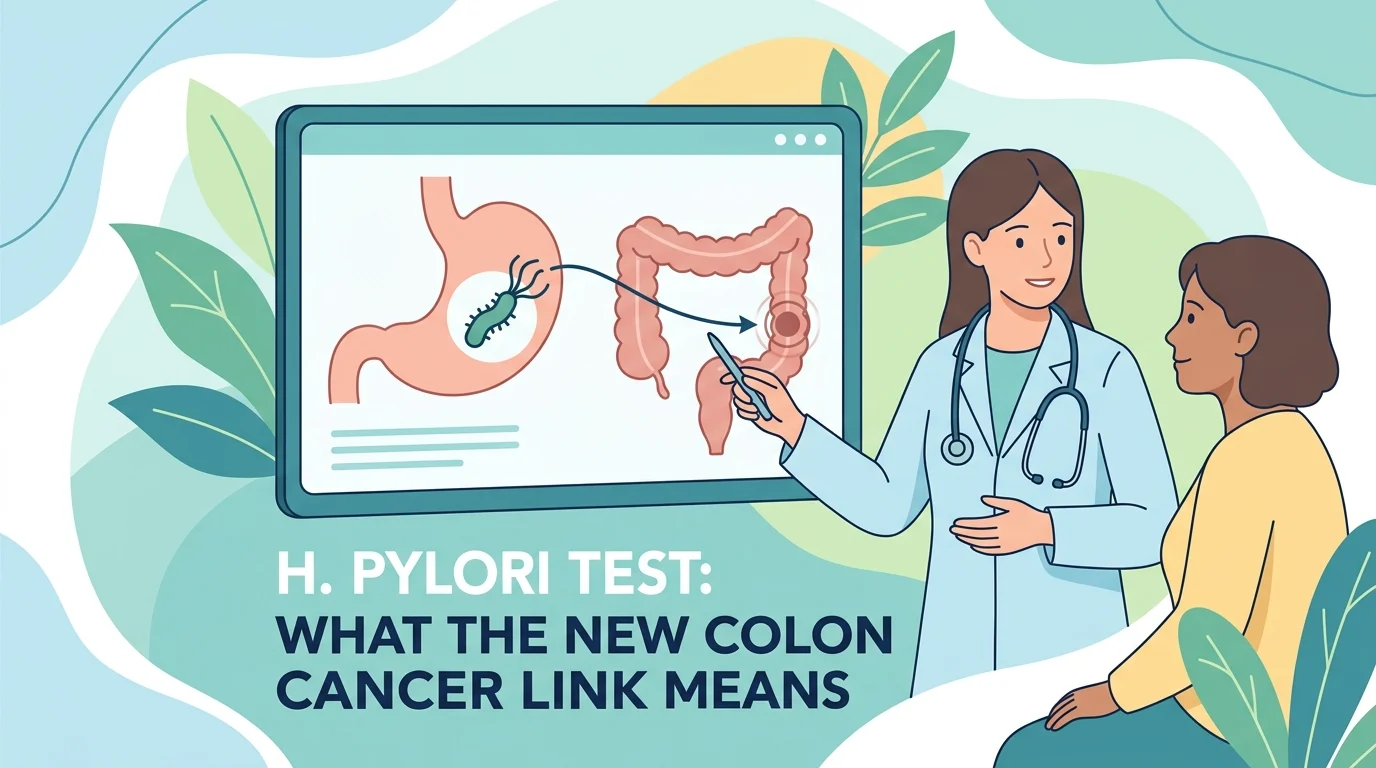
An H. pylori test has long been ordered for one reason: to find out whether a common stomach bacterium is behind indigestion, gastritis or an ulcer. A study reported in September 2026 widens the picture. Drawing on 43 studies covering more than 48 million people, researchers estimate that exposure to Helicobacter pylori may be associated with more than one in five cases of bowel cancer worldwide. That headline travelled fast, and it raises a practical question for anyone who has ever had stomach trouble: should you be tested, and what would the result actually tell you? The short answer is that the finding is a signal about populations, not a new instruction for individuals — but it does make understanding your own result more useful than before.
What the September 2026 study actually found
The analysis, published in the open access journal eGastroenterology and released through BMJ Group on 8 September 2026, is a risk attribution modelling study. Researchers at the University of California San Diego and the University of Hong Kong pooled existing systematic reviews and combined them with global cancer counts from the Global Cancer Observatory for 2022.
Three numbers matter. People exposed to H. pylori had roughly a 1.6-fold greater risk of bowel cancer than people with no exposure. Across all 43 studies, about 22% of bowel cancer cases were potentially attributable to that exposure. And when the researchers restricted the analysis to the 14 strongest designs — population-based and cohort studies — the figure fell to 12%.
That gap between 22% and 12% is the part worth holding on to. A modelling study estimates how much of a disease burden could be linked to a factor; it does not demonstrate that the factor caused the cancers. The authors say so plainly, and they note that lifestyle, diet, age and genetics together account for a much larger share of bowel cancer than H. pylori does. They also flag that eradicating the bacterium at population scale would raise real concerns about antibiotic resistance.
Which H. pylori test does what
There is no single H. pylori test. There are four, they answer different questions, and mixing them up is the most common source of confusion when results come back.
The urea breath test exploits a trick specific to the bacterium. H. pylori converts urea into carbon dioxide. You give a breath sample, swallow urea containing labelled carbon atoms, then give a second sample. If labelled carbon shows up in the second breath, the bacterium is there and it is active now.
The stool antigen test looks for H. pylori proteins in a stool sample. Like the breath test, it detects active infection, and it works well in children and in people who cannot manage a breath test.
A blood test is different in kind. It looks for antibodies your immune system made against H. pylori — which can persist for years after the bacterium is gone. A negative serology usually means you were not infected when the sample was taken. A positive one cannot tell you whether the infection is current or long past, which is why blood testing is rarely used for diagnosis today.
Endoscopy with a biopsy remains the most complete option. It confirms the bacterium, shows any ulcer or precancerous change in the stomach lining, and allows the laboratory to check which antibiotics the strain still responds to.
| Test | Sample | Detects | Best used for |
|---|---|---|---|
| Urea breath test | Breath | Active infection | First diagnosis and confirming a cure |
| Stool antigen test | Stool | Active infection | Diagnosis, children, cure check |
| Blood antibody test | Blood | Past or present exposure | Ruling exposure out; never a cure check |
| Endoscopy with biopsy | Stomach tissue | Bacterium plus tissue damage | Symptoms plus antibiotic sensitivity testing |
Why timing changes your result
Breath and stool tests measure a living bacterium, so anything that suppresses it distorts the answer. Before either test you generally need to stop proton pump inhibitors for about two weeks and antibiotics for about four weeks. Take a breath test while on omeprazole and you may get a false negative — the bacterium is still there, just too quiet to register.
Serology is the exception: antibodies do not care about your current medication. That is precisely why it is the fallback when someone has just finished antibiotics, and precisely why it is useless for checking whether treatment worked.
What a positive result means, and what it does not
A positive active-infection test means the bacterium is in your stomach. Roughly two-thirds of the world’s population carries it, according to CDC estimates cited by the National Cancer Institute, and in the United States prevalence has varied sharply by group — around 21% of non-Hispanic White adults versus 52% of non-Hispanic Black and 64% of Mexican American adults in one national survey.
Of those infected, most never develop disease. About one in ten develops an ulcer, and roughly one in a hundred develops stomach cancer. H. pylori is nonetheless the leading cause of stomach cancer, which is why a confirmed infection is treated rather than watched.
What a positive result does not mean is that you have a bowel cancer diagnosis waiting for you. The 2026 modelling study describes a modest relative risk across whole populations. It does not convert into a personal prediction, and it does not replace standard colorectal cancer screening, which remains the tool that actually finds bowel cancer early. We explain how dementia and other conditions get diagnosed elsewhere in our library; for the gut, the relevant background is stomach cancer symptoms, causes and diagnosis.
Who is advised to be tested today
Guidance has not changed with this study. Testing is recommended for people with an active stomach or duodenal ulcer, or a documented history of one, and after surgery for early gastric cancer or low-grade gastric MALT lymphoma. Persistent indigestion, unexplained nausea, or iron deficiency without an obvious cause are all reasons a clinician may look for the bacterium — H. pylori interferes with iron uptake, and our guide covers what low ferritin means and what happens next.
What most experts still do not support is population-wide testing of people without symptoms. The reason is antibiotic stewardship: unnecessary eradication courses have been linked to rising H. pylori resistance in the United States, and resistance makes the infection harder to clear for everyone.
Latest scientific advances
Two recent studies show why the bowel cancer question is still open, and they point in different directions.
A 2026 analysis in the journal Gut followed two large randomised trial cohorts in China over decades. Untreated infected people did have a higher risk of colorectal cancer than uninfected people. Treatment reduced that risk substantially in the smaller, longer-running cohort — but in the much larger cohort, there was no overall benefit after roughly 14 years, with an apparent effect only in people at high genetic risk or carrying particular bacterial strains. In plain terms: clearing the bacterium may help some people more than others, and we cannot yet say which.
A nationwide Swedish cohort of more than 80,000 people who received eradication therapy found no clear, consistent reduction in colorectal cancer afterwards. Risk was even slightly higher in the first two years, which most likely reflects extra medical attention and extra colonoscopies rather than harm from treatment.
On the testing side, a 2025 review in a clinical microbiology journal reported that modern monoclonal stool antigen tests reach sensitivity and specificity above 90%, making them a genuine alternative to breath testing — though performance varies by kit and by how the sample is handled. A 2026 comparison in children found the breath test still edged ahead, at about 89% sensitivity versus 73% for the stool test.
What this changes for you: if a laboratory offers a stool antigen test instead of a breath test, that is a reasonable substitution, not a downgrade. But a single negative result taken while you were on acid-suppressing medication is worth repeating.
When to see a doctor
- Upper abdominal pain that keeps coming back, bloating, or feeling full unusually early in a meal
- Unexplained weight loss or loss of appetite
- Black or tarry stools, or vomit that looks like coffee grounds — seek care immediately
- Sudden severe abdominal pain, dizziness or fainting — seek care immediately
- A previous H. pylori treatment that was never followed by a cure check about a month later
Glossary
- Antigen: a fragment of a microbe that a test can detect directly, which is why a stool antigen test signals current infection.
- Serology: a blood test that looks for antibodies rather than the microbe itself.
- Eradication therapy: a 10 to 14 day combination of antibiotics plus an acid-reducing drug, which clears H. pylori in most people.
- Risk attribution study: a calculation estimating what share of a disease could be linked to one factor, based on existing research rather than new patients.
- Relative risk: how much more likely an outcome is in one group than another, which says nothing on its own about how common the outcome is.
Frequently asked questions
Is the most accurate H. pylori test the breath test?
For non-invasive testing, the urea breath test is generally the most accurate, with modern monoclonal stool antigen tests close behind. Endoscopy with a biopsy is the most complete assessment because it also shows the state of the stomach lining.
Can I use a home H. pylori test kit?
Home kits exist, and many are antibody-based, meaning a positive result cannot distinguish a current infection from a past one. A result from a home kit should be confirmed through a clinician before any antibiotic treatment.
Does a positive H. pylori test mean cancer?
No. Most infected people never develop cancer; around one in a hundred develops stomach cancer. A positive result is a reason to treat the infection, not a diagnosis.
Should I get tested because of the bowel cancer study?
Not on the basis of the study alone. It is a population-level estimate, and current guidance still bases testing on symptoms, ulcer history and specific risk factors. Standard colorectal cancer screening remains the right tool for bowel cancer.
How soon after treatment should I be retested?
About four weeks after finishing antibiotics, using a breath or stool test — never serology, because antibodies persist after the bacterium is gone.
Sources
- BMJ Group — Helicobacter pylori exposure may be linked to more than 1 in 5 bowel cancer cases worldwide (8 September 2026)
- MedlinePlus (NIH / National Library of Medicine) — Helicobacter pylori (H. pylori) Tests
- National Cancer Institute — Helicobacter pylori (H. pylori) and Cancer
- Global and regional burden of colorectal cancer potentially related to Helicobacter pylori exposure: a risk attribution modelling study, eGastroenterology, 2026
- Han X et al. — H. pylori infection, treatment and colorectal cancer risk by genetic predisposition: evidence from two randomised trials, Gut, 2026
- Liu Q et al. — Helicobacter pylori Eradication Therapy and the Risk of Colorectal Cancer: A Population-Based Nationwide Cohort Study in Sweden, Helicobacter, 2024
- Kang X et al. — Application value and performance of stool antigen detection in the diagnosis of Helicobacter pylori infection, European Journal of Clinical Microbiology & Infectious Diseases, 2025
Other articles
- Stool culture test: what it detects and how results read
- Stomach cancer: symptoms, causes, diagnosis and treatment
- Low ferritin: what it means and what happens next
Understand your lab results with AI DiagMe
A breath, stool or blood result tells you something precise, but rarely in language you can act on. AI DiagMe reads your laboratory report and explains each value in plain English, with the context a clinician would add. Understand your lab results with AI DiagMe.