




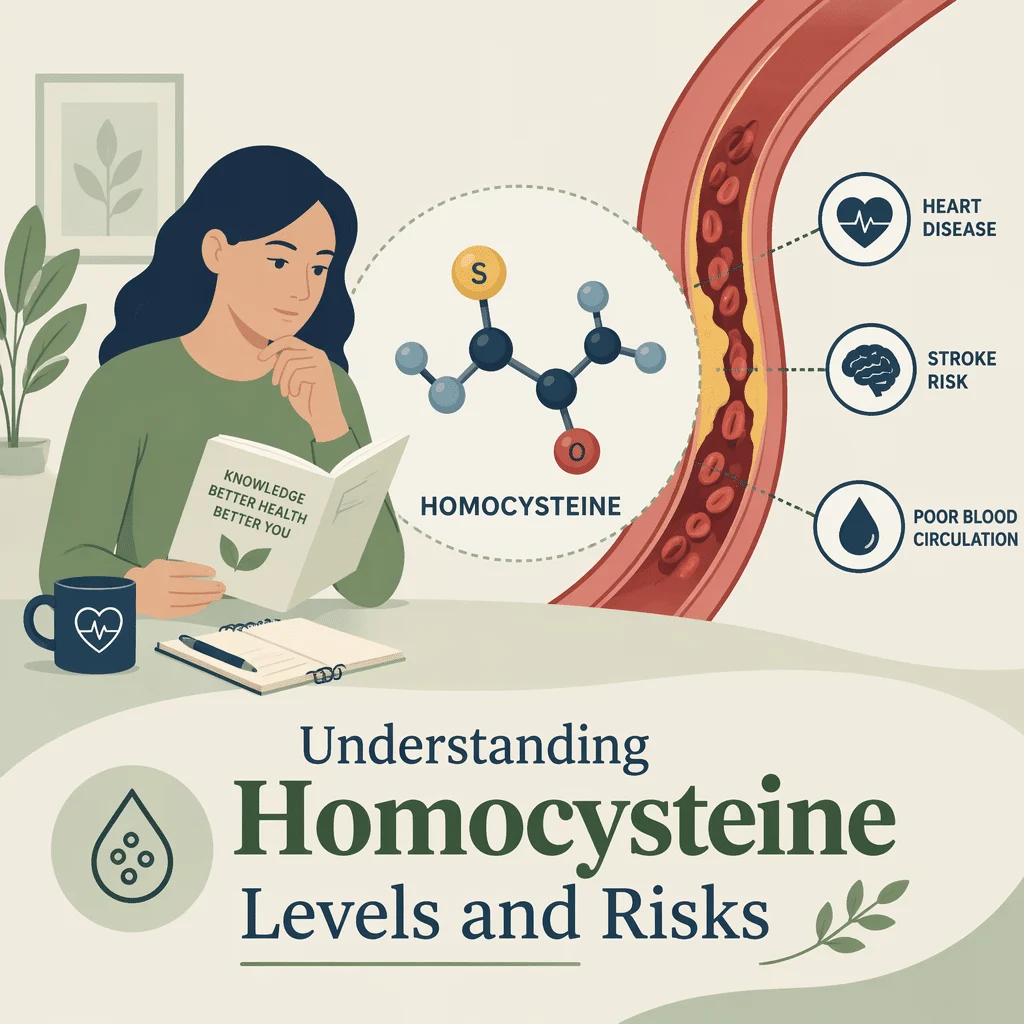
Homocysteine levels are one of the most misunderstood numbers in laboratory medicine. Homocysteine is an ordinary amino acid your body produces every day, and it is cleared by pathways that depend on vitamin B12, folate and vitamin B6. When any of those run short, the level climbs. For two decades it looked like a treatable cause of heart attacks and strokes, until large randomized trials brought the number down and the heart attacks did not follow.
A result below the range raises a different question — see what low homocysteine levels actually mean.
In this article you’ll learn what homocysteine is, what pushes it up, what those trials really showed, and the situations where the test genuinely earns its place. If your own result came back high, that is worth following up. But it is usually a signal pointing at something else, not a verdict about your heart.
What homocysteine is, and what clears it from your blood
Homocysteine is made when your body breaks down methionine, an amino acid you get from protein in food. It is a normal intermediate, not a waste product and not a toxin. Nearly all of it is dealt with within seconds.
There are two disposal routes. Remethylation converts homocysteine back into methionine and needs both folate and vitamin B12. Transsulfuration sends it towards cysteine instead, and needs vitamin B6.
This is the whole reason the test exists. Homocysteine sits at a junction where three separate B vitamins are required, so a shortage of any of them backs up the traffic and the level rises. That makes it a sensitive detector of a metabolic problem. It does not, on its own, make it a cause of disease. Most US laboratories flag a total homocysteine above roughly 15 micromoles per liter, though cutoffs vary and levels drift up with age.
What raises homocysteine besides low B vitamins
Vitamin shortage is the best known cause, but assuming a raised result must mean a deficiency is a common mistake.
Kidney disease, the largest non-vitamin cause
The kidneys do most of the work of clearing homocysteine. When kidney function falls, homocysteine rises early, often before other markers look dramatic, and in established chronic kidney disease a raised level is close to expected. This is why a high result should prompt a look at kidney function, and why our guide to high BUN and creatinine levels is often the more useful page to read next.
Thyroid, lifestyle, age and sex
An underactive thyroid raises homocysteine and correcting it brings the level back down, so a TSH test belongs in the same conversation. Smoking raises it, as does heavy alcohol intake and a heavy coffee habit. Levels rise with age, and men generally run higher than women until after the menopause. None of these are diseases. They are simply why any single result needs context.
Medicines that raise it
Several widely used medicines push homocysteine up as a side effect of how they work. Methotrexate blocks folate metabolism directly. Metformin reduces vitamin B12 absorption over years. Some antiepileptic drugs interfere with folate. Nitrous oxide inactivates vitamin B12 outright, which is why homocysteine rises sharply in people who use it recreationally.
If you take any of these, a raised homocysteine is predictable rather than alarming. It is a reason to ask your prescriber whether your vitamin levels should be checked, and never a reason to stop or change a prescribed medicine on your own.
MTHFR, in three sentences
MTHFR is an enzyme in the folate pathway, and two common variants of its gene reduce its activity slightly, which nudges homocysteine up a little in people who carry them. Because these variants are extremely common, carrying one is unremarkable, and major genetics organizations do not recommend testing for them outside research or specific metabolic investigations. Carrying a variant does not, by itself, justify special supplementation or a different diet. The marketing built around MTHFR and methylfolate belongs with folate rather than here, and our guide to folate deficiency deals with it properly.
The association-versus-causation story, told plainly
What the observational studies found
Starting in the 1990s, study after study reported the same pattern. People with higher homocysteine had more heart attacks, more strokes, more peripheral artery disease and more dementia. The association was consistent, appeared across countries, and survived adjustment for the usual suspects. There was a plausible mechanism too, involving damage to the lining of blood vessels.
Put those together and you have what looks like an ideal target: a cheap test to find people at risk, and cheap vitamins to bring the number down. Homocysteine testing was added to wellness panels on exactly that reasoning.
What happened when the number was actually lowered
Then the randomized trials reported, and they were large. Tens of thousands of people were given folic acid, with or without vitamin B12 and B6, or a placebo, and followed for years. The vitamins worked, in the narrow sense that they reliably lowered homocysteine. What they did not do was reduce heart attacks or cardiovascular deaths.
That is an important result, and not only about homocysteine. It is one of the clearest demonstrations in medicine that a treatment which improves a number does not automatically improve the person. The level came down. The outcomes stayed where they were. The most reasonable reading is that a raised homocysteine is mostly a marker of something else, a vitamin shortage, impaired kidneys or older age, rather than the thing doing the damage.
The stroke signal, stated fairly rather than airbrushed
There is one loose thread, and it deserves describing honestly instead of tidying away. Stroke has behaved differently from heart attack in this literature. Pooled analyses of the trials have found a modest reduction in stroke with folic acid, and genetic studies point the same way for one stroke subtype, the kind caused by disease of the very small vessels deep in the brain.
Two things temper that. First, the benefit has been concentrated in populations where folic acid is not added to flour, meaning people who were mildly folate deficient to begin with. The United States has fortified grain products with folic acid since 1998, and in fortified populations the effect largely disappears. Second, even where the stroke signal is present, it has not extended to coronary heart disease, peripheral artery disease or overall mortality.
So the fair summary is not that homocysteine is irrelevant. It is that a narrow effect on one stroke subtype, in people with low folate intake, has been generalized into a claim about heart disease the evidence does not support. How cardiovascular risk is actually estimated is a separate subject, covered in our guide to cholesterol ratios and what they mean.
Where the homocysteine test is genuinely useful
None of this makes the test worthless. It makes it a test with specific jobs, which it does well.
Detecting vitamin B12 or folate deficiency
This is the everyday use. Homocysteine rises early when either vitamin runs short, often before the serum vitamin level looks convincingly abnormal and well before red blood cells change size. When a serum B12 comes back borderline and the symptoms fit, homocysteine helps settle whether there is a real deficiency at tissue level. Our guide to low vitamin B12 covers that decision in full, including how homocysteine compares with methylmalonic acid.
One catch is worth knowing. Homocysteine rises with both B12 and folate shortage, so alone it cannot tell you which. That is why a folate blood test is usually run alongside, and a raised MCV read together with both.
Homocystinuria, where the test is truly diagnostic
Homocystinuria is a rare inherited disorder in which the enzyme that normally converts homocysteine onward barely works. Levels are not mildly raised but extraordinarily high, and the consequences are visible: dislocation of the lens of the eye, severe short-sightedness, a tall thin build with long limbs, thinning bones, learning difficulties in some people, and a serious tendency to form blood clots at a young age.
This is the one context where homocysteine is not a marker but a diagnosis. Newborns in the United States are screened for it, so it is usually caught in infancy rather than after a clot in a teenager. Treatment is specialized, lifelong and directed by a metabolic team, and has nothing in common with taking a supplement for a mildly raised number.
Investigating unexplained clots in a young person
A clot or a stroke in someone in their twenties or thirties with no obvious explanation triggers a broad investigation, and homocysteine is often part of it. It is not being used there to estimate risk, but to look for homocystinuria or a severe metabolic cause that would change management. In that setting a markedly high result genuinely matters.
Why homocysteine is not a routine screening test
Homocysteine is not part of a standard blood panel and is not recommended as a general cardiovascular screening test. That is a deliberate position, not an oversight, and follows directly from the trial results.
The problem with adding it to a check-up is not the cost of the tube. It is what happens next. A mildly raised result in someone with no symptoms usually reflects age, diet, kidney function or sample handling, and it generates worry, repeat testing and often unnecessary supplements, with no evidence the person ends up healthier. Meanwhile the things that genuinely drive cardiovascular risk, such as blood pressure, smoking, diabetes and LDL cholesterol, are already measurable and already actionable. If a clinic offers homocysteine inside a heart health package, ask what would change depending on the answer.
Sample handling, and the false high nobody warns you about
One practical detail explains a surprising number of unexpectedly high results. Homocysteine is measured in plasma, but red blood cells keep releasing it into the plasma after the blood leaves your arm. If the tube sits at room temperature before the cells are separated, the level rises steadily, and a sample left for hours can read meaningfully higher than the same blood processed promptly. Laboratories chill samples, separate plasma quickly or use tubes with a stabilizer, but a busy collection point on a Friday afternoon does not always deliver that.
So if a first result is unexpectedly high and nothing else fits, asking whether the sample was handled correctly and whether it should be repeated is a sensible question rather than a nitpick.
What to do if your homocysteine result is raised
A raised result is not something to dismiss, and not something to panic about. It is a prompt to ask what it points at: vitamin B12 and folate, kidney function, thyroid function, and your medicines. The table below shows how the same number means different things in different situations.
| Your situation | What it usually reflects | What is worth checking |
|---|---|---|
| Mildly raised, with a borderline vitamin B12 | A real B12 shortage that the serum level was underselling | Folate, methylmalonic acid or active B12, plus the cause of the deficiency |
| Raised, with known or suspected kidney disease | Reduced clearance by the kidneys, which is expected rather than surprising | Creatinine, estimated filtration rate and urine protein, managed as kidney disease |
| Raised, no symptoms, normal B12 and folate | Often age, sex, smoking, alcohol or a delayed sample rather than disease | Kidney and thyroid function, and whether a correctly handled repeat is worthwhile |
| Very high, in a young person with a clot | Possible homocystinuria or another severe metabolic cause | Urgent specialist assessment, amino acid studies and genetic testing |
| Raised while taking methotrexate or metformin | A recognized effect of the medicine on folate or vitamin B12 | Vitamin levels, discussed with your prescriber; never stop the medicine yourself |
What is deliberately not on that list is starting B vitamins to bring the number down. A genuine deficiency has its own treatment and its own follow-up, and which form and route are used is a prescriber’s decision based on the cause. Taking vitamins simply to move the number is the strategy the trials tested and did not support.
Red flags: when to get help immediately
- Sudden weakness or numbness on one side, a drooping face, or difficulty speaking or understanding speech: call 911. These are signs of a stroke and time is critical.
- Chest pain, chest pressure or sudden breathlessness: call 911.
- Pain and swelling in one calf, or breathlessness with chest pain that worsens on breathing in: seek urgent care, as these can indicate a blood clot.
- New numbness, tingling or unsteadiness when walking: arrange prompt assessment, as this can indicate vitamin B12 deficiency affecting the nerves.
- A very high homocysteine result, or a clot or a family history of homocystinuria in a young person: this needs specialist assessment rather than watchful waiting.
Nerve symptoms belong with a doctor rather than the supplement aisle, because the delay is what determines whether they recover. A persistently numb toe is a small thing that occasionally means something.
Latest scientific advances in homocysteine research
A 2024 systematic review and meta-analysis in Clinical Nutrition, led by Nan Zhang, pooled 21 randomized trials covering more than a hundred thousand participants. Found: folic acid reduced stroke overall, but the benefit was concentrated in countries where flour is not fortified with folic acid and largely disappeared in fortified populations. What this means for you: the United States has fortified grain since 1998, so the group most likely to benefit is not the American one.
A 2025 systematic review and meta-analysis in BMC Nutrition, led by Patricia Ghattas Hasbun, brought together 45 studies and almost a hundred thousand participants. Found: folic acid reduced stroke and, marginally, overall cardiovascular disease, but had no effect on deaths, coronary heart disease or peripheral artery disease. What this means for you: any effect is narrow and specific to stroke, not general protection for the heart.
A 2025 systematic review in Nutrition and Metabolism, led by Xiuyuan Zhu, synthesized 33 Mendelian randomization studies, a genetic method that tests causation using inherited variants rather than lifestyle comparisons. Found: genetically higher homocysteine tracked with several stroke types, particularly small vessel stroke, but not with coronary heart disease. What this means for you: even the genetic evidence separates stroke from heart attack, the distinction supplement marketing tends to blur.
A 2025 study in Neurology, led by Mengmeng Wang, used the common MTHFR variant as a natural experiment in East Asian and European populations. Found: reduced MTHFR activity, which raises homocysteine, was linked specifically to small vessel stroke and not to large artery or cardioembolic stroke. What this means for you: if homocysteine does harm, it appears to act on the smallest vessels in the brain, a far narrower claim than the one usually made for it.
A 2025 systematic review and meta-analysis in Nutrition Reviews, led by Jade Berg, pooled 17 randomized trials in more than five thousand older adults. Found: B vitamin supplementation produced at most a very small benefit for thinking and memory, and the apparent effect shrank once weaker studies were excluded. What this means for you: on the dementia question, any effect is small enough to be difficult to notice in one person.
Glossary of key terms
| Term | Definition |
|---|---|
| Homocysteine | An amino acid produced when the body breaks down methionine, normally cleared within seconds |
| Methionine | An amino acid obtained from dietary protein; homocysteine is made as it is broken down |
| Hyperhomocysteinemia | The medical term for a raised blood homocysteine level, whatever the cause |
| Homocystinuria | A rare inherited disorder causing extremely high homocysteine with eye, skeletal and clotting problems |
| MTHFR | An enzyme in the folate pathway; common gene variants reduce its activity and slightly raise homocysteine |
| Methylmalonic acid | A substance that rises specifically in vitamin B12 deficiency, often measured alongside homocysteine |
| Marker | A measurement that reflects a process without necessarily causing it |
| Mendelian randomization | A method that uses inherited gene variants to test whether an exposure causes an outcome |
| Folic acid fortification | The addition of folic acid to flour and grain products, mandatory in the United States since 1998 |
| Micromoles per liter | The unit laboratories use to report a homocysteine concentration |
Frequently asked questions
Should I get my homocysteine tested?
Not as a routine check on your heart. Homocysteine is not part of a standard panel and is not recommended as a general cardiovascular screening test, because lowering it has not been shown to prevent heart attacks. It becomes useful in specific situations: when vitamin B12 or folate deficiency is suspected and the vitamin levels themselves are ambiguous, when homocystinuria is being considered, and when a young person has an unexplained clot. If a clinic offers it inside a wellness package, a reasonable question is what would actually change depending on the result.
Do B vitamins lower homocysteine?
Yes, reliably. Folic acid, vitamin B12 and vitamin B6 all lower homocysteine, and that is exactly what makes the story instructive. Large randomized trials gave these vitamins to tens of thousands of people, brought their homocysteine down, and found no reduction in heart attacks or cardiovascular deaths. A modest reduction in stroke has been seen, mainly in countries that do not fortify flour with folic acid. So the vitamins do move the number. Moving the number is not the same as improving your health, and that is the point.
Is high homocysteine dangerous?
It depends enormously on how high, and on why. A mildly raised level in an adult with no symptoms is a signal to look at vitamin B12, folate, kidney function and thyroid function. It is not an emergency and not a prediction about your heart. The extremely high levels seen in homocystinuria are a different matter entirely, and they do carry a serious risk of clots in young people. Between those extremes, the level is best treated as information about your metabolism rather than a score on your cardiovascular risk.
What causes high homocysteine besides vitamin deficiency?
Chronic kidney disease is the biggest one, because the kidneys do most of the clearing. An underactive thyroid raises it. So do smoking, heavy alcohol intake and a heavy coffee habit. Levels rise with age and are generally higher in men. Several medicines raise it as well, including methotrexate, long-term metformin, some antiepileptic drugs and nitrous oxide. And a sample left standing before the laboratory separates it can read falsely high. That is a long list, which is why context matters more than the number itself.
What foods raise homocysteine?
No ordinary food raises homocysteine in a way that matters. The dietary influence runs the other way: eating patterns low in folate, vitamin B12 or vitamin B6 leave less capacity to clear it, so the level drifts up. Vitamin B12 comes almost entirely from animal foods and fortified products, folate from leafy greens, beans and fortified grains. A very high protein intake does supply more methionine, but in people with normal metabolism this has little lasting effect. Chasing a homocysteine number through diet is not a useful goal in itself.
Can a high homocysteine result be wrong?
Yes, and this is underappreciated. Homocysteine is measured in plasma, and red blood cells continue to release it into the plasma after the blood is drawn. If the sample is not chilled or separated promptly, the result climbs, and a delayed sample can read meaningfully higher than the same blood processed straight away. If an isolated high result does not fit anything else about you, asking whether the sample was handled correctly and whether a repeat is worthwhile is a fair question to put to your doctor.
Sources
- MedlinePlus, U.S. National Library of Medicine. Homocysteine Test. https://medlineplus.gov/lab-tests/homocysteine-test/
- MedlinePlus Genetics, U.S. National Library of Medicine. Homocystinuria. https://medlineplus.gov/genetics/condition/homocystinuria/
- National Institutes of Health, Office of Dietary Supplements. Vitamin B6: Fact Sheet for Health Professionals. https://ods.od.nih.gov/factsheets/VitaminB6-HealthProfessional/
- Sacharow SJ, Levy HL. Homocystinuria Caused by Cystathionine Beta-Synthase Deficiency. GeneReviews, University of Washington, Seattle. https://www.ncbi.nlm.nih.gov/books/NBK1524/
- Zhang N, Zhou Z, Chi X, Fan F, Li S, Song Y, Zhang Y, Qin X, Sun N, Wang X, Huo Y, Li J. Folic acid supplementation for stroke prevention: a systematic review and meta-analysis of 21 randomized clinical trials worldwide. Clinical Nutrition. 2024. https://doi.org/10.1016/j.clnu.2024.05.034
- Ghattas Hasbun P, Calderon Martinez E, Arvelaez Pascucci J, Livier Castillo J, Alonso-Ramirez A, Giron De Marza MM, Martinez Illan J, Sosaya Zuniga B, Camacho Davila K, Flores Monar G, Sanchez Cruz C. Efficacy of folic acid supplementation in the prevention of cardiovascular disease: a systematic review and meta-analysis of randomized controlled trials. BMC Nutrition. 2025. https://doi.org/10.1186/s40795-025-01178-z
- Zhu X, Wei J, Li J, Zuo S, Wang J, Liu N. The causal role of homocysteine in multiple diseases: a systematic review of Mendelian randomization studies. Nutrition and Metabolism. 2025. https://doi.org/10.1186/s12986-025-00933-0
- Wang M, Daghlas I, Zhang Z, Gill D, Liu D. MTHFR polymorphisms, homocysteine elevation, and ischemic stroke susceptibility in East Asian and European populations. Neurology. 2025. https://doi.org/10.1212/WNL.0000000000210245
- Berg J, Grant R, Siervo M, Stephan BCM, Tully PJ. Efficacy of B vitamin supplementation on global cognitive function in older adults: a systematic review and meta-analysis. Nutrition Reviews. 2025. https://doi.org/10.1093/nutrit/nuaf155
Further reading
- Low vitamin B12: symptoms, causes and nerve damage
- Folate deficiency: symptoms, causes and treatments
- Folic acid blood test: what the result means
- High B12 levels: causes, symptoms and risks
- High CRP levels: causes, symptoms and treatments
Understand your lab results with AI DiagMe
A homocysteine result almost never stands alone. It makes sense only next to vitamin B12, folate, kidney tests and thyroid tests, and the meaning sits in how those numbers relate to each other and to your symptoms. AI DiagMe reads your report and explains in plain language what each value refers to and which questions are worth raising with your doctor. It helps you understand your results. It does not diagnose, it does not assess your cardiovascular risk, and it does not replace your doctor.
Get your results interpreted in minutes