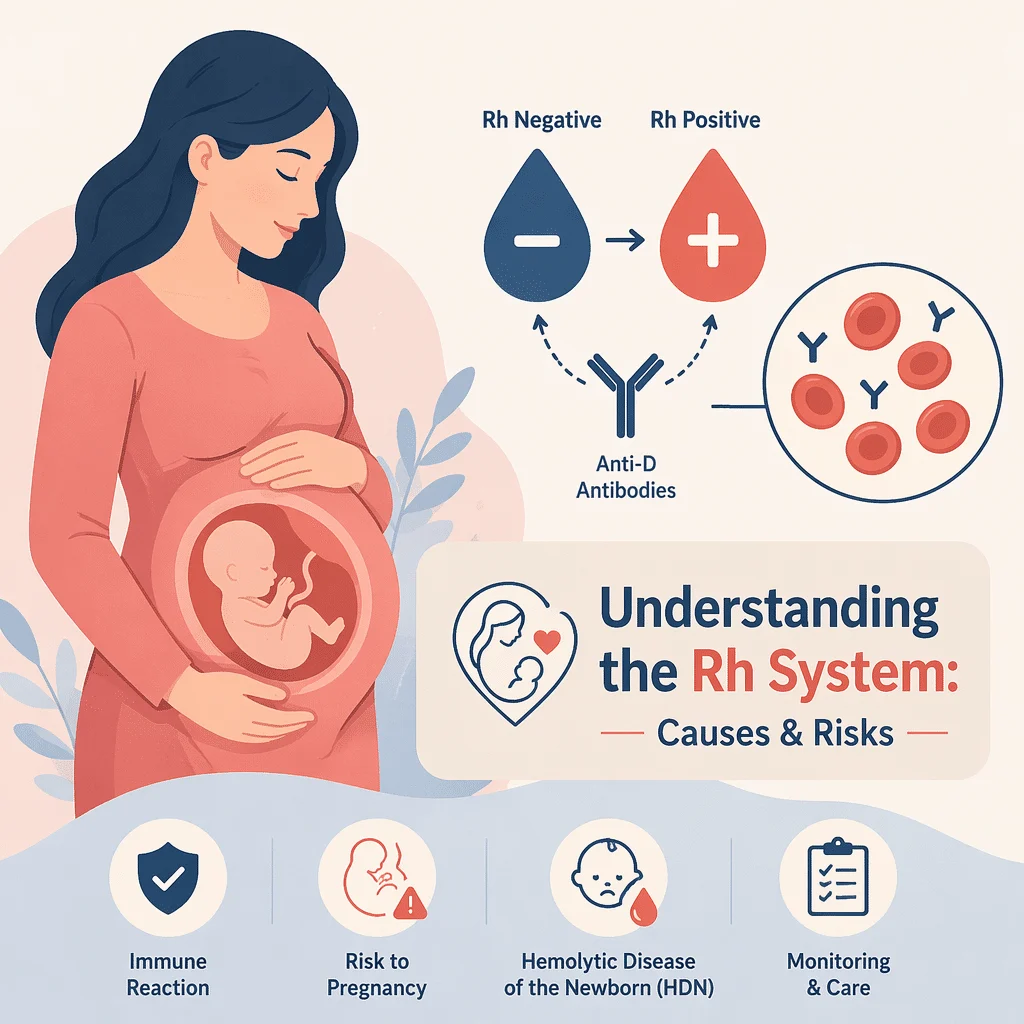
The Rh system is the part of your blood type that decides whether your result ends in a plus or a minus sign. It is a family of proteins carried on the surface of red blood cells, and the one that matters most is called the D antigen. If your cells carry it, you are Rh-positive. If they do not, you are Rh-negative. That single letter changes almost nothing in daily life, but it changes two things a great deal: which blood you can safely receive, and how a pregnancy is monitored when the pregnant parent is Rh-negative and the baby is Rh-positive. In this article you’ll learn how the Rh system is inherited, which tests read it, which parent-baby combinations carry a genuine risk, when anti-D injections are given, what your Rh status means outside pregnancy, and what research published since 2023 has changed about prenatal testing.
What the Rh system is, in plain terms
Every red blood cell is studded with markers that the immune system uses to tell “mine” from “not mine.” The ABO groups you already know about are one such family. The Rh system is another, and it is far larger than most people realize: more than fifty different Rh proteins have been described. In routine practice, only one of them is reported to you.
That one is the D antigen. Blood banks write it as RhD, and it is the reason a result reads A positive or O negative. Around eighty-five percent of people in the United States carry the D antigen and are therefore Rh-positive. The rest are Rh-negative, which is not a disease, a deficiency, or a health problem in itself. It simply means the immune system has never met the D antigen and would treat it as foreign if it ever did.
Other Rh proteins, labeled C, c, E and e, are typed in specialist situations, such as for patients who need repeated transfusions. Our library covers the full ABO and Rh classification of blood groups.
How you inherit your Rh type
Your Rh status comes from a gene called RHD, and you receive one copy from each biological parent. The gene is either present and working, or absent or switched off. A single working copy is enough to build the D antigen, so anyone who inherits at least one functional copy is Rh-positive.
This is why an Rh-positive parent can have an Rh-negative child. Someone who carries one working copy and one silent copy is Rh-positive themselves, but can pass the silent copy on. If the other parent also passes a silent copy, the child inherits two and is Rh-negative. It is also why two Rh-negative parents cannot, in ordinary circumstances, have an Rh-positive child: neither has a working copy to give.
How common Rh-negative blood is depends on ancestry. It is most frequent among people of European descent, less common in African and Asian populations, and rare in some parts of East Asia. Blood banks track these patterns because they determine how difficult a rare unit will be to find. Another guide explains the meaning of blood group O negative, the type emergency departments reach for first.
How the Rh system is tested
Reading the Rh system takes more than one test, and each answers a different question.
Blood typing
The laboratory mixes a sample of your red cells with a reagent containing anti-D antibodies. If your cells carry the D antigen, they clump together, a reaction called agglutination, and the result is Rh-positive. No clumping means Rh-negative. This is done at the same time as ABO typing, and it is the test behind the plus or minus on your card. Our team walks through the full blood test process.
The red cell antibody screen
Typing tells you what is on your cells. The antibody screen, also known as the indirect Coombs test, tells you what is floating in your plasma. It looks for antibodies you have made against red cell markers you do not carry yourself. In pregnancy, a positive screen for anti-D means sensitization has already happened, and the pregnancy is managed differently from that point on. These antibodies belong to the IgG class, which is small enough to cross the placenta; a separate article covers the immunoglobulin G blood test.
Weak D and partial D
Some people carry a version of the D antigen in unusually small amounts, called weak D, or a version missing part of its structure, called partial D. Routine typing may read these as negative on one occasion and positive on another. The distinction is not academic. Most people with the common weak D variants can safely be treated as Rh-positive and do not need anti-D injections, while people with partial D can still make antibodies against the piece they lack. Genetic testing of the RHD gene settles the question when serum testing is ambiguous.
Which pregnancies carry a risk
The risk in the Rh system is never about the parent’s health and never about the first exposure itself. It is about what the immune system remembers afterward. If Rh-positive fetal cells cross into an Rh-negative parent’s bloodstream, that parent can start producing anti-D antibodies. Those antibodies persist for life, and in a later pregnancy with an Rh-positive baby they cross the placenta and destroy the baby’s red blood cells.
Only one combination creates that risk, which is why the table below matters more than any general warning.
| Pregnant parent | Biological father | Can the baby be Rh-positive? | Is anti-D offered? |
|---|---|---|---|
| Rh-negative | Rh-positive | Yes | Yes, this is the situation prophylaxis exists for |
| Rh-negative | Rh-negative | No | Not needed, provided paternity is certain |
| Rh-positive | Rh-positive | Yes, and it poses no Rh risk | No |
| Rh-positive | Rh-negative | Either, and neither poses an Rh risk | No |
Because the father’s type is not always known or confirmed, care teams work from the pregnant parent’s status alone and offer anti-D whenever that parent is Rh-negative. Mayo Clinic publishes a plain-language explanation of the Rh factor blood test.
The Rh timeline of a pregnancy
Rh care follows a predictable schedule. Knowing it in advance removes most of the anxiety around the appointments.
| When | What happens | Why |
|---|---|---|
| First prenatal visit | ABO and RhD typing, plus a red cell antibody screen | Identifies Rh-negative pregnancies and any antibodies already present |
| Around 28 weeks | Antibody screen repeated, then a dose of anti-D immunoglobulin | Covers the third trimester, when small bleeds across the placenta become more likely |
| After any bleeding event | Anti-D given, usually within 72 hours | Miscarriage, amniocentesis, abdominal trauma or bleeding can all move fetal cells across |
| At delivery | Cord blood typed, direct antiglobulin test performed | Shows whether the newborn is Rh-positive and whether antibodies are coating its cells |
| Within 72 hours of birth | A further dose of anti-D if the newborn is Rh-positive | Prevents antibodies forming before any future pregnancy |
| If a large bleed is suspected | Kleihauer-Betke test or flow cytometry | Measures how much fetal blood entered the parent’s circulation, so the dose can be sized correctly |
Anti-D immunoglobulin is not a vaccine and does not train your immune system. It is a dose of ready-made antibodies that finds and clears any Rh-positive fetal cells before your own immune system has time to notice them and build a lasting memory. Our team also details the blood tests done during pregnancy.
When antibodies have already formed
If the antibody screen is positive for anti-D, prevention is no longer the goal and monitoring takes over. The condition the team is watching for is hemolytic disease of the fetus and newborn, in which maternal antibodies cross the placenta and break down the baby’s red blood cells faster than they can be replaced.
Severity varies widely. Many babies are only mildly affected. Others develop anemia before birth, which is tracked without needles by measuring the speed of blood flow in an artery in the baby’s brain on ultrasound. When anemia becomes significant, blood can be transfused to the baby while still in the womb, a procedure done in specialist fetal medicine centers.
After birth, the main sign is jaundice appearing in the first day of life, caused by bilirubin released as red cells break down. Newborns are monitored with repeated bilirubin measurements, a direct antiglobulin test on cord blood, and a complete blood count. Treatment ranges from phototherapy under blue light to exchange transfusion in severe cases. A companion guide covers the bilirubin values on a liver panel, and our team also explains how to read a complete blood count.
What your Rh status means outside pregnancy
Most articles on this subject stop at pregnancy, which leaves out the situation that affects everyone, including men and people past childbearing age: transfusion.
Rh-negative patients are given Rh-negative red cells whenever possible. Receiving Rh-positive blood does not usually cause an immediate reaction, but it can prompt the immune system to make anti-D, which complicates every future transfusion and, in someone who may later become pregnant, creates a lasting risk. Because Rh-negative blood is a minority of the supply, hospitals guard their stock carefully, and this is why O negative donors are asked to give so often.
Emergencies force a harder calculation. When someone is bleeding to death and no Rh-negative units are on the shelf, transfusion teams weigh a certain, immediate danger against a possible future one. Rh proteins are also involved in some autoimmune hemolytic anemias, where the body attacks its own red cells; a reticulocyte count and a lactate dehydrogenase measurement are often added when hemolysis is suspected. Our team explains how to interpret a lactate dehydrogenase blood test. Our library also explains the symptoms and causes of anemia.
Latest scientific advances
Research published since 2023 has converged on one practical question: how do you give anti-D only to the pregnancies that actually need it? Here is what has changed, and what it means for you.
The baby’s Rh type can now be read from a parent’s blood sample
Small fragments of the baby’s DNA circulate in the pregnant parent’s bloodstream, a substance called cell-free fetal DNA. Laboratories can read the RHD gene in those fragments and determine the baby’s Rh type from an ordinary blood draw, with no needle near the pregnancy. A 2025 study of 270 Rh-negative pregnancies in Buenos Aires reported that the test matched the baby’s true Rh type in every sample checked, from as early as the eighth week. About a third of those babies turned out to be Rh-negative.
What this means for you: if the baby is Rh-negative, no anti-D injection is needed at all, because there is nothing for the immune system to react to. Roughly one Rh-negative pregnancy in three could be spared an injection that was never going to serve a purpose. This particular result came from a single hospital, so it still needs confirming across more populations before it can be treated as settled.
Testing first, injecting second, is already national policy somewhere
Denmark did not treat this as an experiment. It switched its entire country to a targeted approach, testing the baby’s Rh type first and giving anti-D only when the baby is Rh-positive, and researchers evaluated the clinical effect of that nationwide rollout in 2024. A 2025 review in a prenatal diagnosis journal drew the same threads together across fetal RHD genotyping, targeted prophylaxis and treatments given before birth.
What this means for you: this is not a future technology. It has been running at country scale for over a decade, which is the strongest argument that it is safe to do.
Prevention is very good, but it is not perfect
A nationwide cohort study published in 2026 followed pregnancies in which the parent became Rh-immunized anyway, ten years after targeted prophylaxis was introduced, and examined what those pregnancies looked like afterward. A separate 2026 study in the United States looked at how much medical care babies with hemolytic disease actually need and how often the condition returns in later pregnancies.
What this means for you: the antibody screen is repeated rather than assumed to be clear, and if you have already had an affected pregnancy, later ones are watched closely from the first visit rather than waiting for a problem to appear.
Genetic testing is cleaning up the ambiguous results
A 2025 US hospital study added DNA testing of the RHD gene to routine serum typing and resolved cases where the D result had been unclear. What this means for you: someone labeled Rh-negative out of caution may be safely reclassified as Rh-positive, which spares unnecessary injections and leaves scarce Rh-negative units for the patients who truly need them.
Supply pressure is shaping the guidance
Anti-D immunoglobulin is made from donated human plasma, and supply is not guaranteed. Colombian researchers documented how availability and prescribing changed after a national shortage in 2024. Separately, a 2026 US clinical practice guideline addressed what to do when a girl or woman of childbearing age is bleeding to death and no Rh-negative blood is available.
What this means for you: targeted testing is not only about comfort or cost. It stretches a limited, donor-dependent medicine toward the pregnancies that genuinely need it. And in a true emergency, the guidance is clear that treating the bleeding comes first, with the smaller future risk managed afterward.
Glossary
| Term | Definition |
|---|---|
| Antigen | A marker on the surface of a cell that the immune system reads as either familiar or foreign. |
| D antigen | The main Rh protein. Carrying it makes you Rh-positive; lacking it makes you Rh-negative. |
| RHD gene | The gene that instructs cells to build the D antigen. Rh-negative people usually carry two missing or inactive copies. |
| Alloimmunization | Making antibodies against red cell markers you do not carry yourself, usually after a pregnancy or a transfusion. |
| Anti-D immunoglobulin | An injection of ready-made antibodies that clears Rh-positive cells before your immune system learns to attack them. |
| Antibody screen | A blood test, also called the indirect Coombs test, that looks for red cell antibodies circulating in plasma. |
| Direct antiglobulin test | A test, also called the direct Coombs test, that checks whether antibodies are already stuck to red blood cells. |
| Hemolytic disease of the fetus and newborn | Destruction of a baby’s red blood cells by antibodies received from the pregnant parent, causing anemia and jaundice. |
| Weak D | A version of the D antigen present in smaller amounts, which routine typing can miss or report inconsistently. |
| Cell-free fetal DNA | Fragments of the baby’s DNA circulating in the pregnant parent’s blood, testable from a simple blood draw. |
Frequently asked questions
Is being Rh-positive better than being Rh-negative?
Neither is better. Rh-negative blood is not weaker, less healthy or more prone to disease, and being Rh-positive confers no advantage. The only practical differences are logistical: Rh-negative people have a smaller pool of compatible donors if they need a transfusion, and Rh-negative pregnancies need anti-D injections that Rh-positive pregnancies do not. Rh-negative donors, on the other hand, are especially valuable, because O negative blood can be given in an emergency before a patient’s own type is known.
How rare is Rh-negative blood?
In the United States, roughly fifteen percent of people are Rh-negative, so it is uncommon rather than rare. The proportion varies considerably with ancestry: it is highest among people of European descent, lower in African and Asian populations, and unusual in parts of East Asia. Combined with ABO type, this is what makes certain groups genuinely scarce in blood bank inventories.
Is Rh-negative the same as blood group O negative?
No. They describe two separate systems that appear side by side on your result. ABO gives the letter, and the Rh system gives the sign. You can be A negative, B negative, AB negative or O negative, and all four are Rh-negative. O negative simply means you are group O in the ABO system and negative in the Rh system.
Which blood types are incompatible in pregnancy?
The combination that requires active prevention is an Rh-negative pregnant parent carrying an Rh-positive baby. ABO differences between parent and baby can also cause a milder form of hemolytic disease, usually when a group O parent carries a group A or B baby, but this is generally less severe and is managed after birth rather than prevented with an injection.
Does a second pregnancy carry more risk for an Rh-negative parent?
It can, but only if antibodies formed during or after the first one. Sensitization takes time, so a first pregnancy is usually unaffected even when the baby is Rh-positive. The purpose of giving anti-D during and after that first pregnancy is precisely to stop antibodies from ever forming, so that later pregnancies start from the same clean slate.
Can an Rh-positive parent have an Rh-negative baby?
Yes. An Rh-positive person may carry one working copy of the RHD gene and one silent copy, and can pass on the silent one. If the other parent does the same, the baby is Rh-negative. This causes no problem at all: the risk in the Rh system runs only in the other direction, when an Rh-negative parent carries an Rh-positive baby.
Sources
- MedlinePlus, National Library of Medicine — Rh Incompatibility — medlineplus.gov
- Mayo Clinic — Rh factor blood test — mayoclinic.org
- Cleveland Clinic — Rhesus (Rh) Factor: Incompatibility, Complications and Pregnancy — my.clevelandclinic.org
- Jackson ME, Baker JM — Hemolytic Disease of the Fetus and Newborn — StatPearls, NCBI Bookshelf, updated 2025 — ncbi.nlm.nih.gov
- Thorup E, et al. — Hemolytic Disease of the Fetus and Newborn: Fetal RHD Genotyping, Targeted Prophylaxis, and Prenatal Therapies — Prenatal Diagnosis, 2025 — pubmed.ncbi.nlm.nih.gov
- Thorup E, et al. — Evaluation of the clinical effect of a nationwide implementation of targeted routine antenatal anti-D prophylaxis in Denmark — Transfusion, 2024 — pubmed.ncbi.nlm.nih.gov
- Santoro DM, et al. — Non-invasive foetal RhD genotyping: a strategy for rationalizing anti-D immunoglobulin prophylaxis in RhD-negative pregnant women — Vox Sanguinis, 2025 — pubmed.ncbi.nlm.nih.gov
- Parhamaa A, et al. — Understanding the consequences of being RhD immunized during pregnancy 10 years after introduction of targeted routine antenatal anti-D prophylaxis: a retrospective nationwide cohort study — Acta Obstetricia et Gynecologica Scandinavica, 2026 — pubmed.ncbi.nlm.nih.gov
- Khadka N, et al. — Health Care Use and Recurrence Rate in Hemolytic Disease of the Fetus and Newborn: Retrospective Cohort Study — JMIR Pediatrics and Parenting, 2026 — pubmed.ncbi.nlm.nih.gov
- Barouqa M, et al. — Integrating Genotyping for More Accurate Rh(D) Antigen Phenotyping: A Retrospective Study — Medicina, 2025 — pubmed.ncbi.nlm.nih.gov
- Leeper CM, et al. — Emergent Transfusion and Hemolytic Disease of the Fetus and Newborn Risk Mitigation in Females of Childbearing Potential with Life-Threatening Bleeding: A Clinical Practice Guideline — Journal of the American College of Surgeons, 2026 — pubmed.ncbi.nlm.nih.gov
- Barake-Ramos M, et al. — Use and availability of anti-RhD immunoglobulin in Colombia following the 2024 national shortage — Vox Sanguinis, 2026 — pubmed.ncbi.nlm.nih.gov
Further reading
- Our team explains how to read your blood test results.
- Our library publishes a reference chart of normal blood test ranges.
- A dedicated guide describes the traits and risks of blood group A negative.
- Our library also covers the causes of hereditary spherocytosis.
- A separate guide sets out the traits and care advice for blood group B negative.
Understand your lab results with AI DiagMe
Your Rh status sits on the same report as your blood group, your antibody screen and your blood counts, and those numbers are far more useful when you understand what each one is measuring. AI DiagMe reads your blood, urine and stool results and explains them in plain language, whether you are looking at a blood type and antibody screen, a complete blood count, a bilirubin level or a lactate dehydrogenase result. It is built to help you understand your report and prepare better questions. It does not diagnose, and it does not replace your doctor.
Get your results interpreted in minutes