Throat herpes is the everyday name for an infection of the throat and the back of the mouth caused by the herpes simplex virus. If reading that phrase made your stomach drop, here is the single most useful fact on this page: the virus behind most oral and throat herpes is HSV-1, and most people who carry it picked it up in early childhood through completely ordinary contact — a kiss from a relative, a shared spoon, a cup passed around a family table. The National Institute of Dental and Craniofacial Research estimates that nearly 90 percent of US adults have been infected with it, and most of them never know. Carrying this virus says nothing about you as a person.
In this article you’ll learn what throat herpes actually is, how a first infection differs from later flare-ups, which very common conditions it gets confused with, how doctors genuinely tell them apart, what treatment involves, and the warning signs that mean you should be seen quickly rather than waiting.
What throat herpes actually is
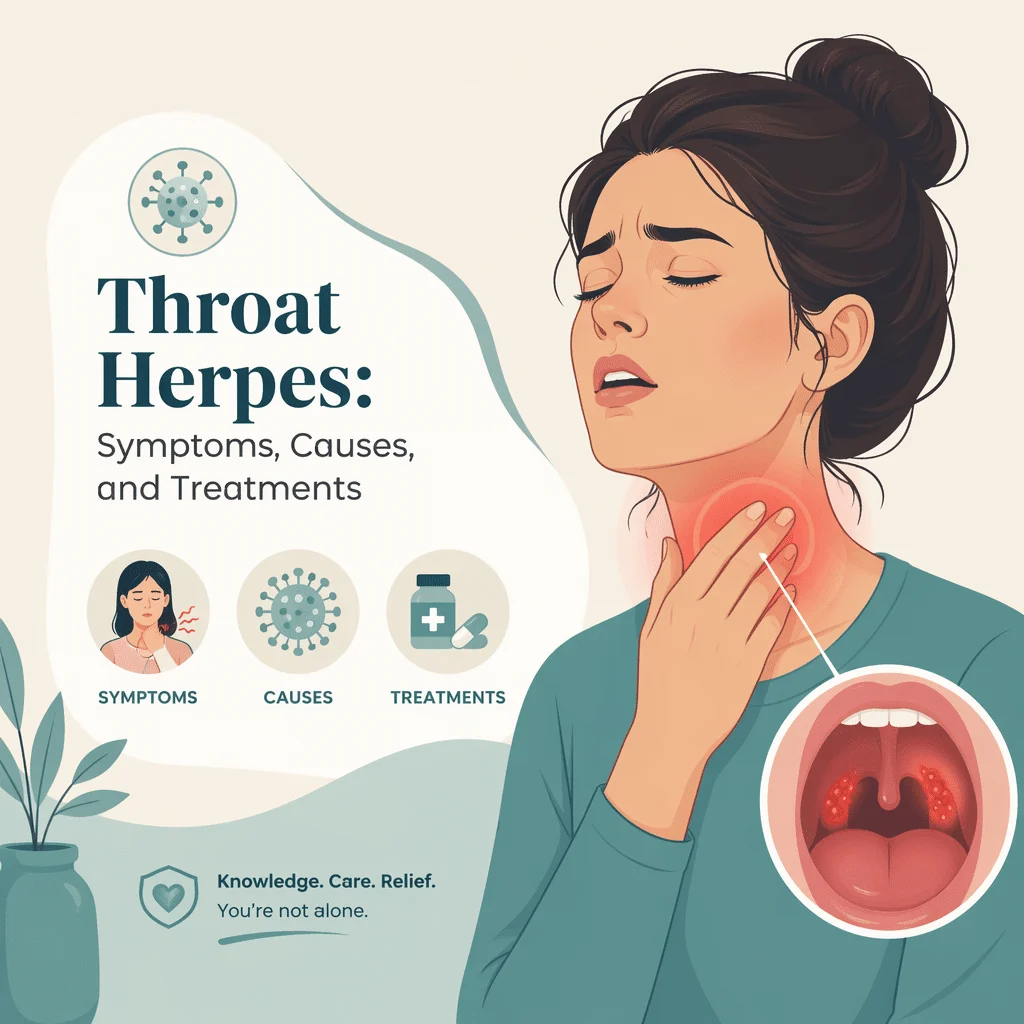
Herpes simplex is a virus that infects skin and the moist lining of the mouth, throat and genitals. When it settles in the tissues at the back of the mouth and the upper throat, clinicians call it herpetic pharyngitis. When it involves the gums, tongue, inner cheeks and lips as well — which is the usual pattern in a young child meeting the virus for the first time — they call it herpetic gingivostomatitis.
The virus does something unusual after a first infection: instead of being cleared, it travels along a nerve and settles quietly in a nerve cluster near the base of the skull. It stays there for life. Most of the time it does nothing at all. Occasionally it travels back down the nerve to the surface, which is what produces a cold sore on the lip or, less often, sores further back in the mouth and throat.
That lifelong residence is why there is no cure, and also why “having herpes” is such a poor description of what most people are living with. For the large majority it is a dormant passenger that surfaces rarely or never.
HSV-1 and HSV-2, explained without the stigma
There are two closely related herpes simplex viruses, and the naming has caused a great deal of unnecessary distress.
HSV-1 is the usual cause of oral and throat herpes. It is extremely common worldwide and, as the Centers for Disease Control and Prevention states plainly, most people with oral herpes acquire it during childhood or young adulthood from non-sexual contact with saliva. HSV-2 more often causes infection in the genital area.
Why the type label matters less than people expect
Here is the part that trips people up. The two viruses are not confined to their traditional territories. Either type can infect either site. HSV-1 from a cold sore can be transferred to the genitals, and HSV-2 can be transferred to the mouth and throat, through oral-genital contact in either direction. The CDC describes this openly, and it is the reason a meaningful share of first-time genital herpes is now caused by HSV-1 rather than HSV-2.
This is a fact about how a virus behaves on mucous membranes. It is not evidence about anybody’s private life, and it does not oblige you to explain or account for anything. A throat swab that returns HSV-1 tells you which virus is present. It cannot tell you when you acquired it, from whom, or how — and no test can.
A first infection versus a recurrence
The first episode is usually the hard one
A primary infection — the very first meeting between a person and the virus — tends to be the most uncomfortable. Small clustered blisters appear on the lining of the mouth and throat, break open within a day or two, and leave shallow, raw ulcers. Alongside that, people commonly describe a severe sore throat, pain on swallowing that is out of proportion to how the throat looks, fever, a general flattened feeling, and tender, swollen glands in the neck. Symptoms usually build over several days and then fade over a week or two.
Recurrences are usually milder and usually elsewhere
Later flare-ups behave differently. They are shorter, less painful, and in most people they surface as a cold sore on or near the lip rather than as sores in the throat. Many people notice a tingling or burning warning a day before anything is visible. Pharyngeal recurrences — flare-ups genuinely at the back of the throat — are much less common in people with a healthy immune system.
What it looks like in young children
In toddlers and preschoolers, a first infection often produces a florid gingivostomatitis: swollen, bleeding gums, ulcers across the tongue and inner cheeks, drooling, refusal to eat or drink, fever and irritability. It looks alarming and it usually settles on its own. The practical risk is not the virus itself but dehydration, because a child whose mouth hurts will simply stop drinking. Watching fluid intake is the main job for parents, and dehydration can affect the whole body, not just the mouth.
The look-alikes, and why you cannot tell by looking
A painful throat with ulcers or white patches has a long list of possible causes, and several of them look strikingly similar from the outside. The realistic contenders are streptococcal throat infection, infectious mononucleosis caused by the Epstein-Barr virus, herpangina and hand-foot-and-mouth disease caused by coxsackieviruses, aphthous ulcers (mouth ulcers with no infectious cause at all), and oral thrush from a Candida yeast overgrowth.
People routinely try to settle this by comparing photographs online. It does not work, and the reason is worth stating clearly: even experienced clinicians examining a throat in person cannot reliably separate these by appearance. Some patterns are suggestive — a cluster of tiny ulcers on the soft palate and tonsillar arches, a strawberry-red throat with a coating, a bumpy cobblestone appearance at the back of the throat, or swelling on one side only — but none of them is decisive.
| Feature | Throat herpes (HSV) | Strep throat | Mononucleosis (EBV) | Herpangina / hand-foot-and-mouth |
|---|---|---|---|---|
| Typical age | Young children for a first episode; any age for a later one | School-age children most often, but adults too | Teenagers and young adults | Mostly under-fives, often in summer clusters |
| What the throat looks like | Clustered small blisters that break into shallow ulcers; gums often inflamed in a first episode | Red, swollen tonsils, often with white or yellow patches; gums normal | Very enlarged tonsils with a thick grey-white coating | Scattered small ulcers on the soft palate and back of the throat; front of the mouth usually spared |
| Other features | Fever, tender neck glands, sometimes cold sores on the lips; no cough | Sudden fever, tender neck glands, no cough; sometimes a fine rash | Prolonged fatigue, glands enlarged in several areas, sometimes an enlarged spleen | Fever; in hand-foot-and-mouth, spots on the hands, feet and buttocks |
| What usually settles it | A swab of a sore sent for PCR | Rapid strep test or throat culture | Blood tests, including a monospot and EBV antibodies | Usually the clinical pattern; swab PCR if needed |
How throat herpes is actually diagnosed
Diagnosis starts with a conversation and an examination, but the answer usually comes from a test.
The most direct method is a swab rubbed against a fresh sore and sent for PCR, a laboratory technique that detects the virus’s genetic material. PCR is fast and sensitive, and it identifies which type of herpes simplex is present. Older viral culture is still used occasionally but is slower and misses more. Because strep is the one cause that changes management most, a rapid strep test or a throat culture is often done at the same time.
Blood tests play a supporting role rather than a starring one. A complete blood count can point towards a viral rather than bacterial picture, and raised lymphocytes are a classic finding in glandular fever. C-reactive protein gives a rough measure of how much inflammation is present but does not name a cause.
Serology — antibody testing — deserves a careful word. IgG antibodies tell you the immune system has met a virus at some point in the past, which for HSV-1 is true of most of the population. IgM antibodies are often read as meaning “recent”, but they are unreliable for herpes and can mislead in both directions. A blood test cannot confirm that the sores in your throat right now are herpes. Only a swab of those sores can.
What treatment involves
There are two parallel goals: acting on the virus, and making it possible to eat and drink.
Oral antiviral medicines are the class of drug used against herpes simplex — acyclovir and its relatives valacyclovir and famciclovir. They do not eliminate the virus, and whether they are appropriate, which one, at what strength and for how long is a prescribing decision that belongs to a doctor who has assessed you. What is consistent across the evidence is that antivirals work best when started early in an episode, which is an argument for seeking advice promptly rather than for self-medicating.
Symptomatic care is not an afterthought. Pain is what stops people drinking, and reduced drinking is what turns an unpleasant illness into a medical problem. General measures described by the NIDCR and MedlinePlus include keeping fluids going in steadily, choosing soft, bland, cool foods, avoiding anything spicy, acidic or very hot, and being gentle with oral hygiene around the sores. Numbing or coating preparations and pain relief are widely used; a pharmacist or doctor can advise on what is suitable for you or your child, and in what amount.
Who is at higher risk of a severe illness
For most healthy people, throat herpes is painful and then over. A smaller group needs a lower threshold for being seen.
People whose immune system is suppressed — through chemotherapy, an organ or stem cell transplant, long-term steroids or other immunosuppressant drugs, or advanced HIV infection — can develop herpes infection that is more extensive, slower to heal, and liable to extend downwards from the throat into the esophagus. Herpes esophagitis causes painful and difficult swallowing and generally needs prompt specialist assessment, usually with a camera examination and a biopsy, and treatment with antivirals.
Newborn babies are a separate and important category: herpes infection in the first weeks of life is treated as a medical emergency. If you have a cold sore, the standard advice is not to kiss a newborn and to wash your hands carefully.
Red flags: when to seek care without waiting
Most sore throats settle. These features are the ones that should prompt contact with a doctor or, where indicated, emergency services.
Seek medical help promptly if any of the following apply.
- Being unable to swallow fluids, or showing signs of dehydration — in a child, that means not passing urine, no tears when crying, a dry mouth, unusual drowsiness or floppiness.
- Difficulty breathing, or drooling combined with an inability to swallow — this can signal involvement of the airway and is an emergency.
- A stiff neck together with fever, or a severe headache with sensitivity to light.
- Symptoms in someone whose immune system is suppressed, or in a newborn baby.
- A first episode with very severe symptoms, high fever, or pain that is not controlled at home.
- Symptoms that are not improving after about ten days, or that are clearly getting worse rather than better.
A sore throat cannot be diagnosed from a web page. If something feels wrong, or worse than you expected, that is reason enough to have it looked at in person.
Latest scientific advances in understanding throat herpes
Recent research, indexed in PubMed, has sharpened several practical points. Full citations appear in the Sources section below.
How common HSV-1 is, and how that is changing. A systematic review with meta-analysis by AlMukdad and colleagues pooled decades of Canadian data and found that HSV-1 is carried by a large proportion of healthy adults and becomes steadily more common with age. It also identified a shift: fewer people are meeting the virus in childhood, while more are acquiring it later, and a growing share of first-episode genital herpes is now caused by HSV-1 rather than HSV-2. What this means for you: the old shorthand of “type 1 is oral, type 2 is genital” is becoming less accurate, and because fewer people encounter HSV-1 as young children, more adults now experience a first infection at an age when it tends to feel worse.
What actually helps in a first episode. A systematic review by Coppola and colleagues examined how primary herpetic gingivostomatitis — the full-blown first infection, mostly seen in children — is managed. The reviewers found that most treatments in everyday use target symptoms rather than the virus, that the evidence supporting antiviral treatment for speeding healing is weak, and that diagnosis is often delayed by a few days, which blunts any antiviral benefit. They also noted that pain can limit eating and drinking enough that some children need hospital care. What this means for you: being seen early matters if antivirals are going to be considered at all, and keeping fluids going is not a minor comfort measure — it is the central task.
Why “does it look like strep?” is the wrong question. A systematic review and meta-analysis by Kanagasabai and colleagues assessed the Centor and McIsaac scores, the standard clinical rules built from symptoms and examination findings to predict streptococcal throat infection. Their conclusion was blunt: at strict thresholds too many true cases are missed, and at loose thresholds too many people without strep are given antibiotics. What this means for you: if trained clinicians examining a throat in person cannot reliably separate bacterial from viral causes by appearance alone, comparing your throat to internet photographs will not settle it either. A swab or rapid test is what gives an answer.
When herpes goes further down. A review of infective esophagitis by Kim and Lee set out the main infectious causes of inflammation in the food pipe, with herpes simplex among the leading viral ones alongside cytomegalovirus, and Candida the commonest fungal cause. These infections are largely seen in people who are immunosuppressed, are identified by direct endoscopic examination with biopsy, and are treated with targeted antiviral or antifungal medicines. What this means for you: if your immune system is suppressed and swallowing becomes painful or difficult, that is a reason to be assessed rather than to wait and see.
Frequently asked questions
How did I get herpes in my throat?
Most likely years ago, without noticing, and through ordinary everyday contact. HSV-1 spreads through saliva and direct contact with skin or the lining of the mouth. The CDC states that most people with oral herpes acquire it in childhood or young adulthood from non-sexual contact — kisses from family, shared cups and cutlery, hands and toys among small children. It can also be transmitted through oral-genital contact in either direction, but that is one route among several, not the presumed one. There is no way to determine when or from whom you acquired it, and nothing you need to have done wrong for this to have happened.
Is throat herpes contagious, and for how long?
Yes, while sores are present. The fluid in the blisters and the saliva during an active episode carry virus, and the period of greatest contagiousness runs from the first tingling until the sores have fully healed — commonly one to two weeks in a first episode and less in a recurrence. The virus can also be shed intermittently when there are no symptoms at all, which is why transmission often happens between people who had no idea anything was active. During an episode, avoiding kissing and not sharing cups, bottles, cutlery or lip products is the practical step.
Is this strep throat or herpes?
This is not answerable by looking, including by a doctor looking. Some things lean one way: strep classically brings sudden fever, tender neck glands and no cough, while herpes more often brings clustered blisters and ulcers that involve the gums and inner mouth as well as the throat. But the overlap is substantial, and getting it wrong in either direction has consequences — untreated strep can lead to complications, while antibiotics do nothing at all for a viral sore throat. A rapid strep test, a throat culture or a viral swab is what resolves it, and all are quick to arrange.
How long does throat herpes take to clear up?
A first episode typically builds over a few days and then settles over one to two weeks, with the ulcers healing without scarring. Recurrences are usually shorter, often under a week. Feeling drained for a while afterwards is common and not a sign that something has gone wrong. What is not normal is symptoms that plateau or worsen beyond about ten days, or pain severe enough that you cannot keep fluids down — either of those warrants review rather than more waiting.
Can I still kiss my partner or share food?
While you have active sores, it is sensible to avoid kissing, oral sex, and sharing anything that goes near the mouth — cups, bottles, cutlery, lip balm, toothbrushes. Wash your hands after touching the sores, and take particular care around newborn babies and anyone whose immune system is suppressed. Between episodes, ordinary life resumes. Because the virus can occasionally be shed without symptoms, no approach removes risk entirely, and that is worth knowing rather than worrying about.
Does a positive herpes blood test mean I have throat herpes?
No. A positive HSV-1 IgG result means your immune system has met the virus at some point, which is true of the majority of adults. It says nothing about whether the sores in your throat today are caused by herpes, when you were infected, or where the virus lives in your body. If a current throat infection needs identifying, a swab of an active sore sent for PCR is the test that answers the question. This distinction matters, because antibody results are a frequent source of unnecessary alarm.
Glossary of key terms
| Term | Definition |
|---|---|
| Herpes simplex virus (HSV) | A common virus with two types, HSV-1 and HSV-2, that infects skin and the moist linings of the mouth, throat and genitals and then stays dormant in nerve tissue. |
| Herpetic pharyngitis | Inflammation of the throat caused by herpes simplex virus, producing blisters and shallow ulcers. |
| Gingivostomatitis | Widespread inflammation and ulceration of the gums and the lining of the mouth, the usual pattern of a first HSV-1 infection in a young child. |
| Primary infection | The first time a person is infected with a virus, before any immunity has developed; usually the most symptomatic episode. |
| Recurrence | A later episode caused by the same dormant virus reactivating, generally shorter and milder than the first. |
| Viral shedding | Release of infectious virus particles, which can happen with or without visible sores. |
| PCR (polymerase chain reaction) | A laboratory method that detects a virus’s genetic material in a sample, used on swabs from sores to identify HSV and its type. |
| Serology | Blood testing for antibodies, which shows past exposure to a virus rather than what is causing symptoms today. |
| Aphthous ulcer | A common mouth ulcer, also called a canker sore, that forms inside the mouth, has no infectious cause and is not contagious. |
| Esophagitis | Inflammation of the food pipe, which herpes simplex can cause mainly in people whose immune system is suppressed. |
Sources
- Centers for Disease Control and Prevention. About Genital Herpes. https://www.cdc.gov/herpes/about/index.html
- MedlinePlus, National Library of Medicine. Cold Sores (Oral Herpes). https://medlineplus.gov/coldsores.html
- National Institute of Dental and Craniofacial Research. Fever Blisters & Canker Sores. https://www.nidcr.nih.gov/health-info/fever-blisters-canker-sores
- AlMukdad S, Harfouche M, Farooqui US, Aldos L, Abu-Raddad LJ. Epidemiology of herpes simplex virus type 1 in Canada: systematic review, meta-analyses, and meta-regressions. Frontiers in Public Health. 2023;11:1118249. https://doi.org/10.3389/fpubh.2023.1118249
- Coppola N, Cantile T, Adamo D, Canfora F, Baldares S, Riccitiello F, Musella G, Mignogna MD, Leuci S. Supportive care and antiviral treatments in primary herpetic gingivostomatitis: a systematic review. Clinical Oral Investigations. 2023;27(11):6333-6344. https://doi.org/10.1007/s00784-023-05250-5
- Kanagasabai A, Evans C, Jones HE, Hay AD, Dawson S, Savović J, Elwenspoek MMC. Systematic review and meta-analysis of the accuracy of McIsaac and Centor score in patients presenting to secondary care with pharyngitis. Clinical Microbiology and Infection. 2024;30(4):445-452. https://doi.org/10.1016/j.cmi.2023.12.025
- Kim NY, Lee J. Infective Esophagitis. The Korean Journal of Helicobacter and Upper Gastrointestinal Research. 2025;25(2):108-116. https://doi.org/10.7704/kjhugr.2025.0007
Further reading
- Bad tasting phlegm: causes and treatments
- Is a sinus infection contagious? Causes and risks
- Kissing tonsils: causes, symptoms and treatments
- Cough drops: benefits, uses and risks
- Lymphocytes explained: your immune system’s guardians
Understand your lab results with AI DiagMe
If a doctor investigates a severe or persistent sore throat, they may order a throat swab, a complete blood count or viral serology. Those results often arrive as a page of numbers with no explanation attached.
AI DiagMe helps you understand blood results after the fact, in plain language, so you can arrive at your next appointment with better questions. It does not diagnose, it cannot examine your throat, and it does not replace your doctor.
Get your results interpreted in minutes