



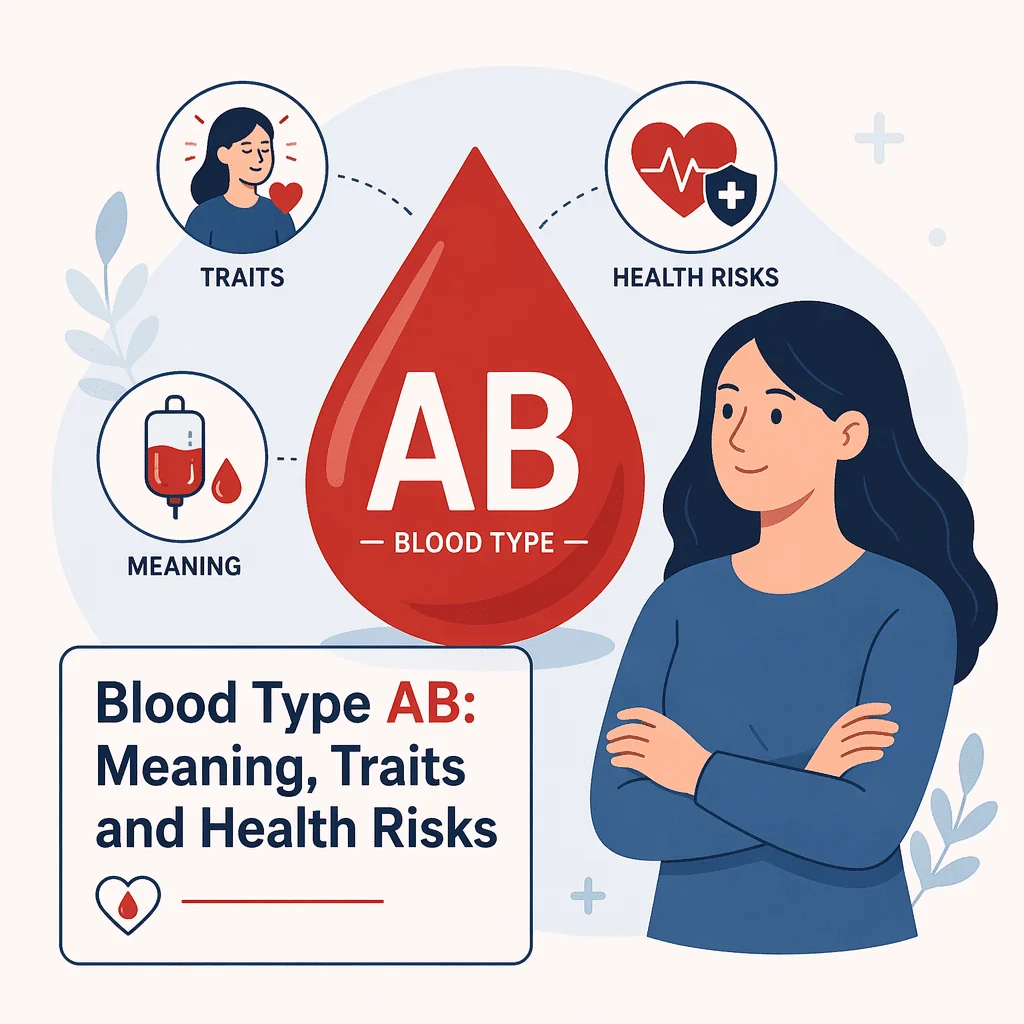
Blood type AB is the least common of the four main ABO blood groups, and it has a few features that set it apart. If you carry this blood type, your red blood cells display both A and B markers, and your plasma usually lacks the antibodies that attack A or B cells. That combination shapes how you give and receive blood, what doctors watch during pregnancy, and a handful of health associations worth understanding. This guide explains, in plain language, what blood type AB means, how you inherit it, how common it is, and what it means for transfusions, pregnancy, and long-term health. You will also find a quick compatibility table, answers to common questions, and clear guidance on when your blood type actually matters in medical care.
The Rh factor changes the picture: see what makes AB positive the universal recipient.
What does blood type AB mean?
Blood type AB belongs to the ABO system, the main way labs sort human blood. People with this group carry two surface markers, called antigens, on their red blood cells: the A antigen and the B antigen. Think of antigens as ID tags that the immune system reads to tell “self” from “foreign.”
Because AB cells already display both tags, the plasma (the liquid part of blood) of most people with blood type AB does not make anti-A or anti-B antibodies. Antibodies are immune proteins that latch onto foreign tags and can destroy the cells that carry them. With no anti-A or anti-B on patrol, AB plasma tolerates a wide range of donor cells.
Your full label also includes the Rh factor, a separate marker written as positive or negative. So a complete result reads as AB positive (AB+) or AB negative (AB−). To see how AB fits alongside the other groups, it helps to review the four ABO blood groups explained as a set.
Key facts about blood type AB:
- Carries both A and B antigens on red blood cells.
- Plasma usually has no anti-A or anti-B antibodies.
- Splits into AB positive (AB+) and AB negative (AB−) based on the Rh factor.
- Rarest of the four main ABO groups, around four percent of people worldwide.
- AB plasma can go to any ABO type, which makes AB a universal plasma donor.
How the ABO and Rh systems create blood type AB
Two independent systems decide your blood type AB label. The first is the ABO system, built on three gene versions, or alleles: A, B, and O. The A and B alleles are co-dominant, which means neither hides the other. When you inherit an A allele from one parent and a B allele from the other, both are expressed, and the result is blood type AB.
The second system is Rh, centered on a protein called the D antigen. If your red cells carry the D antigen, you are Rh positive; if they do not, you are Rh negative. The Rh system follows its own genetic pattern and is tested separately from ABO.
Clinicians combine both results to match blood safely and to flag certain pregnancy risks. A laboratory confirms your type by mixing a small blood sample with test reagents and watching for agglutination, the clumping reaction that shows which antigens are present.
AB positive vs AB negative
The difference between AB positive and AB negative comes down to that single Rh D antigen. AB positive means your cells carry it; AB negative means they do not. AB positive is the more common of the two by a wide margin.
AB negative is one of the rarest combinations on the standard ABO and Rh chart, found in well under one percent of many populations. The distinction matters most for transfusions and pregnancy, where Rh status guides which donor blood is safe and whether preventive treatment is needed.
How is blood type AB inherited?
Blood type AB is passed down through the ABO alleles your parents carry. Each parent gives one allele to each child. If one parent passes an A and the other passes a B, the child inherits blood type AB. This is the everyday way AB arises, and it explains why AB can appear in a family where the parents themselves are type A and type B.
Family history can hint at likely outcomes, but only laboratory typing gives a definitive answer. Genetic testing can also explain unusual results, such as weak subgroups, where an antigen is present but only faintly. The Rh trait is inherited on a separate track, so a child’s positive or negative status does not follow automatically from the ABO result.
Curious how the parent groups differ? You can compare the profiles of blood group A, blood group B, and blood type O to see how each combination behaves.
How is blood typing done?
Finding your blood type AB takes a quick, routine lab test. A technician mixes a small blood sample with reagents that contain known anti-A, anti-B, and anti-D antibodies, then watches for agglutination — the visible clumping that reveals which antigens your cells carry. Clumping with the anti-A and anti-B reagents, for example, points to type AB.
Blood typing is often done alongside other routine work. It is part of pre-surgical testing and early prenatal panels, and it may sit on the same requisition as a complete blood count, which measures your red cells, white cells, and platelets. Typing itself is not part of a standard checkup, though, so many people first learn their type when they donate blood, prepare for surgery, or become pregnant.
Results are reported simply, as one of eight labels from A+ to O−. If you are unsure of yours, a clinician or a blood donation center can confirm it.
How common is blood type AB?
Blood type AB is uncommon everywhere. Across the global population it appears in roughly four percent of people on average, which makes it the rarest of the four ABO groups. AB positive accounts for most of that figure, while AB negative is rarer still, often below one percent.
Frequencies shift by region and ancestry. Some East Asian and South Asian populations show higher AB rates than many populations of European or African descent. National blood services track these local patterns so they can keep balanced stocks and anticipate demand for matching units.
For most everyday situations, the rarity of blood type AB changes little. It becomes relevant mainly when blood needs to be matched, when planning a pregnancy, or when donating, because AB plasma is especially valuable.
Blood type AB and transfusions: universal recipient and plasma donor
Transfusion safety rests on matching ABO and Rh so the recipient’s antibodies do not attack donor cells. Blood type AB has a special place here, but the rules differ for red cells and for plasma, so it helps to separate the two.
For red blood cells, a person who is AB positive can receive cells from any ABO group, as long as Rh is compatible. That is why AB positive is often called the universal red cell recipient. A person who is AB negative can also receive from any ABO group, but only from Rh negative donors.
For plasma, the picture flips. Because AB plasma lacks anti-A and anti-B antibodies, it can be given to recipients of any ABO type. This makes people with blood type AB universal plasma donors, and AB plasma is frequently in high demand at blood centers.
The table below summarizes who an AB person can receive red cells from and donate red cells to.
| Red blood cells | AB positive (AB+) | AB negative (AB−) |
|---|---|---|
| Can receive from | A, B, AB, O — Rh+ or Rh− | A, B, AB, O — Rh− only |
| Can donate to | AB+ only | AB+ and AB− |
One more practical note: in a true emergency, before typing is complete, hospitals often reach for O negative red cells, which carry the lowest risk of a quick reaction. Full typing and a crossmatch — a direct test that mixes donor and recipient samples — still follow as soon as possible.
Blood type AB and pregnancy
During pregnancy, the antibody risk that doctors watch most closely comes from the Rh system, not from ABO. If an Rh negative mother carries an Rh positive baby, her immune system can form anti-D antibodies. These antibodies usually cause no trouble in a first pregnancy but can affect a later Rh positive baby.
Here, blood type AB carries a built-in advantage on the ABO side. Because AB mothers naturally lack anti-A and anti-B antibodies, ABO-related hemolytic disease of the newborn — a condition where maternal antibodies break down fetal red cells — rarely originates from an AB mother.
Standard prenatal care still includes blood typing and an antibody screen early in pregnancy. If the mother is Rh negative, clinicians can give Rh immunoglobulin (a preventive injection, sometimes shortened to RhIg) at the right times to stop anti-D antibodies from forming. You can see how typing fits into the wider schedule of blood tests during pregnancy.
Blood type AB and your health: what the research says
Researchers have looked for links between ABO groups and the risk of certain conditions, and the findings are mixed and modest. Some large studies report a slightly higher risk of cardiovascular problems, including blood clots, among people with non-O blood types, a group that includes blood type AB. A few analyses also describe small differences in the risk of specific cancers across ABO groups, while type O appears modestly protective against some infections and stomach ulcers.
It is important to read these patterns the right way. They describe averages across large populations, not the fate of any one person. A blood type is not a diagnosis, and the size of any added risk is small compared with the factors you can act on.
Day-to-day habits and traditional risk factors remain the main drivers of long-term health. Managing blood pressure, not smoking, staying active, and keeping an eye on high cholesterol matter far more than your ABO group. If your doctor is assessing heart risk, tests such as a lipid panel or a cardiac markers panel give far more actionable information than blood type alone.
When your blood type AB matters most
For most of daily life, blood type AB sits quietly in the background. It moves to the foreground in a handful of specific situations, and knowing them helps you take simple, useful steps.
Your blood type matters most when:
- You may need a transfusion or are scheduled for surgery, where the team will type and crossmatch your blood beforehand.
- You are pregnant or planning a pregnancy, when Rh status guides whether preventive treatment is needed.
- You need or donate an organ, since ABO compatibility is part of the match.
- You face a medical emergency, where a documented blood type speeds safe care.
A few practical habits make these moments smoother. Keep a clear record of your ABO and Rh type on a health document, a donor card, or a phone medical ID. If you give blood, ask local services whether they need AB plasma or red cells, because AB plasma is often in short supply relative to demand. Follow routine preventive care like everyone else, and bring your blood type up with your provider before any planned transfusion, surgery, or pregnancy.
If you have a recent lab report and want to make sense of your blood type alongside the rest of your results, our guide on how to read your blood test results walks through the layout step by step. Tell your doctor promptly if you are ever told your antibody screen is positive, or if you have had a past transfusion reaction, since both can change how your care is planned.
Glossary
| Term | Definition |
|---|---|
| ABO blood group system | The main system that sorts blood into types A, B, AB, and O based on A and B antigens. |
| Agglutination | The clumping of red blood cells that happens when antibodies bind matching antigens; used in blood typing. |
| Antibody | An immune protein in plasma that recognizes a specific antigen and can trigger destruction of the cell carrying it. |
| Antigen | A marker on the red blood cell surface that the immune system uses to tell its own cells from foreign ones. |
| Crossmatch | A direct lab test that mixes donor and recipient blood to confirm they are compatible before a transfusion. |
| Hemolytic disease of the newborn (HDN) | A condition in which a mother’s antibodies cross the placenta and break down the baby’s red blood cells. |
| Hemolytic transfusion reaction | A dangerous reaction in which incompatible transfused blood is destroyed by the recipient’s immune system. |
| Rh factor (D antigen) | A red cell protein that makes blood Rh positive when present and Rh negative when absent. |
| Rh immunoglobulin (RhIg) | A preventive injection given to Rh negative mothers to stop them from forming anti-D antibodies. |
| Universal plasma donor | A person whose plasma lacks anti-A and anti-B antibodies, so it can be given to any ABO type; people with type AB. |
Frequently asked questions
Is blood type AB the rarest blood type?
Among the four main ABO groups, blood type AB is the rarest, appearing in roughly four percent of people worldwide. When you add the Rh factor, AB negative is the least common of the eight standard blood types, often found in under one percent of many populations. That said, “rarest” depends on how you count and on local ancestry. There are also far rarer types outside the ABO and Rh systems, defined by unusual antigen patterns, but these are exceptional. For everyday care, knowing you are AB positive or AB negative is what matters.
Can two parents without AB blood have an AB child?
Yes. The most common way a child inherits blood type AB is when one parent passes an A allele and the other passes a B allele. So a type A parent and a type B parent can have an AB child, even though neither parent is AB themselves. Inheritance also depends on the hidden alleles each parent carries, which is why outcomes are not always obvious from the parents’ visible types. Rare genetic exceptions exist, but the A-plus-B route covers the vast majority of cases. Only laboratory typing confirms a child’s actual blood type.
Does blood type AB mean I should follow a special diet?
No. The popular idea that each blood type needs its own diet is not supported by good evidence. Studies that tested blood-type diets found that any benefits came from the healthy eating pattern itself, not from matching food to blood type AB or any other group. You do not need to eat differently because of your ABO type. A balanced diet, regular activity, and the preventive care your doctor recommends will do far more for your health than tailoring meals to a blood type.
Is blood type AB linked to a higher risk of infections or COVID-19?
Some large studies have explored whether ABO groups affect infection risk, including COVID-19, and the results are mixed and modest. A few reports suggested non-O types, including blood type AB, might have a slightly different risk profile, while type O appeared modestly protective in some analyses. The differences are small, the evidence is not consistent, and they do not change how an individual should protect themselves. Standard measures — vaccination where recommended, hygiene, and following public health advice — matter far more than your blood type. Discuss any specific concerns with your doctor.
How do I find out if I am AB positive or AB negative?
A simple blood typing test settles it. A lab mixes a small sample of your blood with reagents to see which antigens your red cells carry and whether the Rh D antigen is present, then reports a single label such as AB+ or AB−. You will often learn your type when you donate blood, prepare for surgery, or have early prenatal tests. If you have never been typed and want to know, ask your doctor or a local blood donation center. Avoid relying on memory or family assumptions, since only testing is definitive.
Should I be worried about having blood type AB during surgery?
Having blood type AB is not a reason to worry about surgery on its own. Before any planned procedure that might need blood, the team types your blood and runs a crossmatch to confirm a safe match. If you are AB positive, you can receive red cells from any ABO group when Rh is compatible, which often widens your options. The most useful thing you can do is make sure your blood type is on your records and mention any past transfusion reaction to your care team. They handle the compatibility details for you.
Sources
- Cleveland Clinic — Blood Types
- Mayo Clinic — Universal blood donor type
- MedlinePlus (NIH) — ABO incompatibility
Further reading
- The four ABO blood groups explained
- Understanding the Rh system
- Blood group A: traits and health guide
- Blood group B: meaning and health guide
- Blood type O: meaning, risks, and benefits
Understand your lab results with AI DiagMe
Knowing your blood type AB is one piece of a much bigger picture. AI DiagMe can read the rest of your lab report and explain it in plain language — from your blood typing and antibody screen to a complete blood count or a lipid panel for heart-health risk. It turns rows of numbers and abbreviations into clear, useful insights and suggests questions to raise with your clinician. AI DiagMe helps you understand your results; it does not diagnose conditions or replace your doctor. Upload your report to see what your results mean.
➡️ Get your results interpreted in minutes