



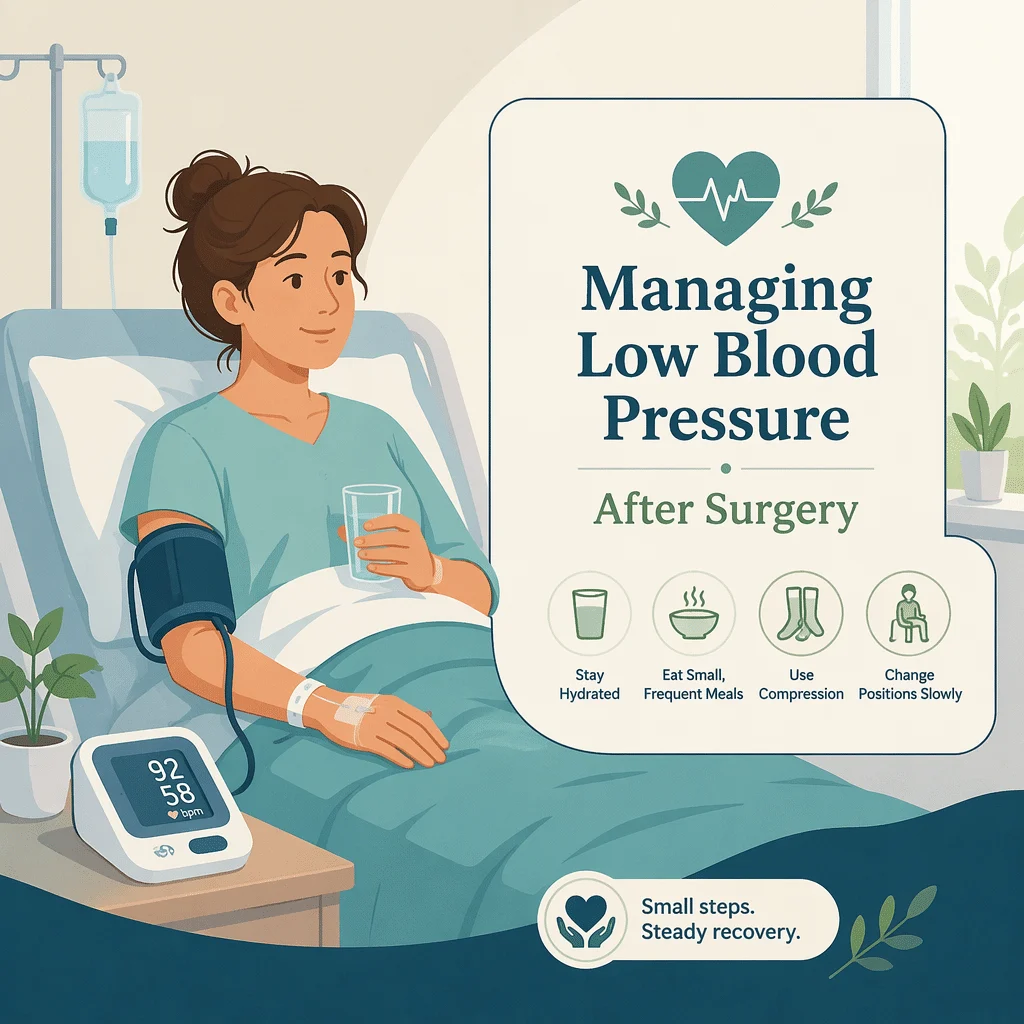
Low blood pressure after surgery is one of the things a recovery team watches most closely, and in most cases it is a short-lived, expected part of waking up from an operation. Anesthesia relaxes the blood vessels, body fluids shift, and pain medicines add their own effect, so a reading below your usual number for a few hours is often not a cause for alarm. What matters is the pattern: how far it has fallen, how you feel, and whether it recovers. In this article you’ll learn what counts as low, which readings and symptoms are expected on each day of recovery, the causes a surgical team looks for, the lab tests used to find them, and the warning signs that need urgent help rather than watchful waiting.
What counts as low blood pressure after surgery
Blood pressure is written as two numbers: the systolic pressure when the heart contracts, and the diastolic pressure when it relaxes. MedlinePlus describes hypotension as a reading of about 90/60 mm Hg or lower, while adding that a low number only becomes a problem when it causes symptoms such as dizziness or fainting. That last point is the key to reading your own chart after an operation.
In the operating room and the recovery unit, clinicians usually watch a third number: the mean arterial pressure, or MAP, the average pressure across a whole heartbeat. A MAP of 65 mm Hg or higher is the target most teams use during and immediately after major surgery. A single reading below your usual range is far less informative than a trend, so nurses record readings every few minutes at first, then space them out as you stabilize.
Your own baseline matters more than a textbook number
Someone who normally runs 100/65 mm Hg can feel perfectly well at 95/60 after an operation. Someone treated for hypertension who normally runs 150/90 may feel dizzy and unwell at 110/70, even though that reading looks reassuring on paper. Teams therefore compare your post-operative readings against the baseline recorded before surgery, and a fall of roughly a fifth below that baseline draws attention even if the absolute number looks acceptable. Our guide explains the blood tests done before surgery, which help establish that baseline picture.
Expected versus concerning readings, day by day
The same number can be routine on the afternoon of your operation and worrying a week later. This table sets out the general pattern most recovery units describe. It does not replace the discharge instructions your own team gave you, which always take priority.
| Time after surgery | Usually expected | Tell the team right away |
|---|---|---|
| First few hours, recovery unit | A reading somewhat below your usual number while you are awake, warm, dry and passing urine | Confusion, chest pain, cold clammy skin, or a reading that keeps falling with each check |
| First 24 to 48 hours, ward | Brief lightheadedness the first times you sit up or stand, settling within a minute or two | Fainting, a fall, breathlessness at rest, or very little urine over several hours |
| Days 2 to 5 | Mild dizziness on standing that eases as you drink more and move more | Dizziness together with fever, a hot or leaking wound, a racing heart, or black tarry stools |
| First two weeks at home | Readings drifting back toward the range you had before the operation | Repeated near-fainting, readings staying far below your usual, or new symptoms after a medicine was restarted |
What causes low blood pressure after surgery
Post-operative hypotension is rarely one problem. It is usually several small effects stacking up, which is why the team looks at timing as much as at the number.
Anesthesia and the widening of blood vessels
General and regional anesthetics relax the muscle in artery walls. The vessels widen, the same volume of blood fills a larger space, and the pressure falls. This effect fades over hours as the drugs wear off, and it is the most common reason for a low reading in the recovery unit.
Blood loss and low circulating volume
Surgery removes fluid from the circulation through bleeding, drains, evaporation from an open field, and the hours of fasting beforehand. Less volume means less pressure. If bleeding continues after the operation, the pressure falls while the heart rate climbs to compensate, and this is the situation teams most want to catch early. Our article covers the symptoms and causes of anemia, which is what significant blood loss eventually produces.
Pain medicines, epidurals and spinal blocks
Opioid painkillers lower blood pressure in two ways: they widen vessels and they reduce the body’s stress response. Epidural and spinal anesthesia block the nerves that keep the vessels in the lower body tight, so pressure can drop each time the block is topped up, and standing up while a block is running is a common moment for a dip.
Infection, heart problems and adrenal causes
From roughly the second day onward, a falling pressure raises the question of infection. In sepsis the vessels widen and leak, and the pressure falls despite a fast pulse and a fever. Heart causes are less common but more urgent: a rhythm disturbance, a weakened pump, or damage to heart muscle around the time of surgery. Rarely, the adrenal glands cannot produce enough cortisol to sustain blood pressure, which is suspected when the pressure does not respond to fluids. Our team explains the causes of low morning cortisol, the test used to explore that possibility.
Your own blood pressure medicine restarted too early
Many people arrive at surgery already taking treatment for hypertension. Those medicines are often paused around the operation and restarted once you are eating, drinking and stable. Restarted too soon, into a circulation that is still refilling, they can produce a sharp drop. Your medication chart is therefore checked against your readings, and the decision belongs to the team. Our library covers the causes and treatment of high blood pressure in more depth.
| Likely cause | Typical timing | What the team usually checks |
|---|---|---|
| Anesthesia widening the vessels | Minutes to a few hours after the operation | Repeat readings, position, a fluid challenge, response to a small dose of a pressure-raising drug |
| Blood loss and low volume | First hours up to about 48 hours | Hemoglobin and hematocrit, wound and drain output, heart rate, urine output |
| Opioid pain medicines | Whenever a dose is given or increased | Dose timing against the readings, breathing rate, how sleepy you are |
| Epidural or spinal block | While the block is running, often 12 to 48 hours | How high the block has spread, fluids, readings when you sit up |
| Infection or sepsis | Usually day 2 onward | Temperature, white cell count, CRP, lactate, blood and wound cultures |
| Heart rhythm or heart muscle problem | Any time, most often days 1 to 3 | ECG, troponin, an echocardiogram if needed |
| Adrenal insufficiency | Uncommon; hours to days, typically when fluids do not help | Cortisol, sodium and potassium |
| Usual blood pressure medicine restarted | Within hours of the first dose back | Medication chart against the readings, standing and lying measurements |
Orthostatic hypotension: the dizziness when you stand up
Most people recovering at home do not see a dangerously low number on a monitor. They feel a few seconds of grey, swimming dizziness the moment they get out of bed. That is orthostatic hypotension, sometimes called postural hypotension: when you stand, gravity pulls around half a liter of blood into your legs, and the reflex that normally tightens the vessels is slower than usual after surgery.
Three things make that reflex sluggish in the first weeks: you are carrying less circulating fluid than normal, you have been lying down far more than usual, and pain or sleep medicines blunt the response. Dehydration makes all of it worse, and this guide explains the link between dehydration and blood pressure.
Standing up safely while you recover
- Sit on the edge of the bed for a slow count of thirty before you stand.
- Pump your ankles and squeeze your calf muscles a few times before rising.
- Stand with a hand on something solid, and wait a moment before walking.
- Have someone nearby for the first few attempts after you get home.
- Drink to the plan your team gave you, especially in warm weather.
- Get up slowly after a hot shower or a large meal, which both widen the vessels.
If the dizziness makes you grey out, buckle, or sit back down every time, report it. That is a fall risk, and it may have a treatable cause.
Lab tests used to find the cause
The monitor tells the team that pressure is low. Blood work tells them why. Most of these tests are drawn together, from a single sample.
- Hemoglobin and hematocrit show whether blood loss explains the fall, and whether a transfusion should be considered. Our team details how to read a complete blood count, which contains both.
- Sodium, potassium and the other electrolytes show how fluids and salts have shifted since the operation. A separate page explains the results of an electrolyte panel.
- Creatinine and urea show how the kidneys are coping, because they suffer first when pressure stays low. We also describe the tests in a kidney function panel, and another article explains the meaning of the BUN to creatinine ratio, which often rises when circulating volume is low.
- Lactate rises when tissues are not receiving enough oxygen, so it helps the team judge how serious a low pressure really is.
- White cell count and C-reactive protein point toward infection. Our library explains how to read a CRP result, and another article covers the causes of high neutrophils.
- Cortisol is measured when adrenal insufficiency is suspected, usually because fluids and drugs are not working as expected.
- Troponin is checked if the heart is a possible cause. A dedicated page explains the role of troponin as a cardiac marker.
When low blood pressure after surgery is an emergency
Call emergency services, or go straight to an emergency department, if a low reading comes with any of the following. The National Heart, Lung, and Blood Institute advises calling 911 for signs of shock, which include cold and sweaty skin, rapid breathing, a bluish skin tone, and a weak, rapid pulse.
- New confusion, drowsiness that is hard to rouse from, or slurred speech.
- Chest pain, severe breathlessness, or a pounding, racing heartbeat.
- Fainting, or collapsing when you try to stand.
- Skin that is cold, pale, grey or clammy, especially with shivering.
- Passing very little urine, or none, over six to eight hours.
- A reading that falls further at every check rather than steadying.
- Dizziness together with a fever, shaking chills, or a wound that is hot, swollen or leaking.
- Heavy bleeding from the wound, vomiting blood, or black tarry stools.
If the dizziness is mild and settles when you sit down, contact your surgical team the same day rather than waiting for your scheduled appointment. They can tell you whether the pattern fits your operation.
How it is treated, and why you must not adjust your own medicines
Treatment follows the cause. Lying flat with your legs raised buys time. Intravenous fluid refills the circulation and is the usual first step. If fluid alone is not enough, a drug that tightens the vessels, called a vasopressor, can be given through a drip in a monitored setting. Bleeding may need a transfusion or a return to the operating room. Infection needs antibiotics and source control, and a heart cause needs cardiac treatment.
One rule matters more than all the rest for anyone reading at home: do not start, stop, skip, halve or restart any medicine on your own because of a blood pressure reading. That includes your usual hypertension tablets, your diuretic, and your pain medicine. Whether a drug is paused, resumed or changed after surgery is a decision for your surgical, anesthetic or medical team, who are weighing your operation, your kidneys, your heart and your other medicines together. Bring your readings and your full medicine list to the conversation, and let them make the call.
Latest scientific advances
Research since 2023 has refined how teams manage blood pressure around surgery. None of it changes what you do at home, but it explains what is happening around you.
Pausing blood pressure tablets before surgery
A large randomized trial published in JAMA in 2024, covering more than two thousand patients in forty French hospitals, looked at renin-angiotensin system inhibitors, a common family of blood pressure drugs that includes ACE inhibitors and ARBs. Continuing them up to the day of surgery caused no more complications overall than stopping them two days beforehand, but low blood pressure episodes during the operation were more frequent in those who kept taking them. What this means for you: if your team pauses a tablet before surgery, that is a deliberate trade-off, not a sign that anything has gone wrong.
Dizziness on first standing is common, and under-defined
A systematic review and meta-analysis published in 2023 pooled twenty-one studies covering more than fourteen thousand people who had hip or knee replacement. Feeling faint or dizzy on first standing was common, though reported rates varied widely because researchers had not agreed on a single definition. A few of the studies pointed to well-controlled pain during that first walk as a factor, a finding the authors call preliminary. What this means for you: feeling faint the first time you stand after joint surgery is something the research describes as ordinary. Say so rather than pushing through it.
Drips that support blood pressure vary a lot between hospitals
An international observational study published in 2025, covering more than twenty-five thousand patients in forty-two countries, found that roughly four in a hundred people received a continuous blood-pressure-supporting infusion after non-cardiac surgery. The rate ranged from none at all to almost one in five depending on the hospital, a gap that differences between patients did not explain. Those who received one had worse outcomes overall, but because this was an observational study rather than a trial, it cannot show that the drug caused the difference; needing one is more likely a marker of a difficult recovery. What this means for you: practice varies, and it is reasonable to ask why a particular support is or is not being used.
Personalized pressure targets have not yet proved better
In a 2025 German trial of high-risk patients having major abdominal surgery, setting the pressure target from each person’s own nighttime average did not reduce kidney injury, heart injury or death in the first week compared with the standard target used in routine care. A pooled analysis of ten randomized trials, published in 2023, also found no increase in deaths when a somewhat lower pressure was accepted during surgery rather than pushed higher. What this means for you: the familiar targets your team already uses are holding up under testing, and a moderately low number on the chart during your operation is not, on its own, evidence that something went wrong.
Glossary
| Term | Definition |
|---|---|
| Hypotension | The medical word for low blood pressure. It usually describes a reading around 90/60 mm Hg or lower, but it matters most when it causes symptoms. |
| Mean arterial pressure (MAP) | The average pressure in your arteries across a whole heartbeat. It is the number anesthetic and intensive care teams watch most closely. |
| Orthostatic hypotension | A drop in blood pressure that happens when you stand up, causing brief dizziness or greying of vision. Also called postural hypotension. |
| Hypovolemia | Too little fluid circulating in the blood vessels, usually from bleeding, fasting, drains or fluid loss. Less volume means less pressure. |
| Vasodilation | Widening of the blood vessels. The same amount of blood fills a bigger space, so the pressure inside falls. |
| Vasopressor | A drug given through a drip that tightens the blood vessels to raise blood pressure. It is used in monitored settings such as recovery units. |
| Adrenal insufficiency | A state in which the adrenal glands do not make enough cortisol, a hormone needed to keep blood pressure up during stress such as surgery. |
| Lactate | A substance that builds up in the blood when tissues are short of oxygen. A rising level suggests low pressure is affecting the organs. |
| Hematocrit | The proportion of your blood made up of red cells. It falls after significant bleeding and is read alongside hemoglobin. |
Frequently asked questions
How long does low blood pressure last after surgery?
For most people the anesthetic-related drop fades within hours, and readings look close to normal within one to three days. Dizziness on standing often takes longer, easing over one to two weeks as fluid balance, activity and sleep return to normal. Bigger operations, longer hospital stays and older age all stretch that timeline. What is not expected is a reading that keeps falling, or one that is still clearly below your usual range several weeks later without explanation. That pattern deserves a review of your medicines, your fluid intake and your blood work rather than more waiting.
What is a dangerously low blood pressure after surgery?
There is no single cut-off, because symptoms matter more than the number. A systolic reading below 90 mm Hg is usually the point at which teams act, and a mean arterial pressure under 65 mm Hg is the threshold most recovery units treat. In practice, any reading that comes with confusion, chest pain, fainting, cold clammy skin or very low urine output is treated as dangerous whatever it says, and any reading that keeps falling at each check is treated as urgent even if it has not yet crossed a threshold.
Why does blood pressure drop after surgery?
Usually several reasons at once. Anesthetic drugs relax the artery walls so blood fills a wider space. Fasting, bleeding, drains and evaporation from the surgical field leave less fluid in the circulation. Opioid painkillers and epidural or spinal blocks add their own lowering effect. Later in recovery, infection, a heart problem or the resumption of your usual blood pressure medicine can take over as the main driver. This is why the timing of a drop tells the team almost as much as the reading itself.
Is low blood pressure two weeks after surgery normal?
Mild dizziness when standing two weeks after a major operation is common, particularly if you are eating and drinking less than usual, moving less, or still taking pain medicine. A reading that remains well below your pre-surgery baseline at that point is worth investigating, because by then the anesthetic effect has long gone. The usual explanations are ongoing low fluid intake, slow recovery from blood loss, or blood pressure medicine that no longer suits your current state. All three are for your medical team to assess, not to adjust yourself.
Can low blood pressure after surgery be life-threatening?
It can be, which is why it is monitored so closely, but the great majority of episodes are mild and resolve with position, fluids and time. Pressure becomes dangerous when it is low enough, for long enough, to starve organs of oxygen, which is what happens in severe bleeding, in sepsis and in shock. Those situations announce themselves with more than a number: altered thinking, cold clammy skin, breathlessness, a racing pulse and a sharp fall in urine output. Recognizing that combination early is what changes the outcome.
Does low blood pressure after surgery affect older adults differently?
Older adults are more susceptible, for several reasons that stack up. Blood vessels are stiffer and slower to tighten when you stand, kidneys hold on to salt and water less efficiently, and many older patients take blood pressure medicines, diuretics or drugs for the prostate that all lower pressure further. The consequences are also more serious, because a fall in this age group can mean a fracture on top of a recent operation. Slower position changes, careful attention to drinking, and a medication review with the team all carry more weight.
Sources
- National Heart, Lung, and Blood Institute — Low Blood Pressure, National Institutes of Health https://www.nhlbi.nih.gov/health/low-blood-pressure
- MedlinePlus — Low Blood Pressure (Hypotension), U.S. National Library of Medicine https://medlineplus.gov/lowbloodpressure.html
- Cleveland Clinic — Low Blood Pressure (Hypotension) https://my.clevelandclinic.org/health/diseases/21156-low-blood-pressure-hypotension
- Legrand M, Falcone J, Cholley B, et al. — Continuation vs Discontinuation of Renin-Angiotensin System Inhibitors Before Major Noncardiac Surgery: The Stop-or-Not Randomized Clinical Trial — JAMA, 2024 https://pubmed.ncbi.nlm.nih.gov/39212270/
- de Campos TF, Vertzyas N, Wolden M, et al. — Orthostatic Intolerance-Type Events Following Hip and Knee Arthroplasty: A Systematic Review and Meta-Analysis — The Journal of Bone and Joint Surgery, 2023 https://pubmed.ncbi.nlm.nih.gov/36723468/
- Jammer I, Martin P, Wunsch H, et al. — Vasopressor use after noncardiac surgery: an international observational study — British Journal of Anaesthesia, 2025 https://pubmed.ncbi.nlm.nih.gov/40796492/
- Saugel B, Meidert AS, Brunkhorst FM, et al. — Individualized Perioperative Blood Pressure Management in Patients Undergoing Major Abdominal Surgery: The IMPROVE-multi Randomized Clinical Trial — JAMA, 2025 https://pubmed.ncbi.nlm.nih.gov/41076588/
- D’Amico F, Fominskiy EV, Turi S, et al. — Intraoperative hypotension and postoperative outcomes: a meta-analysis of randomised trials — British Journal of Anaesthesia, 2023 https://pubmed.ncbi.nlm.nih.gov/37739903/
Further reading
- Cardiac markers panel: troponin, BNP and CK explained
- Adrenal panel: cortisol, ACTH, aldosterone and DHEA
- Iron studies panel: ferritin, serum iron and transferrin saturation
- Low albumin: causes, symptoms and risks
- Hemoglobin levels: what your blood test results mean
Understand your lab results with AI DiagMe
After an operation, the reason behind a low reading is often written in your blood work rather than on the monitor. Hemoglobin and hematocrit show how much blood you lost, sodium and potassium show how your fluids have shifted, creatinine shows how your kidneys handled the low pressure, and a white cell count with CRP can point toward an infection. AI DiagMe reads those numbers back to you in plain language, so you arrive at your follow-up appointment knowing which questions to ask. It helps you understand your results; it does not diagnose you and it does not replace your surgical team.
Get your results interpreted in minutes