
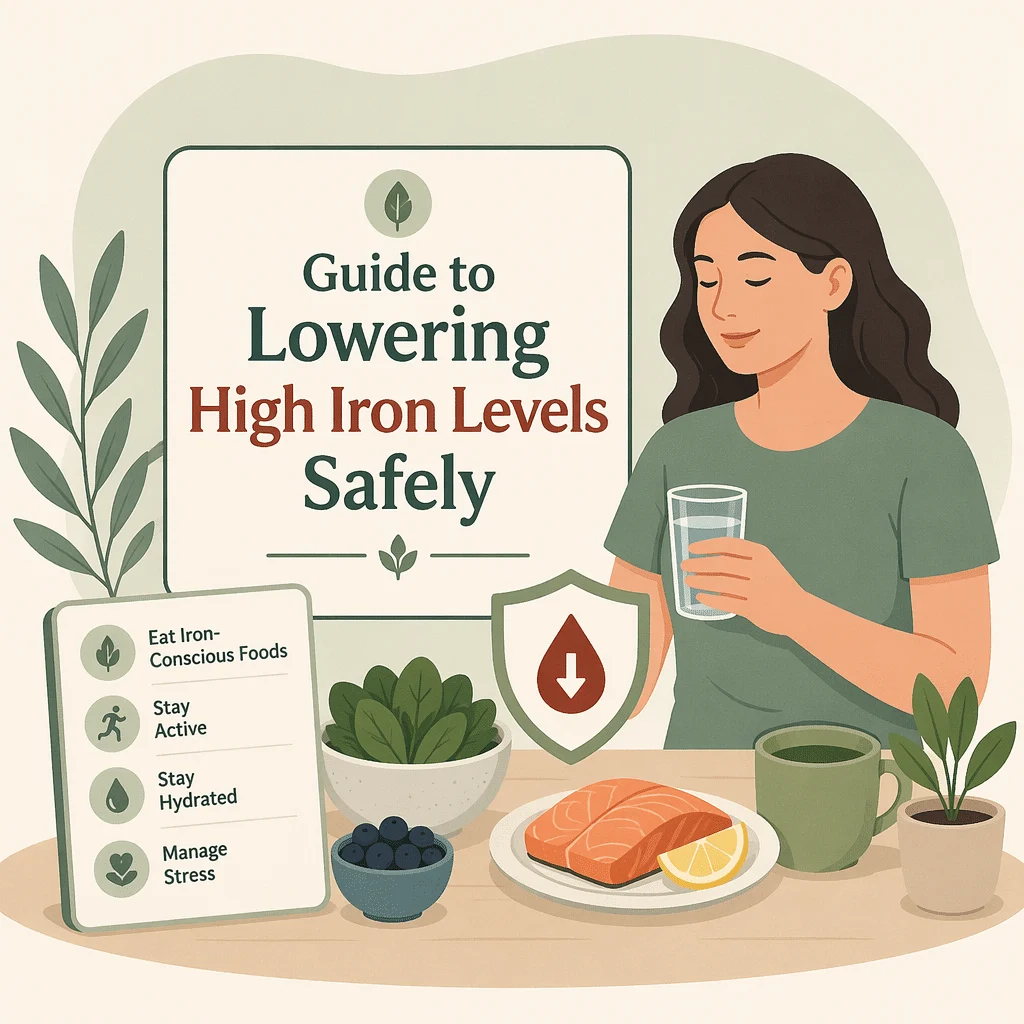
Lowering high iron levels safely starts with a question most articles skip: does your body actually hold too much iron? A high ferritin result is common, and it does not always mean iron overload. Inflammation, alcohol, obesity and fatty liver disease all push ferritin up while total body iron stays normal. Removing blood in that situation can leave you tired without fixing anything. When iron overload is real — hereditary hemochromatosis, repeated transfusions, certain inherited anemias — treatment is effective and well established. In this article you’ll learn which tests confirm true overload, how therapeutic phlebotomy works, where iron chelation fits, what diet can and cannot do, and what long-term follow-up involves. The aim is to help you understand the plan your clinician builds with you, and why the workup always comes before the treatment.
Before lowering high iron levels, confirm the overload is real
Ferritin is a storage protein, and its blood level is the easiest way to estimate how much iron the body has put away. It is also one of the least specific tests in routine medicine. A review of hyperferritinemia published in the International Journal of Molecular Sciences notes that infection, inflammation, metabolic problems and cancer can all raise serum ferritin, which makes a single high value hard to interpret on its own. Our team explains in detail what a high ferritin result actually means, so this article does not repeat that ground. It starts one step later, at the moment the result is confirmed and the question becomes what to do about it.
Two very different situations behind the same number
The first situation is true iron overload: the body absorbs or receives more iron than it can use, and the excess is stored in organs. Hereditary hemochromatosis is the classic cause, alongside repeated blood transfusions and iron-loading anemias such as thalassemia. The second situation is a high ferritin without excess iron. A 2023 review in La Revue de Médecine Interne lists the usual drivers: inflammation, heavy alcohol intake, liver cell damage and certain inherited ferritin variants. In that second group, taking blood out of the patient treats a number rather than a disease.
Transferrin saturation separates the two worlds
Transferrin is the protein that carries iron through the bloodstream. Transferrin saturation measures how much of that carrying capacity is currently filled. When body iron is genuinely in excess, saturation tends to be high; when ferritin is high because of inflammation or metabolic disease, saturation is usually normal or even low. That single comparison is what stops a reader from asking for blood removal they may not need. Our library explains iron saturation levels and their causes and describes the role of transferrin in iron transport.
The workup that comes before any treatment
No one should start removing iron on the strength of one lab printout. A clinician usually repeats ferritin, measures transferrin saturation, and reads both alongside the rest of the picture. Our guide covers the markers in a full iron studies panel, which is normally the next test ordered.
From there, the workup follows the clues. Genetic testing for the HFE gene is offered when the pattern suggests hereditary hemochromatosis. Inflammatory markers help explain a raised ferritin that has nothing to do with iron; our article details the causes of high CRP levels. Because the liver is the main iron store, liver enzymes and sometimes imaging are checked too. A 2025 review of iron and liver disease describes hepatic iron concentration as a reliable stand-in for total body iron, and notes that measuring it matters both for starting treatment and for monitoring it. Our team explains the markers in a liver panel and reviews the blood tests used for fatty liver disease.
Donating blood before the workup is not a plan
Booking a blood donation or buying a supplement to “detox” iron before the cause is known does two unhelpful things. It can mask the very numbers a clinician needs to interpret, and it exposes people whose iron stores are normal to unnecessary blood loss. Donation has a place in this story, but it comes after the diagnosis, not before it.
Therapeutic phlebotomy: the first-line treatment for iron overload
Therapeutic phlebotomy is the controlled removal of a set volume of blood on a prescribed schedule. Because each red blood cell carries iron, taking blood out obliges the body to draw on its stores to rebuild them. The National Institute of Diabetes and Digestive and Kidney Diseases describes the standard approach for hemochromatosis as drawing about a pint of blood at a time on a regular schedule.
Induction, then maintenance
Treatment usually runs in two phases. The induction phase is intensive and aims to bring iron stores down; Mayo Clinic describes around a pint of blood being taken once or twice a week during this stage, usually in a hospital or a clinician’s office. Once stores have fallen, the rhythm slows into a maintenance phase, which Mayo Clinic describes as sessions typically every two to four months. How long each phase lasts depends on how much iron has accumulated, and only the treating team can set the pace.
What gets checked along the way
Phlebotomy is prescribed and supervised, not self-managed. Ferritin is tracked to see whether stores are falling, and hemoglobin is checked so that treatment does not tip someone into anemia. Our guide explains how to read a complete blood count, the test that carries hemoglobin. If sessions leave you unusually tired or lightheaded, that is information for your clinician, not a reason to push on.
Blood donation is possible for some people, not all
Once iron stores have been brought down, an expert review published by the American Society of Hematology in 2024 notes that maintenance phlebotomy can often be converted into a regular blood donation program. That is convenient, but it is not automatic: donation centers apply their own eligibility rules, and people who cannot meet them continue with prescribed sessions instead. For readers whose diagnosis is confirmed, our library sets out the treatment path for hereditary hemochromatosis in more depth.
Iron chelation: reserved for people who cannot be phlebotomized
Some people cannot afford to lose red blood cells, because the reason their iron is high is that they receive regular transfusions for a chronic anemia. Removing blood would make the underlying condition worse. For them, iron chelation is the alternative: prescription medicines that bind iron so the body can excrete it in urine or stool.
A review in the European Journal of Haematology explains that three chelating drugs are approved for iron overload — deferoxamine, deferiprone and deferasirox — and that the most common blood conditions leading to transfusional iron overload are myelodysplastic syndromes, sickle cell disease and thalassemia. A 2025 review in Advances in Experimental Medicine and Biology adds that one of these drugs is given by injection or infusion and two are taken by mouth, that doses need careful adjustment as iron levels fall, and that staying with the treatment over the long term is the single biggest factor in whether it works. Mayo Clinic notes that chelation is not commonly used for hemochromatosis itself. Doses and drug choice belong to a specialist; this article names the categories only.
Diet and lifestyle: what they can and cannot do
This is where most of the misinformation sits. Diet does not treat established iron overload. A 2023 review in Current Opinion in Gastroenterology is direct about it: phlebotomy is the standard of care for removing excess iron, and the clinical evidence for dietary changes remains limited because large trials have not been done. What diet can do is avoid making things worse and support the medical plan.
Supplements: the easiest thing to get right
NIDDK advises people with hemochromatosis to avoid iron and vitamin C supplements, because vitamin C increases how much iron the gut absorbs. Mayo Clinic gives the same advice and adds a useful nuance: there is usually no need to restrict vitamin C from food, only from supplements. Multivitamins are worth checking, since many contain iron. Our team reviews the benefits and risks of vitamin C.
Alcohol counts twice
Alcohol matters for two separate reasons in iron overload. It raises ferritin on its own, muddying the picture, and it compounds the liver damage that excess iron already causes. NIDDK recommends limiting alcohol, and advises stopping completely for anyone who has developed cirrhosis. Mayo Clinic frames it the same way: alcohol increases the risk of liver damage in people with hemochromatosis.
Heme iron, tea, coffee and calcium
Iron from red meat and organ meats is heme iron, which the gut absorbs more readily than the non-heme iron in plants. A 2023 review in Nutrients explains that hereditary hemochromatosis is driven by a shortage of hepcidin, the hormone that limits how much dietary iron enters the bloodstream, which is why absorption stays high. The same review summarizes population data linking high heme iron intake to metabolic and cardiovascular risk, while stressing that these are observational findings and that cause and effect are not settled. Polyphenols in tea and coffee, and calcium from dairy or supplements, both reduce iron absorption when consumed with a meal. These effects are real but modest: they nudge absorption, they do not empty a loaded liver.
The raw shellfish rule
One dietary instruction in iron overload is not a preference but a safety rule. NIDDK advises avoiding raw shellfish, and Mayo Clinic advises against raw fish and shellfish, because excess iron in the body favors certain infections. Vibrio vulnificus, a bacterium found in raw and undercooked shellfish, is the reason most often cited. Cooked seafood does not carry the same risk.
Monitoring: which approach fits which situation
Treatment for high iron is a long-term rhythm rather than a one-off fix. The table below sets out the main approaches, who each one is for, what it involves and how progress is followed. It is a map for the conversation with your clinician, not a self-selection menu.
| Approach | Who it is for | What it involves | How progress is tracked |
|---|---|---|---|
| Treat the cause, not the number | High ferritin with normal transferrin saturation: inflammation, alcohol, metabolic liver disease | Address the underlying condition; repeat testing instead of removing iron | Repeat ferritin and transferrin saturation, plus markers of the underlying cause |
| Therapeutic phlebotomy, induction phase | Confirmed iron overload, most often hereditary hemochromatosis | Regular removal of a set volume of blood, prescribed and supervised by a clinician | Ferritin to follow stores, hemoglobin to avoid causing anemia |
| Maintenance phlebotomy or blood donation | People whose stores have come down and now need to stay down | Less frequent sessions; some people become eligible for conventional donation | Periodic ferritin, with hemoglobin checked before each session |
| Iron chelation therapy | People who cannot be phlebotomized, chiefly transfusion-dependent patients | Prescription medicines that bind iron so the body can excrete it | Ferritin, imaging of organ iron and drug-specific safety tests |
| Diet and lifestyle adjustments | A support measure for anyone with confirmed or suspected overload | No iron or vitamin C supplements, limited alcohol, moderate heme iron, no raw shellfish | Reviewed alongside lab results; never used as a standalone treatment |
Follow-up also looks beyond iron itself. Because the pancreas is one of the organs iron accumulates in, blood sugar is often watched; our guide explains A1C targets and average glucose.
Why untreated iron overload matters
Iron that has nowhere to go is deposited in tissue. Cleveland Clinic describes the heart, liver and pancreas as the organs most affected, and lists the effects patients notice: fatigue, joint pain, upper abdominal pain, skin that takes on a bronze or gray tint, heart rhythm problems, reduced libido or erectile dysfunction, and unexplained weight loss. The pituitary gland and the joints can be involved as well. None of this is inevitable. Treated early, iron overload is one of the more manageable chronic conditions in medicine, which is exactly why the diagnosis matters more than any home remedy.
Reasons to get tested rather than self-treat
- Persistent fatigue combined with joint pain, particularly in the knuckles
- Skin that has taken on a bronze or grayish tone without sun exposure
- New or unexplained diabetes, or blood sugar that is drifting upward
- Palpitations, an irregular heartbeat or unexplained breathlessness
- A parent, sibling or child diagnosed with hereditary hemochromatosis
- Liver enzymes that keep coming back abnormal without a clear explanation
Any of these is a reason to ask for iron studies and a clinical assessment. None of them is a reason to start removing blood on your own.
Latest scientific advances
Research in the last three years has changed the emphasis in this field. Here is what has moved, in plain language.
The first shift concerns how doctors read a high ferritin. An expert review published by the American Society of Hematology in 2024 makes the point bluntly: among the many people referred for a raised ferritin, only a minority turn out to have hemochromatosis. What this means for you is that a second test, not a treatment, is the correct next step. The same review reports that the main genetic form of hemochromatosis is carried by roughly one person in two hundred of Northern European descent, but that many carriers never develop iron overload at all — the effect is weaker in women.
The second shift concerns who should not be bled. In dysmetabolic iron overload syndrome — a raised ferritin found alongside features of the metabolic syndrome, with only mild iron accumulation in the liver — a 2023 French review reports that repeated bloodletting is often poorly tolerated and without clear benefit. What this means for you is that if your high ferritin travels with excess weight, high blood sugar or fatty liver, the useful treatment is aimed at those problems, not at your veins.
The third shift is more practical. Once stores have been brought down, maintenance treatment can often be turned into a conventional blood donation program rather than a hospital appointment. What this means for you is that long-term management can become simpler over time, if the donation service accepts you.
Finally, the evidence on diet remains thin. A 2023 review aimed at physicians found that dietary counseling in iron overload is not standardized, that early results are encouraging, and that large trials are still missing. What this means for you is that food choices are a sensible support, not a substitute for treatment. These are all reviews of existing work rather than new discoveries, so they describe the current direction of practice rather than a settled endpoint.
Glossary of key terms
| Term | Definition |
|---|---|
| Ferritin | The protein that stores iron inside cells. The blood level estimates iron stores, but it also rises with inflammation, alcohol and liver disease. |
| Transferrin saturation | The share of the blood’s iron-carrying capacity that is currently occupied. It is the marker that distinguishes true iron overload from a raised ferritin. |
| Iron overload | A genuine excess of iron in the body, stored in organs such as the liver, heart and pancreas. |
| Hereditary hemochromatosis | An inherited condition in which the gut absorbs more iron than the body needs, year after year. It is the most common cause of iron overload. |
| HFE gene | The gene most often involved in hereditary hemochromatosis. A blood test can look for the relevant variants. |
| Hepcidin | The hormone that controls how much dietary iron enters the bloodstream. Too little hepcidin allows iron to keep accumulating. |
| Therapeutic phlebotomy | The prescribed removal of a set volume of blood to reduce iron stores. It is the first-line treatment for hemochromatosis. |
| Iron chelation | Treatment with medicines that bind iron so the body can excrete it, used mainly when blood cannot be removed. |
| Dysmetabolic iron overload syndrome | A raised ferritin with mild liver iron accumulation, found alongside features of the metabolic syndrome such as excess weight or high blood sugar. |
| Heme iron | The form of iron found in red meat, organ meats and seafood. The gut absorbs it more readily than the iron in plant foods. |
Frequently asked questions
Does donating blood lower iron levels?
Yes, each donation removes red blood cells and the iron they contain, which is why donation can serve as maintenance treatment once a diagnosis is established. It is not a substitute for the initial workup or for the intensive first phase of treatment, which needs a schedule and lab checks that a donation center is not set up to provide. Eligibility rules also vary between services, and some people with iron overload are not accepted as donors. The right sequence is diagnosis first, prescribed phlebotomy next, and donation later if your clinician and the donation service both agree.
How quickly can high iron levels come down?
There is no honest quick answer, and any source promising one should be treated with caution. The pace depends on how much iron has accumulated, how well you tolerate blood removal and what your hemoglobin allows. Intensive treatment is typically measured in months rather than days or weeks, and the schedule is adjusted as ferritin falls. Trying to accelerate the process on your own risks anemia, which brings its own fatigue and does nothing useful for iron stores.
What foods should I avoid if my iron is high?
The clearest instructions are to avoid iron supplements and vitamin C supplements, to limit alcohol, and to avoid raw shellfish and raw fish. Moderating red meat and organ meats is reasonable because they are the richest sources of readily absorbed iron. Beyond that, a normal balanced diet is appropriate, and there is generally no need to eliminate vitamin C from food. Diet supports treatment; it does not replace it.
Do coffee and tea lower iron levels?
Polyphenols in coffee and tea reduce how much iron the gut absorbs from a meal eaten at the same time, and calcium has a similar effect. That is a genuine mechanism, and it is one reason clinicians sometimes suggest drinking tea with meals rather than between them. It is also a small effect. It can slightly slow further accumulation, but it will not clear iron already stored in the liver or the heart.
Are there supplements that lower iron levels?
No supplement has been shown to remove stored iron from the body, and products marketed as iron detox or iron cleanse are not treatments. Some substances reduce absorption at the table, which is a different thing entirely. There is also a risk in the other direction: supplements taken without supervision can interact with medicines or mask the symptoms that need investigating. Any product aimed at iron is worth discussing with your clinician before you start it.
Can high iron levels have a cause other than hemochromatosis?
Frequently, yes. Repeated blood transfusions, iron-loading anemias such as thalassemia, chronic liver disease, heavy alcohol use, chronic inflammation and the metabolic syndrome can all raise ferritin, sometimes with iron overload and sometimes without. Rarer inherited variants affecting ferritin or iron transport exist too. This is precisely why transferrin saturation, a repeat ferritin and, where relevant, genetic testing and liver imaging come before any decision about treatment.
Sources
- National Institute of Diabetes and Digestive and Kidney Diseases — Hemochromatosis — NIDDK, National Institutes of Health
- Mayo Clinic — Hemochromatosis: diagnosis and treatment — Mayo Clinic
- Cleveland Clinic — Hemochromatosis: symptoms, causes and treatment — Cleveland Clinic
- Girelli D, Marchi G, Busti F — Diagnosis and management of hereditary hemochromatosis: lifestyle modification, phlebotomy, and blood donation — Hematology, American Society of Hematology Education Program, 2024
- Ruivard M, Lobbes H — Diagnosis and treatment of iron overload — La Revue de Médecine Interne, 2023
- Piperno A, Pelucchi S, Mariani R — Hereditary hyperferritinemia — International Journal of Molecular Sciences, 2023
- Saleh H, Seaman LAK, Palmer WC — Proposed dietary recommendations for iron overload: a guide for physician practice — Current Opinion in Gastroenterology, 2023
- Charlebois E, Pantopoulos K — Nutritional aspects of iron in health and disease — Nutrients, 2023
- Bruzzese A, Martino EA, Mendicino F, et al. — Iron chelation therapy — European Journal of Haematology, 2023
- Cappellini MD, Scaramellini N, Leoni S, Motta I — Iron chelation therapy — Advances in Experimental Medicine and Biology, 2025
- Zoller H — Iron and liver disease — Advances in Experimental Medicine and Biology, 2025
Further reading
- Understanding high total iron-binding capacity
- Anemia: symptoms, causes, types and diagnosis
- Low ferritin: causes, symptoms and treatment
- ALT levels: meaning, causes and normal ranges
- The AST/ALT ratio and how to read it
Understand your lab results with AI DiagMe
A high iron result raises a practical question long before any treatment decision: what do these numbers actually say? AI DiagMe turns a lab report into plain language, whether it shows ferritin, transferrin saturation, hemoglobin or liver enzymes, so you arrive at your appointment knowing which values moved and which questions to ask. It helps you understand your results; it does not make a diagnosis and does not replace your doctor.
Get your results interpreted in minutes