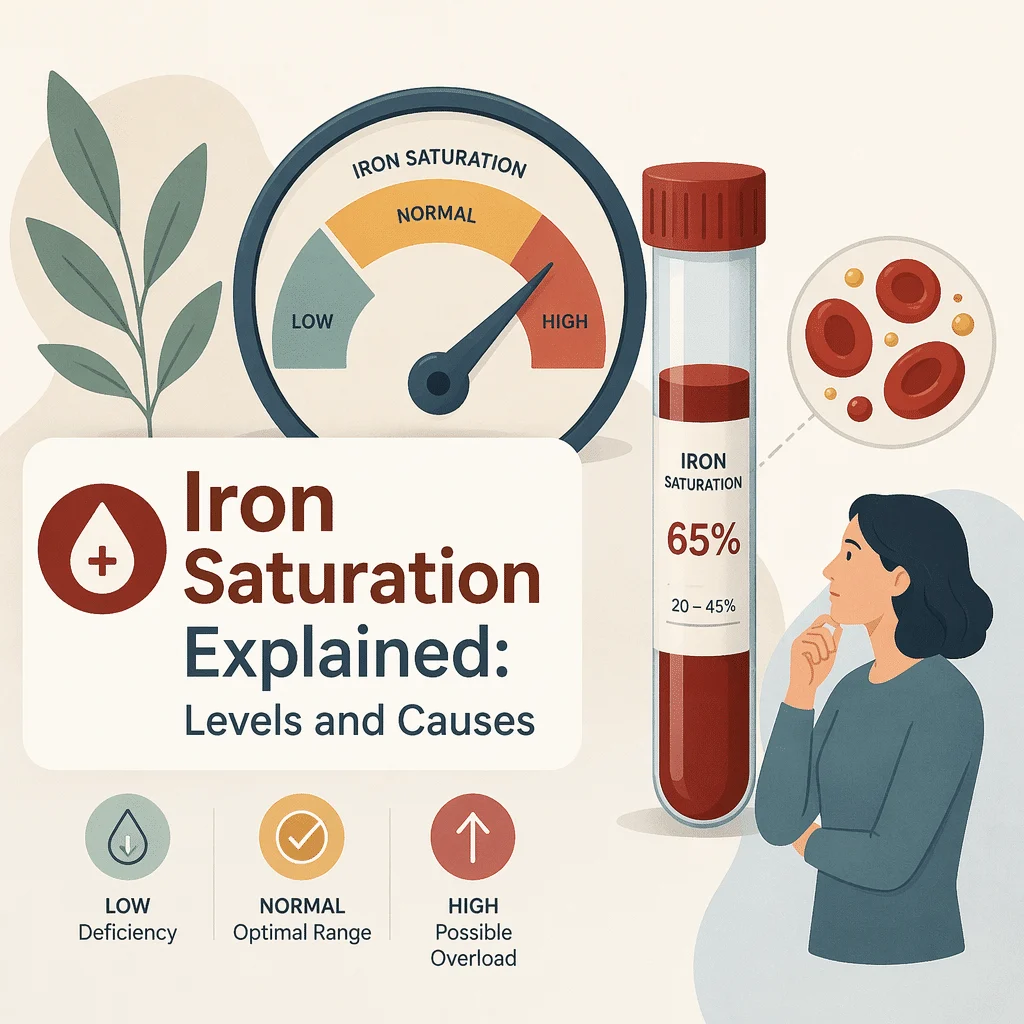
Iron saturation is the percentage on your iron panel that tells you how much of your blood’s iron-carrying capacity is actually being used. It is also written as transferrin saturation, or TSAT, and it is calculated rather than measured directly, which is why it can move around more than people expect.
In this article you’ll learn what the percentage actually represents, how it is worked out from two other lab values, why the time of day and your last meal can shift it, what a low result and a high result each point to, how saturation and ferritin are read together as a pattern, and what usually happens after an abnormal number appears on your report.
What iron saturation actually measures
Iron does not float freely in your blood. It travels bound to a carrier protein called transferrin, and each transferrin molecule has a small number of binding sites that iron can occupy. If you want the full picture of that carrier protein, our guide to the transferrin blood test covers what it is, why a high level usually signals low iron, and what lowers it.
Iron saturation answers one narrow question about that system: of all the iron-carrying seats available on transferrin right now, what share is occupied?
A saturation of 30% means roughly three in ten seats are filled. A saturation of 8% means the carriers are running mostly empty, and tissues that need iron, particularly the bone marrow making red cells, are being short-changed. A saturation of 65% means the carriers are unusually full, and some iron may be circulating without a seat at all, which is the state that damages organs over years.
How the percentage is worked out
Laboratories do not measure saturation with its own test. They calculate it from two results you will usually see printed above it on the same panel.
The first is serum iron, the amount of iron circulating in your blood at the moment of the draw. The second is total iron-binding capacity, or TIBC, which stands in for how many carrying seats exist in total.
The formula is simply serum iron divided by TIBC, multiplied by 100. Some laboratories use unsaturated iron-binding capacity (UIBC) in the arithmetic instead, but the output is the same percentage.
This matters more than it sounds. Because saturation is a ratio of two separate measurements, anything that moves either one moves the percentage. A serum iron result that drifts for a harmless reason will drag the saturation with it, even when your actual iron status has not changed at all.
The usual reference band, and why one reading is noisy
Most laboratories place the adult reference range somewhere around 20% to 50%. Your own report may say 15% to 45%, or 20% to 55%, depending on the analyser and the population the lab used to set its range.
Always compare your number to the range printed on your own report. Men tend to sit a little higher in the band than pre-menopausal women, and ranges for children differ again.
The more useful point, and the one most articles skip, is that a single iron saturation result is genuinely noisy.
Time of day, food and recent supplements
Serum iron follows a daily rhythm. The National Library of Medicine’s MedlinePlus guide to iron tests notes that the amount of iron in your blood varies through the day and may be higher in the morning, and that providers often ask for a fasting sample taken in the morning for exactly that reason.
Because saturation is calculated from serum iron, that daily swing lands directly on the percentage. Two samples from the same person on the same day can differ enough to move a result from inside the range to outside it.
Food does the same thing on a shorter timescale. A meal rich in iron, and above all an iron supplement or a multivitamin containing iron taken in the hours before the draw, can push serum iron up sharply and produce a saturation that looks alarmingly high but reflects only what was in the tablet.
This is one of the most common reasons a high result turns out to be nothing. If you take iron in any form, tell whoever orders the test.
Acute illness and inflammation pull the other way, temporarily lowering serum iron and therefore the saturation, which is worth remembering when reading a low number taken during a flare.
Reading a low iron saturation
A low saturation says the carriers are running empty. It does not, by itself, say why.
Symptoms that often sit alongside a low result include tiredness that sleep does not fix, breathlessness on stairs or mild exertion, pallor, a racing heart, brittle nails, hair shedding and difficulty concentrating. Many people with a mildly low saturation feel completely well.
True iron deficiency: the most common explanation
Most low saturations come down to a real shortage of iron in the body. Blood loss is the usual driver: heavy or prolonged periods, bleeding somewhere in the gut, frequent blood donation, or losses around surgery.
Intake and absorption matter too. Pregnancy and breastfeeding raise demand steeply. Coeliac disease, inflammatory bowel disease, some stomach surgeries, and long-term acid-suppressing medication all reduce how much dietary iron gets absorbed.
When iron deficiency has gone on long enough to affect red cell production, other markers usually shift with it: hemoglobin falls, and on the complete blood count the red cells often become smaller than normal. Our article on anemia symptoms, causes and tests explains that progression; the opposite pattern, where cells become larger, is covered in our guide to high MCV levels.
Critically, a low saturation is not a reason to start iron on your own. Iron taken on a wrong assumption is genuinely harmful in anyone who is actually overloaded, and unnecessary iron commonly causes constipation, nausea and stomach pain for no benefit. The cause of the deficiency, especially unexplained blood loss, is the thing that needs finding, and only a clinician can decide whether, how and for how long to treat.
Functional iron deficiency: iron that exists but cannot be moved
In chronic inflammation, chronic kidney disease, heart failure, cancer and long-standing infection, the body deliberately locks iron away inside storage cells. Stores may be perfectly adequate, or even generous, but the iron cannot be released into the blood fast enough to meet demand. This is called functional iron deficiency.
The signature is a low saturation sitting alongside a ferritin that is normal or high rather than low. Because ferritin also rises with inflammation in its own right, an inflammatory marker such as CRP is often measured at the same time to help read the picture.
The distinction is not academic. True and functional deficiency are managed differently, and the route through both runs via a doctor rather than a supplement aisle.
Reading a high iron saturation
A high saturation is the single most useful early signal of iron overload, which is precisely why it exists on the panel.
In routine practice, a fasting saturation above roughly 45% in an adult is the point at which most clinicians start looking for a cause. It is a trigger for assessment, not a diagnosis, and the bar for calling something biochemical hemochromatosis is set considerably higher: the National Library of Medicine’s GeneReviews chapter on HFE hemochromatosis describes a fasting transferrin saturation of at least 60% in men or at least 50% in women, found on two or more occasions, with other causes excluded.
Note the two features patients almost always miss: fasting, and on more than one occasion.
The hemochromatosis question, framed calmly
Hereditary hemochromatosis is an inherited condition in which the gut absorbs more iron than the body needs, year after year. According to the US Centers for Disease Control and Prevention, it is most common among people with Northern European ancestry, men tend to develop complications earlier than women, and most people who carry the relevant genetic changes never develop symptoms or complications at all.
Untreated iron overload is worth taking seriously, because iron accumulating in the liver, heart, pancreas and joints causes damage that does not reverse. Equally, a single raised iron saturation is a very long way from a diagnosis. Most raised saturations are not hemochromatosis, and even among people who carry two copies of the main gene variant, only a minority ever develop iron overload severe enough to cause disease.
Where it is present, it is one of the more treatable conditions in medicine. The standard treatment is scheduled removal of blood, which lowers body iron directly, and our guide to hemochromatosis treatments walks through what that involves.
High results that have nothing to do with genetics
Iron supplementation, whether prescribed or bought over the counter, raises serum iron and therefore saturation, and a dose taken shortly before the blood draw can do so dramatically. Repeated blood transfusions deliver iron the body has no way of excreting. Intravenous iron given for treatment does the same thing on a shorter timescale.
Liver disease is another common cause. Damaged liver cells release stored iron into the blood, and both alcohol-related liver disease and fatty liver disease are associated with raised iron markers, so liver function tests are usually checked alongside.
Why saturation is always read alongside ferritin
Saturation and ferritin answer different questions. Saturation describes iron in transit right now. Ferritin estimates how much iron is in the warehouse.
Read together they form patterns far more informative than either alone. The table below sets out the combinations clinicians see most often. It is a map of the reasoning, not a self-diagnosis tool.
| Iron saturation | Ferritin | Likely picture | Usual next step |
|---|---|---|---|
| Low | Low | True iron deficiency: stores are empty and supply is short | Look for the cause, especially blood loss; blood count reviewed; treatment decided by a doctor |
| Low | Normal or high | Functional iron deficiency: stores exist but iron cannot be mobilised, typically with inflammation or kidney disease | Inflammatory markers and kidney function checked; the underlying condition is addressed first |
| High | High | Possible iron overload, including hereditary hemochromatosis, transfusional iron loading or liver disease | Repeat fasting sample, liver tests, and genetic testing where the pattern persists |
| High | Normal | Often a recent iron dose, a non-fasting sample or an early stage of iron loading before stores rise | Repeat fasting sample after pausing iron-containing supplements on medical advice |
| Normal | Low | Early or developing iron deficiency: stores falling before transport is affected | Clinical review, dietary and menstrual history, monitoring over time |
Ferritin rises with inflammation regardless of iron status. Our articles on low ferritin and high ferritin levels go into what shifts it in each direction.
What usually happens next
For both a low and a high result, the first move is almost always the same: repeat the test properly.
That normally means a fasting morning sample, taken when you are not acutely unwell, with any iron-containing supplement paused beforehand if your clinician tells you to pause it. A surprising share of abnormal saturations quietly resolve at this step.
A persistently low saturation leads to a hunt for the cause: a full blood count, ferritin, questions about periods and bowel habit, and where relevant, investigation of the gut. Treatment is chosen afterwards, based on what is found.
A persistently high saturation leads to ferritin, liver tests, and a conversation about alcohol, supplements, transfusions and family history. Where the pattern points that way, genetic testing for the HFE variants confirms or excludes hereditary hemochromatosis, and imaging is sometimes used to estimate how much iron the liver actually holds.
When to see a doctor about your iron saturation
Any result outside your laboratory’s range deserves a conversation, even if you feel fine. Some combinations deserve one sooner.
Red flags that warrant medical assessment
- Joint pain, particularly in the knuckles or knees, together with fatigue and a raised iron saturation
- Skin that has taken on a bronze, grey or metallic tone
- A new diagnosis of diabetes, or blood sugar that is becoming harder to control, alongside a raised saturation
- Signs pointing to the liver: pain under the right ribs, yellowing of the eyes or skin, abdominal swelling, or abnormal liver blood tests
- A parent, sibling or child known to have hereditary hemochromatosis, whatever your own result
- Profound fatigue with breathlessness, chest pain, dizziness or a racing heart together with a very low saturation, which warrants prompt review
Chest pain, fainting or severe breathlessness are reasons to seek urgent care rather than wait for an appointment.
Bring the whole panel, not just the saturation. The full iron studies panel tells your doctor far more than one line from it.
Latest scientific advances in iron saturation testing
According to research indexed in PubMed, recent work has focused less on new tests than on where the thresholds for this old one should sit.
A 2024 retrospective study in Clinical Biochemistry by Lou and colleagues examined more than 23,000 people who had undergone HFE genetic testing in Atlantic Canada. What was found: transferrin saturation was the best single blood marker for identifying people carrying two copies of the C282Y variant, outperforming both ferritin and the liver enzyme ALT. What this means for you: your saturation is doing real diagnostic work on that panel, and a normal one makes hereditary hemochromatosis much less likely.
A 2024 population-based cohort study in Liver International by Schaefer and colleagues followed people in Tyrol, Austria, who had been genotyped for the C282Y variant. What was found: among those carrying two copies, only a minority aged 60 or under actually showed iron overload, and the great majority had no sign of liver scarring, although life expectancy was measurably shorter than in matched controls. What this means for you: carrying the genotype is not the same as having the disease, which is exactly why a raised saturation triggers assessment rather than a diagnosis.
A 2024 cross-sectional analysis in JAMA Network Open by Barton and colleagues compared three definitions of iron deficiency in more than 62,000 women screened in the United States and Canada. What was found: depending on the definition used, including one combining a transferrin saturation below 10% with a low ferritin, measured prevalence varied several-fold. What this means for you: whether you are called iron deficient can depend on which cut-off your laboratory uses, which is one reason results are read in context rather than off a chart.
A 2025 registry study in JACC: Heart Failure by Lindberg and colleagues assessed four definitions of iron deficiency in more than 20,000 patients with heart failure. What was found: defining it by a transferrin saturation below 20% identified the group with the worst symptoms and outcomes more reliably than ferritin-based definitions. What this means for you: saturation appears to capture something ferritin misses, which is part of why doctors do not rely on stores alone.
The direction of travel is consistent. Iron saturation is being treated as a more informative number than it once was, and none of it changes the basic advice that an abnormal result is a starting point for a clinical conversation.
Frequently asked questions about iron saturation
What does high iron saturation mean on my report?
It means more of your transferrin binding sites were occupied by iron than the laboratory expects. The most common explanations are a recent iron-containing supplement or a non-fasting sample, followed by liver disease, repeated transfusions and, less often, hereditary hemochromatosis. On its own it is a prompt to investigate, not a diagnosis. Your doctor will usually repeat the test on a fasting morning sample and look at ferritin at the same time before deciding whether anything further is needed.
Do I need to fast for an iron saturation test?
Often, yes. Because serum iron rises after food and is naturally higher in the morning, many providers ask for a fasting morning sample so the calculation is not distorted. MedlinePlus notes that a 12-hour fast is sometimes requested and that the test is usually done in the morning. Follow the instructions given with your request form rather than assuming, and tell whoever takes the sample if you have eaten, taken a supplement or had an infusion recently.
Should I take iron if my saturation is low?
Not on your own. A low saturation tells you iron is in short supply in the blood, but it does not tell you why, and the why is what determines the right response. Starting iron without knowing the cause can delay the discovery of bleeding that needs attention, and iron taken by someone who is actually overloaded is harmful. Unnecessary iron also causes constipation, nausea and stomach pain for no benefit. Take the result to your doctor and let the decision follow the diagnosis.
Can my saturation be normal while I am still iron deficient?
Yes. Iron stores usually fall before transport is affected, so ferritin often drops while saturation is still sitting inside the reference range. This early stage is common in people with heavy periods or a plant-based diet who feel tired but look fine on a basic panel. It is the main reason ferritin and saturation are ordered together rather than one instead of the other, and why a doctor reads the pattern rather than a single line.
How different can two results be in the same week?
More different than most people expect. Serum iron swings through the day, rises after an iron-rich meal or a supplement, and falls during infection or inflammation, and every one of those changes lands on the calculated percentage. A result that moves from just inside the range to just outside it, or the reverse, is entirely ordinary. That is why an abnormal saturation is usually confirmed on a second, properly prepared sample before anything else happens.
Does pregnancy or a heavy period change the result?
Both can. Pregnancy raises iron demand substantially and blood volume expands, so saturation commonly falls as pregnancy progresses even when nothing is wrong. Heavy or prolonged menstrual bleeding is one of the most frequent causes of a genuinely low saturation in women of reproductive age. Neither situation is self-managed: iron in pregnancy in particular is monitored and prescribed by the team looking after you, because both too little and too much carry risks.
Glossary of key terms
| Term | Definition |
|---|---|
| Iron saturation (TSAT) | The percentage of transferrin’s iron-carrying sites that are currently occupied by iron. |
| Transferrin | The blood protein that carries iron from the gut and from recycled red cells to the tissues that need it. |
| Serum iron | The amount of iron circulating in the blood at the moment the sample is taken. |
| TIBC | Total iron-binding capacity: a measure of how much iron the blood’s carrier proteins could hold in total. |
| Ferritin | A storage protein whose blood level reflects how much iron the body has in reserve. |
| Functional iron deficiency | A state in which iron stores exist but cannot be released fast enough to meet demand, typically during inflammation or kidney disease. |
| Iron overload | Accumulation of excess iron in organs such as the liver, heart and pancreas, which can cause lasting damage. |
| Hereditary hemochromatosis | An inherited condition in which the gut absorbs more iron than the body needs over many years. |
| C282Y | The most common HFE gene variant linked to hereditary hemochromatosis in people of Northern European ancestry. |
| Therapeutic phlebotomy | Scheduled removal of a measured volume of blood, used to lower body iron in confirmed iron overload. |
Sources
- MedlinePlus, National Library of Medicine. Iron Tests
- National Institute of Diabetes and Digestive and Kidney Diseases. Diagnosis of Hemochromatosis
- Centers for Disease Control and Prevention. About Hereditary Hemochromatosis
- Barton JC, Edwards CQ, Acton RT. HFE Hemochromatosis. GeneReviews, National Center for Biotechnology Information
- Lou A, Elnenaei MO, Zhu J, et al. Re-evaluating the utility of iron indices in hereditary hemochromatosis genotyping: a retrospective study. Clinical Biochemistry, 2024
- Schaefer B, Pammer LM, Pfeifer B, et al. Penetrance, cancer incidence and survival in HFE haemochromatosis: a population-based cohort study. Liver International, 2024
- Barton JC, Wiener HW, Barton JC, Acton RT. Prevalence of iron deficiency using 3 definitions among women in the US and Canada. JAMA Network Open, 2024
- Lindberg F, Cabrera CC, Benson L, et al. Iron deficiency definitions in heart failure across ejection fraction phenotypes. JACC: Heart Failure, 2025
Study summaries were identified via PubMed.
Further reading
- Iron studies panel: what each marker tells you
- Transferrin blood test: why high levels usually mean low iron
- Hemochromatosis treatments: a practical guide
- Low MCV: causes, symptoms and treatments
- High ferritin levels: causes, symptoms and risks
Understand your lab results with AI DiagMe
Iron saturation only makes sense next to ferritin, serum iron and TIBC, and reading four numbers together is exactly where most people get stuck. AI DiagMe turns those lines into plain language and helps you arrive at your appointment with better questions. It helps you understand your results; it does not diagnose anything and it does not replace your doctor.
Get your results interpreted in minutes