





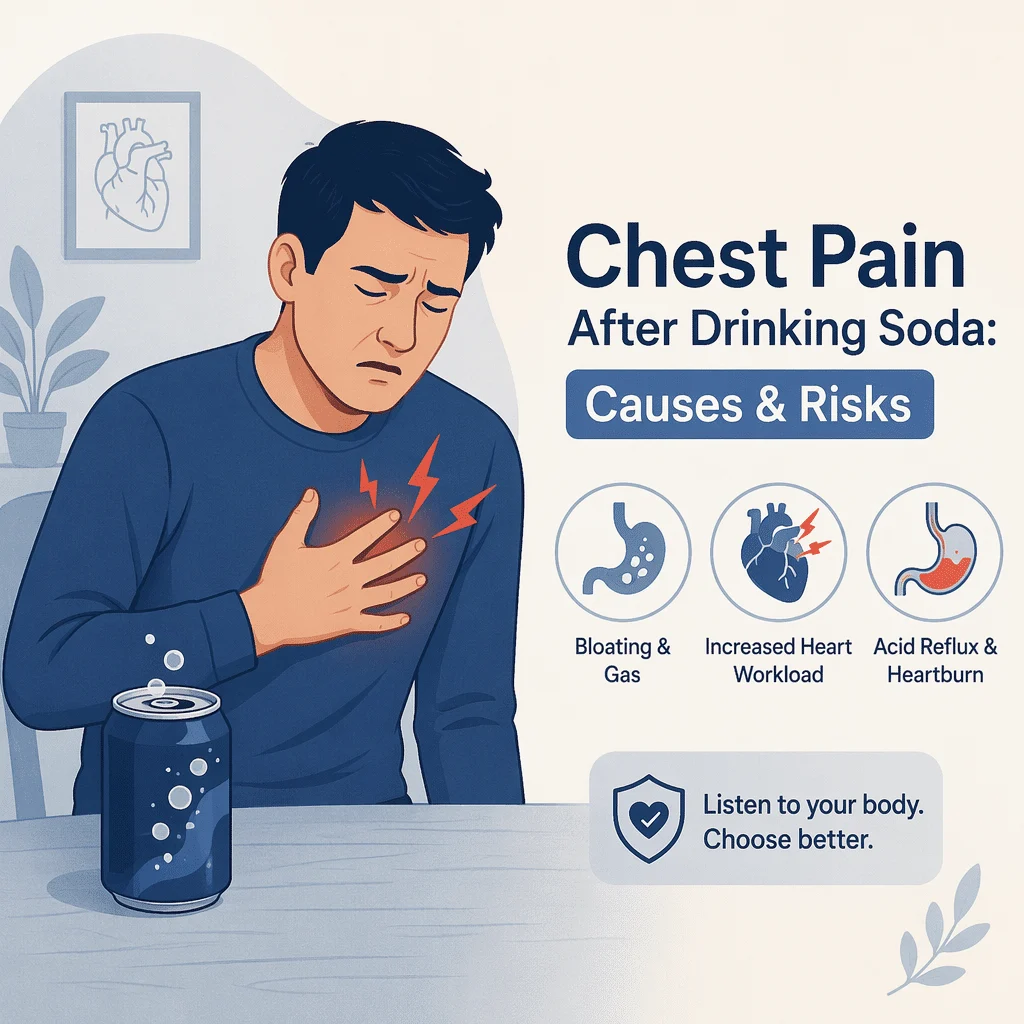
Chest pain after drinking soda is common, and in most people it starts in the digestive tract rather than the heart. Carbonation stretches the stomach, gas rises toward the esophagus, and the result can be a tight, burning or stabbing sensation right behind the breastbone. That reassuring explanation is usually correct, but not always, and the exceptions are the ones that matter: a heart attack, a tear in the esophagus and a problem with the aorta can all begin while someone happens to be holding a can of cola. In this article you will learn which symptoms need emergency care before anything else, what fizzy drinks actually do to the stomach and esophagus, why reflux and heart pain are so hard to tell apart, and which lab tests help clarify the picture.
When chest pain after drinking soda is an emergency
Start here, not at the end of the article. The drink in your hand does not decide whether your chest pain is dangerous. The symptoms do. If the pattern below matches what you feel, treat it as an emergency and call 911, even if you are convinced it is only gas.
Red flags that need emergency care now
- Pressure, squeezing, heaviness or tightness in the center or left side of the chest that lasts more than a few minutes
- Pain spreading to the jaw, neck, shoulder, back, upper belly or either arm
- Cold sweat, nausea, vomiting, lightheadedness or a sudden sense that something is very wrong
- Shortness of breath at rest or after minimal effort
- Severe chest pain that begins immediately after forceful vomiting or violent retching
- Sudden tearing or ripping pain that moves through to the back
- Fainting, a racing irregular pulse, or pain that keeps worsening
Mayo Clinic lists heartburn and indigestion among the recognized presentations of a heart attack, which is precisely why the soda explanation is unsafe as a self-diagnosis. Women, older adults and people with diabetes more often have symptoms that do not match the textbook description. This library covers the causes of pain under the left breast, but location alone never rules out a cardiac cause.
| What you notice | What it may point to | What to do |
|---|---|---|
| Pressure or squeezing spreading to the jaw, neck, back or an arm, with sweating, nausea or breathlessness | Possible heart attack, whatever you were drinking | Call 911 immediately |
| Severe chest pain starting right after forceful vomiting or retching | Possible tear in the esophagus (Boerhaave syndrome) | Call 911 immediately |
| Sudden tearing pain moving to the back, sometimes with unequal pulses in the arms | Possible aortic emergency | Call 911 immediately |
| Squeezing chest discomfort brought on by exertion and relieved within minutes of rest | Possible angina | Urgent medical assessment, not self-care |
| Burning behind the breastbone, sour taste, worse lying flat, eased by an antacid | Reflux is likely, but a heart cause is not excluded | Same-day advice if new, severe or repeating |
| Tight, full, bloated feeling minutes after a fizzy drink that eases after burping | Stomach distension and trapped gas are likely | Self-care; see a doctor if episodes repeat |
One rule deserves its own line. If chest pain follows forceful vomiting, whether after too much soda and alcohol, after an illness or after violent retching, doctors have to consider a tear in the wall of the esophagus. It is rare, time-critical, and can imitate a heart attack closely enough to fool the first round of tests.
Why carbonated drinks can cause chest pain
Once the emergencies are excluded, most episodes have a mechanical explanation. Four mechanisms do most of the work, and they often act together.
Stomach distension and trapped gas
A can of soda delivers dissolved carbon dioxide that turns back into gas as soon as it meets the warmth of your stomach. The stomach stretches, internal pressure rises, and that stretch registers as fullness, tightness or a sharp pressure high in the abdomen and low in the chest. Gas traveling upward can lodge behind the breastbone before it escapes as a burp. Drinking quickly, using a straw and drinking on an empty stomach all strengthen the effect, which is why the same can causes trouble on some days and none on others.
The valve at the bottom of the esophagus
A muscular ring called the lower esophageal sphincter normally keeps stomach contents where they belong. When the stomach is distended, that ring relaxes more often and for longer, letting acid move upward. MedlinePlus and the National Institute of Diabetes and Digestive and Kidney Diseases both describe heartburn as a burning feeling in the middle of the chest, intense enough at times to be mistaken for cardiac pain. Our team also explains how an acid reflux cough develops when that acid reaches the throat and airway.
Esophageal spasm and the cold shock
The esophagus is a muscular tube, and when it contracts in an uncoordinated way the result is a gripping, squeezing pain lasting seconds to minutes. Very cold liquids swallowed fast are a recognized trigger in susceptible people, which is why the same symptom can follow iced water rather than soda. A separate guide describes the warning signs behind a tingling sensation in the chest for readers whose symptom feels more electrical than crushing.
Acidity, caffeine and sugar
Colas are acidic in their own right, so refluxed material can be more irritating than stomach acid alone. Caffeine relaxes the same valve and can lift the heart rate, which some people feel as pounding rather than pain. Sugar adds its own long-term load, and another guide explains what blood glucose levels reveal about how your body handles it.
The overlap that makes this question dangerous
Reflux pain and heart pain travel along shared nerve pathways, so the brain receives similar signals from very different organs. Cleveland Clinic describes reflux chest pain as heavy pressure or tightness, exactly the words patients use for angina. Angina itself often appears after a meal, because digestion pulls blood toward the gut and increases the work of the heart, so symptoms following food or drink do not point away from a cardiac cause.
Two familiar shortcuts fail here. Relief after an antacid feels like proof of reflux, but a systematic review pooling nineteen studies found that a short trial of an acid-blocking drug identifies most true reflux cases while also coming back positive in many people who have no reflux at all. And pain that worsens lying down is typical of reflux, yet unstable angina can also appear at rest.
Clinicians cannot separate the two from the story alone, which is why formal chest pain protocols rely on tests rather than intuition.
Symptom patterns that shift the odds
No single symptom settles the diagnosis, but combinations shift the probability.
- Burning that rises toward the throat with a sour or bitter taste leans toward reflux
- Clear relief after burping or passing gas leans toward distension
- Discomfort that appears reliably with exertion and settles within minutes of rest leans toward the heart
- Pain reproduced by pressing on the chest wall or by twisting leans toward muscle and joint origins
- Breathlessness out of proportion to the pain always deserves urgent assessment
- Trouble swallowing, food sticking, vomiting blood, black stools or unintended weight loss are alarm features needing prompt evaluation
Our team also explains the causes of shortness of breath after eating, a symptom that overlaps heavily with this one. Alarm features matter because long-standing reflux can signal more than irritation: this library covers the symptoms and causes of stomach cancer, and Helicobacter pylori infection is one reason doctors test rather than assume. Another article describes the causes of vomiting bile when what comes up is not simply acid.
How doctors evaluate chest pain after drinking soda
An emergency department does not begin by asking what you drank. It begins by excluding the diagnoses that can cause harm within hours, then works backward.
First-line tests
- An electrocardiogram, a painless recording of the electrical activity of the heart, usually within ten minutes of arrival
- Blood troponin, a protein released when heart muscle is injured, measured on arrival and again a short time later
- Vital signs, oxygen saturation and a chest X-ray
- A CT scan when a tear in the aorta or in the esophagus is suspected
This guide details what a high troponin result means, and our reference page lists the tests included in a cardiac markers panel.
Digestive tests once the heart is cleared
Upper endoscopy inspects the lining of the esophagus and stomach with a camera. Ambulatory pH monitoring measures how much acid reaches the esophagus across a full day. High-resolution manometry records the pressure waves of swallowing and can identify a motility disorder. Testing for Helicobacter pylori through breath, stool or blood is standard when ulcer disease is on the table.
Lab results worth understanding
Beyond troponin, several routine results help build the picture. A companion article explains the cholesterol values in a lipid panel, which estimates long-term arterial risk rather than immediate danger. Our team also explains how to read a complete blood count, which can reveal anemia from slow bleeding in the digestive tract. Fasting glucose and A1C describe how your body handles sugar, relevant when soda is a daily habit.
How to stop chest pain after drinking soda and prevent it
These steps apply only after the emergency patterns above have been excluded. If there is any doubt, seek care first and manage the reflux later.
In the moment
- Stop drinking and sit upright, because lying flat makes reflux worse
- Loosen tight clothing at the waist and breathe slowly
- Let yourself burp instead of suppressing it, and walk gently to help gas move
- Sip a small amount of plain, room-temperature water
- An over-the-counter antacid may ease burning, but treat relief as information, not a diagnosis
- If the pain lasts more than a few minutes, worsens, or brings sweating, breathlessness or nausea, call emergency services
Preventing the next episode
- Drink carbonated beverages slowly, in smaller volumes, and not on an empty stomach
- Skip the straw, which increases the air you swallow
- Avoid ice-cold fizzy drinks if cold liquids reliably set off your symptoms
- Leave two to three hours between your last drink and lying down, and raise the head of the bed if symptoms wake you
- Reduce the number of sodas per day rather than switching brands
- Address the classic contributors: smoking, excess abdominal weight, large late meals and heavy alcohol use
Sparkling water shares the carbonation but not the acidity, caffeine or sugar of a cola, so many people tolerate it better. Plain water remains the safest substitute.
Latest scientific advances
Research from the last three years has sharpened how carbonation, reflux and chest pain are understood. None of it changes the emergency rules above.
Bubbles genuinely act on the food pipe
Two teams used high-resolution manometry, a thin pressure-sensing tube that records how strongly the esophagus squeezes during a swallow, to compare still water with carbonated water. Both studies, published in 2025, found that carbonated swallows produced stronger contractions when people sat upright, and in one, a modest share of tests that looked abnormal with still water read as normal with fizzy water. What this means for you: the fizz has a real, measurable effect on the muscle of your esophagus, which supports a pressure explanation for the discomfort rather than an injury one. These are laboratory findings, not an instruction to drink or avoid soda.
The antacid trial is a clue, not an answer
A systematic review and meta-analysis published in 2023, pooling nineteen studies and roughly 1,700 adults, measured how well a short course of an acid-reducing drug identifies reflux. It caught most people who genuinely had reflux but also came back positive in many who did not, and it performed better, though still imperfectly, in people whose chest pain had already been shown not to come from the heart. What this means for you: feeling better on an acid blocker supports reflux, but on its own it does not exclude a cardiac cause.
Anxiety amplifies genuinely felt esophageal pain
A 2024 review in a gut-motility journal reported that anxiety, panic and depression are common in people whose chest pain originates in the esophagus, and that close attention to chest sensations can make ordinary stretching feel severe. The authors describe cognitive behavioral therapy, a structured talking treatment, as the best-supported option. What this means for you: if your heart and esophagus both check out and the pain is still real, the nerve pathway carrying the signal may simply be turned up, and that is treatable.
Emergency assessment has become faster
A 2025 study across three United States emergency departments compared care before and after a switch to high-sensitivity troponin, a blood test that detects far smaller amounts of heart-muscle protein. Afterward, patients spent less time in hospital and fewer were admitted. What this means for you: getting chest pain checked is less likely to mean a long overnight stay, which removes a common reason people talk themselves out of going.
The rare mimic worth knowing about
Doctors reported in 2024 the case of a man in his sixties whose chest pain and electrocardiogram resembled a heart attack so closely that he received a coronary stent; a later CT scan showed the true cause was a tear in the esophagus after forceful retching. What this means for you: chest pain starting right after violent vomiting is an emergency in its own right, and it can imitate a heart attack well enough to delay the correct treatment.
Glossary of key terms
| Term | Definition |
|---|---|
| Esophagus | The muscular tube that carries food and drink from the throat to the stomach. |
| Lower esophageal sphincter | The ring of muscle at the bottom of the esophagus that opens for food and closes to keep stomach contents down. |
| Gastroesophageal reflux disease (GERD) | A condition in which stomach contents move back into the esophagus often enough to cause symptoms or damage. |
| Esophageal spasm | An uncoordinated contraction of the esophagus that produces a gripping chest pain lasting seconds to minutes. |
| Noncardiac chest pain | Chest pain that resembles heart pain but has been shown to come from another source, most often the esophagus. |
| Angina | Chest discomfort caused by reduced blood flow to the heart muscle, classically brought on by exertion and eased by rest. |
| Troponin | A protein released into the blood when heart muscle is injured; the main test used to detect a heart attack. |
| High-resolution manometry | A test that measures the pressure waves generated by the esophagus during swallowing to detect motility disorders. |
| Boerhaave syndrome | A tear through the wall of the esophagus caused by a sudden rise in pressure, typically after forceful vomiting. It is a surgical emergency. |
Frequently asked questions
How soon after drinking soda does chest pain usually start?
Discomfort caused by gas and stomach stretching typically appears within a few minutes of finishing the drink and eases once you burp or move around. Reflux pain often takes ten to sixty minutes, because acid needs time to travel upward, and it tends to be worse if you sit slumped or lie down afterward. Timing alone cannot confirm the cause. Pain that begins during physical effort, or that lasts more than a few minutes and comes with sweating, breathlessness or nausea, needs emergency assessment regardless of how recently you drank anything.
Why does my chest hurt when I drink soda but not water?
Soda combines four things plain water does not have: dissolved carbon dioxide that expands into gas in your stomach, acidity, sugar and often caffeine. The gas raises pressure inside the stomach and makes the valve at the top relax more easily, while acidity and caffeine make any reflux that follows more irritating. Plain water carries none of those loads. If cold water also causes chest pain for you, the likely explanation is a temperature-sensitive esophageal spasm rather than reflux, and that is worth mentioning to your doctor.
How do I stop chest pain after drinking soda at home?
Once emergency causes are excluded, sit upright rather than lying down, loosen anything tight around your waist, breathe slowly, and allow yourself to burp. Gentle walking helps trapped gas move along. A few sips of room-temperature water can settle the sensation, and an over-the-counter antacid may reduce burning. Do not use relief from an antacid as proof that your heart is fine. If pain persists beyond a few minutes, intensifies, or is joined by sweating, nausea or shortness of breath, stop self-treating and call emergency services.
Is diet soda or Coke Zero less likely to cause chest pain?
Not necessarily. Sugar-free colas remove the sugar but keep the carbonation, the acidity and, in most versions, the caffeine, and those are the three components most closely linked to reflux and to stomach distension. Many people notice no difference at all when they switch. If your symptoms are driven mainly by the bubbles, the volume you drink and the speed at which you drink it will matter far more than whether the can is labeled diet, zero or regular.
Can sparkling water cause the same chest pain as soda?
It can, though usually to a lesser degree. Sparkling water carries the same dissolved carbon dioxide, so it produces the same stomach stretching and the same upward push of gas. What it lacks is the acidity of a cola, the sugar and the caffeine, so it is less likely to trigger prolonged burning. People who react to any carbonated drink often do better with still water, smaller sips and drinking alongside food rather than on an empty stomach.
Can trapped gas in the chest feel like a heart attack?
Yes, and this is the reason the question is so often searched. Gas trapped behind the breastbone can produce pressure, tightness and even pain radiating to the shoulder, which are also classic cardiac descriptions. The distinguishing features are not reliable enough to use alone: gas pain often eases after burping or changing position, while cardiac pain tends to persist and to come with sweating, nausea or breathlessness. When you cannot tell the difference, assume the more serious cause and get assessed.
Sources
- MedlinePlus, National Library of Medicine — GERD (gastroesophageal reflux disease) — medlineplus.gov
- National Institute of Diabetes and Digestive and Kidney Diseases — Symptoms & Causes of GER & GERD — niddk.nih.gov
- Cleveland Clinic — Acid Reflux & GERD — my.clevelandclinic.org
- Mayo Clinic — Heart attack: symptoms and causes — mayoclinic.org
- Huang CW, Chen YY, Yen HH, et al. — Effect of carbonated water on esophageal high-resolution manometry metrics: a retrospective study — BMC Gastroenterology, 2025 — pubmed.ncbi.nlm.nih.gov/41331445
- Chou KC, Tseng PH, Yen HH, et al. — Effect of Carbonated Water on Esophageal Motility in Different Body Positions: A Study Based on High-Resolution Manometry — Neurogastroenterology & Motility, 2025 — pubmed.ncbi.nlm.nih.gov/40851345
- Ghoneim S, Wang J, El Hage Chehade N, et al. — Diagnostic Accuracy of the Proton Pump Inhibitor Test in Gastroesophageal Reflux Disease and Noncardiac Chest Pain: A Systematic Review and Meta-analysis — Journal of Clinical Gastroenterology, 2023 — pubmed.ncbi.nlm.nih.gov/35324483
- Gonzalez-Ibarra F, Cruz-Ruiz M, Murillo Llanes J, et al. — The Role of Psychological Factors in Noncardiac Chest Pain of Esophageal Origin — Journal of Neurogastroenterology and Motility, 2024 — pubmed.ncbi.nlm.nih.gov/38972864
- Martin JA, Zhang RS, Rhee AJ, et al. — Real-World Clinical Impact of High-Sensitivity Troponin for Chest Pain Evaluation in the Emergency Department — Journal of the American Heart Association, 2025 — pubmed.ncbi.nlm.nih.gov/40240953
- Schalet R, Carro Cruz F, Berezowski I, et al. — Boerhaave Syndrome Mimicking Acute Coronary Syndrome — ACG Case Reports Journal, 2024 — pubmed.ncbi.nlm.nih.gov/39176213
Further reading
- High cholesterol: symptoms, causes, numbers and treatment
- The ApoB test and what it says about heart risk
- High blood pressure: numbers, causes and how to lower it
- The BNP blood test and what your result means
- Nausea at night: causes, red flags and what helps
Understand your lab results with AI DiagMe
Chest pain that follows a fizzy drink usually turns out to be reflux or trapped gas, but the only way to retire the cardiac question is with objective results. AI DiagMe reads the reports you already have, from troponin and a cardiac markers panel to a lipid panel, a complete blood count or a Helicobacter pylori test, and explains each value in plain language. It helps you understand what your numbers mean and which ones deserve a conversation. It does not diagnose, and it does not replace your doctor.
Get your results interpreted in minutes