









































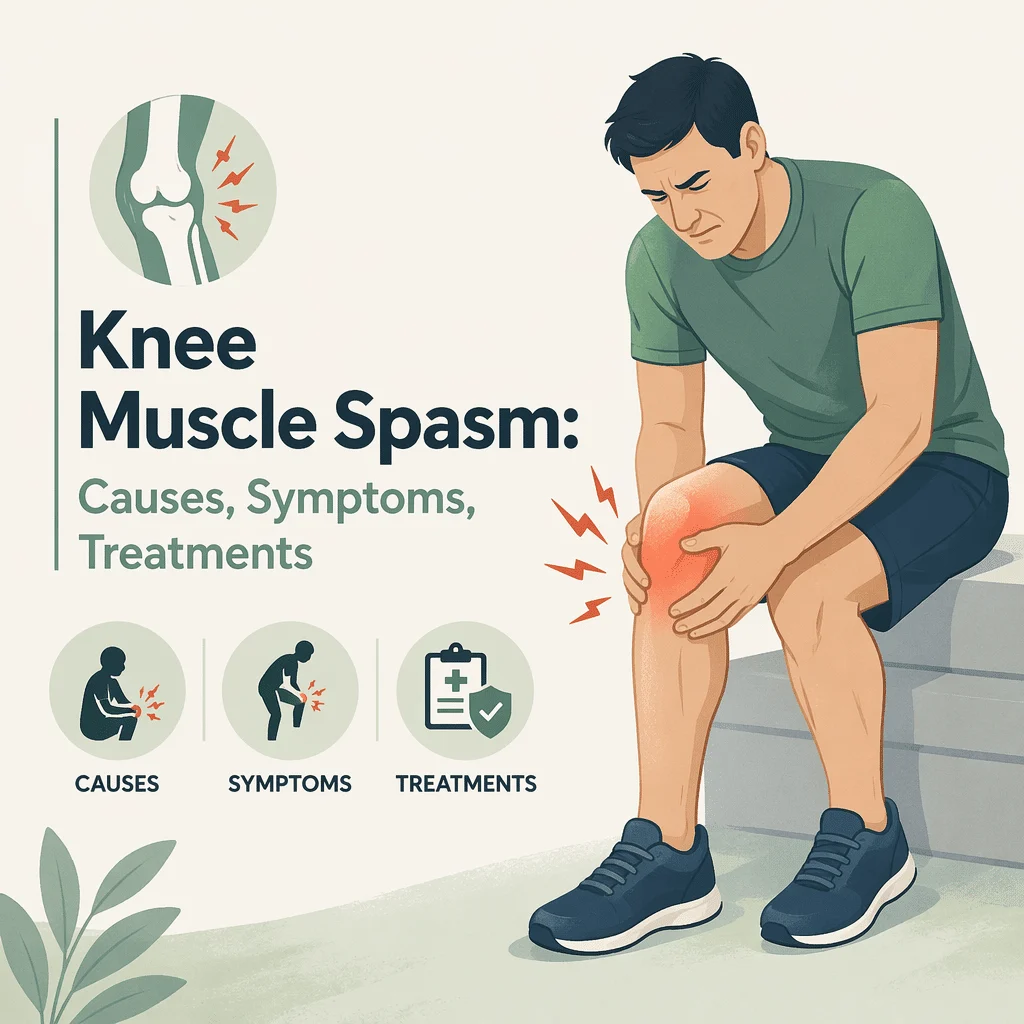
Kejang otot lutut adalah kontraksi mendadak dan tidak disengaja pada salah satu otot yang menggerakkan atau menstabilkan lutut — biasanya otot paha depan (quadriceps) di bagian depan paha, otot paha belakang (hamstring), atau otot betis tepat di bawah sendi. Beberapa episode hanya berlangsung beberapa detik dan terasa seperti getaran di bawah tempurung lutut. Yang lain bisa membuat kaki terkunci selama beberapa menit dan cukup nyeri hingga menghentikan langkah Anda. Sebagian besar kasus tidak berbahaya dan akan mereda dengan sendirinya. Sebagian kecil lainnya bisa menandakan kehilangan cairan, ketidakseimbangan mineral, efek samping obat, atau cedera lutut yang perlu diperiksa lebih lanjut. Dalam artikel ini, Anda akan mengetahui apa yang memicu kejang ini, cara meredakannya dengan cepat, tanda-tanda yang membedakan kram biasa dari gejala peringatan, serta tes laboratorium yang biasa dianjurkan dokter ketika kejang terus berulang.
Apa sebenarnya kejang otot lutut itu
Serat otot berkontraksi ketika saraf memberi sinyal. Kejang terjadi saat sinyal tersebut muncul tanpa ada keputusan dari Anda, dan otot tetap berkontraksi alih-alih mengendur. Anda mungkin melihat otot menonjol atau bergerak di bawah kulit, dan area tersebut sering terasa nyeri selama satu atau dua hari setelahnya — mirip seperti rasa yang Anda rasakan setelah olahraga yang sangat berat.
Ada tiga kelompok otot yang biasanya terlibat di sekitar lutut. Otot quadriceps membentang di bagian depan paha dan meluruskan sendi. Otot hamstring membentang di bagian belakang dan menekuk sendi. Otot betis melintas di belakang lutut dan menariknya setiap kali kaki menunjuk ke bawah. Karena semuanya menempel di dekat sendi, kejang pada salah satu otot tersebut terasa seperti masalah lutut meskipun sendinya sendiri dalam kondisi sehat. Tim kami juga menjelaskan penyebab utama nyeri lutut.
Kejang, kram, kedutan, atau kontraktur
Keempat kata ini menggambarkan kondisi yang berbeda, dan membedakannya akan menentukan langkah apa yang sebaiknya Anda ambil selanjutnya. Kejang adalah kontraksi otot yang terjadi tanpa disengaja. Kram adalah kejang yang terasa nyeri dan membuat otot mengeras secara terlihat. Kedutan, yang juga disebut fasikulasi, adalah gerakan kecil beberapa serat otot di bawah kulit — terlihat, biasanya tidak nyeri, dan umum terjadi pada orang yang kelelahan, stres, atau terlalu banyak mengonsumsi kafein. Kontraktur adalah pemendekan otot yang tidak bisa dilepaskan dengan peregangan dan termasuk dalam kelompok penyebab yang berbeda. Sebuah tinjauan tahun 2023 dalam jurnal Practical Neurology menegaskan bahwa kram biasa, pada umumnya, merupakan bagian dari fisiologi normal, dan hanya sebagian kecil yang mencerminkan penyakit saraf atau sistemik yang mendasarinya.
Apa yang menyebabkan kejang otot lutut
Penggunaan berlebihan, kelelahan, dan kerusakan otot
Menegangkan atau menggunakan otot secara berlebihan adalah pemicu paling umum yang disebutkan oleh MedlinePlus. Lari jarak jauh, rutinitas squat baru, seharian berkebun sambil berlutut, atau sekadar mempertahankan satu posisi selama berjam-jam dapat membuat otot paha depan atau paha belakang berkontraksi secara tidak teratur. Kelelahan mengubah cara sensor di dalam otot melaporkan ketegangan ke sumsum tulang belakang, sehingga otot menjadi lebih mudah mengalami kram. Itulah mengapa kram dalam olahraga ketahanan biasanya muncul di akhir suatu kegiatan, bukan di awal.
Kehilangan cairan, panas, dan mineral
Cleveland Clinic menyebutkan olahraga dalam cuaca sangat panas, dehidrasi, kurang peregangan, serta ketidakseimbangan kalium, magnesium, dan kalsium sebagai penyebab umum. Berkeringat banyak tanpa mengganti cairan yang hilang dapat mengurangi volume darah dan mengubah keseimbangan garam di sekitar serat otot. Penggunaan diuretik jangka panjang, muntah atau diare berulang, serta pola makan yang sangat ketat dapat menimbulkan efek serupa secara lebih lambat. Kami juga membahas efek dehidrasi terhadap tekanan darah, yang sering muncul dalam episode yang sama.
Sinyal yang berasal dari sendi lutut itu sendiri
Setelah cedera lutut, sendi dapat mengirimkan serangkaian sinyal abnormal yang sebagian "mematikan" otot paha depan. Para klinisi menyebut kondisi ini sebagai hambatan otot artrogenik, dan kondisi ini menghasilkan kebalikan dari apa yang kebanyakan orang bayangkan: alih-alih kram yang keras, otot paha gagal berkontraksi dengan baik, lutut tidak dapat diluruskan sepenuhnya, dan kaki terasa seolah-olah akan lemas. Sebuah studi tahun 2024 dalam American Journal of Sports Medicine menemukan pola ini pada lebih dari separuh kasus cedera ligamen anterior cruciate yang baru terjadi dalam jumlah besar. Osteoartritis lutut dapat menimbulkan refleks perlindungan serupa, di mana otot-otot di sekitar sendi yang nyeri menahan diri dalam keadaan tegang.
Obat-obatan dan kondisi medis
Beberapa obat dikenal sebagai pemicu kram, dan MedlinePlus menyebutkannya bersama dialisis dan kehamilan. Diuretik mengubah kadar kalium dan magnesium. Statin menyebabkan gejala otot pada sebagian kecil penggunanya: sebuah tinjauan tahun 2023 dalam Endocrine Practice mencatat bahwa kram yang tidak dapat dijelaskan, disertai kadar kreatin kinase yang sebelumnya meningkat, termasuk di antara tanda-tanda yang seharusnya mendorong diskusi tentang toleransi statin — bukan penghentian diam-diam. Gangguan tiroid, diabetes, gangguan saraf, dan penyakit hati semuanya tercantum dalam daftar Mayo Clinic sebagai kondisi yang meningkatkan risiko kram. Kram sangat sering terjadi pada penyakit hati stadium lanjut — sebuah tinjauan tahun 2023 dalam JAMA melaporkan bahwa sekitar dua dari tiga orang yang hidup dengan sirosis mengalaminya, dan bahwa kondisi ini dapat ditangani.
Kedutan di tempat lain menimbulkan pertanyaan yang sama: lihat apa penyebab hidung berkedut dan kapan hal itu perlu diperhatikan.
Kemungkinan penyebab, petunjuk gejala, dan tes yang sering dipesan
Tabel di bawah ini adalah panduan pembacaan, bukan diagnosis. Tabel ini menunjukkan bagaimana dokter biasanya bergerak dari pola gejala menuju daftar pendek pemeriksaan. Riwayat kesehatan Anda, daftar obat-obatan Anda, dan pemeriksaan fisik selalu menjadi prioritas utama.
| Kemungkinan penyebab | Petunjuk dari gejala Anda | Tes yang sering dipesan dokter |
|---|---|---|
| Penggunaan berlebihan atau olahraga yang sangat berat | Kram saat atau beberapa jam setelah aktivitas yang tidak biasa; paha atau betis terasa nyeri dan sakit saat ditekan | Biasanya tidak diperlukan; creatine kinase diperiksa jika nyeri parah atau urine berubah warna menjadi gelap |
| Kehilangan cairan dan panas | Kram setelah berkeringat lama, rasa haus, urine berwarna gelap, pusing saat berdiri | Panel elektrolit (natrium, kalium, klorida, bikarbonat), kreatinin |
| Kadar mineral rendah | Kram di beberapa kelompok otot, kesemutan, kedutan kelopak mata, diet ketat atau penggunaan diuretik jangka panjang | Magnesium, kalium, kalsium, kadang vitamin D |
| Gangguan tiroid | Kram disertai kelelahan, tidak tahan dingin, perubahan berat badan, kulit kering | TSH terlebih dahulu, kemudian free T4 jika TSH tidak normal |
| Penyakit ginjal atau dialisis | Kram di malam hari atau saat sesi dialisis, pembengkakan, berkurangnya produksi urine | Kreatinin dan eGFR, panel elektrolit |
| Efek samping obat | Kram yang muncul beberapa minggu setelah mulai mengonsumsi statin, diuretik, atau inhaler asma | Creatine kinase, kalium, magnesium, ditambah tinjauan obat-obatan |
| Cedera lutut atau osteoartritis | Otot paha yang tidak bisa meluruskan lutut sepenuhnya, rasa seperti lutut mau 'copot', pembengkakan setelah terkilir | Pemeriksaan lutut secara klinis dan pencitraan, bukan tes darah |
| Penekanan saraf di punggung bawah | Kram disertai nyeri menusuk, mati rasa, atau kesemutan yang menjalar ke bawah kaki | Pemeriksaan klinis; pencitraan jika ada tanda-tanda peringatan |
| Penyakit hati | Kram malam yang sering, kelelahan, mudah memar, perut membengkak | Enzim hati, albumin, jumlah trombosit |
Cara menghentikan kram otot lutut
Saat kram terjadi
- Regangkan otot yang sedang kram. Untuk otot paha depan (quadriceps), berdirilah, tekuk lutut, dan tarik tumit perlahan ke arah bokong. Untuk otot paha belakang (hamstrings), luruskan kaki dan condongkan tubuh ke depan dari pinggul.
- Pijat area yang tegang dengan tekanan yang kuat dan stabil sambil tetap mempertahankan regangan.
- Berikan beban pada kaki jika memungkinkan. Berjalan beberapa langkah sering kali memutus siklus kram lebih cepat dibandingkan berbaring diam.
- Kompres hangat pada otot yang terasa tegang dan kaku, serta kompres dingin pada otot yang terasa nyeri dan meradang setelah kram mereda.
- Minum cairan jika Anda sudah banyak berkeringat, dan terus minum sedikit demi sedikit selama beberapa jam ke depan, bukan sekaligus.
Dalam beberapa hari ke depan
Harap maklum bahwa rasa nyeri sisa mungkin masih terasa. Tetap bergerak dengan gerakan ringan yang bebas nyeri, bukan beristirahat total, dan perkenalkan beban secara bertahap. Jika kejadian tunggal berlangsung dengan keras, atau jika otot tetap bengkak dan nyeri lebih dari 48 jam, sebaiknya hubungi dokter Anda daripada melanjutkan latihan.
Tes laboratorium apa yang membantu jika kejang lutut terus berulang
Kram sekali waktu setelah berlari di cuaca panas jarang memerlukan pemeriksaan darah. Kejang yang berulang — beberapa kali dalam seminggu, atau kejang disertai gejala lain — adalah kondisi yang berbeda, dan serangkaian tes rutin sederhana dapat menjelaskan sebagian besar penyebabnya.
- Panel elektrolit memeriksa natrium, kalium, klorida, dan bikarbonat — garam-garam yang mengatur seberapa mudah serabut otot berkontraksi. Panduan kami menjelaskan apa yang diukur oleh panel elektrolit.
- Magnesium dan kalsium diukur secara terpisah dari panel standar di banyak laboratorium. Artikel ini membahas gejala kekurangan magnesium, dan panduan kami membahas tes kalsium darah dan panel tulang.
- Kreatinin dan eGFR menunjukkan seberapa baik ginjal membuang limbah dan menjaga keseimbangan cairan. Tim kami menjelaskan penanda dalam panel fungsi ginjal.
- TSH memeriksa tiroid, karena kelenjar yang kurang aktif maupun terlalu aktif dapat menyebabkan kram dan kelemahan otot. Sumber ini mencantumkan rentang normal hormon tiroid.
- Creatine kinase, yang sering disingkat CK atau CPK, meningkat ketika serabut otot mengalami kerusakan. Ini adalah tes yang membedakan nyeri otot biasa setelah olahraga dari kerusakan otot yang signifikan. Panduan ini menjelaskan tes darah CPK dan apa yang diukurnya.
Kram jarang hanya terbatas pada satu kelompok otot, sehingga pemeriksaan yang sama berlaku untuk otot kaki mana pun yang terdampak. Tim kami juga membahas kram pada otot hamstring.
Kapan harus menemui dokter?
Mayo Clinic, MedlinePlus, dan Cleveland Clinic sepakat pada daftar singkat situasi yang memerlukan saran medis, bukan penanganan mandiri.
- Kejang terasa parah, atau terus berulang beberapa kali dalam seminggu.
- Tidak membaik dengan peregangan, gerakan ringan, dan minum cairan.
- Kaki bengkak, kemerahan, terasa hangat, atau tampilan kulit berubah.
- Anda merasakan kelemahan otot, mati rasa, atau gangguan koordinasi di antara episode kejang.
- Kram muncul di seluruh tubuh, bukan hanya di satu area.
- Kram muncul setelah mengonsumsi obat baru, atau bersamaan dengan kondisi ginjal, hati, atau tiroid yang sudah diketahui.
Segera cari pertolongan medis jika nyeri otot parah dan kram terjadi setelah usaha fisik yang ekstrem dan urine Anda berubah menjadi cokelat atau berwarna seperti cola. Sebuah tinjauan sistematis tahun 2023 dalam Clinical Journal of Sport Medicine mengidentifikasi kombinasi tersebut — aktivitas fisik berat, nyeri atau kram otot, dan urine gelap — sebagai pola yang harus mendorong pemeriksaan untuk rhabdomyolysis akibat aktivitas fisik, yaitu kondisi di mana otot yang rusak melepaskan isinya ke dalam darah dan dapat membebani ginjal.
Cara mencegah kejang otot lutut
Pencegahan paling efektif jika menargetkan mekanisme penyebabnya, bukan hanya satu mineral saja.
- Tingkatkan beban latihan secara bertahap. Lonjakan mendadak dalam jarak, beban, atau paparan panas menjadi penyebab sebagian besar kejadian yang sebenarnya bisa dihindari.
- Perkuat otot-otot di sekitar lutut. Latihan ketahanan rutin untuk otot paha depan (quadriceps) dan paha belakang (hamstrings) meningkatkan kemampuan otot dalam menahan kelelahan.
- Lakukan peregangan setelah beraktivitas, bukan hanya sebelumnya, dan tahan setiap posisi cukup lama hingga Anda merasakan otot mengendur.
- Ganti cairan dan garam yang hilang selama sesi latihan panjang atau dalam cuaca panas, tanpa berlebihan mengonsumsi air putih saja.
- Tinjau daftar obat Anda bersama dokter jika kejang mulai muncul dalam beberapa minggu setelah memulai resep baru.
- Berdirilah dan bergerak jika pekerjaan Anda mengharuskan Anda duduk berjam-jam, yang menurut Cleveland Clinic berkaitan dengan kram kaki di malam hari.
Kemajuan ilmiah terkini
Penelitian yang diterbitkan dalam tiga tahun terakhir telah mengubah cara para ahli memandang kram di sekitar lutut dan tungkai bawah. Berikut penjelasannya dalam bahasa yang mudah dipahami.
Elektrolit ternyata tidak sepenting yang kita kira
Dua penelitian terbaru pada atlet ketahanan menguji gagasan klasik bahwa kram disebabkan oleh kehilangan garam melalui keringat. Sebuah analisis tahun 2026 terhadap hampir 50.000 atlet triatlon jarak Ironman selama tiga dekade menemukan bahwa kadar natrium dan kalium dalam darah tidak berbeda antara atlet yang mengalami kram dan yang tidak; dehidrasi dan kelelahan ekstrem adalah faktor yang paling menonjol. Sebuah studi ultra-trail tahun 2026 mencapai kesimpulan yang sama dan menambahkan temuan baru: para pelari yang mengalami kram menunjukkan kadar creatine kinase dan LDH yang lebih tinggi — dua penanda yang meningkat saat serat otot mengalami kerusakan — dalam 24 hingga 48 jam setelahnya. Artinya bagi Anda: jika Anda mengalami kram saat latihan panjang, mengonsumsi tablet garam kemungkinan besar bukan satu-satunya solusi. Kelelahan otot dan kerusakan otot sama pentingnya, itulah mengapa pengaturan tempo dan kondisi fisik cenderung lebih membantu dibandingkan suplemen.
Latihan kekuatan mungkin merupakan langkah pencegahan yang paling bermanfaat
Dalam studi ultra-trail yang sama, latihan kekuatan tungkai bawah secara rutin jauh lebih jarang dilakukan oleh pelari yang mengalami kram dibandingkan mereka yang tidak. Temuan ini bersifat observasional — menunjukkan adanya hubungan, bukan bukti sebab-akibat — namun sejalan dengan apa yang diketahui tentang ketahanan terhadap kelelahan. Dari sisi sendi, sebuah meta-analisis jaringan tahun 2024 di PLoS One yang menggabungkan uji coba latihan resistansi pada osteoartritis lutut menemukan bahwa ketiga format yang diteliti berhasil mengurangi nyeri dan meningkatkan fungsi lutut lebih baik dibandingkan fisioterapi konvensional saja. Artinya bagi Anda: memperkuat otot paha adalah salah satu dari sedikit langkah yang didukung bukti, baik untuk mengatasi kejang otot maupun masalah lutut yang mendasarinya.
Suplemen: satu kekecewaan, satu sinyal awal yang menjanjikan
Magnesium adalah suplemen yang paling sering disarankan untuk mengatasi kram, namun bukti ilmiah tidak mendukung penggunaannya untuk kram malam hari yang umum terjadi. Sebuah ringkasan bukti tahun 2023 dalam American Family Physician menyimpulkan bahwa suplementasi magnesium tidak mengurangi kram kaki nokturnal idiopatik pada orang dewasa — yaitu kram tanpa penyebab yang teridentifikasi. Hal ini tidak berlaku bagi orang yang memang memiliki kadar magnesium rendah, yang memang perlu dikoreksi. Sementara itu, sebuah uji coba acak tahun 2024 yang diterbitkan dalam JAMA Internal Medicine menguji vitamin K2 pada hampir 200 orang dewasa berusia 65 tahun ke atas yang sering mengalami kram malam hari, dan menemukan bahwa frekuensi kram per minggu lebih sedikit dibandingkan dengan kapsul plasebo, tanpa efek samping yang terkait. Artinya bagi Anda: ini adalah satu uji coba yang dilakukan dengan baik pada orang dewasa yang lebih tua dari satu negara. Ini merupakan hasil awal yang menggembirakan, belum menjadi rekomendasi, dan sebaiknya didiskusikan dengan dokter Anda daripada langsung dijadikan alasan untuk mulai mengonsumsi suplemen.
Setelah cedera lutut, masalahnya mungkin adalah aktivitas otot yang terlalu rendah
Studi American Journal of Sports Medicine tahun 2024 tentang cedera ligamen krusiatum anterior yang baru terjadi menemukan hambatan otot artrogenik — yaitu penonaktifan refleks otot quadriceps seperti yang dijelaskan sebelumnya — pada sebagian besar kasus, dan melaporkan bahwa sebagian besar kasus tersebut membaik dengan program latihan sederhana yang terarah. Artinya bagi Anda: jika lutut Anda terasa kaku, tidak stabil, atau tidak bisa diluruskan setelah cedera, jawabannya biasanya adalah rehabilitasi terstruktur, bukan istirahat total. Sebuah tinjauan tahun 2023 dalam Practical Neurology memberikan poin pelengkap untuk kram secara umum: riwayat medis dan pemeriksaan yang cermat dapat mengidentifikasi penyebabnya pada sebagian besar orang, dan pemeriksaan lebih lanjut yang ekstensif hanya diperuntukkan bagi mereka yang menunjukkan tanda-tanda peringatan.
Glosarium
| Ketentuan | Definisi |
|---|---|
| Hambatan otot artrogenik | Refleks di mana sendi yang cedera atau nyeri sebagian 'mematikan' otot-otot di sekitarnya, sehingga otot quadriceps tidak dapat berkontraksi sepenuhnya meskipun otot itu sendiri tidak rusak. |
| Kontraktur | Pemendekan otot atau jaringan di sekitarnya yang berlangsung lama dan tidak mereda meski sudah diregangkan, berbeda dengan kram biasa. |
| Kreatinin kinase (CK atau CPK) | Enzim yang tersimpan di dalam sel otot. Kadarnya dalam darah meningkat ketika serat otot mengalami kerusakan, sehingga membantu mengukur seberapa besar tekanan yang dialami otot. |
| eGFR | Laju filtrasi glomerulus yang diperkirakan, yaitu angka hasil perhitungan yang menggambarkan seberapa efisien ginjal menyaring darah. |
| Elektrolit | Mineral yang membawa muatan listrik dalam cairan tubuh, seperti natrium, kalium, kalsium, atau magnesium. Elektrolit mengatur cara kerja saraf dan otot. |
| Fasikulasi | Kedutan kecil yang terlihat pada beberapa serat otot di bawah kulit, umumnya disebut sebagai sentakan. Biasanya tidak terasa nyeri. |
| Hamstring | Kelompok otot yang membentang di bagian belakang paha, berfungsi untuk menekuk lutut dan meluruskan pinggul. |
| Quadriceps | Kelompok otot yang terdiri dari empat bagian di bagian depan paha, berfungsi untuk meluruskan lutut dan menyerap benturan saat mendarat. |
| Rabdomiolisis | Kondisi di mana otot yang rusak melepaskan isinya ke dalam aliran darah, yang terkadang membuat urine berwarna gelap dan membebani ginjal. |
| TSH | Hormon perangsang tiroid, yaitu sinyal dari kelenjar pituitari yang memberi tahu tiroid seberapa banyak hormon yang harus diproduksi. Ini adalah tes darah tiroid lini pertama yang biasa dilakukan. |
Pertanyaan yang sering diajukan
Apa yang menyebabkan kejang lutut yang nyeri?
Sebagian besar kejang nyeri di sekitar lutut disebabkan oleh penggunaan otot yang berlebihan dan kelelahan, kehilangan cairan saat kepanasan atau olahraga berat, atau mempertahankan satu posisi dalam waktu lama. Kadar kalium, kalsium, atau magnesium yang rendah dapat menjadi faktor penyebab, begitu pula obat-obatan tertentu, penyakit ginjal atau tiroid, serta penekanan saraf di punggung bawah. Ketika kejang terjadi setelah cedera lutut, sendi itu sendiri mungkin memicu refleks otot yang tidak normal. Satu episode nyeri setelah aktivitas yang tidak biasa biasanya tidak lebih dari itu. Kejang nyeri yang berulang perlu dievaluasi secara medis, karena penyebabnya sering kali dapat diidentifikasi dan ditangani.
Bagaimana cara menghentikan kedutan otot lutut?
Kedutan yang terlihat tetapi hampir tidak terasa umumnya tidak berbahaya dan berkaitan dengan kelelahan, stres, kafein, atau dehidrasi. Mengurangi kafein, tidur yang cukup, minum secara teratur sepanjang hari, dan meregangkan paha secara perlahan biasanya akan meredakannya dalam beberapa hari. Jika kedutan berlangsung selama berminggu-minggu, menyebar ke area lain, atau disertai kelemahan atau penyusutan otot yang nyata, sebaiknya lakukan pemeriksaan medis daripada menunggu.
Apakah bisa mengalami kejang otot di lutut tanpa rasa nyeri?
Ya. Kejang tanpa rasa sakit terasa seperti ketegangan, tarikan, atau sensasi bergetar tanpa cengkeraman tajam seperti kram. Hal ini sering mencerminkan otot yang lelah atau kedutan ringan pada beberapa serat otot. Kejang tanpa rasa sakit adalah hal yang umum dan jarang serius. Yang perlu diperhatikan adalah apakah ada gejala lain yang menyertainya: pembengkakan, kelemahan, mati rasa, ketidakmampuan untuk meluruskan lutut sepenuhnya, atau rasa seperti kaki tidak kuat menopang. Tanda-tanda tambahan itulah — bukan rasa sakitnya sendiri — yang mendorong perlunya pemeriksaan lebih lanjut.
Seperti apa rasanya kejang lutut?
Kebanyakan orang menggambarkannya sebagai pengerasan mendadak pada paha atau betis, tonjolan atau riak yang terlihat di bawah kulit, dan ketidakmampuan untuk menggerakkan sendi secara normal hingga kejang mereda. Biasanya berlangsung dari beberapa detik hingga beberapa menit. Setelahnya, otot sering terasa nyeri saat disentuh selama satu atau dua hari. Karena otot-otot yang melewati lutut menempel dekat dengan sendi, sensasinya sering terasa di dalam lutut meskipun sendinya sepenuhnya normal.
Mengapa saya mengalami kejang otot setelah operasi penggantian lutut?
Kejang adalah hal yang umum terjadi pada minggu-minggu setelah operasi lutut. Otot-otot di sekitar sendi telah mengalami pembengkakan, perubahan pola gerakan, dan periode penggunaan yang berkurang, sehingga merespons dengan cara menegang. Sendi juga mengirimkan sinyal yang tidak normal selama proses penyembuhan yang mengganggu cara otot quadriceps bekerja. Rehabilitasi yang terpandu, pembebanan bertahap, dan latihan rentang gerak yang konsisten biasanya dapat mengatasinya. Beritahu tim bedah Anda jika kejang terasa intens, semakin memburuk, atau disertai demam, pembengkakan yang nyata, atau kemerahan yang semakin parah.
Mengapa lutut saya berkedut saat berbaring?
Otot berada dalam kondisi paling rileks saat Anda berbaring, sehingga kontraksi kecil yang tidak terasa selama siang hari menjadi lebih jelas terasa. Akhir hari yang penuh aktivitas fisik, kurangnya asupan cairan, kafein, dan obat-obatan tertentu semuanya meningkatkan kemungkinan terjadinya hal ini. Cleveland Clinic juga mengaitkan duduk terlalu lama dan posisi tubuh yang kurang baik dengan kram kaki di malam hari. Jika sensasi yang Anda rasakan adalah dorongan untuk menggerakkan kaki yang mereda hanya saat Anda bergerak, diskusikan kemungkinan sindrom kaki gelisah dengan dokter Anda, karena itu adalah kondisi yang berbeda dengan penanganannya sendiri.
Sumber
- Mayo Clinic — Kram otot: gejala dan penyebab, 2025 — mayoclinic.org
- MedlinePlus, National Library of Medicine — Kram otot, 2024 — medlineplus.gov
- Cleveland Clinic — Kejang otot (kram otot): penyebab, pengobatan, dan pencegahan, 2023 — my.clevelandclinic.org
- Dijkstra JN, Boon E, Kruijt N, et al. — Kram otot dan kontraktur: penyebab dan pengobatan — Practical Neurology, 2023 — doi.org/10.1136/pn-2022-003574
- Sonnery-Cottet B, Hopper GP, Gousopoulos L, et al. — Incidence of and risk factors for arthrogenic muscle inhibition in acute anterior cruciate ligament injuries — American Journal of Sports Medicine, 2024 — doi.org/10.1177/03635465231209987
- Nilssen PK, Hew-Butler T, Rosemann T, et al. — Exercise-associated muscle cramps in Ironman-distance triathletes over three decades — Clinical Journal of Sport Medicine, 2026 — doi.org/10.1097/JSM.0000000000001276
- Martinez-Navarro I, Montoya-Vieco A, Hernando B, et al. — Muscle cramping in ultra-trail: dehydration and electrolyte depletion versus muscle damage — Journal of Strength and Conditioning Research, 2026 — doi.org/10.1519/JSC.0000000000005440
- Jiang Y, Zhang J, Wang X, et al. — Effects of three types of resistance training on knee osteoarthritis: a systematic review and network meta-analysis — PLoS One, 2024 — doi.org/10.1371/journal.pone.0309950
- Tan J, Zhu Y, Li Y, et al. — Vitamin K2 in managing nocturnal leg cramps: a randomized clinical trial — JAMA Internal Medicine, 2024 — doi.org/10.1001/jamainternmed.2024.5726
- Kaufman N, Nguyen T, Bolduc L — Does magnesium supplementation treat nocturnal leg cramps? — American Family Physician, 2023 — pubmed.ncbi.nlm.nih.gov/38215424
- Tsushima Y, Hatipoglu B — Statin intolerance: a review and update — Endocrine Practice, 2023 — doi.org/10.1016/j.eprac.2023.03.004
- Bäcker HC, Richards JT, Kienzle A, et al. — Exertional rhabdomyolysis in athletes: a systematic review — Clinical Journal of Sport Medicine, 2023 — doi.org/10.1097/JSM.0000000000001082
- Tapper EB, Parikh ND — Diagnosis and management of cirrhosis and its complications: a review — JAMA, 2023 — doi.org/10.1001/jama.2023.5997
Bacaan lebih lanjut
- Cara membaca hasil tes darah Anda
- Penjelasan lengkap tentang panel metabolik komprehensif
- Gejala, cara meredakan, dan tanda bahaya skiatika
- Kram pada tulang rusuk, penyebabnya, dan tanda-tanda peringatannya
- Tes darah vitamin D dan cara membaca hasilnya
Pahami hasil lab Anda dengan AI DiagMe.
Ketika kejang lutut terus berulang, penjelasannya sering kali terlihat dari beberapa nilai darah rutin, bukan dari lututnya sendiri. AI DiagMe membaca laporan lab Anda dan menjelaskan, dalam bahasa yang mudah dipahami, apa arti kadar natrium, kalium, magnesium, dan kalsium Anda, beserta penanda ginjal seperti kreatinin, skrining tiroid dengan TSH, serta kreatin kinase bila ada pertanyaan seputar ketegangan otot. Tujuannya adalah membantu Anda memahami apa yang disampaikan hasil Anda dan datang ke janji dokter dengan pertanyaan yang jelas. Layanan ini tidak membuat diagnosis dan tidak menggantikan dokter Anda.
Dapatkan interpretasi hasil Anda dalam hitungan menit.