


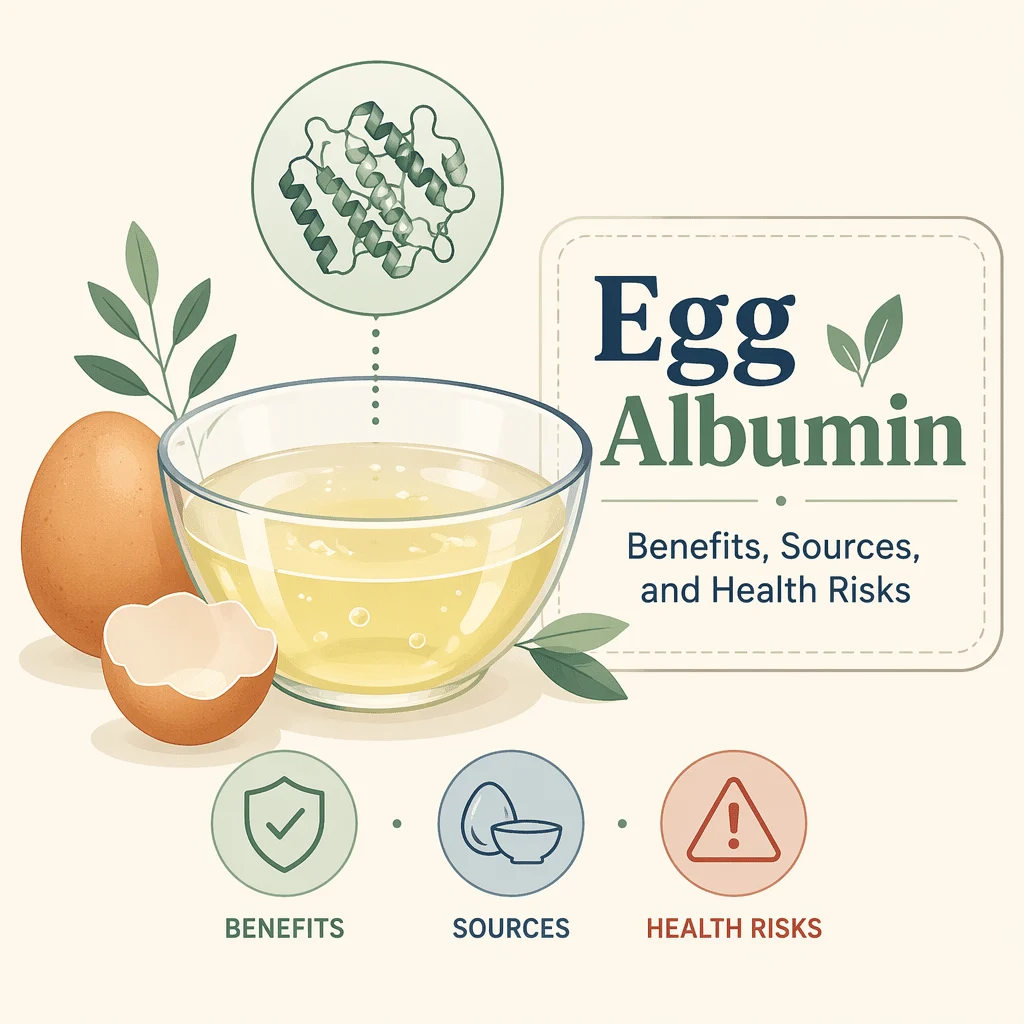
Egg albumin is the main protein in egg white, and it explains much of what makes eggs such a valued food for muscle, weight control, and everyday nutrition. Also called ovalbumin, this water-soluble protein sets when you cook or whip an egg white, which is why a clear liquid turns firm and opaque. Beyond the kitchen, it delivers a complete, low-calorie protein that the body absorbs easily. In this article you will learn what egg albumin is, its nutrition and benefits, its food sources, the allergy and food-safety risks worth knowing, and what recent research adds. You will also see how dietary egg albumin differs from the albumin measured in your blood tests, so your lab results make more sense.
What is egg albumin?
Egg albumin is the family of proteins that makes up egg white, the clear part of the egg that surrounds the yolk. In everyday language, people use “egg albumin,” “egg white protein,” and “albumen” to mean roughly the same thing. Chemically, it is dominated by one protein called ovalbumin, which accounts for a little over half of the protein in egg white. Other proteins in the mix include ovotransferrin, ovomucoid, lysozyme, and avidin, each with its own role in protecting the developing chick from bacteria.
Ovalbumin and the other egg white proteins
Ovalbumin is a globular protein, meaning its chain of amino acids folds into a compact ball. In nature, it acts as a storage protein, holding amino acids in reserve for the embryo. That same nutrient density is what makes egg white such an efficient protein source for people. Because it is water-soluble and free of fat, egg white protein is also widely used in laboratories and food manufacturing as a reliable, well-characterized protein.
Why egg albumin changes when you cook it
Raw egg white is a runny, transparent liquid. Apply heat or vigorous whisking and it turns white and firm. This change is called denaturation: the folded protein unravels and the strands link together into a solid network. Denaturation is not a loss of nutrition. In fact, cooked egg white is easier to digest than raw, and heating also switches off two proteins, avidin and certain protease inhibitors, that can interfere with nutrient absorption when eaten raw.
Nutrition profile and benefits of egg albumin
The appeal comes down to a simple trade: a lot of high-quality protein for very few calories. A single large egg white supplies about 3.6 grams of protein and roughly 17 calories, with essentially no fat, no cholesterol, and only a trace of carbohydrate. That makes egg white one of the leanest whole-food protein sources in the kitchen.
A complete, easy-to-absorb protein
Egg albumin is a complete protein, which means it contains all nine essential amino acids your body cannot make on its own. It is also one of the most digestible proteins studied, so a high share of what you eat is actually absorbed and used. For anyone building meals around protein quality rather than quantity, egg white is a benchmark. The Harvard T.H. Chan School of Public Health lists eggs among convenient, nutrient-dense sources of protein for a balanced diet.
Muscle repair, weight management, and steadier meals
Because it is rich in essential amino acids, egg white protein supports muscle repair and maintenance, especially helpful alongside regular activity or as people age and naturally lose muscle. Its high protein-to-calorie ratio also suits weight management: protein is the most filling of the three macronutrients, so an egg-white-based meal can help you feel satisfied on fewer calories. Protein also blunts how quickly a mixed meal raises blood sugar, which can make breakfasts feel steadier.
Egg albumin nutrition at a glance
| Nutrient | Approximate amount in 1 large egg white |
|---|---|
| Calories | About 17 kcal |
| Protein | About 3.6 g |
| Fat | 0 g |
| Carbohydrate | About 0.2 g |
| Cholesterol | 0 mg |
| Minerals | Small amounts of potassium, magnesium, and sodium |
Food sources and culinary uses
The most obvious source of egg albumin is the white of a fresh chicken egg, separated from the yolk. Beyond the shell egg, you will find it as liquid egg whites in cartons, as dried egg white powder, and as egg white protein supplements aimed at athletes who want a lactose-free, dairy-free protein. Powdered and pasteurized forms are convenient because they are already heat-treated for safety and store well.
In cooking, egg albumin is a workhorse. Whipped into a foam, it gives lift to meringues, soufflés, angel food cake, and macarons. Its setting ability binds and thickens custards, and its clarifying power is used to filter cloudy stocks and some beverages. In each case, the same protein chemistry, foaming and setting, is doing the work.
Health risks and cautions
Egg albumin is safe and nourishing for most people, but a few cautions are worth understanding before you rely on it heavily.
Egg allergy
Egg is one of the most common food allergies in early childhood, and the immune system usually reacts to egg white proteins such as ovalbumin and ovomucoid. Reactions range from mild hives and stomach upset to swelling, breathing trouble, and, rarely, anaphylaxis. Many children outgrow egg allergy by school age, but some carry it into adulthood. When symptoms suggest a food trigger, an allergist can confirm sensitization by checking IgE antibodies with an allergy blood test. If you or your child has a diagnosed egg allergy, read ingredient labels carefully, since egg white is a hidden ingredient in many baked and processed foods.
Raw egg white: Salmonella and the biotin question
Two issues make raw egg white a poor idea. First, raw and undercooked eggs can carry Salmonella, bacteria that cause food poisoning. The U.S. Food and Drug Administration advises cooking eggs until both the white and yolk are firm and avoiding foods that contain raw egg. Second, raw egg white contains avidin, a protein that binds the B vitamin biotin and can block its absorption if you eat large amounts of raw whites over time. Cooking solves both problems at once: heat destroys Salmonella and inactivates avidin. People eating varied diets rarely develop a biotin shortfall, but if fatigue or other symptoms prompt testing, doctors can check related B vitamins on a blood panel, including the test that flags low vitamin B12.
Egg albumin, cholesterol, and heart health
Egg white itself contains no cholesterol; all of an egg’s cholesterol sits in the yolk. For years, dietary cholesterol drove worry about eggs and the heart. Current guidance is more reassuring. Mayo Clinic notes that most healthy people can eat up to about seven eggs a week without raising their risk of heart disease. If you track heart risk, your doctor looks less at egg intake and more at your blood lipids. To gauge that risk, clinicians measure the fats in your blood with a lipid panel and then interpret your cholesterol ratio.
Who should be careful with egg albumin
Most people can enjoy egg whites freely. A few groups should take extra care. Anyone with a diagnosed egg allergy must avoid it unless an allergist advises otherwise. Infants are introduced to egg under pediatric guidance, since early, careful exposure may actually lower allergy risk. People who are pregnant, older, or immunocompromised should be especially strict about cooking eggs thoroughly to avoid Salmonella. And anyone leaning on egg white protein powders for a large share of daily protein should still eat a varied diet, so they do not miss the vitamins and healthy fats that whole foods provide.
Practical tips for using egg albumin safely
- Cook egg whites until firm, and skip recipes that use raw egg unless the eggs are pasteurized.
- Buy refrigerated eggs, keep them cold, and use them before the date on the carton.
- Choose pasteurized liquid or powdered egg whites when a recipe calls for uncooked whites, such as some frostings or protein shakes.
- Pair egg whites with a source of healthy fat and fiber, such as vegetables or whole grains, for a more complete meal.
- If you use egg white protein powder, treat it as one protein source among several rather than your only one.
How egg albumin connects to your blood tests
The word “albumin” appears both on your plate and on your lab report, and the two are easy to confuse. Egg albumin is a dietary protein you eat. Serum albumin is a different protein your liver makes and releases into the blood, where it carries hormones and keeps fluid inside your vessels. Eating egg white does not directly top up blood albumin, but good overall protein nutrition does help your body maintain healthy levels.
On a routine panel, doctors assess this circulating protein alongside liver function tests, because the liver produces it. When results come back under range, clinicians investigate the cause and record low albumin levels, and a marked, lasting drop is called hypoalbuminemia. Because the kidneys normally keep albumin in the blood, damaged kidneys can leak it into the urine, a finding doctors call proteinuria; that is why albumin testing is often paired with a urinalysis and a kidney function panel. To see the whole protein picture, laboratories can separate the blood proteins using protein electrophoresis. Understanding these links turns a confusing set of numbers into a clear story about nutrition, liver, and kidney health.
Latest scientific advances
Research on eggs has shifted in recent years, both for heart health and for the treatment of egg allergy. Here is what the newest high-quality studies suggest, in plain terms.
Are eggs bad for your heart? Updated reviews say mostly no
A 2025 umbrella review, a study that pools together many earlier reviews to see the big picture, examined egg consumption and a wide range of health outcomes and found that moderate egg intake is generally not linked to higher heart disease risk in healthy adults (Formisano and colleagues, published in Nutrition, Metabolism & Cardiovascular Diseases, DOI 10.1016/j.numecd.2025.103849). An earlier review of high-quality studies on hen’s eggs reached a similar, reassuring conclusion (Myers and colleagues, Nutrients, 2023, DOI 10.3390/nu15122657). What this means for you: if you are healthy, an egg or so a day fits comfortably in a balanced diet. If you live with diabetes or existing heart disease, the evidence is more mixed, so it is worth asking your doctor about the right amount for you.
New and better options for egg allergy
Care for egg allergy is advancing quickly. European allergy guidelines updated in 2024 emphasize that many children outgrow egg allergy, that plainly baked egg is often tolerated, and that oral immunotherapy, slowly eating tiny, increasing amounts of the allergen under medical supervision, can build tolerance in selected patients (Santos and colleagues, Allergy, 2024, DOI 10.1111/all.16345). A 2025 study tested oral immunotherapy paired with a probiotic for egg and milk allergy and reported lasting tolerance in a share of children, an encouraging but still-developing approach that needs more confirmation (Lloyd and colleagues, Pediatric Allergy and Immunology, 2025, DOI 10.1111/pai.70222). Separately, a landmark trial found that omalizumab, a lab-made antibody given by injection, raised the amount of allergen, including egg, that allergic children could tolerate without a reaction (Wood and colleagues, New England Journal of Medicine, 2024, DOI 10.1056/NEJMoa2312382). What this means for you: egg allergy is more manageable than it used to be, but every one of these treatments belongs in the hands of an allergist, never a do-it-yourself attempt at home.
Glossary
| Term | Definition |
|---|---|
| Egg albumin | The collective protein that makes up egg white; ovalbumin is its main component. |
| Ovalbumin | The most abundant protein in egg white, a little over half of its protein. |
| Serum albumin | A protein made by the liver that circulates in blood; different from dietary egg albumin. |
| Amino acids | The building blocks of protein; essential ones must come from food. |
| Complete protein | A protein that supplies all nine essential amino acids. |
| Denaturation | The unfolding of a protein by heat or whipping, which firms egg white. |
| Avidin | An egg white protein that binds biotin and is inactivated by cooking. |
| Biotin | A B vitamin (B7) involved in metabolism, hair, and skin health. |
| Salmonella | Bacteria that can contaminate eggs and cause food poisoning if eggs are raw or undercooked. |
| Oral immunotherapy | A supervised treatment that gradually introduces an allergen to build tolerance. |
Frequently asked questions
What is egg albumin?
Egg albumin is the protein portion of egg white. It is made up mostly of ovalbumin, along with smaller proteins such as ovotransferrin and lysozyme. It provides a complete, low-calorie protein and is what turns firm and white when an egg is cooked or whipped.
Is egg albumin the same as egg white?
They are closely related but not identical. Egg white is the whole clear part of the egg, which is mostly water. Egg albumin refers specifically to the proteins dissolved in that liquid. When people say egg white protein, they are essentially talking about egg albumin.
Is egg albumin good for building muscle?
Yes. Egg albumin is a complete, highly digestible protein containing all nine essential amino acids, which supports muscle repair and maintenance. Combined with regular resistance activity and enough total daily protein, egg whites are a useful, low-calorie way to meet protein needs.
Can you eat egg albumin raw?
It is not recommended. Raw egg white can carry Salmonella and contains avidin, which can block absorption of the vitamin biotin. Cooking egg white until firm destroys the bacteria and inactivates avidin, making the protein safer and easier to digest. Use pasteurized whites if a recipe needs uncooked egg.
Does egg albumin raise your cholesterol?
No. Egg white contains no cholesterol, since all of an egg’s cholesterol is in the yolk. For most healthy people, moderate whole-egg intake does not meaningfully raise heart disease risk, though anyone with diabetes or heart disease should discuss their intake with a doctor.
Is egg albumin good for weight loss?
It can help. Egg albumin delivers filling protein for very few calories and no fat, so it fits well into a calorie-controlled diet. Swapping some higher-calorie protein for egg whites can lower the calories in a meal while keeping you satisfied.
Sources
- Harvard T.H. Chan School of Public Health, The Nutrition Source — Eggs. nutritionsource.hsph.harvard.edu
- U.S. Food and Drug Administration — What You Need to Know About Egg Safety. fda.gov
- Mayo Clinic — Eggs: Are they good or bad for my cholesterol? mayoclinic.org
- Formisano E, et al. — Effect of egg consumption on health outcomes: an updated umbrella review of systematic reviews and meta-analysis. Nutrition, Metabolism & Cardiovascular Diseases, 2025. doi.org/10.1016/j.numecd.2025.103849
- Myers M, et al. — Eggs: Healthy or Risky? A Review of Evidence from High Quality Studies on Hen’s Eggs. Nutrients, 2023. doi.org/10.3390/nu15122657
- Santos AF, et al. — EAACI guidelines on the management of IgE-mediated food allergy. Allergy, 2024. doi.org/10.1111/all.16345
- Lloyd M, et al. — Probiotic oral immunotherapy for egg and milk allergy induces sustained unresponsiveness. Pediatric Allergy and Immunology, 2025. doi.org/10.1111/pai.70222
- Wood RA, et al. — Omalizumab for the Treatment of Multiple Food Allergies. New England Journal of Medicine, 2024. doi.org/10.1056/NEJMoa2312382
Further reading
- Low albumin: causes, symptoms, and risks
- Allergy blood test: IgE and panels explained
- Lipid panel: cholesterol, LDL, and HDL
- Protein electrophoresis and immunoglobulins
- Low vitamin B12: symptoms, causes, treatments
Understand your lab results with AI DiagMe
The word albumin shows up in your kitchen and on your blood work, and the two tell different stories. On a lab report, serum albumin reflects your nutrition and your liver and kidney health, while a suspected egg allergy can be checked with IgE testing. AI DiagMe helps you understand results like these in plain language, connecting a single number to the bigger picture. It is built to help you understand your results, not to diagnose you, and it never replaces your doctor.
Get your results interpreted in minutes