







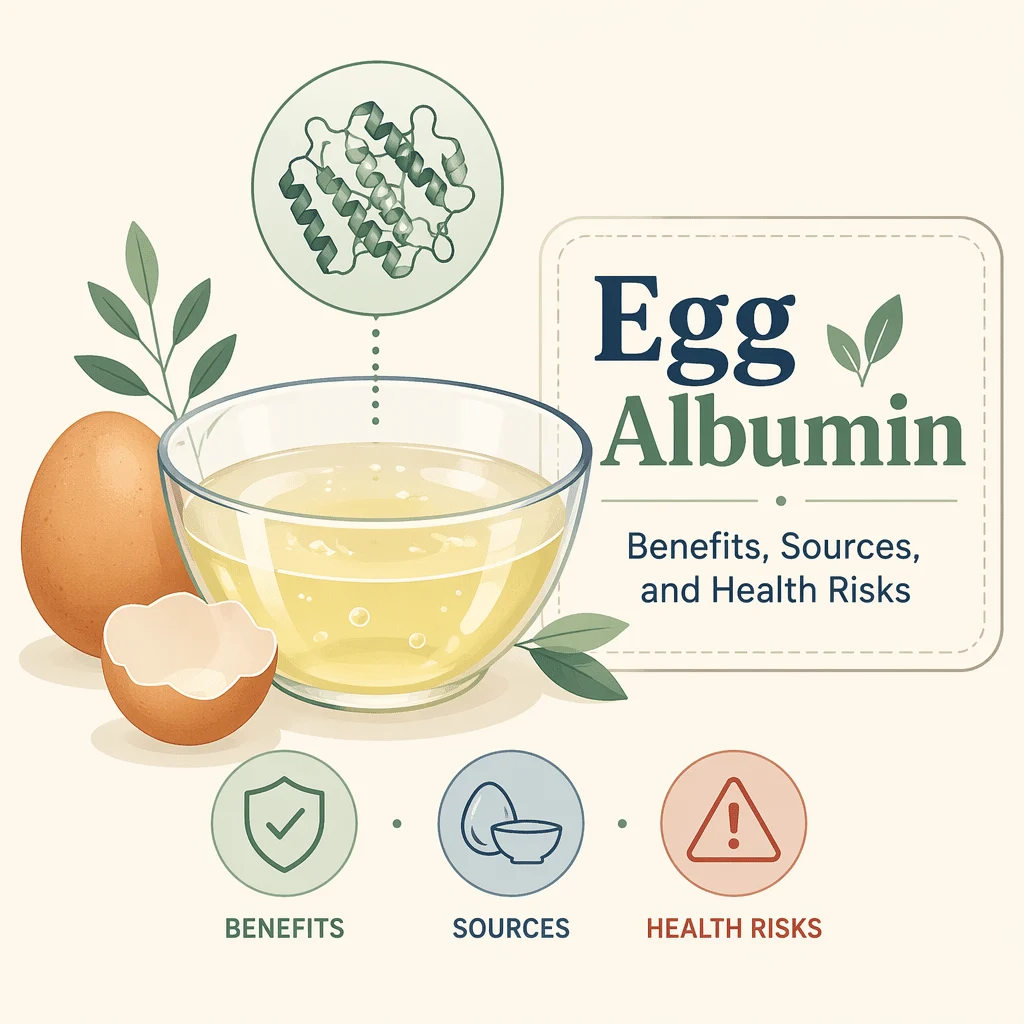
Ei-albumine is het belangrijkste eiwit in eiwit, en het verklaart grotendeels waarom eieren zo'n waardevol voedingsmiddel zijn voor spieropbouw, gewichtsbeheersing en dagelijkse voeding. Dit wateroplosbare eiwit, ook wel ovalbuminen genoemd, stolt wanneer u een eiwit kookt of klopt, waardoor een heldere vloeistof stevig en ondoorzichtig wordt. Buiten de keuken levert het een volledig, caloriearm eiwit dat het lichaam gemakkelijk opneemt. In dit artikel leert u wat ei-albumine is, de voedingswaarde en voordelen, de voedselbronnen, de allergie- en voedingsveiligheidsrisico's die u moet kennen, en wat recent onderzoek toevoegt. U ziet ook hoe voedings-ei-albumine verschilt van het albumine dat in uw bloedonderzoek wordt gemeten, zodat uw laboratoriumuitslagen meer betekenis krijgen.
Wat is ei-albumine?
Ei-albumine is de verzameling eiwitten die het eiwit vormt, het heldere deel van het ei dat de dooier omgeeft. In het dagelijks taalgebruik gebruiken mensen “ei-albumine,” “eiwitproteïne,” en “albumen” om ongeveer hetzelfde aan te duiden. Chemisch gezien wordt het gedomineerd door één eiwit genaamd ovalbuminen, dat iets meer dan de helft van het eiwit in eiwit uitmaakt. Andere eiwitten in het mengsel zijn ovotransferrine, ovomucoid, lysozym en avidine, elk met een eigen rol bij het beschermen van het zich ontwikkelende kuiken tegen bacteriën.
Ovalbuminen en de andere eiwitproteïnen
Ovalbumine is een bolvormig eiwit, wat betekent dat de keten van aminozuren zich opvouwt tot een compacte bol. In de natuur fungeert het als opslagproteïne en houdt het aminozuren in reserve voor het embryo. Diezelfde voedingsdichtheid maakt eiwit zo'n efficiënte eiwitbron voor mensen. Omdat het wateroplosbaar en vetvrij is, wordt eiwit ook veel gebruikt in laboratoria en de voedingsindustrie als een betrouwbaar, goed gekarakteriseerd proteïne.
Waarom eialbumine verandert tijdens het koken
Rauw eiwit is een vloeibare, doorzichtige vloeistof. Breng het op temperatuur of klop het krachtig op, en het wordt wit en stevig. Deze verandering heet denaturatie: het gevouwen eiwit ontvouwt zich en de strengen verbinden zich tot een vast netwerk. Denaturatie betekent geen verlies van voedingswaarde. Gekookt eiwit is zelfs makkelijker te verteren dan rauw eiwit, en verhitting schakelt ook twee eiwitten uit — avidine en bepaalde proteaseremmers — die bij rauwe consumptie de opname van voedingsstoffen kunnen verstoren.
Voedingsprofiel en voordelen van eialbumine
De aantrekkingskracht is eenvoudig: veel hoogwaardig eiwit voor heel weinig calorieën. Eén groot eiwit levert ongeveer 3,6 gram proteïne en zo'n 17 calorieën, met vrijwel geen vet, geen cholesterol en slechts een spoor koolhydraten. Daarmee is eiwit een van de magerste volwaardige eiwitbronnen die je in de keuken kunt vinden.
Een complete, gemakkelijk opneembare eiwitbron
Eialbumine is een compleet eiwit, wat betekent dat het alle negen essentiële aminozuren bevat die je lichaam zelf niet kan aanmaken. Het behoort ook tot de best verteerbare eiwitten die zijn onderzocht, zodat een groot deel van wat je eet daadwerkelijk wordt opgenomen en benut. Voor iedereen die maaltijden samenstelt op basis van eiwitkwaliteit in plaats van -hoeveelheid, is eiwit een referentiepunt. De Harvard T.H. Chan School of Public Health noemt eieren als een handige, voedingsdichte eiwitbron voor een evenwichtig voedingspatroon.
Spierherstel, gewichtsbeheer en verzadigende maaltijden
Omdat eiwit rijk is aan essentiële aminozuren, ondersteunt het de spieropbouw en het spierherstel — vooral nuttig in combinatie met regelmatige beweging of naarmate mensen ouder worden en van nature spiermassa verliezen. De hoge eiwit-calorieratio maakt het ook geschikt bij gewichtsbeheer: eiwit is het meest verzadigende van de drie macronutriënten, zodat een maaltijd op basis van eiwit je langer een vol gevoel kan geven bij minder calorieën. Eiwit vertraagt ook hoe snel een gemengde maaltijd de bloedsuiker doet stijgen, waardoor een ontbijt stabieler kan aanvoelen.
Voedingswaarde van eialbumine in één oogopslag
| Voedingsstof | Geschatte hoeveelheid in 1 groot eiwit |
|---|---|
| Calorieën | Ongeveer 17 kcal |
| Eiwit | Ongeveer 3,6 g |
| Vet | 0 g |
| Koolhydraten | Ongeveer 0,2 g |
| Cholesterol | 0 mg |
| Mineralen | Kleine hoeveelheden kalium, magnesium en natrium |
Voedselbronnen en culinair gebruik
De meest voor de hand liggende bron van eialbumine is het wit van een vers kippenei, gescheiden van de dooier. Naast het schaaldier vind je het ook als vloeibaar eiwit in kartonnen verpakkingen, als gedroogd eiwitpoeder en als eiwitproteïnesupplementen voor sporters die een lactosevrije, zuivelvrije eiwitbron zoeken. Gepoederde en gepasteuriseerde vormen zijn handig omdat ze al hittebehandeld zijn voor veiligheid en goed houdbaar zijn.
In de keuken is ei-albumine een echte alleskunner. Opgeklopt tot schuim geeft het volume aan meringues, soufflés, engelentaart en macarons. Door zijn stollende werking bindt en dikt het custards in, en zijn klaaringsmiddel wordt gebruikt om troebele bouillons en sommige dranken te filteren. In al deze gevallen doet dezelfde eiwitchemie het werk: schuimvorming en stolling.
Gezondheidsrisico's en aandachtspunten
Ei-albumine is voor de meeste mensen veilig en voedzaam, maar er zijn een paar aandachtspunten die het waard zijn te begrijpen voordat je er sterk op vertrouwt.
Ei-allergie
Ei is een van de meest voorkomende voedselallergieën bij jonge kinderen, waarbij het immuunsysteem doorgaans reageert op eiwitten in het eiwit, zoals ovalbumineovomucoid. Reacties variëren van milde netelroos en maagklachten tot zwelling, ademhalingsmoeilijkheden en, zelden, anafylaxie. Veel kinderen groeien over hun ei-allergie heen tegen de schoolleeftijd, maar sommigen houden er last van tot in de volwassenheid. Wanneer symptomen wijzen op een voedselgerelateerde oorzaak, kan een allergoloog de gevoeligheid bevestigen door IgE-antilichamen te meten met een allergie bloedtest. Als jij of je kind een vastgestelde eiwitallergie heeft, lees dan de ingrediëntenetiketten zorgvuldig, want eiwit is een verborgen ingrediënt in veel gebakken en bewerkte producten.
Rauw eiwit: Salmonella en de biotinekwestie
Er zijn twee redenen waarom rauw eiwit geen goed idee is. Ten eerste kunnen rauwe en onvoldoende verhitte eieren Salmonella bevatten, bacteriën die voedselvergiftiging veroorzaken. De Amerikaanse Food and Drug Administration adviseert eieren te koken totdat zowel het eiwit als de dooier stevig is, en voedingsmiddelen met rauw ei te vermijden. Ten tweede bevat rauw eiwit avidine, een eiwit dat de B-vitamine biotine bindt en de opname ervan kan blokkeren als je gedurende langere tijd grote hoeveelheden rauw eiwit eet. Verhitting lost beide problemen tegelijk op: warmte vernietigt Salmonella en maakt avidine onwerkzaam. Mensen met een gevarieerd dieet ontwikkelen zelden een biotinekort, maar als vermoeidheid of andere klachten aanleiding geven tot onderzoek, kunnen artsen verwante B-vitaminen controleren via een bloedonderzoek, inclusief de test die een tekort aan laag vitamine B12-gehalte.
Ei-albumine, cholesterol en hartgezondheid
Eiwit zelf bevat geen cholesterol; al het cholesterol in een ei zit in de dooier. Jarenlang zorgde voedingscholesterol voor bezorgdheid over eieren en het hart. De huidige richtlijnen zijn geruststellender. De Mayo Clinic stelt dat de meeste gezonde mensen tot ongeveer zeven eieren per week kunnen eten zonder hun risico op hartziekten te verhogen. Als je je hartrisico in de gaten houdt, kijkt je arts minder naar je eierconsumptie en meer naar je bloedvetten. Om dat risico in te schatten, meten artsen de vetten in je bloed met een lipidenpanel en interpreteer vervolgens je cholesterolratio.
Wie moet voorzichtig zijn met ei-albumine
De meeste mensen kunnen eiwitten (het witte gedeelte van het ei) vrijelijk eten. Een aantal groepen moet extra voorzichtig zijn. Iedereen met een vastgestelde eiwittenallergie moet het vermijden, tenzij een allergoloog anders adviseert. Baby's worden onder begeleiding van een kinderarts aan ei blootgesteld, omdat vroege, zorgvuldige introductie het risico op een allergie juist kan verlagen. Zwangere vrouwen, ouderen en mensen met een verzwakt immuunsysteem moeten eieren altijd goed doorbakken om Salmonella te vermijden. En wie voor een groot deel van zijn dagelijkse eiwitbehoefte op eiwitpoeder van eiwit vertrouwt, doet er goed aan gevarieerd te blijven eten, zodat hij de vitamines en gezonde vetten die volwaardige voeding biedt niet mist.
Praktische tips voor het veilig gebruik van ei-albumine
- Verhit eiwit tot het volledig gestold is en vermijd recepten met rauw ei, tenzij de eieren gepasteuriseerd zijn.
- Koop gekoelde eieren, bewaar ze koud en gebruik ze vóór de datum op de verpakking.
- Kies gepasteuriseerd vloeibaar of gedroogd eiwit wanneer een recept om ongekookt eiwit vraagt, zoals bij sommige glazuursoorten of eiwitshakes.
- Combineer eiwitten met een bron van gezonde vetten en vezels, zoals groenten of volkoren granen, voor een completere maaltijd.
- Als je eiwitpoeder van eiwit gebruikt, beschouw het dan als één eiwitbron naast andere, niet als je enige bron.
Hoe ei-albumine verband houdt met je bloedonderzoek
Het woord “albumine” komt zowel op je bord als in je laboratoriumuitslag voor, en de twee zijn gemakkelijk te verwarren. Ei-albumine is een voedingseiwit dat je eet. Serumalbumine is een ander eiwit dat je lever aanmaakt en in het bloed afgeeft, waar het hormonen vervoert en vocht in je bloedvaten houdt. Het eten van eiwit verhoogt je bloedalbuminewaarden niet rechtstreeks, maar een goede algehele eiwitinname helpt je lichaam wel om gezonde waarden te handhaven.
Bij een standaard bloedpanel beoordelen artsen dit circulerende eiwit samen met leverfunctietests, omdat de lever het aanmaakt. Wanneer de uitslag onder de referentiewaarde valt, zoeken artsen naar de oorzaak en noteren ze een laag albuminegehalte hebben, en een duidelijke, aanhoudende daling wordt hypoalbuminemiegenoemd. Omdat de nieren albumine normaal gesproken in het bloed houden, kunnen beschadigde nieren het in de urine laten lekken — een bevinding die artsen proteïnurienoemen; daarom wordt albumineonderzoek vaak gecombineerd met een urineonderzoek en een nierfunctiepanel. Om het volledige eiwitplaatje te zien, kunnen laboratoria de bloedeiwitten scheiden met behulp van eiwitelektroforese. Als je deze verbanden begrijpt, verandert een verwarrende reeks getallen in een helder verhaal over voeding, lever- en niergezonheid.
Recente wetenschappelijke ontwikkelingen
Het onderzoek naar eieren is de afgelopen jaren verschoven, zowel op het gebied van hartgezondheid als bij de behandeling van een eiwittenallergie. Dit is wat de nieuwste hoogwaardige studies in begrijpelijke taal suggereren.
Zijn eieren slecht voor je hart? Bijgewerkte overzichten zeggen van niet
Een overkoepelend review uit 2025 — een studie die veel eerdere reviews samenvoegt om het grote geheel te zien — onderzocht de consumptie van eieren en een breed scala aan gezondheidsuitkomsten. De conclusie: een gematigde eierconsumptie is bij gezonde volwassenen over het algemeen niet gekoppeld aan een hoger risico op hartziekten (Formisano en collega's, gepubliceerd in Nutrition, Metabolism & Cardiovascular Diseases, DOI 10.1016/j.numecd.2025.103849). Een eerder overzicht van hoogwaardige studies naar kippeneieren kwam tot een vergelijkbare, geruststellende conclusie (Myers en collega's, Nutrients, 2023, DOI 10.3390/nu15122657). Wat dit voor jou betekent: als je gezond bent, past een ei per dag prima in een evenwichtig voedingspatroon. Als je diabetes of een bestaande hartaandoening hebt, zijn de bevindingen minder eenduidig, dus het is de moeite waard om je arts te vragen wat de juiste hoeveelheid voor jou is.
Nieuwe en betere opties bij eiwittenallergie
De behandeling van ei-allergie gaat snel vooruit. Europese allergierichtlijnen die in 2024 zijn bijgewerkt, benadrukken dat veel kinderen ei-allergie ontgroeien, dat gewoon gebakken ei vaak goed wordt verdragen, en dat orale immunotherapie — waarbij onder medisch toezicht langzaam steeds grotere hoeveelheden van het allergeen worden gegeten — bij bepaalde patiënten tolerantie kan opbouwen (Santos en collega's, Allergy, 2024, DOI 10.1111/all.16345). Een studie uit 2025 testte orale immunotherapie in combinatie met een probioticum bij ei- en melkallergie en rapporteerde blijvende tolerantie bij een deel van de kinderen — een bemoedigende maar nog in ontwikkeling zijnde aanpak die meer bevestiging nodig heeft (Lloyd en collega's, Pediatric Allergy and Immunology, 2025, DOI 10.1111/pai.70222). Daarnaast bleek uit een baanbrekende studie dat omalizumab, een in het laboratorium gemaakt antilichaam dat via injectie wordt toegediend, de hoeveelheid allergeen — waaronder ei — verhoogde die allergische kinderen zonder reactie konden verdragen (Wood en collega's, New England Journal of Medicine, 2024, DOI 10.1056/NEJMoa2312382). Wat dit voor jou betekent: ei-allergie is beter beheersbaar dan vroeger, maar al deze behandelingen horen thuis in de handen van een allergoloog — probeer dit nooit zelf thuis uit.
Glossarium
| Termijn | Definitie |
|---|---|
| Ei-albumine | Het geheel van eiwitten dat het eiwit (het witte gedeelte van het ei) vormt; ovalbumineisde belangrijkste component. |
| Ovalbumine | Het meest voorkomende eiwit in het eiwit van het ei, goed voor iets meer dan de helft van het totale eiwitgehalte. |
| Serumalbumine | Een eiwit dat door de lever wordt aangemaakt en in het bloed circuleert; verschilt van het voedingsalbumine in eieren. |
| Aminozuren | De bouwstenen van eiwitten; essentiële aminozuren moeten via voeding worden ingenomen. |
| Volledig eiwit | Een eiwit dat alle negen essentiële aminozuren levert. |
| Denaturatie | Het ontvouwen van een eiwit door verhitting of kloppen, waardoor het eiwit stevig en wit wordt. |
| Avidine | Een eiwiteiwit dat biotine bindt en door verhitting wordt geïnactiveerd. |
| Biotine | Een B-vitamine (B7) dat betrokken is bij de stofwisseling en de gezondheid van haar en huid. |
| Salmonella | Bacteriën die eieren kunnen besmetten en voedselvergiftiging kunnen veroorzaken als eieren rauw of onvoldoende gaar zijn. |
| Orale immunotherapie | Een behandeling onder medisch toezicht waarbij een allergeen geleidelijk wordt geïntroduceerd om tolerantie op te bouwen. |
Veelgestelde vragen
Wat is ei-albumine?
Ei-albumine is het eiwitgedeelte van het eiwit (het witte gedeelte van het ei). Het bestaat voornamelijk uit ovalbumine, aangevuld met kleinere eiwitten zoals ovotransferrine en lysozym. Het levert een compleet, caloriearm eiwit en is wat stevig en wit wordt wanneer een ei wordt gekookt of geklopt.
Is eialbumine hetzelfde als eiwit?
Ze zijn nauw verwant, maar niet identiek. Eiwit is het volledige heldere deel van het ei, dat voornamelijk uit water bestaat. Ei-albumine verwijst specifiek naar de eiwitten die in die vloeistof zijn opgelost. Wanneer mensen spreken over eiwitproteïne, hebben ze het in wezen over ei-albumine.
Is ei-albumine goed voor spieropbouw?
Ja. Ei-albumine is een volledig, goed verteerbaar eiwit dat alle negen essentiële aminozuren bevat, wat spierherstel en -behoud ondersteunt. In combinatie met regelmatige krachttraining en voldoende dagelijkse eiwitinname zijn eiwitten een handige, calorieluwe manier om in je eiwitbehoefte te voorzien.
Kun je ei-albumine rauw eten?
Dit wordt niet aangeraden. Rauw eiwit kan Salmonella bevatten en bevat avidine, dat de opname van het vitamine biotine kan blokkeren. Door eiwit goed te verhitten worden de bacteriën vernietigd en wordt avidine geïnactiveerd, waardoor het eiwit veiliger en makkelijker te verteren is. Gebruik gepasteuriseerde eiwitten als een recept ongekookt ei vereist.
Verhoogt ei-albumine je cholesterol?
Nee. Eiwit bevat geen cholesterol, omdat al het cholesterol in een ei zich in de dooier bevindt. Voor de meeste gezonde mensen verhoogt een gematigde consumptie van hele eieren het risico op hart- en vaatziekten niet noemenswaardig, hoewel iedereen met diabetes of een hartaandoening zijn inname met een arts moet bespreken.
Is ei-albumine goed voor gewichtsverlies?
Het kan helpen. Ei-albumine levert een verzadigend eiwit voor zeer weinig calorieën en zonder vet, waardoor het goed past in een caloriegecontroleerd dieet. Door een deel van eiwitrijke, calorierijkere voeding te vervangen door eiwitten kun je de calorieën in een maaltijd verlagen terwijl je toch verzadigd blijft.
Bronnen
- Harvard T.H. Chan School of Public Health, The Nutrition Source — Eggs. nutritionsource.hsph.harvard.edu
- U.S. Food and Drug Administration — What You Need to Know About Egg Safety. fda.gov
- Mayo Clinic — Eggs: Are they good or bad for my cholesterol? mayoclinic.org
- Formisano E, et al. — Effect of egg consumption on health outcomes: an updated umbrella review of systematic reviews and meta-analysis. Nutrition, Metabolism & Cardiovascular Diseases, 2025. doi.org/10.1016/j.numecd.2025.103849
- Myers M, et al. — Eggs: Healthy or Risky? A Review of Evidence from High Quality Studies on Hen’s Eggs. Nutrients, 2023. doi.org/10.3390/nu15122657
- Santos AF, et al. — EAACI guidelines on the management of IgE-mediated food allergy. Allergy, 2024. doi.org/10.1111/all.16345
- Lloyd M, et al. — Probiotic oral immunotherapy for egg and milk allergy induces sustained unresponsiveness. Pediatric Allergy and Immunology, 2025. doi.org/10.1111/pai.70222
- Wood RA, et al. — Omalizumab for the Treatment of Multiple Food Allergies. New England Journal of Medicine, 2024. doi.org/10.1056/NEJMoa2312382
Verder lezen
- Laag albumine: oorzaken, symptomen en risico's
- Allergie bloedtest: IgE en panels uitgelegd
- Lipidenprofiel: cholesterol, LDL en HDL
- Eiwitelectroforese en immunoglobulinen
- Vitamine B12-tekort: symptomen, oorzaken en behandelingen.
Begrijp uw laboratoriumresultaten met AI DiagMe.
Het woord albumine duikt op in je keuken én in je bloedonderzoek, maar de betekenis verschilt. Op een laboratoriumuitslag weerspiegelt serumalbumine je voedingstoestand en de gezondheid van je lever en nieren, terwijl een vermoedelijke eiwittenallergie kan worden onderzocht met een IgE-test. AI DiagMe helpt je dit soort uitslagen in begrijpelijke taal te lezen, en legt het verband tussen één getal en het grotere geheel. Het is bedoeld om je uitslagen te begrijpen — niet om een diagnose te stellen — en vervangt nooit je arts.
Ontvang binnen enkele minuten een interpretatie van uw resultaten.