



Telling conjunctivitis vs uveitis apart matters more than most people expect, because one is usually a passing nuisance and the other can threaten your sight. Both turn the eye red. Both can water. From the bathroom mirror they look close enough that people routinely assume the milder answer and wait it out. The difference is not in the redness itself but in what comes with it: itching and sticky discharge point one way, deep ache, real light sensitivity and blurred vision point the other. In this article you will learn where each condition sits inside the eye, which signs you can genuinely check yourself, the red flags that mean same-day care, why uveitis often points to a condition elsewhere in the body, and which blood tests help doctors find the cause.
Conjunctivitis vs uveitis: the difference in one minute
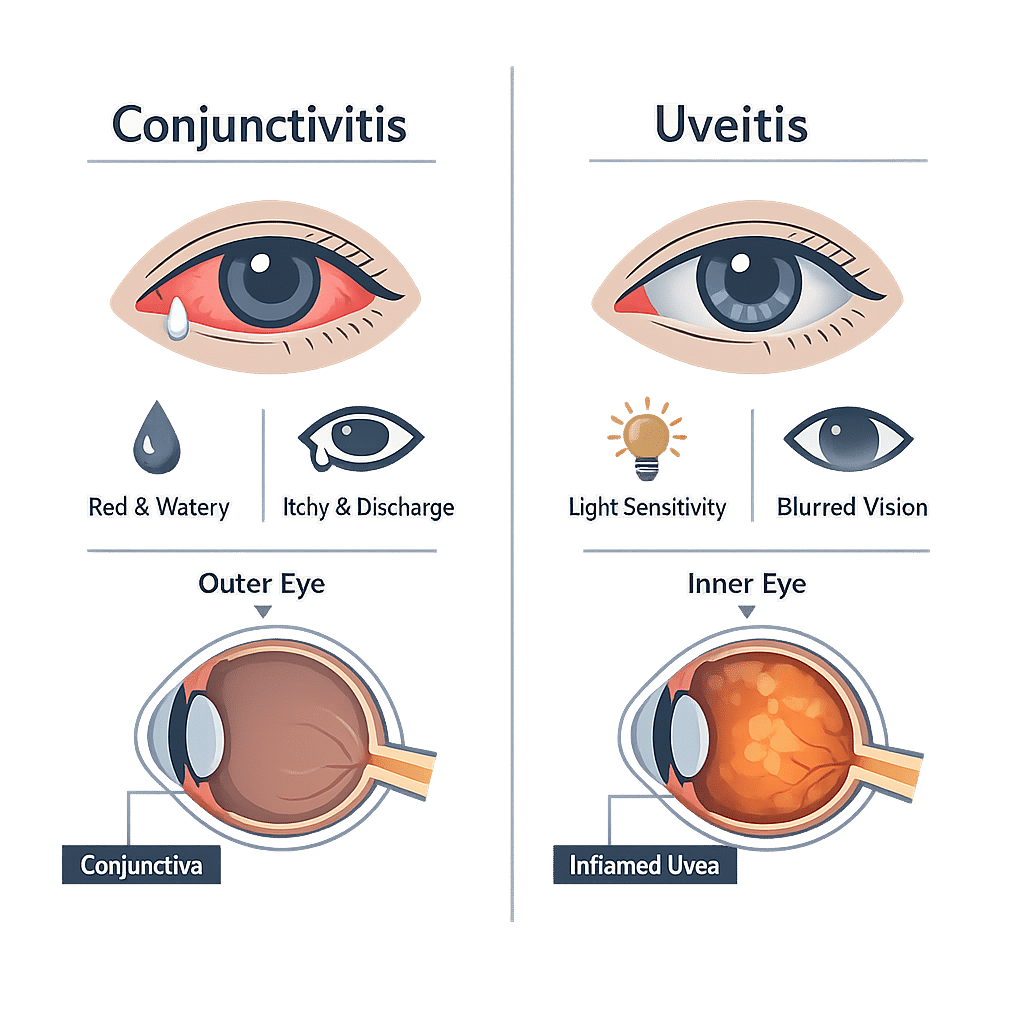
Conjunctivitis is inflammation of the surface film of the eye. Uveitis is inflammation inside the eye. That single distinction explains almost everything that follows.
Because conjunctivitis sits on the outside, it irritates: the eye itches, feels gritty, waters and often produces discharge that glues the lashes together overnight. Vision stays normal once you blink the film away. Most cases are viral, most settle on their own within one to two weeks, and the common forms spread easily between people. Our team also explains the types, symptoms and treatment of conjunctivitis for readers who already know that is what they have.
Uveitis sits behind the surface, in tissue rich in blood vessels and nerves. It aches rather than itches, it makes bright light genuinely painful, and it blurs vision in a way blinking does not fix. It is not contagious. It does not resolve on its own, and untreated inflammation inside the eye can scar delicate structures, raise the pressure inside the eye or damage the retina. That is why uveitis is the one that earns urgency.
Where each condition sits inside the eye
The conjunctiva: the surface layer
The conjunctiva is a thin, transparent membrane that covers the white of the eye and lines the inside of the eyelids. It carries fine blood vessels that are normally invisible. When it is irritated by a virus, bacteria or an allergen, those vessels widen and the whole surface takes on a diffuse pink or red wash that reaches right into the corners and up under the lids.
The uvea: the layer underneath
The uvea is the pigmented middle layer of the eye. It has three parts: the iris, the colored ring you see; the ciliary body just behind it, which focuses the lens and produces the fluid inside the eye; and the choroid, a vascular sheet that nourishes the retina. Inflammation of the front section, called anterior uveitis or iritis, is the most common form and the one most likely to be mistaken for pink eye. When it flares, the vessels that congest are the deep ones circling the edge of the iris, producing a concentrated ring of redness known as a ciliary flush rather than an even pink wash.
Conjunctivitis vs uveitis: the signs you can actually observe
The table below sets out what a person can reasonably assess at home. It sorts the odds; it does not replace an examination, and no single line in it is proof on its own.
| What you notice | Points toward conjunctivitis | Points toward uveitis |
|---|---|---|
| Where the redness sits | A diffuse pink wash across the white of the eye and inside the lids | A deeper ring of redness hugging the edge of the colored iris |
| Discharge | Watery, stringy, or thick and sticky; lids may crust shut overnight | Little or none; the eye waters without producing pus |
| What it feels like | Itching, burning, grittiness, a sensation of sand under the lid | A deep, dull ache in or behind the eye, often worse when focusing |
| Vision | Normal, apart from brief blurring that clears when you blink | Genuinely blurred or dimmed, and it does not clear |
| Light sensitivity | Mild at most | Marked; bright light can be actively painful |
| The pupil | Normal size and shape, reacts normally | May look smaller, irregular in shape, or slow to react |
| How it starts | Often one eye, spreading to the other over a few days | Usually one eye alone, coming on over hours to a couple of days |
| Contagious | Viral and bacterial forms spread easily between people | Not contagious |
| Usual course | Most cases settle within one to two weeks | Needs prompt specialist treatment to protect vision |
One practical shortcut is worth remembering. Itch with discharge and normal vision is reassuring. Ache with light sensitivity and reduced vision is not, whatever the discharge is doing.
Red flags: when a red eye needs same-day care
Any of the following turns a red eye into a problem for the same day rather than the same week. Contact an eye specialist or urgent care rather than waiting to see whether it settles.
- Vision that is blurred, dimmed or reduced and does not clear when you blink
- Genuine pain in or around the eye, as opposed to itching or grittiness
- Marked discomfort in bright light, enough to make you squint or seek a dark room
- Redness concentrated in a ring around the colored part of the eye
- A pupil that looks different in size or shape from the other side
- New floaters, flashes of light, or a shadow moving across the field of view
- A red, painful eye in anyone who wears contact lenses, has had eye surgery or an eye injury, or has a known autoimmune condition
- A red eye in a newborn or a very young infant
Floaters deserve a note of their own, because they can accompany inflammation deeper in the eye and also signal problems in the retina. Another guide describes the causes of black spots in vision. Pain with reduced vision and a hazy cornea can also mean a sudden rise in pressure inside the eye, so this library covers the causes and testing of glaucoma as well.
What causes conjunctivitis, and what causes uveitis
Causes of conjunctivitis
The Centers for Disease Control and Prevention groups the common causes into three: viruses, bacteria and allergens. Viral conjunctivitis is the most frequent, usually accompanies a cold, produces watery discharge and clears without specific treatment. Bacterial conjunctivitis tends to produce thicker, more persistent discharge. Allergic conjunctivitis affects both eyes at once, itches intensely and travels with sneezing or a blocked nose. Irritants such as chlorine, smoke and cosmetics cause a fourth, non-infectious pattern. When the trigger looks seasonal or environmental, our team explains the results of an allergy blood test, which can identify the specific allergens involved.
Causes of uveitis
Uveitis is a different category of problem. In roughly half of cases no cause is ever identified. In the rest, the inflammation is driven either by the immune system attacking the eye or by an infection reaching it. The autoimmune group includes ankylosing spondylitis and related spinal conditions, sarcoidosis, inflammatory bowel disease, juvenile idiopathic arthritis, psoriatic arthritis and Behcet disease. The infectious group includes herpes viruses and shingles, toxoplasmosis, syphilis, tuberculosis and Lyme disease. Trauma and some medications account for a smaller share.
Why uveitis often signals a condition elsewhere in the body
This is the part patients are least often told, and it is the reason a first episode of uveitis usually leads to blood tests rather than eye drops alone.
The spine and the eye
An inherited marker called HLA-B27, found on the surface of white blood cells, links a family of inflammatory conditions affecting the spine and large joints to recurrent inflammation at the front of the eye. People who carry it are far more likely to have repeated attacks of anterior uveitis, and in some the eye flares before the back pain is ever recognized. Morning stiffness in the lower back lasting more than half an hour, in someone with recurrent red painful eyes, is a combination worth raising with a doctor.
Sarcoidosis, bowel disease and joint disease
Sarcoidosis, in which small clusters of inflammatory cells form in the lungs, lymph nodes, skin and eyes, can announce itself through the eye first. Crohn’s disease and ulcerative colitis carry a recognized risk of uveitis, and this library covers the symptoms and diagnosis of Crohn’s disease for readers with digestive symptoms alongside eye inflammation.
Infections that reach the eye
Several infections can inflame the uvea, sometimes years after the original exposure, which is why the workup can look surprisingly broad. Our team explains the meaning of a positive RPR syphilis test, a companion article describes the interpretation of toxoplasmosis IgG and IgM results, and a further guide covers the types and results of a tuberculosis test.
The blood tests doctors commonly order
There is no single test for uveitis. The eye diagnosis is made by examination; blood work looks for the cause behind it, guided by your symptoms rather than ordered as a blanket panel. Markers of general inflammation come first, and our team explains how to read a CRP blood test, while a companion article covers the meaning of ESR blood test results. When an autoimmune cause is suspected, this library details the tests included in an autoimmune panel, and another guide explains the meaning of an antinuclear antibodies test. HLA-B27 typing, chest imaging and infection screening are added according to the pattern.
How doctors diagnose and treat each condition
Conjunctivitis is usually diagnosed on the story and a look at the eye. Swabs are reserved for severe, persistent or newborn cases. Viral conjunctivitis is managed with cool compresses, lubricating drops and hygiene that stops it spreading. Allergic conjunctivitis responds to antihistamine or mast-cell stabilizing drops. Antibiotic drops shorten bacterial cases modestly, but they are prescribed far more often than the evidence supports.
Uveitis is diagnosed with a slit lamp, a microscope with a narrow, bright beam that lets a specialist see inflammatory cells floating in the fluid at the front of the eye. Pressure inside the eye is measured, and the retina is examined through a dilated pupil. Treatment usually starts with steroid eye drops to quiet the inflammation, plus drops that dilate the pupil to ease the ache and stop the inflamed iris sticking to the lens. More severe or recurrent disease may need steroid injections around the eye, oral treatment, or medication that dampens the immune system long term. The clock matters: the sooner the inflammation is controlled, the less scarring is left behind.
Latest scientific advances
Research published since 2023 has refined how doctors decide who needs which test, and how carefully a red eye should be triaged. None of it changes the red flags above.
A first episode of uveitis can uncover hidden spinal disease
A systematic review and meta-analysis published in 2023 pooled studies of people seen for inflammation at the front of the eye and looked for spondyloarthritis, a family of inflammatory conditions affecting the spine, that had not yet been diagnosed. A substantial minority turned out to have it. What this means for you: if you have had uveitis and also live with back pain or morning stiffness, mention both to the same doctor rather than treating them as separate problems.
HLA-B27 testing has moved into the standard workup
An expert consensus published in 2024 set out how non-infectious inflammation at the front of the eye should be assessed and treated, with and without the HLA-B27 marker. It positions the test as part of the routine assessment rather than a specialist extra, because carrying the marker changes how likely attacks are to return and how closely you should be followed. What this means for you: being offered a blood test after an eye problem is normal practice, not a sign that something rarer is suspected.
Lab testing for infectious causes has become more targeted
A 2023 review of laboratory investigations in infectious uveitis argued for tests chosen from the clinical picture rather than a broad screen sent on every patient. What this means for you: if your doctor orders three tests instead of fifteen, that is current best practice, and a shorter list often reaches the answer faster.
The eye can be the first sign of sarcoidosis
A 2023 review of sarcoidosis-related uveitis described how often eye inflammation is the presenting feature, before any lung or skin sign appears, and how imaging and blood work are combined to confirm it. What this means for you: a chest X-ray after an episode of uveitis is not an over-reaction; it is one of the quickest ways to identify a treatable cause.
Antibiotic drops are still overused in childhood conjunctivitis
A large study published in a leading ophthalmology journal in 2024 followed children and adolescents treated for conjunctivitis. Most were given antibiotic eye drops, yet those who received them were no less likely to need further care afterward. What this means for you: a sticky eye does not automatically call for antibiotics, and a clinician who advises hygiene and watchful waiting is following the evidence.
Red flags are missed more often than they should be
A 2023 quality-improvement project in primary care examined how acute red eye consultations were recorded and found that key warning features were documented in only a minority of them; structured prompts improved that. A 2024 review for family physicians set out the same warning signs for everyday practice. What this means for you: knowing the red flags yourself is genuinely useful, and saying plainly that your vision is affected or that light hurts changes how urgently you are seen.
Glossary of key terms
| Term | Definition |
|---|---|
| Conjunctiva | The thin, clear membrane covering the white of the eye and lining the inside of the eyelids. |
| Uvea | The pigmented middle layer of the eye, made up of the iris, the ciliary body and the choroid. |
| Anterior uveitis | Inflammation of the front part of the uvea, mainly the iris. Also called iritis, it is the most common form. |
| Ciliary flush | A ring of deep redness where the white of the eye meets the colored iris, typical of inflammation inside the eye. |
| Photophobia | Discomfort or pain caused by bright light. |
| Slit lamp | A microscope with a narrow, bright beam that lets an eye specialist examine the structures at the front of the eye. |
| HLA-B27 | An inherited marker on the surface of white blood cells, linked to certain forms of spinal arthritis and to repeated attacks of anterior uveitis. |
| Spondyloarthritis | A family of inflammatory conditions affecting the spine and large joints, typically causing back pain and morning stiffness. |
| Sarcoidosis | A condition in which small clusters of inflammatory cells form in organs such as the lungs, lymph nodes, skin and eyes. |
| Synechiae | Adhesions that form when inflamed iris tissue sticks to nearby structures, which can leave the pupil irregular in shape. |
Frequently asked questions
Can conjunctivitis turn into uveitis?
Ordinary conjunctivitis does not progress into uveitis; they are inflammation of different layers of the eye. There are exceptions worth knowing. Some viruses, particularly the herpes family and the virus that causes shingles, can affect the surface of the eye and the inside of it, either at the same time or one after the other. A severe or untreated infection of the cornea can also spill inflammation inward. In practice, if a red eye that started with itching and discharge develops an ache, light sensitivity or blurred vision after several days, that change is the signal to be examined rather than to keep waiting.
Is there a cure for uveitis?
A single episode with an identified cause can often be treated and never return, which is as close to a cure as the term allows. Uveitis linked to a long-term autoimmune condition is better described as controllable: treatment settles each flare and reduces how often flares happen, but the underlying tendency remains. What determines the outcome more than anything is how quickly the first episode is treated, because most permanent damage comes from inflammation left running rather than from the condition itself.
What eye drops are used for uveitis?
Two families of drops do most of the work. Corticosteroid drops reduce the inflammation itself and are usually given frequently at first, then tapered under supervision. Dilating drops widen the pupil, which relieves the deep ache caused by spasm of the focusing muscle and prevents the inflamed iris from sticking to the lens. Because steroid drops can raise the pressure inside the eye and, with long use, contribute to cataract, they are prescribed and monitored by an eye specialist rather than used from an old bottle at home.
Is uveitis contagious?
No. Uveitis is inflammation of a layer inside your own eye and cannot be passed to anyone else, even when an infection somewhere in the body is what triggered it. Conjunctivitis is different: the viral and bacterial forms spread easily through hands, shared towels and pillows. If you are unsure which you have, hand washing costs nothing and covers both possibilities while you get the eye examined.
How quickly can uveitis affect vision?
Vision can blur within a day or two of an attack starting, and severe untreated inflammation can begin to cause lasting damage over days to weeks rather than months. That is the whole reason for the urgency. Complications include raised pressure inside the eye, clouding of the lens, swelling at the center of the retina and adhesions that distort the pupil. Treated promptly, most people recover their vision fully. This is why an eye that aches, dislikes light and sees less clearly should be assessed the same day rather than given a week to improve.
Do I need antibiotics for a red, sticky eye?
Usually not. Most infectious conjunctivitis is viral, and antibiotic drops do nothing against a virus. Even in bacterial cases, most clear without treatment, and drops shorten symptoms only modestly. Doctors do prescribe them in specific situations: newborns, contact lens wearers, severe or persistent discharge, and people whose immune system is suppressed. If your eye also aches, dislikes bright light or sees less clearly, the question is no longer which antibiotic but whether the inflammation is inside the eye, which needs a different examination and a different treatment.
Sources
- National Eye Institute, National Institutes of Health — Uveitis — nei.nih.gov
- Centers for Disease Control and Prevention — About Pink Eye (conjunctivitis) — cdc.gov
- Mayo Clinic — Uveitis: symptoms and causes — mayoclinic.org
- Lee SC, Lee JY, Kim SH, et al. — The effect of uveitis and undiagnosed spondyloarthritis: a systematic review and meta-analysis — Scientific Reports, 2023 — pubmed.ncbi.nlm.nih.gov/37679498
- Chao YJ, Hwang DK, Chen SN, et al. — Diagnosis, Treatment, and Prevention of Noninfectious Acute Anterior Uveitis with or without Human Leukocyte Antigen B27 in Adults: Expert Consensus in Taiwan — Ocular Immunology and Inflammation, 2024 — pubmed.ncbi.nlm.nih.gov/36701640
- Dutta Majumder P, Ghosh A, Biswas J, et al. — Laboratory Investigations in Infectious Uveitis — Ocular Immunology and Inflammation, 2023 — pubmed.ncbi.nlm.nih.gov/36698066
- Giorgiutti S, Jacquot R, El Jammal T, et al. — Sarcoidosis-Related Uveitis: A Review — Journal of Clinical Medicine, 2023 — pubmed.ncbi.nlm.nih.gov/37176633
- Shapiro DJ, Hersh AL, Kronman MP, et al. — Antibiotic Treatment and Health Care Use in Children and Adolescents With Conjunctivitis — JAMA Ophthalmology, 2024 — pubmed.ncbi.nlm.nih.gov/38935389
- Winters S, Bernstein E, Mitchell A — Conjunctivitis: Diagnosis and Management — American Family Physician, 2024 — pubmed.ncbi.nlm.nih.gov/39172671
- Hayre A, Ahmed I, Patel N, et al. — A Quality Improvement Project of Acute Red Eye Consultations in Primary Care: Improving the Identification of Red Flags — Cureus, 2023 — pubmed.ncbi.nlm.nih.gov/38205501
Further reading
- Autoimmune disease symptoms, tests and treatments
- Rheumatoid arthritis: symptoms, diagnosis and treatment
- Psoriasis symptoms, types, causes and triggers
- Lyme disease: symptoms, stages, testing and treatment
- How to read your blood test results
Understand your lab results with AI DiagMe
A red eye is examined by an eye specialist, but the reason behind repeated inflammation is often found in your blood work. AI DiagMe reads the reports you already have, from CRP and sed rate to an antinuclear antibody test, an autoimmune panel or infection screening, and explains each value in plain language so you can see what was looked for and what came back. It helps you understand your results and prepare better questions. It does not diagnose, and it does not replace your doctor.
Get your results interpreted in minutes