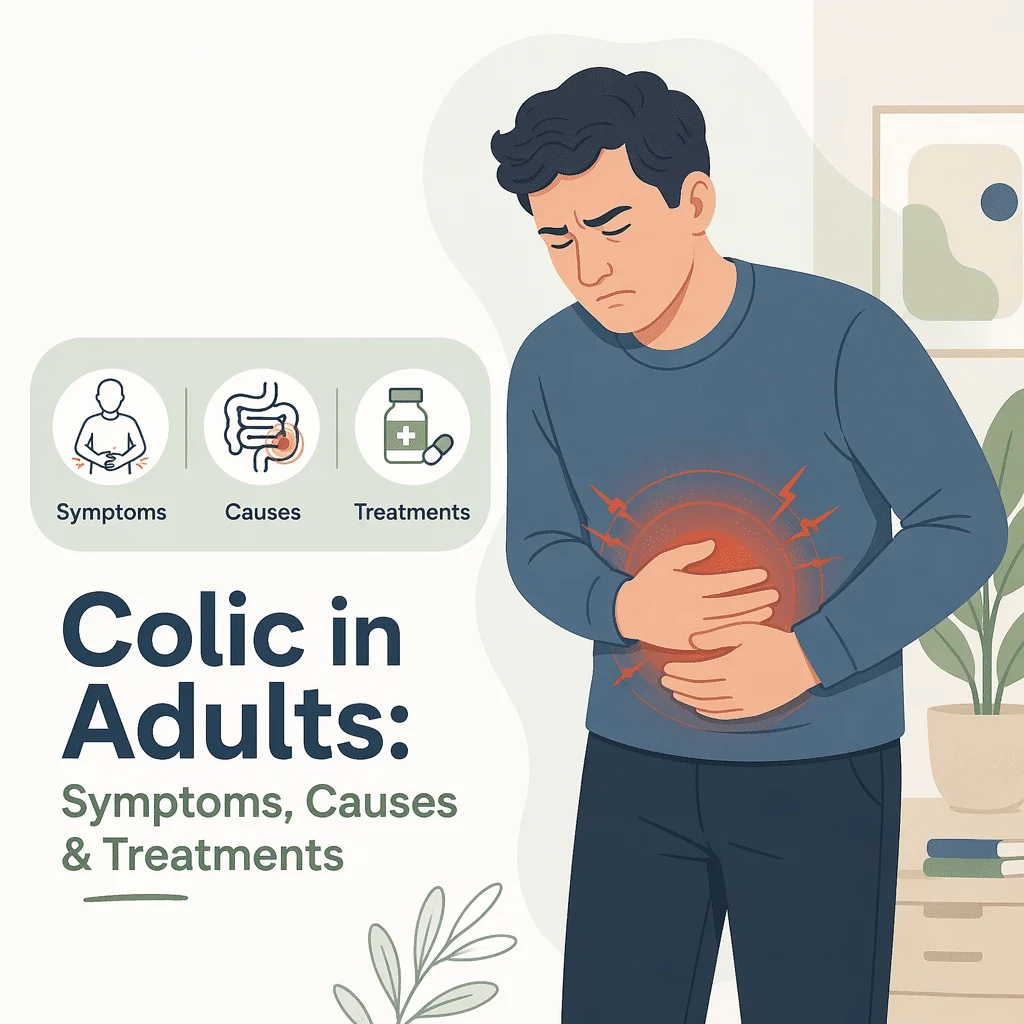
Colic in adults describes a very specific kind of pain: it builds steadily to a peak, holds there for a while, then eases off, only to return in another wave. That rising-and-falling rhythm is the real clue. It happens when a hollow organ — a tube or sac such as a bile duct, a ureter or a loop of intestine — squeezes hard against something blocking it. Because the pattern comes from the blockage rather than from one particular spot, colicky pain can show up in the upper abdomen, the flank or the pelvis. The location then tells your care team which organ is involved. In this article you’ll learn what colicky pain really is, how biliary, renal and intestinal colic differ, which warning signs mean you should not wait at home, and which lab tests and scans actually help find the cause.
What colic in adults actually means
The pattern matters more than the place
Most descriptions of abdominal pain start with location. Colic is different, because it is defined by its shape over time. A hollow organ is a muscular tube or pouch, and its muscle contracts in rhythmic waves — a movement called peristalsis — to push contents along. When a stone, a scar band or a tumor blocks that path, the muscle contracts harder against the obstruction. Each contraction produces a surge of pain that climbs, plateaus, then fades as the muscle relaxes. Minutes later, the next wave arrives.
This is why people with colic often say the pain “comes and goes.” It also explains a detail that surprises many patients: unlike the pain of a lining inflammation, which usually worsens with any movement, colicky pain often has people pacing, shifting position or curling up, searching for relief that does not come.
Adult colic is not the same thing as infant colic
This point deserves stating plainly, because it is where a great deal of online information goes wrong. Infant colic refers to prolonged, unexplained crying in an otherwise healthy and well-fed baby. It is a behavioral pattern with no identified obstruction, and it resolves on its own with age. Colic in adults means something entirely different: a mechanical problem in a specific organ, with a specific cause that can usually be found and treated. Advice written for infant colic — soothing routines, feeding changes, gripe preparations — has no bearing on an adult with wave-like abdominal pain, and following it can delay a diagnosis that matters.
Biliary colic: when the gallbladder is the source
What a gallbladder attack feels like
Biliary colic happens when a gallstone temporarily blocks the outlet of the gallbladder or a bile duct. The pain typically sits in the upper right quadrant of the abdomen or just below the breastbone, and it commonly radiates through to the right shoulder blade or the right shoulder. Many people notice it after a fatty meal, because fat triggers the gallbladder to contract, and it frequently strikes at night.
Here is an important correction to the name itself. Despite being called colic, a biliary attack is often not truly intermittent. It usually builds over several minutes to a steady, severe plateau that lasts at least half an hour and can persist for several hours before easing. If you are waiting for the pain to come in short repeating waves before taking it seriously, you may wait too long. Nausea and vomiting frequently accompany it.
When a gallbladder attack escalates
An uncomplicated attack settles once the stone falls back and the duct reopens. Several complications can follow if it does not. Cholecystitis is inflammation and infection of the gallbladder wall, and it usually announces itself with pain lasting beyond a few hours plus fever. Choledocholithiasis means a stone has moved into the common bile duct, which backs bile up into the bloodstream and can turn the skin and eyes yellow. Gallstone pancreatitis occurs when a stone obstructs the shared drainage channel with the pancreas, causing severe pain that bores through to the back. Our library also covers the symptoms and warning signs of pancreatitis, and a separate guide explains what happens during a gallbladder rupture. Each of these is a reason to seek care the same day rather than waiting it out.
Renal colic: when a kidney stone is the source
Renal or ureteral colic occurs when a stone moves out of the kidney and lodges in the ureter, the narrow tube carrying urine down to the bladder. The pain starts abruptly, often without warning, and sits in the flank — the area between the lower ribs and the hip. As the stone travels downward, it characteristically radiates around the side and into the groin, the testicle or the labia.
Two features stand out. The first is the inability to stay still: people with stone pain typically writhe, pace or repeatedly change position, which clinicians recognize immediately. The second is blood in the urine, which may be visible or only detectable on a dipstick. Nausea and vomiting are common, and some people also feel a sudden urge to urinate more often. Our team explains the causes, symptoms and treatments of kidney stones in detail, and a companion article covers the causes of blood in the urine.
A stone that blocks the ureter while an infection is present is a genuine emergency. Fever or shaking chills alongside flank pain requires urgent assessment, because a blocked, infected kidney can deteriorate quickly.
Intestinal colic: when the bowel is the source
Intestinal colic is the broadest category. Its most serious cause is bowel obstruction, in which the intestine is physically blocked. Adhesions — bands of internal scar tissue, usually from previous abdominal surgery — are a leading cause, along with hernias, in which a loop of bowel is trapped as it pushes through a weak point in the abdominal wall. Tumors and severe constipation can also obstruct the passage. The pain typically centers around the navel or lower abdomen, arrives in waves every few minutes, and comes with bloating, loud gurgling and vomiting.
Not every case of intestinal cramping is an obstruction, though. Cramping that recurs over months, links to bowel habit and eases after passing stool points instead toward a functional disorder such as irritable bowel syndrome, where the gut is oversensitive without any structural blockage. Our library covers how to understand and manage irritable bowel syndrome. Inflammatory bowel disease can also produce cramping, and it often leaves markers that testing picks up.
Gynecologic causes of colicky pelvic pain
The uterus and fallopian tubes are hollow organs too, so they can generate the same wave-like pain. Severe menstrual cramping, endometriosis, a twisting ovarian cyst and ectopic pregnancy can all present as colicky pelvic pain, sometimes with radiation into the lower back or thigh. Pain that tracks with the menstrual cycle, or that comes with abnormal bleeding or pain during intercourse, points in this direction. Our library details how endometriosis is diagnosed and treated. Sudden, severe one-sided pelvic pain in anyone who could be pregnant needs immediate evaluation.
Matching your pain to the likely organ
Because colic in adults is defined by pattern rather than place, narrowing it down means combining four clues: where the pain sits, where it spreads, what sets it off, and what comes with it. The table below maps those clues onto the organ most likely responsible. It is an orientation aid for a conversation with your doctor, not a substitute for examination and imaging.
| Where the pain sits | Where it spreads | Timing and triggers | Features that often come with it | Organ most likely involved |
|---|---|---|---|---|
| Upper right abdomen, or just under the breastbone | Right shoulder blade or right shoulder | Often after a fatty meal; frequently at night; steady for 30 minutes to several hours | Nausea, vomiting, sweating | Gallbladder or bile ducts (biliary colic) |
| Flank, between the lower ribs and the hip | Around the side toward the groin, testicle or labia | Abrupt onset, no link to meals; waves lasting minutes | Blood in the urine, nausea, an inability to lie still | Kidney or ureter (renal colic) |
| Around the navel or across the lower abdomen | Diffuse and hard to pinpoint | Waves every few minutes; may follow eating | Bloating, loud gurgling, vomiting, changed bowel habit | Small or large bowel (intestinal colic) |
| Lower abdomen or pelvis, often on one side | Lower back or upper thigh | May track with the menstrual cycle | Abnormal bleeding, pain during intercourse | Uterus, ovaries or fallopian tubes |
Red flags that mean emergency care, not watchful waiting
Most colic episodes settle once the blockage clears. Some do not, and the difference matters. Seek emergency care, rather than an appointment next week, if any of the following applies:
- Fever or shaking chills alongside the abdominal pain, which suggests infection behind the blockage.
- Yellowing of the skin or the whites of the eyes, or dark urine with pale stools, which suggests a blocked bile duct.
- Pain that continues beyond several hours without any let-up, instead of easing between waves.
- An abdomen that is rigid, board-like or exquisitely tender to light touch.
- Vomiting combined with an inability to pass any stool or gas, which suggests a complete bowel obstruction.
- Blood in the stool, or black tarry stools.
- Fainting, near-fainting, a racing pulse or confusion.
- Severe one-sided pelvic pain in anyone who could be pregnant.
Our library also covers the causes of rectal bleeding and when to seek help.
Which lab tests help when colic is suspected
Laboratory results cannot diagnose colic on their own. What they do is support or weaken a clinical picture, point toward one organ over another, and reveal complications early. Imaging is what confirms the cause.
Blood tests
For a suspected biliary cause, liver enzymes and bilirubin are the key markers. Rising bilirubin with raised alkaline phosphatase suggests bile is not draining properly, which points toward a stone in the common bile duct rather than a simple gallbladder attack. Our guide explains how to read a liver function panel. Lipase, an enzyme released by the pancreas, is the test used to detect pancreatitis, and our team covers what amylase and lipase results indicate. A complete blood count can show a rising white cell count suggesting infection, and our library explains how to read a complete blood count. C-reactive protein tracks inflammation and is often measured alongside it, as detailed in our guide to the CRP inflammation marker.
For a suspected kidney stone, creatinine and estimated glomerular filtration rate show whether the blockage is affecting kidney function, and our library covers the tests in a kidney function panel.
Urine tests
Urinalysis is central in renal colic. It commonly shows red blood cells even when the urine looks normal, and it can flag nitrites or white cells suggesting a urinary infection layered on top of the stone — the combination that turns a painful stone into an urgent one. Our guide walks through the interpretation of urinalysis results.
Imaging confirms what labs only suggest
Abdominal ultrasound is the first-line test for gallstones, because it shows stones and gallbladder wall thickening without radiation. Non-contrast CT is the standard for suspected kidney stones, since it reveals stone size and position, both of which drive treatment. CT is also used when bowel obstruction is suspected. A normal blood panel does not rule out a stone, and an abnormal one does not confirm it — which is why imaging remains the confirmation step.
How colic in adults is treated
Treatment targets the underlying blockage, not just the pain, and it falls into a few broad categories. Pain control is the immediate priority, usually with anti-inflammatory or other analgesic medication given by a clinician who has assessed your kidney function and other medicines. Hydration and anti-nausea medication support recovery, particularly when vomiting has been persistent.
For stones in the lower ureter, medical expulsive therapy uses medication that relaxes the ureter so a small stone can pass on its own instead of needing a procedure. Larger or stuck stones are treated with shock wave lithotripsy or ureteroscopy. For repeated biliary attacks, keyhole removal of the gallbladder is the standard definitive treatment, while a stone trapped in the bile duct is usually retrieved endoscopically. Bowel obstruction is managed first with bowel rest and decompression, and surgery follows if the blockage does not resolve or if the bowel’s blood supply is threatened.
Two cautions matter here. Do not use over-the-counter anti-inflammatory medication to self-manage suspected stone or gallbladder pain without medical advice, because these drugs are unsafe for some people, particularly those with reduced kidney function. And never treat suspected bowel obstruction with laxatives.
Latest scientific advances
Research published over the past three years has refined how colicky pain is managed. The findings below are summarized in plain language, with full references in the Sources section.
Anti-inflammatory painkillers for kidney stone pain
A 2025 Cochrane review — a Cochrane review pools the results of many separate trials into one combined analysis — gathered 29 randomized trials of anti-inflammatory painkillers for sudden kidney stone pain. It found that these drugs relieve renal colic better than a dummy treatment, though the authors rated the certainty of that evidence as low, meaning future studies could shift the picture. Comparing the individual drugs showed little consistent difference between them, and giving them through a vein worked about as well as an injection into muscle. What this means for you: there is no single best anti-inflammatory for stone pain, so your emergency team will choose based on your kidney function, your other medicines and what you tolerate.
Gallbladder surgery is not always the automatic answer
A large UK trial published in 2023 randomly assigned adults with uncomplicated gallstone symptoms either to keyhole gallbladder removal or to conservative management, meaning watchful waiting with symptom control. Across the first 18 months, average pain-related quality of life was essentially the same in both groups, and conservative care cost less. What this means for you: if your attacks are infrequent and uncomplicated, surgery is not automatically the only reasonable path, and watchful waiting is a legitimate option to raise with your surgeon. This is short-horizon evidence, though — the researchers stressed that longer follow-up is needed, and many people in the watchful-waiting group did eventually have surgery. Complicated gallstone disease, with infection, jaundice or pancreatitis, is a separate situation and is treated urgently.
Helping small stones pass with medication
A 2025 network meta-analysis — a method that compares several treatments even when they were never tested directly against one another — pooled 19 trials of medical expulsive therapy for stones in the lower ureter. Combining a muscle-relaxing alpha-blocker with a second agent helped more stones pass than the alpha-blocker used alone, and reduced how much pain medication people needed. What this means for you: when a scan shows a small stone low in the ureter, your urologist may offer medication to help it pass rather than moving straight to a procedure. These remain prescription decisions that depend on the stone’s size and position.
Glossary
| Term | Definition |
|---|---|
| Adhesions | Bands of internal scar tissue, most often left by previous abdominal surgery. They can tether or kink a loop of bowel and cause an obstruction years later. |
| Biliary colic | Pain caused by a gallstone temporarily blocking the outlet of the gallbladder or a bile duct. It usually builds to a steady, severe plateau lasting from half an hour to several hours. |
| Cholecystitis | Inflammation and infection of the gallbladder wall, usually caused by a stone that stays lodged. Pain lasting beyond a few hours together with fever is the typical warning sign. |
| Choledocholithiasis | A gallstone that has moved into the common bile duct. Because bile can no longer drain freely, it can cause jaundice, dark urine and pale stools. |
| Colicky pain | Pain that builds to a peak, plateaus, then eases and returns in waves. It signals a hollow organ contracting against a blockage. |
| Hematuria | Blood in the urine. It may be visible to the eye or detectable only by a laboratory test or dipstick. |
| Hollow organ | Any tube or sac in the body that carries or stores contents, such as the intestine, a bile duct, a ureter or the uterus. Only hollow organs produce true colic. |
| Lipase | A digestive enzyme made by the pancreas. A markedly raised blood level is the main laboratory signal of pancreatitis. |
| Medical expulsive therapy | Prescription medication that relaxes the ureter to help a small stone pass on its own, avoiding a procedure. |
| Peristalsis | The rhythmic squeezing of a hollow organ’s muscular wall that moves contents along. When it pushes against a blockage, colicky pain results. |
| Ureter | The narrow tube carrying urine from a kidney down to the bladder. It is the usual place a kidney stone becomes stuck. |
Frequently asked questions
How can I tell colic from ordinary stomach cramps?
The two clues are rhythm and severity. Ordinary cramping tends to be mild, diffuse and short-lived, and it often eases after passing gas or stool. Colic builds to a peak that is genuinely hard to ignore, holds there, then fades, and it typically brings nausea with it. Another useful sign is behavior during the episode: people with colic often cannot find a comfortable position and keep moving, whereas someone with an inflamed abdominal lining lies very still because movement hurts. If pain is severe enough to stop you in your tracks, it deserves assessment regardless of which label fits.
Is colic in adults the same as colic in babies?
No, and confusing the two is a common source of poor information. Infant colic means prolonged crying in a healthy, well-fed baby with no identified obstruction, and it resolves as the baby grows. Colic in adults means a hollow organ is contracting against a genuine blockage, most often a gallstone, a kidney stone or a bowel obstruction. The causes, the tests and the treatments have nothing in common, so advice written for infants does not apply.
How long does a colic attack usually last?
It depends on the organ. Biliary attacks generally last at least 30 minutes and can continue for several hours before easing, often as a steady severe plateau rather than short repeating waves. Renal colic tends to come in sharper waves lasting minutes at a time, though episodes can recur over hours as the stone moves. Intestinal colic waves often arrive every few minutes. Any colicky pain that carries on for several hours without letting up should be assessed urgently, because that pattern suggests the blockage has not cleared.
Can blood tests alone show what is causing my colic?
No. Blood tests support a clinical picture and reveal complications, but they do not confirm the cause. Liver enzymes and bilirubin suggest a bile duct problem, lipase points to the pancreas, and a white cell count and CRP flag infection or inflammation. All of these can be normal early in an attack even when a stone is present. Imaging — ultrasound for gallstones, CT for kidney stones and obstruction — is what establishes the diagnosis. Labs and imaging work together, and neither replaces a clinical examination.
Does fatty food really trigger gallbladder attacks?
It genuinely can. Fat entering the small intestine prompts the gallbladder to contract and release bile, and if a stone is sitting near the outlet, that contraction can wedge it in place. This is why gallbladder attacks so often follow a rich meal and why they frequently start in the evening or overnight. Reducing very fatty meals may lower how often attacks happen, but it does not dissolve stones or remove the underlying problem, so it is not a substitute for medical assessment when attacks keep recurring.
Can colic pain go away on its own?
Often, yes. A gallstone can fall back into the gallbladder and reopen the duct, and a small kidney stone can pass into the bladder, ending the episode. The pain stopping does not mean the cause has gone, though — the stone is still there and attacks tend to recur, sometimes with complications. Any first episode of significant colicky pain should be evaluated so the cause can be identified. Recurring episodes are worth investigating even when each one settles by itself.
Sources
- National Institute of Diabetes and Digestive and Kidney Diseases (NIDDK) — Gallstones — National Institutes of Health https://www.niddk.nih.gov/health-information/digestive-diseases/gallstones
- MedlinePlus, National Library of Medicine — Kidney Stones https://medlineplus.gov/kidneystones.html
- Mayo Clinic — Intestinal obstruction: symptoms and causes https://www.mayoclinic.org/diseases-conditions/intestinal-obstruction/symptoms-causes/syc-20351460
- Cleveland Clinic — Gallstones (Cholelithiasis): symptoms, causes and treatment https://my.clevelandclinic.org/health/diseases/7313-gallstones
- Afshar K, Gill J, Mostafa H, Noparast M — Nonsteroidal anti-inflammatory drugs (NSAIDs) for acute renal colic — Cochrane Database of Systematic Reviews, 2025 https://doi.org/10.1002/14651858.CD006027.pub3
- Ahmed I, Hudson J, Innes K, et al. — Effectiveness of conservative management versus laparoscopic cholecystectomy in adults with uncomplicated symptomatic gallstone disease (C-GALL trial) — BMJ, 2023 https://doi.org/10.1136/bmj-2023-075383
- Taheri M, Borumandnia N, Abdi H, et al. — Which combination of medical expulsive therapy is more effective for treatment of distal ureteral stone in adults? A systematic review and network meta-analysis — BMC Urology, 2025 https://doi.org/10.1186/s12894-024-01679-2
Further reading
- Our team explains the meaning of the AST to ALT ratio.
- This guide covers the causes and risks behind raised lipase levels.
- Our library details the causes and treatments of vomiting bile.
- This article explains the risks linked to ovarian cyst size.
- Our team walks through the results of a comprehensive metabolic panel.
Understand your lab results with AI DiagMe
When colicky pain sends you for testing, the results often arrive as a page of numbers with no explanation attached. AI DiagMe reads your report and explains it in plain language — what your liver enzymes and bilirubin suggest about bile drainage, whether your lipase points toward the pancreas, what your white cell count and CRP say about inflammation, and how your creatinine and urine findings relate to your kidneys. It helps you understand your results and prepare better questions for your appointment. It does not diagnose, and it does not replace your doctor.
Get your results interpreted in minutes