







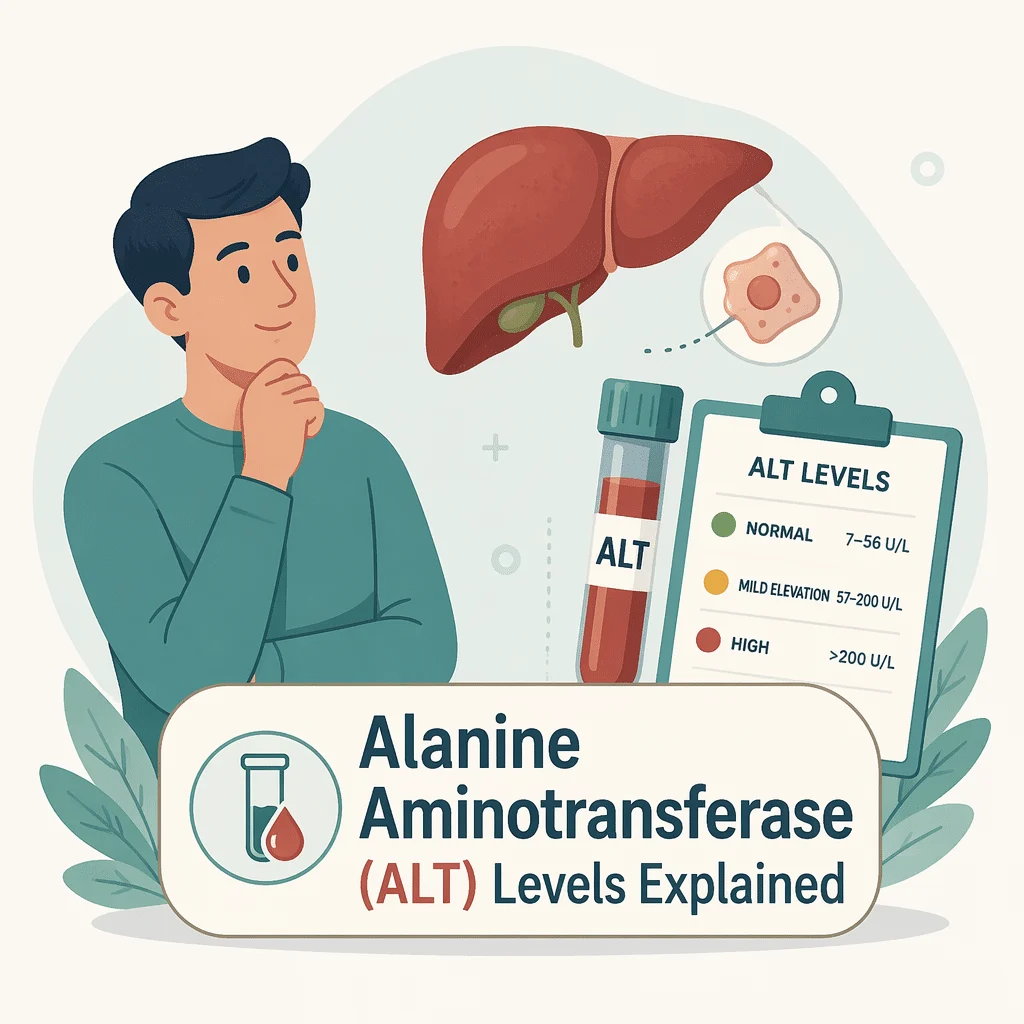
Una ALT alta generalmente significa que las células del hígado han liberado más de esta enzima de lo normal hacia tu sangre, lo que puede ser una señal de estrés o daño hepático. La mayoría de las veces, una ALT alta refleja algo común y manejable, como hígado graso, consumo de alcohol o algún medicamento, y no una emergencia. Aun así, vale la pena entender el número, porque una ALT muy elevada o en aumento puede indicar un problema que requiere atención pronta. En este artículo aprenderás qué se considera una ALT alta, las causas más frecuentes, los síntomas que pueden acompañarla y cuándo es momento de consultar a un médico.
Qué significa un resultado de ALT alta
La ALT, o alanina aminotransferasa, es una enzima que se encuentra principalmente dentro de las células del hígado, donde ayuda a procesar los aminoácidos. Cuando esas células se inflaman o se dañan, la ALT se filtra al torrente sanguíneo, por lo que un nivel elevado en sangre generalmente indica que el hígado está bajo estrés. Como la ALT es bastante específica del hígado, es uno de los marcadores más útiles de daño hepatocelular y puede elevarse antes de que aparezca cualquier síntoma. Para conocer los conceptos básicos del estudio, nuestra guía principal explica los valores normales de ALT.
¿Cuándo se considera alto el nivel de ALT?
No existe un punto de corte universal único. Muchos laboratorios establecen el límite superior normal cerca de 40 U/L, pero estudios en poblaciones sanas sugieren un umbral más bajo: aproximadamente 30 U/L en hombres y 19 U/L en mujeres. Tu resultado mostrará el rango de referencia que usa tu laboratorio, y lo que más importa es qué tan elevado está el valor, no el número exacto. La tabla a continuación es una guía general, no un diagnóstico.
| Grado de elevación | Aproximadamente | Contexto frecuente |
|---|---|---|
| Leve | Hasta unas 3 veces el límite superior | Hígado graso, alcohol, medicamentos, ejercicio intenso reciente |
| Moderado | Entre 3 y 10 veces el límite superior | Hepatitis activa, daño por medicamentos, hepatitis autoinmune |
| Marcado | Más de unas 10 a 15 veces el límite superior | Daño hepático agudo por toxinas, hepatitis viral aguda o flujo sanguíneo deficiente; requiere evaluación urgente |
Este contexto responde la pregunta frecuente de si un número específico es motivo de preocupación. Un resultado entre 50 y 100 suele ser una elevación leve y con frecuencia tiene una causa benigna y reversible, mientras que un valor en los cientos o miles indica un daño hepático grave y repentino que requiere atención urgente. Las tendencias también importan: una ALT ligeramente elevada pero estable se interpreta de manera distinta a una que va en aumento.
¿Qué causa la ALT alta?
Hígado graso (MASLD)
La enfermedad hepática esteatósica asociada a disfunción metabólica (MASLD), el nombre actual para la mayoría de los casos de hígado graso, es hoy la principal causa de elevación leve de las enzimas hepáticas. Está relacionada con el exceso de peso, la diabetes tipo 2, los triglicéridos altos y el síndrome metabólico, y con frecuencia produce un aumento moderado y persistente de la ALT sin ningún síntoma.
Alcohol
El alcohol es procesado por el hígado y resulta directamente tóxico en dosis altas, por lo que el consumo regular o excesivo suele elevar la ALT. Reducir o dejar de tomar alcohol es a menudo una de las formas más efectivas de bajar este valor.
Medicamentos y suplementos
Muchos medicamentos de uso cotidiano pueden elevar la ALT, entre ellos las estatinas y el paracetamol (acetaminofén), así como algunos antibióticos y suplementos herbales o vitamínicos como la vitamina A en dosis altas. Siempre dile a tu médico todo lo que estás tomando, incluidos los productos de venta libre.
Hepatitis viral y autoinmune
Las hepatitis A, B y C inflaman el hígado y pueden elevar la ALT de forma considerable; la hepatitis autoinmune hace lo mismo cuando el sistema inmunológico ataca las células hepáticas. Estas causas generalmente requieren estudios específicos y tratamiento.
Músculo y ejercicio
La ALT también está presente en el músculo, no solo en el hígado, por lo que un ejercicio intenso o poco habitual puede elevar el valor de forma temporal. Repetir el análisis después de unos días de descanso suele aclarar si ese fue el motivo del cambio.
Causas menos frecuentes
Los bloqueos en el flujo de bilis, la sobrecarga de hierro (hemocromatosis), la enfermedad celíaca y tiroidea, la mala circulación hacia el hígado y, en casos raros, los tumores también pueden elevar la ALT. Por eso, este valor siempre se interpreta en contexto y no de forma aislada.
ALT alta con AST normal: qué significa este patrón
Los médicos rara vez analizan la ALT sola. La comparan con una enzima relacionada, por lo que conviene revisar tu resultado junto con tu nivel de AST. Una ALT alta con AST normal o más baja es un patrón típico del hígado graso, mientras que una AST más elevada que la ALT suele apuntar hacia una lesión relacionada con el alcohol o una cicatrización avanzada. El equilibrio entre ambas se refleja en el cociente AST/ALT, y las dos enzimas generalmente aparecen juntas en un panel hepático completo agrupado como estándar pruebas de función hepática.
Síntomas que pueden acompañar una ALT alta
Muchas personas con ALT alta se sienten completamente bien, por eso suele detectarse por casualidad en estudios de laboratorio de rutina. Cuando aparecen síntomas, pueden incluir cansancio, falta de apetito, náuseas, molestia abdominal en el lado superior derecho, comezón, orina oscura, heces pálidas o coloración amarillenta de la piel y los ojos (ictericia). La ictericia o el vómito persistente junto con una ALT alta requieren atención médica pronta.
Cuándo preocuparse por una ALT alta
Una ALT levemente alta en una sola ocasión es común y generalmente no es una urgencia, pero hay situaciones que requieren actuar más rápido. Consulta a un profesional de la salud de inmediato si tu ALT está muy elevada (varias veces el límite superior), si sigue subiendo en pruebas repetidas, o si viene acompañada de ictericia, confusión, dolor abdominal intenso o vómito persistente. También debes buscar orientación antes si tienes factores de riesgo como consumo elevado de alcohol, exposición conocida a hepatitis, diabetes o algún medicamento que pueda afectar el hígado. Una evaluación temprana es la mejor manera de detectar un problema tratable antes de que cause daño permanente.
Qué hacer ante una ALT alta
El primer paso es identificar y atender la causa, lo que generalmente implica revisar tus medicamentos, tu consumo de alcohol y tu salud metabólica, y luego repetir el análisis después de algunas semanas para ver la tendencia. En el caso del hígado graso, bajar de peso de forma gradual y mejorar el control del azúcar en sangre suele reducir la ALT; si el aumento se debe a un medicamento, tu médico puede ajustarlo o suspenderlo. Para un plan paso a paso, nuestra guía complementaria te lleva por medidas prácticas formas de bajar los niveles de ALT.
Avances científicos recientes
Investigaciones recientes se han enfocado en qué tanto importa realmente una ALT levemente alta, especialmente en el hígado graso. Aquí te explicamos qué aportan esos hallazgos, en términos sencillos.
Un editorial de 2024 argumentó que incluso un ALT repetidamente alto-normal, es decir, un valor cercano al límite superior del rango normal en lugar de claramente por encima de él, puede ser una señal temprana de MASLD. Parte del debate está en dónde debe terminar lo normal: el límite tradicional de 40 U/L se estableció usando poblaciones que probablemente incluían enfermedad hepática no diagnosticada, y muchos expertos ahora prefieren un umbral saludable más bajo de aproximadamente 30 U/L para hombres y 19 para mujeres. Lo que esto significa para ti es que un número que tu laboratorio considera normal no siempre es completamente tranquilizador si tienes factores de riesgo metabólico.
Un estudio de 2024 con más de 1,300 personas que se realizaron chequeos de salud de rutina encontró que un ALT por encima de 30 U/L, junto con hígado graso, estaba relacionado con cicatrización hepática significativa, especialmente en adultos de 65 años o más. En términos sencillos, un ALT moderadamente elevado vale la pena tomarlo en serio en lugar de ignorarlo, especialmente en etapas avanzadas de la vida. Al mismo tiempo, un análisis de 2021 advirtió que las enzimas hepáticas por sí solas son imperfectas y que el riesgo se evalúa mejor combinando el ALT con otros factores y, cuando sea necesario, con estudios de imagen. Estos hallazgos siguen refinándose, pero el mensaje común es que un ALT elevado es una señal para investigar más a fondo, no un diagnóstico por sí solo.
Glosario
- ALT (alanina aminotransferasa): una enzima que se encuentra principalmente en el hígado y que aumenta en la sangre cuando las células hepáticas se dañan.
- AST (aspartato aminotransferasa): una enzima relacionada, presente en el hígado y el músculo, que se mide frecuentemente junto con el ALT.
- Límite superior normal (LSN): el valor más alto del rango de referencia de un laboratorio para un estudio.
- MASLD: enfermedad hepática esteatótica asociada a disfunción metabólica, el nombre actual para la mayoría de los casos de hígado graso.
- Hepatitis: inflamación del hígado causada por virus, alcohol, medicamentos o enfermedades autoinmunes.
- Ictericia: coloración amarilla de la piel o los ojos por acumulación de bilirrubina.
- Relación AST/ALT: el equilibrio entre las dos enzimas, que ayuda a identificar la causa.
Preguntas frecuentes
¿Un ALT de 70 u 80 es alto? Sí, ambos valores están por encima de la mayoría de los rangos de referencia, pero generalmente son elevaciones leves. Las causas más comunes incluyen hígado graso, alcohol, medicamentos o ejercicio intenso reciente, y tu médico revisará la tendencia y tus factores de riesgo.
¿Qué significa un ALT por encima de 100? Es una elevación más clara que requiere evaluación para encontrar la causa. Suele ser reversible, pero valores altos y en aumento, especialmente en los cientos, necesitan revisión médica pronta.
¿Qué medicamentos pueden elevar el ALT? Las estatinas, el paracetamol (acetaminofén), algunos antibióticos y ciertos suplementos herbales y vitamínicos pueden elevar el ALT. Nunca dejes de tomar un medicamento recetado por tu cuenta; habla de cualquier duda con tu médico o prescriptor.
¿Puede un ALT elevado volver a la normalidad? Muchas veces sí. Cuando se trata la causa, como bajar de peso en caso de hígado graso o reducir el consumo de alcohol, el ALT suele regresar a niveles normales en semanas o meses.
¿Un ALT elevado significa enfermedad hepática? No necesariamente. Indica que el hígado está bajo estrés, pero la causa puede ir desde algo inofensivo y pasajero hasta algo serio, por eso se interpreta junto con otros estudios y tu historial médico.
¿Debo ir en ayuno para el examen de ALT? Por lo general no se requiere ayuno solo para el ALT, pero sigue las indicaciones de tu laboratorio, sobre todo si se van a tomar otras muestras al mismo tiempo.
Lecturas recomendadas
- Niveles de ALT: significado, causas y rangos normales
- Cómo bajar los niveles de ALT
- Valores normales de AST explicados
- Panorama general de las pruebas de función hepática
- SGPT: la misma enzima con otro nombre
Fuentes
- MedlinePlus, Biblioteca Nacional de Medicina de los NIH. Prueba de ALT en sangre. https://medlineplus.gov/lab-tests/alt-blood-test/
- Cleveland Clinic. Enzimas hepáticas elevadas. https://my.clevelandclinic.org/health/symptoms/17679-elevated-liver-enzymes
- Mayo Clinic. Enzimas hepáticas elevadas: causas. https://www.mayoclinic.org/symptoms/elevated-liver-enzymes/basics/causes/sym-20050830
- Moyana TN. Enfermedad hepática esteatótica asociada a disfunción metabólica: ALT alta-normal a largo plazo como prueba de detección. World J Gastroenterol, 2024. https://consensus.app/papers/details/086c5d3017ff599a8b78b83163865351/
- Nakano M, et al. Perfiles asociados con fibrosis hepática significativa: ALT >30 U/L, hábitos de ejercicio y MASLD. Hepatology Research, 2024. https://consensus.app/papers/details/9c3a790b3683520a906bc7e71fa7d2b1/
- Forlano R, et al. Pruebas de función hepática e hígado graso asociado a alteraciones metabólicas: cambios en los límites superiores normales. World J Hepatol, 2021. https://consensus.app/papers/details/0891a16133ff59b583590dd405acbb09/
Entiende tus resultados de laboratorio con AI DiagMe
Un ALT elevado cobra más sentido cuando puedes verlo junto a tu AST, GGT, bilirrubina y marcadores metabólicos. AI DiagMe lee el reporte de laboratorio que subas y te explica en un lenguaje sencillo qué pueden significar tu ALT y los demás valores relacionados con el hígado, para que sepas qué preguntas hacerle a tu médico. Te ayuda a entender tus resultados; no diagnostica enfermedades ni reemplaza la atención médica.
Obtén la lectura de tus resultados en minutos