




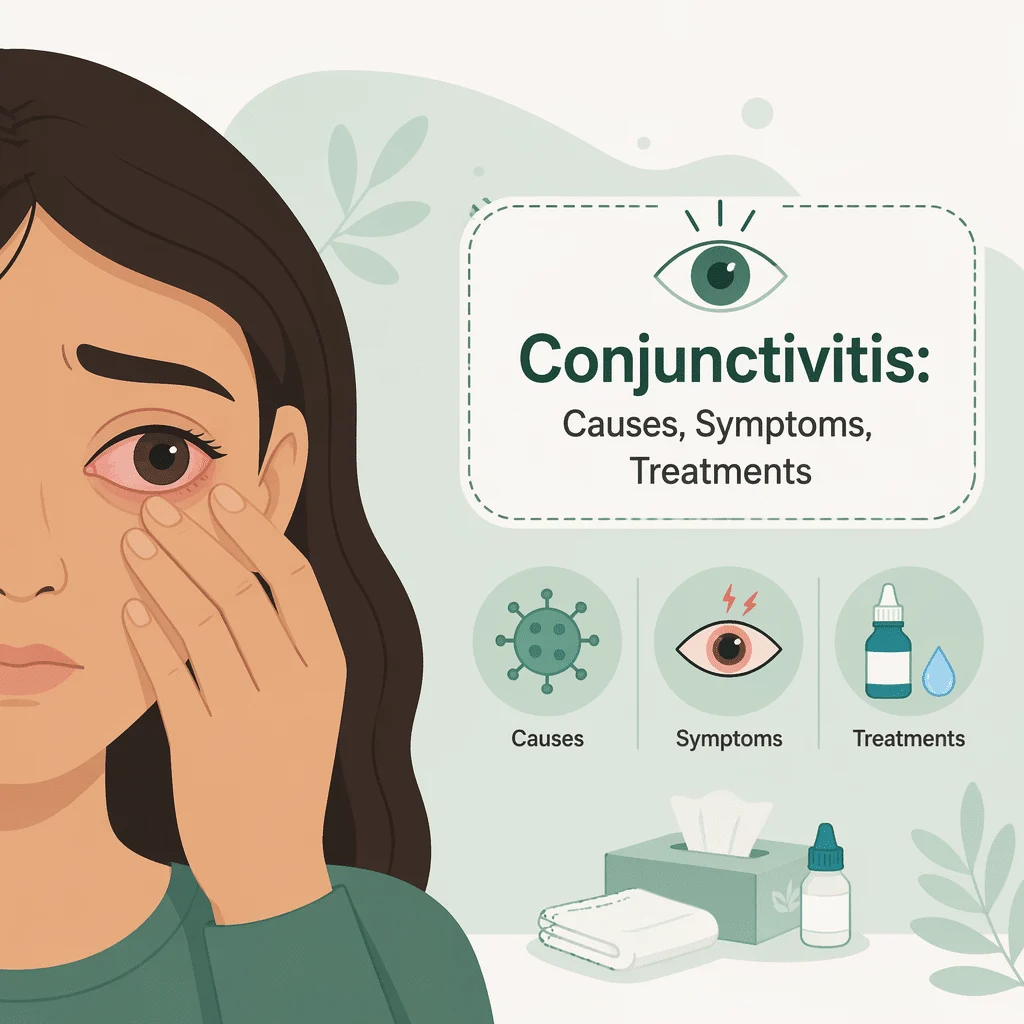
Conjunctivitis, better known as pink eye, is one of the most common eye problems seen in primary care, and in the great majority of cases it is mild and clears up on its own. The word describes inflammation of the conjunctiva — the thin, clear membrane that covers the white of the eye and lines the inside of the eyelids — which leaves the eye looking red and feeling watery, itchy, or gritty. It can be triggered by a virus, by bacteria, by an allergy, or by an irritant, and telling these apart matters because each is managed differently. In this article you’ll learn what conjunctivitis is, how to recognise each type, why most cases do not need antibiotics, how it is treated and prevented, and the warning signs that mean you should see a doctor.
What is conjunctivitis (pink eye)?
Conjunctivitis is inflammation of the conjunctiva, the thin, transparent layer of tissue that lines the inside of your eyelids and wraps over the white part of your eye. When this membrane is irritated or infected, its tiny blood vessels swell and become more visible, which gives the eye its characteristic pink or red appearance. The eye may also water, sting, or feel gritty, as though a grain of sand is caught under the lid.
Pink eye can be acute, coming on suddenly and lasting from a few days to a couple of weeks, or chronic, lingering for weeks or returning again and again. The reassuring news is that most acute cases are self-limiting, meaning they settle without any specific treatment. Conjunctivitis rarely threatens your sight, but a small number of cases are more serious, which is exactly why knowing the warning signs is worthwhile.
The four main types of conjunctivitis
Conjunctivitis is usually grouped by its cause. The four types can look similar at a glance but differ in how they spread and how they are treated.
Viral conjunctivitis
Viruses are behind the large majority of infectious cases. Research reviews estimate that viruses account for roughly 80% of acute conjunctivitis, and that a family of viruses called adenoviruses causes about 80% of those viral cases. Viral pink eye typically produces a watery, clear discharge, often starts in one eye before spreading to the other, and may follow a cold or sore throat. It is very contagious and, much like a common cold, generally has to run its course.
Bacterial conjunctivitis
Bacteria such as staphylococci and streptococci cause a smaller share of cases, and more often in children than in adults. The hallmark is a thick, yellow or green (mucopurulent) discharge that can glue the eyelids together after sleep. Bacterial conjunctivitis is also contagious, yet many cases still clear without antibiotics.
Allergic conjunctivitis
Allergic conjunctivitis is not an infection and cannot be passed to anyone else. It is an IgE-mediated reaction — an immune response driven by an antibody called immunoglobulin E — to triggers such as pollen, dust mites, pet dander, or mould. Intense itching in both eyes is the standout feature, usually alongside a watery discharge and often a runny nose. It may be seasonal, flaring in spring or autumn, or year-round.
Irritant conjunctivitis
Chemicals and physical irritants — chlorine in a swimming pool, smoke, air pollution, a splash of shampoo, or a poorly fitting contact lens — can inflame the conjunctiva without any germ or allergen involved. Rinsing the eye and removing the irritant usually brings quick relief.
How to tell the types of conjunctivitis apart
No single symptom reliably separates one type from another, and even clinicians cannot always distinguish viral from bacterial pink eye by looking alone. Still, the overall pattern of your symptoms offers useful clues. The table below summarises the typical differences; treat it as a guide, not a diagnosis.
| Type | Common cause | Discharge and itch | Contagious? | Usual first-line care |
|---|---|---|---|---|
| Viral | Adenovirus and other viruses | Watery; mild itch | Yes, highly | Comfort measures; clears on its own |
| Bacterial | Staph or strep bacteria | Thick, yellow-green; sticky lids | Yes | Often clears alone; drops in selected cases |
| Allergic | Pollen, dust mites, dander | Watery; intense itch | No | Antihistamine or mast-cell drops |
| Irritant | Smoke, chlorine, chemicals, lenses | Watery; variable itch | No | Remove the trigger; rinse the eye |
One practical rule of thumb: intense itching points towards allergy, eyelids sealed shut with pus lean towards bacteria, and a watery eye following a cold suggests a virus. Because these signs overlap so much, the fuller picture — including whether people around you are affected and how the eye behaves over several days — matters more than any single feature.
Symptoms and warning signs
Most conjunctivitis shares a core set of symptoms: redness in one or both eyes, a watery or thicker discharge, itching or burning, a gritty sensation, swollen eyelids, and crusting on the lashes after sleep. Mild sensitivity to bright light can occur. These symptoms are uncomfortable but, on their own, are not usually dangerous.
Some features are different. They can signal a problem beyond ordinary pink eye — such as a corneal infection, herpes involvement, or a condition that is not conjunctivitis at all — and they deserve prompt medical attention. Mayo Clinic advises seeking care for eye pain, vision changes, or marked light sensitivity, because these can point to something more serious.
When to see a doctor
Seek same-day medical or eye care if you notice any of the following:
- Moderate to severe eye pain (ordinary pink eye is uncomfortable, not truly painful)
- Any change in vision, such as blurring that does not clear when you blink
- Marked sensitivity to light, known as photophobia
- Very intense redness, or a red eye accompanied by headache and nausea
- Symptoms in a newborn baby
- A weakened immune system, recent eye surgery, or a history of herpes eye infection
- A blister-like rash on the eyelid, nose, or forehead
- Symptoms that do not begin to improve after a week, or that keep returning
Contact lens wearers deserve extra caution. Stop wearing your lenses at the first sign of pink eye and check with an eye care professional, because contact lens use raises the risk of a sight-threatening corneal infection and can make some cases harder to treat.
Treatment and the truth about antibiotics
Treatment depends entirely on the cause, and for most people it is simpler than expected. Comfort measures help nearly every type: a clean, cool compress laid over closed eyes, lubricating artificial tears, and gently wiping away crusts with a fresh, damp cloth. Wash your hands often, avoid touching or rubbing the eye, and set aside eye makeup and contact lenses until the eye is back to normal.
Viral and bacterial pink eye
Viral conjunctivitis has no specific cure; antibiotics do nothing against viruses, and the infection clears on its own over one to two weeks. Bacterial conjunctivitis is where the biggest myth lives. A 2023 Cochrane review that pooled 21 trials and more than 8,800 people found that most acute bacterial cases get better without antibiotics — more than half of the people given a placebo had recovered within about a week — whilst antibiotic drops offered only a modest extra benefit and caused no serious side effects. A 2022 clinical trial and meta-analysis in children reached a similar conclusion, with antibiotic drops shortening symptoms only slightly.
Because of this, and to help slow antibiotic resistance, many clinicians now use a watchful-waiting or delayed-prescription approach, reserving antibiotic drops for more severe cases, contact lens wearers, or people whose symptoms are not settling. The Centers for Disease Control and Prevention and the American Academy of Ophthalmology both note that antibiotics are frequently prescribed for pink eye when they are not needed. This does not mean drops are never useful — they can shorten symptoms in selected cases — but it does mean a red eye is not an automatic reason for antibiotics.
Allergic and irritant conjunctivitis
Allergic conjunctivitis responds best to avoiding the trigger where possible and using anti-allergy eye drops. Guidelines favour antihistamine drops, mast-cell stabilisers, or dual-action drops that do both; cool compresses and preservative-free artificial tears add relief. For irritant conjunctivitis, flushing the eye with clean water or saline and removing the source of irritation is usually all that is required.
How long does pink eye last, and when can you go back to work or school?
Timelines vary by cause. Viral conjunctivitis often worsens for a few days and then improves over one to two weeks, though a stubborn case can linger longer. Bacterial conjunctivitis usually improves within a week, with or without antibiotic drops. Allergic conjunctivitis lasts as long as you are exposed to the allergen and eases once the trigger is gone or treated, and irritant cases typically settle within a day of removing the cause.
Contagiousness is the main concern for returning to work, daycare, or school. Viral and bacterial pink eye can spread whilst the eye is red and weeping. General guidance is that you can usually return once the eye is no longer producing discharge and any fever has resolved; when antibiotic drops are prescribed for a bacterial infection, many settings allow a return after 24 hours of treatment. Because policies differ, check your workplace or school rules, and ask your doctor when you are unsure.
How conjunctivitis is diagnosed, and when lab tests help
Conjunctivitis is almost always a clinical diagnosis: a doctor examines the eye, asks about your symptoms and their timing, and rarely needs any test to confirm ordinary pink eye. Laboratory swabs of the eye discharge are reserved for severe, persistent, or recurring cases, for newborns, and for contact lens wearers.
Blood tests are not part of routine pink eye care. They become useful in two specific situations, and this is where understanding your results can help. First, when conjunctivitis is allergic or keeps recurring, allergy testing can identify what you are reacting to: a laboratory can measure allergen-specific antibodies, and you can read our guide to allergy blood testing and IgE panels to see how that works. Related markers sometimes round out the picture — our explainer covers the role of eosinophils in allergy, the same reaction recruits histamine-releasing basophils, and in cases that resemble a severe allergic response clinicians may order a serum tryptase test.
Second, a red or inflamed eye is occasionally one sign of a wider, whole-body condition rather than an isolated infection. Persistent or unusual eye inflammation can accompany autoimmune disease; a specialist may request an autoimmune antibody panel, and our guide explains the C-reactive protein test used to gauge inflammation. Our overview also explains how lupus can involve the eyes. Some infections show the link as well — conjunctivitis is one of the classic features of measles — and laboratories can measure antibody classes including immunoglobulin G to document past or present infection. The message is modest but important: most pink eye needs no blood test at all, yet when the pattern is unusual, the right lab work helps your doctor look beyond the eye.
Preventing conjunctivitis
Because viral and bacterial pink eye spread so easily, everyday hygiene is the most effective prevention. Wash your hands often and thoroughly, keep them away from your eyes, and do not share towels, pillowcases, flannels, eye drops, or make-up. During an active infection, change your pillowcase and towel frequently and disinfect the surfaces you touch.
If you wear contact lenses, follow cleaning and replacement schedules carefully and never sleep in lenses that are not designed for it. For allergic conjunctivitis, prevention means limiting contact with your triggers: keep windows closed on high-pollen days, shower after being outdoors, use dust-mite covers, and manage pet exposure. Wraparound sunglasses can cut down how much pollen reaches your eyes.
Latest scientific advances
Conjunctivitis is a familiar condition, but research over the past few years has refined how it is understood and managed. Here is what recent studies suggest, in plain terms.
Fewer antibiotics, not more
The strongest recent message concerns antibiotic use. The 2023 Cochrane review described above confirmed that most acute bacterial conjunctivitis resolves on its own and that antibiotic drops add only a small benefit. A 2024 clinical review in American Family Physician reached a practical conclusion: delaying an antibiotic prescription controls symptoms about as well as prescribing one straight away. What this means for you is reassurance — being sent home without drops is often good, evidence-based care rather than neglect.
A promising option for stubborn viral cases
For adenoviral conjunctivitis, the highly contagious viral form, there is still no proven cure, but researchers are studying an antiseptic called povidone-iodine that may lower the amount of virus in the eye and ease symptoms. A 2025 review calls the early results encouraging whilst stressing that they are still preliminary and need larger trials before this becomes standard care. What this means for you: it is an area to watch, not yet a treatment to expect.
Allergic eyes and the environment
Reviews published in 2024 and 2025 highlight that allergic conjunctivitis is being shaped by environmental change — rising air pollution and shifting pollen seasons appear to be increasing allergic eye disease. The same research points towards more personalised care, including allergen immunotherapy, which gradually retrains the immune system to tolerate a trigger, for people with persistent, hard-to-control symptoms. For most people with seasonal itchy eyes, though, simple antihistamine drops and trigger avoidance remain the mainstay. Severe, chronic childhood forms such as vernal keratoconjunctivitis need specialist eye care.
Glossary
| Term | Definition |
|---|---|
| Conjunctiva | The thin, clear membrane that covers the white of the eye and lines the inside of the eyelids. |
| Conjunctivitis (pink eye) | Inflammation of the conjunctiva, causing redness, watering, and irritation. |
| Adenovirus | A common family of viruses responsible for most cases of viral conjunctivitis and many colds. |
| Mucopurulent discharge | Thick, yellow-green discharge containing pus, typical of bacterial conjunctivitis. |
| Photophobia | Increased sensitivity to light that can make bright surroundings uncomfortable. |
| Allergen-specific IgE | An antibody the immune system makes against a particular allergen; it can be measured with a blood test to identify allergy triggers. |
| Mast-cell stabiliser | A type of eye drop that stops cells from releasing histamine, used to treat and prevent allergic conjunctivitis. |
| Keratitis | Inflammation of the cornea, the clear front window of the eye; a more serious problem that can affect vision. |
| Self-limiting | A condition that resolves on its own without specific treatment. |
Frequently asked questions
Is conjunctivitis the same as pink eye?
Yes. Pink eye is the everyday name for conjunctivitis, the medical term for inflammation of the conjunctiva. The two words describe the same condition, whatever the cause. People sometimes assume pink eye always means an infection, but the same red, irritated look can come from allergies or irritants as well as from viruses and bacteria.
Is conjunctivitis contagious, and for how long?
Viral and bacterial conjunctivitis are contagious; allergic and irritant conjunctivitis are not. Infectious pink eye can spread whilst the eye is red and weeping, roughly until the discharge stops. For bacterial cases treated with antibiotic drops, many settings consider you much less contagious after about 24 hours of treatment. Careful handwashing and not sharing towels or pillows greatly reduce the risk of passing it on.
Do I really need antibiotics for pink eye?
Usually not. Most conjunctivitis is viral, and antibiotics do not work against viruses. Even bacterial conjunctivitis often clears on its own, and evidence shows antibiotic drops add only a modest benefit. Doctors increasingly reserve them for more severe cases, contact lens wearers, or symptoms that are not improving. If you are not given antibiotics, that is frequently the correct, evidence-based choice.
Can allergy testing help if my pink eye keeps coming back?
It can, when the cause looks allergic. Recurrent, itchy, both-eye symptoms that follow seasons or specific exposures suggest an allergy, and an allergen-specific IgE blood test can help pinpoint what you are reacting to, such as pollen, dust mites, or pet dander. Identifying the trigger makes it easier to avoid and to treat. Testing supports, but does not replace, an assessment by your doctor or an allergist.
Can I wear contact lenses with conjunctivitis?
No. Stop wearing contact lenses as soon as symptoms appear and do not resume until your eye is completely back to normal and, ideally, an eye care professional has confirmed it is safe. Throw away lenses, solutions, and cases used just before or during the infection, and replace any eye make-up, since these can harbour germs and cause the problem to return.
When should I worry about a red eye?
Treat a red eye as urgent if it comes with moderate or severe pain, any change in vision, strong light sensitivity, or if you wear contact lenses. Symptoms in a newborn, a blister-like rash near the eye, a weakened immune system, or a red eye that is not improving after a week also warrant prompt care. These features can signal a condition more serious than ordinary conjunctivitis.
Sources
- Centers for Disease Control and Prevention — About Pink Eye (Conjunctivitis), 2024 — cdc.gov
- American Academy of Ophthalmology — Pink Eye (Conjunctivitis): Symptoms, Causes, and Treatment — aao.org
- Mayo Clinic — Pink Eye (Conjunctivitis): Symptoms and Causes, 2025 — mayoclinic.org
- Chen Y-Y, Liu S-H, Nurmatov U, et al. — Antibiotics versus placebo for acute bacterial conjunctivitis — Cochrane Database of Systematic Reviews, 2023 — doi.org/10.1002/14651858.CD001211.pub4
- Winters S, Frazier W, Winters J — Conjunctivitis: Diagnosis and Management — American Family Physician, 2024 — pubmed.ncbi.nlm.nih.gov/39172671
- Muto T, Imaizumi S, Kamoi K — Viral Conjunctivitis — Viruses, 2023 — doi.org/10.3390/v15030676
- Honkila M, Koskela U, Kontiokari T, et al. — Effect of Topical Antibiotics on Duration of Acute Infective Conjunctivitis in Children — JAMA Network Open, 2022 — doi.org/10.1001/jamanetworkopen.2022.34459
- Leonardi A, Quintieri L, Presa IJ, et al. — Allergic Conjunctivitis Management: Update on Ophthalmic Solutions — Current Allergy and Asthma Reports, 2024 — doi.org/10.1007/s11882-024-01150-0
- Bao J, Wen Y, Tian L, Jie Y — Decoding Allergic Conjunctivitis: Latest Perspectives on Etiological Drivers and Immunopathological Mechanisms — Clinical Reviews in Allergy and Immunology, 2025 — doi.org/10.1007/s12016-025-09098-3
- Shaikh S, Choudhry HS, Khan H, et al. — A Comprehensive Review of Adenoviral Conjunctivitis: Exploring the Role of Povidone-iodine in Treatment — International Ophthalmology Clinics, 2025 — doi.org/10.1097/IIO.0000000000000556
- Bruschi G, Ghiglioni DG, Cozzi L, et al. — Vernal Keratoconjunctivitis: A Systematic Review — Clinical Reviews in Allergy and Immunology, 2023 — doi.org/10.1007/s12016-023-08970-4
- Hübschen JM, Gouandjika-Vasilache I, Dina J — Measles — The Lancet, 2022 — doi.org/10.1016/S0140-6736(21)02004-3
Further reading
- Read our guide to allergy blood testing and IgE panels — Allergy Blood Testing: IgE and Allergy Panels Explained
- Explore our explainer on eosinophils and their link to allergies — Eosinophils: Understanding these key blood cells
- Review our guide to the serum tryptase blood test — Serum Tryptase: Understanding this blood test
- Consult our autoimmune panel guide covering ANA and rheumatoid factor — Autoimmune Panel: Understanding ANA, Rheumatoid Factor, and Anti-CCP Tests
- Read our overview of C-reactive protein and inflammation — CRP (C-Reactive Protein): understanding this inflammation marker
Understand your lab results with AI DiagMe
Get your results interpreted in minutes
Conjunctivitis itself is diagnosed by looking at the eye, not by a blood test — but when a red eye is allergic, recurrent, or part of a wider health picture, your lab work can add real clarity. AI DiagMe helps you make sense of results such as an allergy blood test and allergen-specific IgE, eosinophils, a C-reactive protein level, or an autoimmune panel, all in plain language. It is built to help you understand your results, not to diagnose you or replace your doctor.