




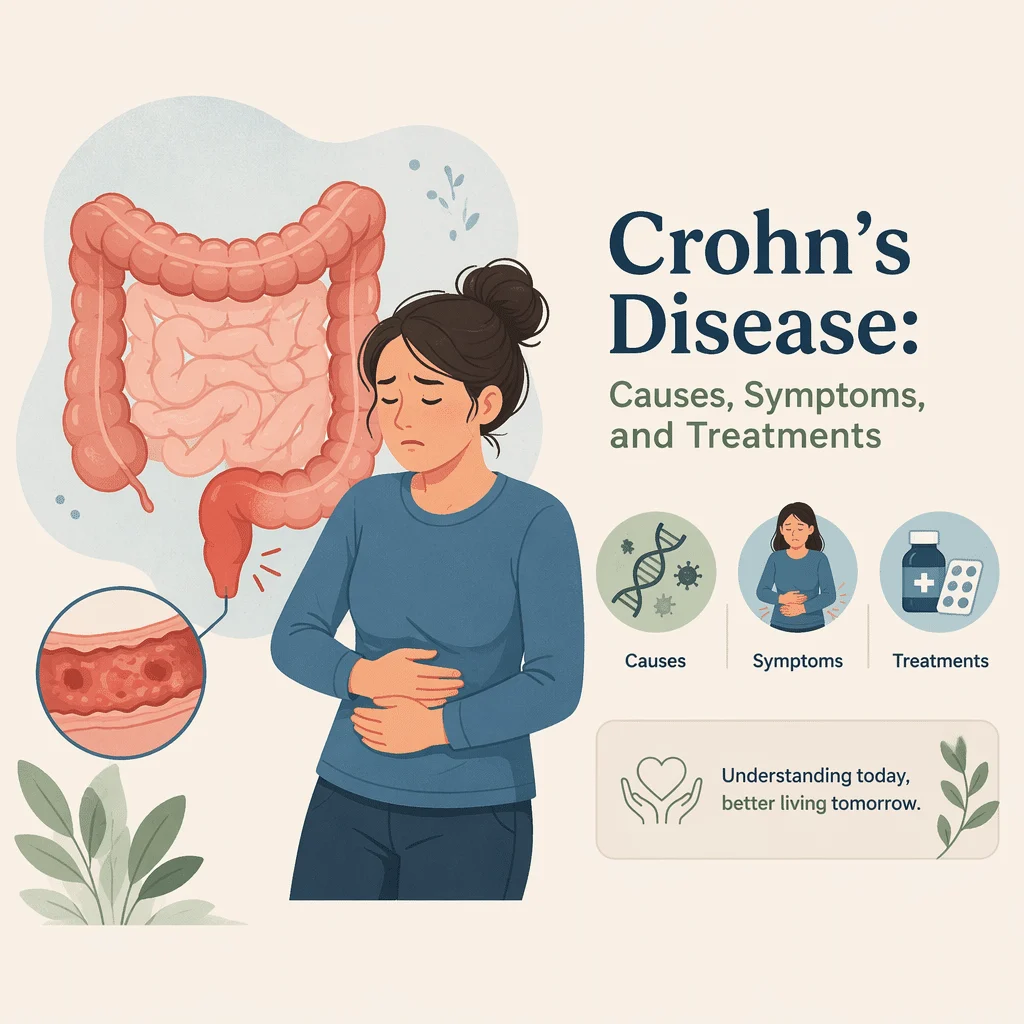
Crohn’s disease is a lifelong inflammatory bowel disease that can inflame any part of the digestive tract, from the mouth to the anus, though it most often affects the end of the small intestine and the start of the colon. The condition tends to run in cycles: flare-ups of active inflammation alternate with calmer stretches called remission. The reassuring news is that a modern combination of medicines, regular monitoring, and everyday self-care lets most people keep the disease under control and live full, active lives. In this article you’ll learn what Crohn’s disease is, how doctors recognise and diagnose it, which blood and stool tests help track it over time, how it is treated today, and practical ways to live well with it.
What is Crohn’s disease?
Crohn’s disease is one of the two main forms of inflammatory bowel disease (IBD), the other being ulcerative colitis. In Crohn’s, the immune system drives ongoing inflammation in the wall of the digestive tract. Unlike ulcerative colitis, which is limited to the colon and affects only the surface lining, Crohn’s can appear anywhere along the gut and can involve the full thickness of the bowel wall. Patches of inflamed tissue often sit next to healthy areas, a pattern doctors call “skip lesions.”
If colitis is the diagnosis instead, here is what an ulcerative colitis blood test really shows.
The disease usually begins between the ages of 15 and 35, but it can start at any age. It is not caused by anything a person did wrong, and it is not a result of a weak character or poor willpower. It is a chronic medical condition that behaves differently from person to person, which is why care is tailored to each individual.
Where Crohn’s disease appears in the digestive tract
The most common site is the ileum, the last section of the small intestine, together with the beginning of the large intestine. Some people have disease only in the colon, some only in the small bowel, and others have inflammation around the anus, with fissures or fistulas (abnormal tunnels between the bowel and nearby tissue). The location shapes the symptoms and helps guide treatment choices.
How Crohn’s differs from other gut conditions
Because belly pain and changed bowel habits are common to many conditions, Crohn’s is sometimes confused with other disorders. Irritable bowel syndrome, for example, causes real and distressing symptoms but does not inflame or damage the bowel wall. To understand that distinction, you can read our guide to understanding and managing irritable bowel syndrome. Gluten-related disorders can also mimic some features, and you can review our explainer on coeliac disease and gluten intolerance. The key difference is that Crohn’s involves measurable inflammation, which is where laboratory tests become useful.
Symptoms and warning signs
Symptoms depend on where the inflammation sits and how active it is. Many people notice that symptoms come and go, worsening during a flare and easing during remission.
Digestive symptoms
- Persistent diarrhoea, sometimes with urgency
- Cramping abdominal pain, often in the lower right side
- Blood or mucus in the stool
- Reduced appetite and unintended weight loss
- Nausea, and sometimes fever during active disease
Symptoms beyond the gut
Crohn’s is a whole-body condition, so it can cause effects outside the digestive tract. These include fatigue, joint pain, mouth ulcers, red or painful eyes, and skin rashes. Chronic inflammation and blood loss can also lead to anaemia, which deepens tiredness and breathlessness. For a fuller picture of that complication, you can read our detailed article on the symptoms, causes, and tests for anaemia.
When to see a doctor
Contact a healthcare professional if you have any of the following, especially when they persist or recur:
- Diarrhoea lasting more than a couple of weeks, or that keeps returning
- Blood in the stool, or black, tarry stools
- Ongoing abdominal pain, fever, or night sweats
- Unexplained weight loss or constant fatigue
- Poor growth or delayed puberty in a child or teenager
These signs do not automatically mean Crohn’s disease, but they deserve proper evaluation rather than guesswork.
What causes Crohn’s disease?
Researchers do not yet know a single cause. Instead, Crohn’s develops when several factors overlap. A person may inherit genes that make the immune system more likely to overreact; something in the environment then appears to trigger that overreaction, and the inflammation does not switch off as it should.
Known contributors include a family history of IBD, an immune response aimed at the normal bacteria of the gut, and changes in the gut microbiome (the community of microbes living in the intestine). Smoking is the most important modifiable risk factor: it roughly doubles the risk of developing Crohn’s and makes the disease harder to control. Diet and stress do not cause Crohn’s, but they can influence how symptoms feel day to day.
How Crohn’s disease is diagnosed
There is no single test that confirms Crohn’s disease. Doctors combine your history and physical examination with laboratory tests, endoscopy, and imaging to build a complete picture and to rule out other causes.
Endoscopy and imaging
Colonoscopy, in which a thin camera examines the colon and the end of the small intestine, remains the reference method. It lets the doctor see inflammation directly and take small tissue samples (biopsies) for the laboratory. Cross-sectional imaging, such as MR enterography or CT enterography, shows parts of the small bowel a scope cannot reach and reveals complications like narrowing or fistulas.
Blood tests
Blood work supports the diagnosis and measures the body’s response to inflammation. A full blood count can reveal anaemia or a raised white-cell count; to see how that panel is read, you can review our guide to reading a full blood count report. C-reactive protein rises when inflammation is active, and you can see our overview of C-reactive protein as an inflammation marker. Doctors sometimes add the erythrocyte sedimentation rate as a second, non-specific signal; to see how it is measured, you can read our guide to the erythrocyte sedimentation rate (ESR). Because Crohn’s can impair absorption, iron and other nutrients are checked too; you can consult our guide to ferritin as a blood marker of iron stores or explore our explainer covering the full iron studies panel.
Stool tests
Stool tests are especially valuable because they detect inflammation coming directly from the gut. The most useful is faecal calprotectin, a protein released by white blood cells when the bowel wall is inflamed; levels below roughly 50 micrograms per gram are generally considered normal, although each laboratory sets its own cutoff. To understand what those numbers mean, you can read our guide to faecal calprotectin test results. A related marker is measured in the same way, and you can see our article on what a positive faecal lactoferrin result means. Stool tests also help distinguish inflammatory bowel disease from non-inflammatory conditions and can flag infections that mimic a flare.
| Test | What it looks at | Why it matters in Crohn’s |
|---|---|---|
| Faecal calprotectin (stool) | Protein released by white cells in an inflamed gut wall | Flags active bowel inflammation; helps separate IBD from IBS and track flares |
| Faecal lactoferrin (stool) | Another inflammation protein from white cells | Plays a similar role to calprotectin and supports monitoring |
| C-reactive protein / CRP (blood) | General inflammation marker made by the liver | Often rises in flares, but can stay normal even with active disease |
| Full blood count / FBC (blood) | Red cells, white cells, and platelets | Detects anaemia and other signs of ongoing inflammation |
| Ferritin and iron studies (blood) | Iron stores and how iron is carried | Identifies iron-deficiency anaemia from blood loss or poor absorption |
| Vitamin B12 (blood) | Level of vitamin B12 | Can fall when disease or surgery affects the last part of the small intestine |
Monitoring Crohn’s with a treat-to-target approach
Modern care no longer stops at “do you feel better?” Because inflammation can smoulder even when symptoms ease, gastroenterologists now aim for clear, measurable goals. This strategy, known as treat-to-target, was set out by an international expert panel in a consensus called STRIDE-II. The targets combine symptom relief with objective signs of calmer disease, such as a normal C-reactive protein, a faecal calprotectin in the normal range, and, over the longer term, healing of the bowel lining seen at colonoscopy.
In practice, this means your stool and blood tests are repeated at intervals to check that treatment is truly working, not just masking symptoms. A rising calprotectin can warn of a flare weeks before it is felt, allowing an earlier adjustment and sparing some people a repeat scope. This is exactly where understanding your own numbers pays off, and it is the reason lab interpretation has become central to living well with Crohn’s.
Treatment options for Crohn’s disease
There is no cure yet, but treatment is highly effective at calming inflammation, healing the gut, and keeping people in remission. The plan depends on where the disease is, how severe it is, and how a person responds. Two broad goals guide it: settle the current flare, then maintain remission over the long term.
Medicines
Corticosteroids such as budesonide or prednisolone are used in short courses to bring a flare under control quickly; they are not meant for long-term use because of side effects. Immunomodulators such as azathioprine or methotrexate work more slowly and help keep the disease quiet, often alongside another drug. Aminosalicylates play only a limited role in Crohn’s compared with ulcerative colitis.
Advanced therapies: biologics and small molecules
For moderate-to-severe disease, advanced therapies target specific steps in the immune response rather than dampening the whole system. Biologics are antibody medicines given by infusion or injection. They include anti-TNF agents (such as infliximab and adalimumab), a gut-selective anti-integrin (vedolizumab), and antibodies that block interleukin signals (ustekinumab, and newer anti-interleukin-23 agents such as risankizumab). A separate group, oral small-molecule JAK inhibitors such as upadacitinib, can be taken as a daily tablet. These medicines have transformed outcomes, though they require specialist supervision and monitoring.
Surgery and nutrition
Around half of people with Crohn’s eventually need surgery, most often to remove a badly damaged or narrowed segment of bowel, or to treat a fistula. Surgery is not a cure, but it can restore quality of life when medicines are not enough. Nutritional therapy, in which specific formula feeds replace normal food for a period, is also an effective way to induce remission, particularly in children.
| Treatment group | Everyday examples | How it is generally used |
|---|---|---|
| Corticosteroids | budesonide, prednisone | Short courses to calm an active flare, not long-term |
| Immunomodulators | azathioprine, methotrexate | Help maintain remission, often with a biologic |
| Biologics (antibodies) | infliximab, adalimumab, vedolizumab, ustekinumab, risankizumab | Target specific immune signals in moderate-to-severe disease |
| Oral small molecules (JAK inhibitors) | upadacitinib | Daily tablet for moderate-to-severe disease, with monitoring |
| Surgery | bowel resection, treatment of a fistula | For complications or disease not controlled by medicine |
Living with Crohn’s disease
With good care, most people with Crohn’s have a normal or near-normal life expectancy. Living well is about steady routines rather than dramatic restrictions.
There is no single “Crohn’s diet.” During a flare, some people find low-fibre or easily digested foods gentler, whilst a varied, balanced diet suits most people in remission. Keeping a simple food-and-symptom diary helps identify personal triggers. Stopping smoking is one of the most powerful steps a person can take, because it improves the course of the disease directly.
Because inflammation and reduced absorption can drain nutrients, deficiencies are common and worth watching. Iron, vitamin B12, and vitamin D are frequently affected, and low blood protein can occur when the gut is very active. Periodic blood tests catch these early, and understanding the results helps you and your care team act before symptoms worsen. Emotional health matters too: anxiety and low mood are common with any chronic illness, and support from professionals, family, or patient groups makes a real difference. For a plain-language overview of the condition, many patients also consult the patient resources published by the Crohn’s and Colitis Foundation.
Latest scientific advances in Crohn’s disease
Research is moving quickly, and several recent findings are already shaping care. Here is what they mean in plain terms.
An oral option now exists for severe disease. A large clinical trial published in 2023 tested upadacitinib, a once-daily tablet, in people with moderate-to-severe Crohn’s who often had not responded to other drugs. Many reached and kept remission. What this means for you: there is now a pill-based advanced therapy, not only infusions or injections, though it is prescription-only and comes with specific safety checks.
Newer antibody treatments are proving their worth. A 2025 comparison that pooled results across studies (a network meta-analysis, which lines up different trials side by side) looked at guselkumab, one of the newest antibodies that block a signal called interleukin-23. Over a year it performed at least as well as several established advanced therapies. What this means for you: the menu of effective treatments keeps growing, which improves the odds of finding one that fits.
Monitoring is becoming smarter. The international treat-to-target consensus recommends aiming beyond symptom relief towards measurable calm, including a normal fecal calprotectin, and a 2023 systematic review confirmed how reliably this stool protein reflects gut inflammation. What this means for you: your test results, not just how you feel, increasingly guide treatment decisions. Researchers are also studying newer blood markers; a 2025 review found that a marker called leucine-rich alpha-2 glycoprotein (LRG) may help track inflammation, which could one day mean fewer invasive tests. This work is still early and not yet part of routine care.
Glossary
| Term | Definition |
|---|---|
| Inflammatory bowel disease (IBD) | An umbrella term for chronic inflammation of the gut, mainly Crohn’s disease and ulcerative colitis. |
| Flare | A period when the disease is active and symptoms return or worsen. |
| Remission | A calmer period with few or no symptoms and reduced inflammation. |
| Faecal calprotectin | A stool protein that rises when the bowel wall is inflamed, used to track disease activity. |
| C-reactive protein (CRP) | A blood protein made by the liver that increases during inflammation. |
| Biologic | An antibody-based medicine that targets a specific part of the immune response. |
| Treat-to-target | A strategy that adjusts treatment until measurable goals, not just symptoms, are met. |
| Colonoscopy | A camera examination of the colon and lower small intestine that can also take biopsies. |
| Fistula | An abnormal tunnel that can form between the bowel and nearby organs or the skin. |
Frequently asked questions about Crohn’s disease
Is Crohn’s disease hereditary?
Genes play a part, and having a close relative with IBD raises the risk, but heredity is not the whole story. Most people with Crohn’s have no affected family member, and most relatives of someone with the disease never develop it. Genes appear to set the stage, while environmental triggers determine whether the disease actually appears.
What foods should I avoid with Crohn’s disease?
There is no universal list. Triggers vary from person to person, so a food that bothers one individual may be fine for another. During a flare, many people tolerate low-fibre, easily digested foods better, whilst a broad, balanced diet works well in remission. A food-and-symptom diary is the most reliable way to spot your own patterns, ideally with input from a dietitian.
Can Crohn’s disease be cured?
Not yet. However, current treatments are very effective at controlling inflammation, healing the gut lining, and keeping people in long remission. Many people go for years with few or no symptoms. The goal of care is durable remission and a good quality of life rather than a one-time cure.
Is Crohn’s disease contagious?
No. Crohn’s disease cannot be passed from one person to another through contact, food, or air. It is an immune-driven condition, not an infection, even though infections can sometimes trigger symptoms that resemble a flare.
Does Crohn’s disease shorten life expectancy?
For most people, life expectancy is normal or close to normal, especially with consistent treatment and monitoring. Complications can occur, which is why regular follow-up and early action on warning signs matter. Staying smoke-free and keeping up with recommended tests are among the most protective steps.
Can a blood or stool test diagnose Crohn’s on its own?
No single test confirms Crohn’s disease. Blood and stool tests such as CRP and faecal calprotectin are powerful for spotting inflammation and for monitoring, but diagnosis relies on combining them with colonoscopy, biopsies, and imaging. Interpreting these results together, with your doctor, is what leads to an accurate answer.
Sources
- National Institute of Diabetes and Digestive and Kidney Diseases (NIDDK) — Crohn’s Disease — niddk.nih.gov
- Mayo Clinic — Crohn’s disease: Symptoms and causes — mayoclinic.org
- Crohn’s & Colitis Foundation — What Is Crohn’s Disease? — crohnscolitisfoundation.org
- Turner D, et al. — STRIDE-II: An Update on the Selecting Therapeutic Targets in Inflammatory Bowel Disease (STRIDE) Initiative — Gastroenterology, 2021 — doi.org/10.1053/j.gastro.2020.12.031
- Loftus EV, et al. — Upadacitinib Induction and Maintenance Therapy for Crohn’s Disease — New England Journal of Medicine, 2023 — doi.org/10.1056/NEJMoa2212728
- Disher T, et al. — One-Year Efficacy of Guselkumab Versus Advanced Therapies for Moderately to Severely Active Crohn’s Disease: A Network Meta-Analysis — Advances in Therapy, 2025 — doi.org/10.1007/s12325-025-03183-x
- Asiri A, et al. — Fecal Calprotectin and Organic Gastrointestinal Disease: A Systematic Review — Cureus, 2023 — doi.org/10.7759/cureus.45019
- Ojaghi Shirmard F, et al. — Serum leucine-rich alpha-2 glycoprotein as a novel biomarker in monitoring inflammatory bowel disease: a systematic review and meta-analysis — European Journal of Gastroenterology & Hepatology, 2025 — doi.org/10.1097/MEG.0000000000002952
Further reading
- Low Vitamin B12: Symptoms, Causes, Treatments
- Hypoalbuminaemia: Causes, Mechanisms, and Treatment
- Vitamin D Blood Test (25-OH): How to Read Your Results
- Low Ferritin: Causes, Symptoms, and Treatment
- Stool consistency: understanding normal and abnormal changes
Understand your lab results with AI DiagMe
Get your results interpreted in minutes
Crohn’s disease is monitored as much through numbers as through symptoms, so making sense of your reports helps you stay ahead of a flare. AI DiagMe explains common results in plain language, including faecal calprotectin, C-reactive protein, a full blood count, and iron studies such as ferritin. It is built to help you understand your values and prepare for a better conversation with your doctor; it does not diagnose Crohn’s disease and does not replace the medical team who cares for you.