








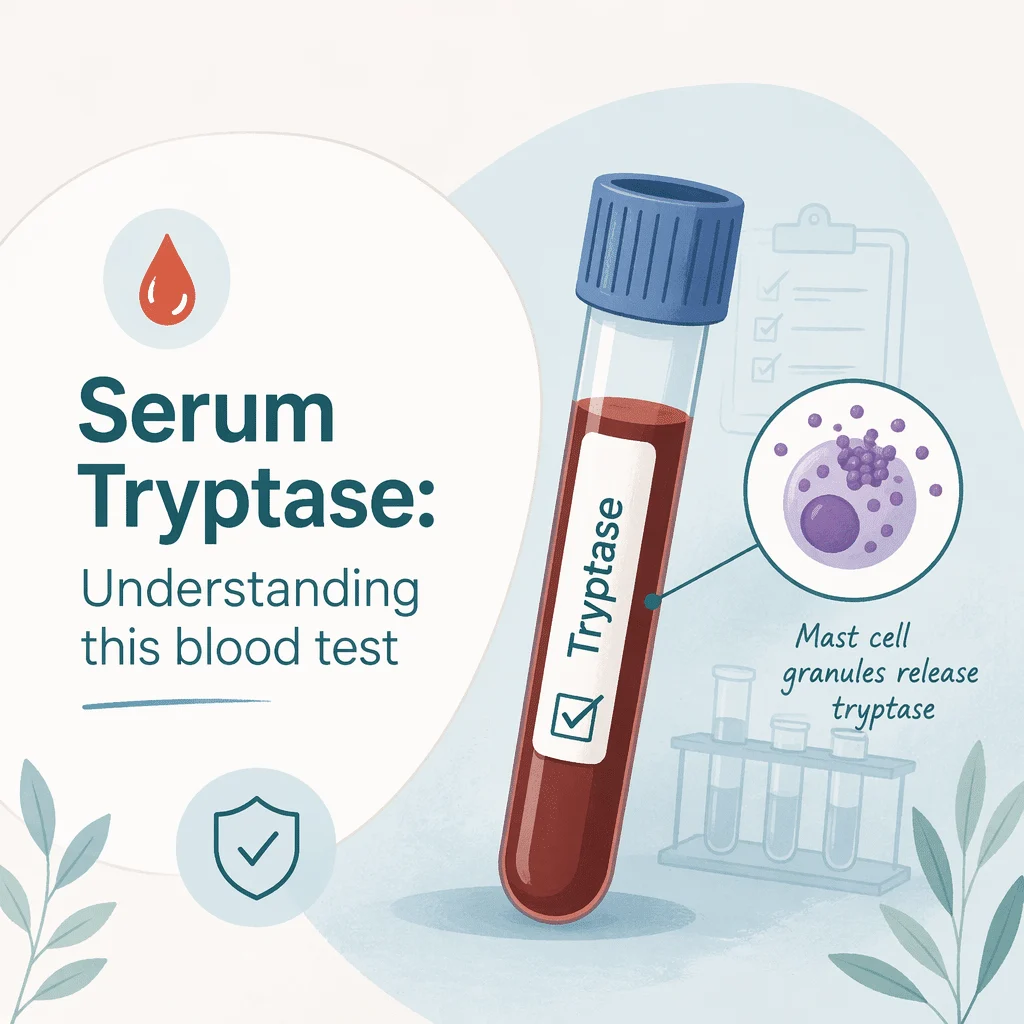
Serum tryptase is a blood test that measures an enzyme released by mast cells, the immune cells that drive allergic reactions. A doctor usually checks it for one of two reasons: to help confirm a severe allergic reaction (anaphylaxis) using carefully timed samples, or to look into a level that stays high over time, which can point to a mast cell disorder or an inherited trait. A single number rarely tells the whole story, so timing and context are everything. In this article you will learn what tryptase is, when the test is ordered, how to read a result against the reference range, what a high or normal value can mean, and when a result is worth discussing with your doctor.
What is serum tryptase?
Serum tryptase is an enzyme stored in large amounts inside mast cells. Mast cells are sentinel cells of the immune system, and they sit in the tissues that meet the outside world, such as the skin, the lining of the airways, and the digestive tract. When a mast cell is triggered, it releases its contents, including tryptase, into the surrounding tissue and the bloodstream, where a blood test can pick it up. The amount that reaches the blood broadly reflects how strongly those cells have been activated.
Because tryptase comes almost entirely from mast cells, measuring it gives doctors an indirect read on mast cell activity. It has become the most widely used laboratory marker of mast cell activation, whether that activation is driven by a classic, antibody-mediated allergy or by another mechanism.
The role of mast cells
Mast cells are part of your first line of defence. They carry packets of chemical messengers, including histamine and tryptase, and release them during allergic and inflammatory responses. This release widens blood vessels and helps other immune cells reach the affected area, which is useful against genuine threats such as parasites. The same process, aimed at a harmless trigger like pollen or a food protein, produces the familiar symptoms of allergy.
Why doctors measure tryptase
A tryptase result helps answer two very different questions. A short-lived jump can support the diagnosis of a severe, sudden allergic reaction, while a level that is persistently raised at rest can flag a condition in which mast cells are either too numerous or too easily triggered. The value is never read alone; it is always weighed against your symptoms, your medical history, and the exact timing of the sample. That is why the same figure can be routine for one person and worth investigating for another.
When is a serum tryptase test ordered?
Doctors order tryptase in two main situations, and the timing of the blood draw is what separates them. The test may be requested in an emergency department, by an anaesthetic team after an unexpected reaction during surgery, or by an allergist or haematologist during a planned assessment.
The first situation is a suspected anaphylactic reaction. Here the goal is to catch a transient spike, so the sample is taken soon after symptoms begin, ideally between about 15 minutes and 3 hours, when the level tends to peak. A second, later sample, usually taken at least 24 hours after everything has settled, measures your baseline, and the two numbers are then compared.
The second situation is a level that is high at rest, away from any reaction. A persistently raised baseline can prompt a search for a mast cell disorder such as mastocytosis, or for an inherited trait that raises tryptase without any illness at all. In this setting the test may be repeated on a separate day and combined with other investigations, sometimes including genetic testing, before any conclusion is drawn.
How to read your serum tryptase results
Your report shows your tryptase value next to a reference range. Many laboratories use an upper limit of about 11.4 ng/mL (nanograms per millilitre; some reports use µg/L, which is the same number). A result below that figure is generally considered normal. Reference ranges vary between laboratories and testing methods, though, so the range printed on your own report is always the one that matters, not a figure from elsewhere.
What a normal baseline means
A baseline within the reference range is reassuring and is what most healthy people show. Physiological tryptase varies from one person to the next, depending partly on how many mast cells you have and on your genetics. Recent expert reviews have argued that the normal baseline should be read a little more broadly, roughly 1 to 15 ng/mL, precisely so that healthy people are not sent for needless investigations, or left anxious, over a mildly raised figure.
The acute rise: comparing peak and baseline
For a suspected reaction, the change between the timed samples matters more than any single number. Allergy specialists use a widely accepted formula, often called the 20% + 2 rule: the peak level should be greater than 1.2 times the baseline plus 2 ng/mL to support recent mast cell activation. This is why one isolated tryptase value can be hard to interpret, and why the paired, timed samples are so valuable. The table below summarises how results are commonly grouped; treat the bands as a guide for understanding your report, not as a diagnosis.
| Tryptase pattern | What it can suggest |
|---|---|
| Baseline below about 11.4 ng/mL | Within the usual reference range for most healthy people |
| Baseline mildly raised (about 8 to 20 ng/mL) | Often the inherited trait hereditary alpha-tryptasaemia; sometimes kidney disease or other factors |
| Baseline above 20 ng/mL | May point towards a mast cell disorder such as mastocytosis and usually prompts further tests |
| A timed rise meeting the 20% + 2 rule | Supports recent mast cell activation, as seen in anaphylaxis |
What causes a high serum tryptase level?
A raised tryptase is a sign, not a disease in itself. Several very different situations can push the number up, which is exactly why the result is always interpreted in context rather than treated as a verdict.
Anaphylaxis
A severe, whole-body allergic reaction is the classic cause of a large, rapid rise. In anaphylaxis, many mast cells release their contents at once, and tryptase climbs within an hour or two before falling back towards baseline. Common triggers include foods, insect stings, and certain medicines. When a drug is involved, it helps to understand the specific reaction, and our guides explain a penicillin allergy and an amoxicillin allergy.
Mastocytosis
Mastocytosis is a rare condition in which the body builds up too many mast cells in the skin, bone marrow, or other organs. The extra cells release tryptase steadily, so the baseline stays high between reactions. A resting level above 20 ng/mL is one of the criteria doctors weigh when they consider this diagnosis, alongside bone marrow tests and other findings.
Hereditary alpha-tryptasaemia
Hereditary alpha-tryptasaemia is an inherited trait, not a disease, in which a person carries extra copies of the gene that codes for alpha-tryptase (TPSAB1). More copies mean more tryptase circulating in the blood at all times, whether or not a reaction is happening. It is common, with estimates of around 4 to 6% of the general population, and it is now recognised as the most frequent reason for a mildly raised baseline. For a plain-language overview, the US National Institute of Allergy and Infectious Diseases keeps a public FAQ on hereditary alpha-tryptasaemia.
Mast cell activation syndrome
In mast cell activation syndrome, mast cells are over-reactive rather than too numerous. Symptoms can resemble mastocytosis, but the baseline tryptase is often normal or only mildly raised. The diagnosis therefore leans on capturing a timed rise during an episode, using the same 20% + 2 rule that applies to anaphylaxis.
Other causes
Tryptase can also sit a little higher for reasons unrelated to allergy. Chronic kidney disease, some blood conditions, and other factors can nudge the baseline up. Separately, certain drugs given in hospital, such as opioids or some imaging contrast agents, can trigger mast cell release, which is one more reason to tell your care team about every medicine you take. The table below shows the typical pattern for each cause.
| Cause | Typical tryptase pattern |
|---|---|
| Anaphylaxis | Sharp, temporary rise that peaks within hours, then returns to baseline |
| Mastocytosis | Persistently high baseline, often above 20 ng/mL |
| Hereditary alpha-tryptasaemia | Mildly to moderately raised baseline that stays stable over time |
| Mast cell activation syndrome | Baseline often normal; a timed rise appears during episodes |
| Kidney disease and other factors | Modestly raised baseline unrelated to allergy |
Can a normal tryptase rule out an allergy?
No. A normal tryptase does not exclude a serious allergic reaction. Not every episode of anaphylaxis raises the enzyme enough to be caught, and food-triggered reactions in particular can occur with a level that stays within range. Studies of emergency patients have shown that tryptase, used on its own, misses a meaningful share of true reactions, so it is best treated as supportive evidence rather than a pass-or-fail test. This is exactly why doctors never rely on tryptase alone and always weigh it against the clinical picture. A very low level, meanwhile, is generally of little concern by itself.
Related blood tests
Tryptase is usually one piece of a wider assessment. Depending on your symptoms, your doctor may order additional tests to build a fuller picture. To look for specific allergic triggers, they may request an allergy blood test, which measures IgE antibodies. To check for a raised eosinophil count, a type of white cell sometimes increased in allergic and mast cell conditions, they may order a complete blood count. And to gauge overall immune function, they sometimes measure immunoglobulin A (IgA).
If the layout of the report is unfamiliar, our guide explains how to read your blood test results.
When should you see a doctor?
Tryptase is interpreted by a clinician, but some situations deserve prompt attention. Consider contacting a doctor if any of the following apply.
- You have had a severe reaction with swelling of the lips or throat, difficulty breathing, dizziness, or fainting; treat these signs as a medical emergency and call for help.
- Your baseline tryptase stays above the reference range on more than one test.
- You have repeated episodes of flushing, hives, abdominal cramps, or unexplained drops in blood pressure.
- A close relative has a mast cell disorder or a known raised tryptase level.
- Your result is well outside the range, rather than sitting just at the edge of it.
An allergist or a haematologist is often the right specialist when a mast cell problem is suspected, and either can arrange any genetic or bone marrow tests that may be needed.
Latest scientific advances
Research on tryptase has moved quickly, and much of it aims to keep people from being over-diagnosed. Here is what recent work adds, in plain terms.
First, experts are rethinking what counts as normal. A 2023 international review proposed that the normal baseline range should be read as roughly 1 to 15 ng/mL, so that healthy people with a naturally higher figure are not sent for unnecessary tests or left worried about their health.
Second, the inherited trait behind many raised results is now much better understood. Recent reviews describe hereditary alpha-tryptasaemia as the single most common reason for a high baseline tryptase, and note that it is confirmed by counting copies of the tryptase gene rather than by the tryptase level alone.
Third, studies have mapped who carries the trait. Among people with a high baseline but no mastocytosis, the great majority turn out to carry extra gene copies; the trait appears more often in women, and researchers have flagged a possible link with thyroid conditions that is still being explored.
Fourth, large population studies have measured how common the trait really is, finding it in a few per cent of people and showing that other variations in the tryptase genes can raise or lower the baseline too. That helps explain why the same number can mean different things in different people, and it is nudging laboratories towards more tailored thresholds.
Finally, work in people with mast cell disorders has added useful nuance. A large network study found the trait more often in these patients than in healthy volunteers, but also cautioned that carrying it does not automatically mean more severe reactions, a reminder that the result needs careful, individual interpretation. Taken together, these findings are reassuring: a mildly raised tryptase is common, often inherited, and frequently harmless, and a practical step-by-step reading of the result has become the standard approach.
Glossary
| Term | Definition |
|---|---|
| Mast cell | An immune cell in tissues such as skin and gut that stores and releases tryptase and histamine. |
| Tryptase | An enzyme released by mast cells; its blood level is used as a marker of mast cell activation. |
| Baseline tryptase | Your tryptase level measured at rest, away from any reaction. |
| Anaphylaxis | A severe, rapid, whole-body allergic reaction that can affect breathing and blood pressure. |
| Mastocytosis | A rare condition with a build-up of too many mast cells in one or more organs. |
| Hereditary alpha-tryptasaemia | An inherited trait with extra copies of the TPSAB1 gene, raising baseline tryptase. |
| Mast cell activation syndrome | A condition in which mast cells over-react without being too numerous. |
| TPSAB1 | The gene that codes for alpha-tryptase; extra copies cause hereditary alpha-tryptasemia. |
| The 20% + 2 rule | A formula comparing peak and baseline tryptase to confirm recent mast cell activation. |
Frequently asked questions
Do I need to fast before a tryptase test?
No. Fasting is not required for a tryptase test, because food does not meaningfully change the level in your blood. You can usually eat and drink as normal. If the tryptase test happens to be bundled with other blood tests that do need fasting, follow the instructions for those tests. Always check the specific guidance from your clinic or laboratory, since some appointments have their own requirements.
What is the best time to measure tryptase after a reaction?
To capture the transient rise of anaphylaxis, the sample is best taken between about 15 minutes and 3 hours after symptoms start, when tryptase peaks. A second sample is then taken at least 24 hours later, once you have fully recovered, to record your baseline. Comparing the two is far more informative than a single value, which is why the timing of the draw is so important and why staff note the time of your reaction.
Can medications affect a tryptase result?
Yes, some can. Drugs used around procedures, such as opioids or certain imaging contrast agents, can prompt mast cells to release their contents and nudge tryptase up. This is one reason it helps to tell your doctor about every medicine, supplement, and recent procedure. Your clinician takes this information into account when interpreting the number, so it is worth mentioning even details that seem minor.
Does a high baseline tryptase mean I have a serious disease?
Not usually. The most common reason for a mildly raised baseline is hereditary alpha-tryptasaemia, an inherited trait rather than a disease, and many people who carry it have few or no symptoms. A higher figure, especially above 20 ng/mL, may prompt further tests to look for a mast cell disorder, but the result is always read alongside your history and symptoms rather than on its own. A single raised value is a reason to follow up, not to panic.
Can tryptase be used to follow a known condition?
Yes. In people with a confirmed mast cell disorder, repeated tryptase measurements can help track the condition over time. A stable or falling level is generally a good sign, whilst a rising trend may prompt a closer look. Your specialist decides how often to check and how to interpret any change, always in the context of your overall care rather than as a number in isolation.
Understanding a tryptase result is easier when the numbers are explained in plain language and placed in context. If you have had a reaction and are looking at timed tryptase samples, an allergy blood test, or a full blood count, it helps to see what each value means and what to ask your doctor. AI DiagMe is built to help you understand your results, not to diagnose you or replace your doctor.
Understand your lab results with AI DiagMe
Get your results interpreted in minutes
Sources
- National Institute of Allergy and Infectious Diseases — Hereditary Alpha Tryptasemia and Hereditary Alpha Tryptasemia Syndrome FAQ — niaid.nih.gov
- American Academy of Allergy, Asthma & Immunology — Understanding serum tryptase variability and anaphylaxis, 2021 — aaaai.org
- Cleveland Clinic Laboratories — Tryptase — clevelandcliniclabs.com
- Valent P, et al. — The Normal Range of Baseline Tryptase Should Be 1 to 15 ng/mL and Covers Healthy Individuals With HαT — J Allergy Clin Immunol Pract, 2023 — doi.org/10.1016/j.jaip.2023.08.008
- Beyens M, et al. — Diagnostic Significance of Tryptase for Suspected Mast Cell Disorders — Diagnostics (Basel), 2023 — doi.org/10.3390/diagnostics13243662
- Rama TA, Gulen T — Hereditary Alpha-Tryptasemia and Mastocytosis: What We Know and What We Need To Learn — Curr Allergy Asthma Rep, 2026 — doi.org/10.1007/s11882-026-01262-9
- Puxkandl V, et al. — Hereditary alpha tryptasemia: elevated tryptase, female sex, thyroid disorders, and anaphylaxis — Front Allergy, 2024 — doi.org/10.3389/falgy.2024.1461359
- González-de-Olano D, et al. — Clinical impact of the TPSAB1 genotype in mast cell diseases: A REMA study — Allergy, 2023 — doi.org/10.1111/all.15911
- Chantran Y, et al. — Distinct Tryptase Gene Copy Number Variations Correlate With Tryptase Levels in a Population-Based Cohort — Allergy, 2025 — consensus.app
Further reading
- IgG (immunoglobulin G): understanding your blood test
- Autoimmune panel: ANA, rheumatoid factor and anti-CCP tests
- CRP (C-reactive protein): understanding this inflammation marker
- Erythrocyte sedimentation rate (ESR): understanding this marker
- Anti-TPO antibodies: understanding this thyroid marker