







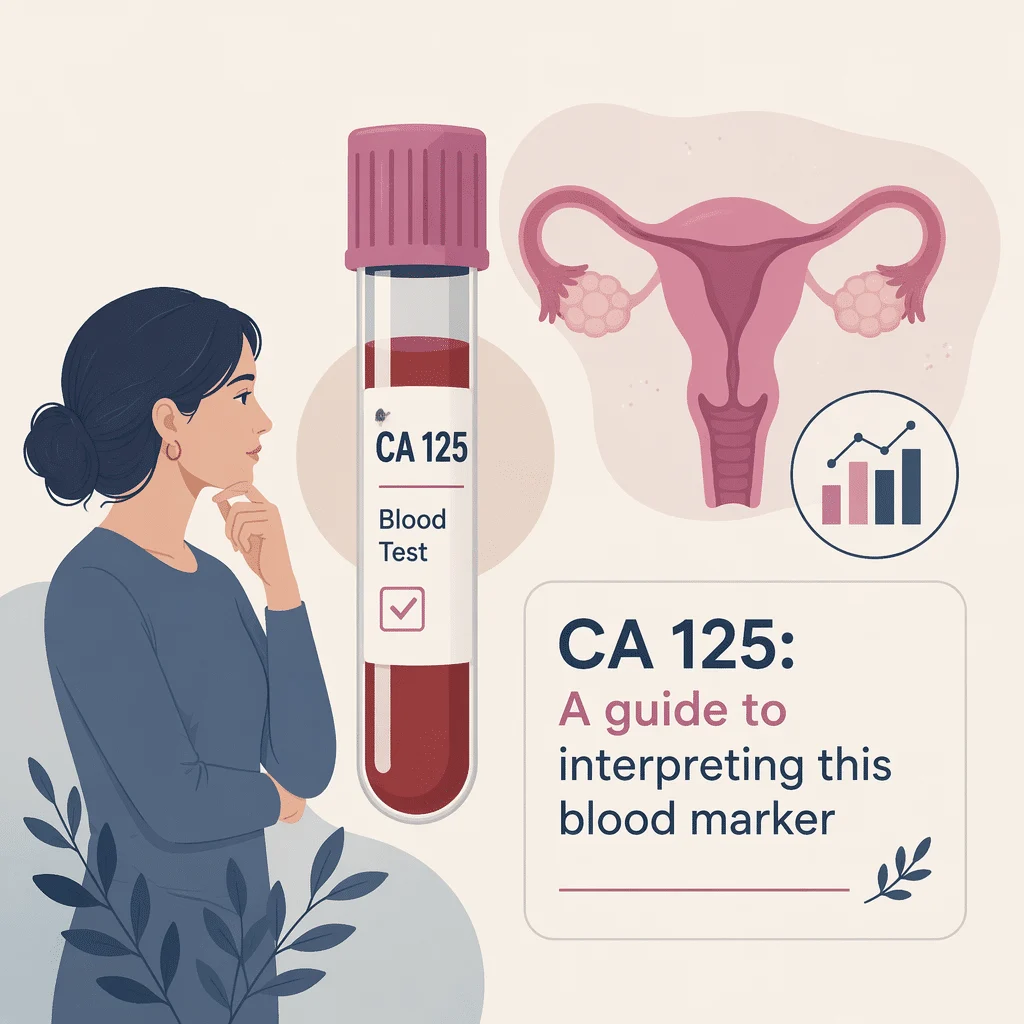
A CA 125 blood test measures a protein that ovarian and pelvic tissue releases when it is irritated or inflamed — and cancer is only one of many things that can irritate it. If your result came back above the usual range, please read this first: a raised CA 125 is not a cancer diagnosis. In women who have not yet reached the menopause, an everyday cause such as endometriosis, an ovarian cyst, fibroids or simply the timing of a period is far more common than cancer. Doctors mainly use this test to help assess a lump already seen on a scan, to follow how treatment is working, and to watch for a cancer returning — not to check healthy women who have no symptoms.
In this article you’ll learn what CA 125 is, why doctors order it, the many harmless reasons the number climbs, how results are read differently before and after the menopause, what a raised result actually triggers, why a normal result does not rule cancer out, and which symptoms deserve a doctor’s review whatever your number says.
What CA 125 is and what the test measures
CA 125 stands for cancer antigen 125. Despite the name, it is not a cancer-only substance. It is a large glycoprotein — a molecule built from sugar and protein — made by the coelomic epithelium, the thin lining that covers the ovaries, the fallopian tubes, the inside of the uterus and the peritoneum (the membrane wrapping the organs inside your abdomen).
The important detail is what makes these linings release it. They shed CA 125 into the bloodstream whenever they are stretched, inflamed or disturbed. A tumour growing on an ovary does that. So does a cyst, a patch of endometriosis, an infection, or the monthly shedding of the uterine lining. The blood test simply counts how much of the protein is circulating; it cannot tell your doctor which of those causes put it there.
Laboratories report the result in units per millilitre (U/mL), and most use 35 U/mL as the upper limit of the usual range. That number is a statistical convention rather than a biological wall: it was chosen because roughly 99 in 100 healthy people sit below it. Crossing it means “worth a look”, not “something is wrong”.
Why doctors order a CA 125 blood test
CA 125 has three well-established roles, and all three involve a question that has already been raised by something else — a scan, a symptom, or a diagnosis.
Helping to assess a lump that has already been found
If an ultrasound has shown a mass on or near an ovary (doctors call this an adnexal mass), CA 125 becomes one factor among several. It is weighed alongside the appearance of the mass on the scan, your age and your menopausal status. It never decides the answer on its own; only examining tissue under a microscope can confirm what a mass actually is.
Following treatment
In someone already diagnosed with ovarian cancer, CA 125 is genuinely useful. Levels that fall over successive tests usually indicate treatment is working. Levels that plateau or climb suggest the opposite. Here the marker is measuring change in a known quantity, which is a far easier task than identifying an unknown one.
Watching for recurrence
After treatment ends, a rising trend across several tests can signal the cancer returning, sometimes before symptoms appear. Again, the value comes from the direction of travel over time, not from any single reading.
If you want the wider picture of how markers like this fit together, you can also read our guide to tumour markers in blood tests. Notice what is absent from that list of three jobs: checking healthy women for ovarian cancer.
Why CA 125 is not a screening test for average-risk women
This is the point most worth understanding, and it is not a matter of opinion. The US Preventive Services Task Force — the independent panel of experts that sets American prevention guidance — recommends against screening for ovarian cancer in asymptomatic women who are not known to carry a high-risk hereditary cancer syndrome. It gives this a grade D, its designation for a service where there is at least moderate certainty that the harms outweigh the benefits.
That deserves an explanation.
Two very large trials tested the idea properly. In the UK, the UKCTOCS trial invited more than 200,000 postmenopausal women and screened them annually for years, using either repeated CA 125 measurements or ultrasound. In the US, the PLCO trial ran a comparable experiment. Screening did find more cancers at an earlier stage. But when researchers counted what actually mattered — how many women died of ovarian cancer — the screened groups did no better than the unscreened ones.
Meanwhile the harm was real and measurable. Because CA 125 rises for so many innocent reasons, screening produced false alarms, and a false alarm about an ovary is not a trivial thing. It leads to more scans, more anxiety, and for some women an operation to remove an ovary that turned out to be perfectly healthy. In UKCTOCS, for every cancer the CA 125 programme detected, roughly two additional women had surgery that, in hindsight, they did not need.
So the recommendation is not saying ovarian cancer doesn’t matter. It is saying this particular test, used this particular way, costs more than it delivers. Women with a known high-risk inherited condition, or a strong family history, are a separate conversation entirely and should discuss surveillance with a specialist.
The many benign reasons CA 125 can be raised
CA 125 has a specificity problem, especially before the menopause. Specificity means how good a test is at staying quiet when the disease is absent — and in premenopausal women, CA 125 is not good at staying quiet at all. The reason is simple: a premenopausal pelvis is a busy place. Ovulation, menstruation, cysts and hormone-driven tissue all disturb exactly the linings that release this protein.
Conditions and situations that commonly raise CA 125 without any cancer involved include:
- Endometriosis, where tissue similar to the uterine lining grows outside the uterus and causes chronic inflammation
- Uterine fibroids, particularly larger ones
- Ovarian cysts, including the ordinary functional cysts that come and go with the cycle
- Normal menstruation — the level can drift up around your period
- Pregnancy, especially in the first trimester
- Pelvic inflammatory disease and other pelvic infections
- Liver disease, particularly cirrhosis with fluid in the abdomen
- Pancreatitis, recent abdominal surgery, or anything else that irritates the peritoneum
- Heart failure and some lung conditions
If you live with endometriosis, a mildly raised CA 125 is close to expected rather than alarming, and your gynaecologist will read it in that light. If you have a known cyst, you can also read our article on ovarian cyst sizes and what they mean.
| Points towards a benign explanation | Prompts closer assessment |
|---|---|
| You have not yet reached the menopause | You are past the menopause |
| The rise is modest and stays stable when repeated | The level climbs steadily across several tests |
| You have a known cause such as endometriosis, fibroids or a cyst | No benign explanation is apparent |
| The scan looks normal or shows a simple, smooth cyst | The scan shows a solid or complex mass, or free fluid |
| You feel well and have no persistent symptoms | Bloating, pelvic pain or early fullness persist for weeks |
| The test was taken around your period | You have a strong family history of ovarian or breast cancer |
How results are read before and after the menopause
The same number can carry two very different meanings depending on where you are in life, and this is one of the most useful things to understand about your result.
Before the menopause, the pelvis generates plenty of background noise. A result of, say, 60 U/mL in a 34-year-old with painful periods is far more likely to reflect endometriosis or a cyst than anything sinister. Doctors are correspondingly slow to be alarmed and quick to look for the ordinary explanation first. If that describes you, you can also read our guide to endometriosis.
After the menopause, the ovaries quieten down, periods stop, and most of the benign sources of CA 125 fall away. The same 60 U/mL in a 63-year-old is therefore more meaningful, simply because there are fewer innocent candidates left. That does not make it a diagnosis — fibroids, liver disease and old surgical scarring do not disappear at the menopause — but it does lower the threshold for investigating. If you are unsure where you stand, you can read our guide to menopause symptoms. To see how doctors confirm the menopause with blood tests, you can also consult our article on the FSH blood test.
One reading is also a snapshot, not a story. A single number taken once tells your doctor much less than two or three taken over months. A stable level is reassuring in a way that no isolated value can be; a steadily rising one deserves attention even if each individual result looks unremarkable.
What actually happens after a raised CA 125
Knowing the next steps takes a lot of the fear out of waiting for them. A raised CA 125 does not send anyone straight to an operating theatre. It starts a sequence.
- Your doctor reviews your history and symptoms, and asks what else could explain it — your cycle, a known cyst, endometriosis, recent illness
- A pelvic or transvaginal ultrasound looks directly at the ovaries. Imaging carries far more weight than the marker, because it shows whether there is anything there at all
- The test may simply be repeated after a few weeks. Many transient rises settle on their own
- If a mass is present, a gynaecologist or gynaecological oncologist combines the scan, your menopausal status and your bloods into a structured risk assessment
- Only if that combined picture suggests real concern does surgery enter the discussion, and it is a specialist decision
Two tools often appear at this stage. ROMA (the Risk of Ovarian Malignancy Algorithm) combines CA 125 with a second marker called HE4 and your menopausal status. RMI (the Risk of Malignancy Index) combines CA 125 with ultrasound findings and menopausal status. Both exist for the same reason: one number in isolation is not reliable enough, and combining sources of information is. Doctors may also look for other explanations, such as an infection. To understand those tests, you can read our guide to high CRP levels. You can also consult our guide to the complete blood count.
Why a normal CA 125 does not rule out ovarian cancer
This point cuts the other way.
Roughly half of early-stage ovarian cancers do not raise CA 125 at all. Some tumour types barely produce the protein regardless of stage. So a result inside the normal range is genuinely good news in context, but it is not a clearance certificate, and it should never be used to dismiss symptoms that are telling you something.
This is precisely why a normal CA 125 cannot be used to talk anyone out of investigating a persistent problem. If you have symptoms that will not settle, they deserve assessment on their own merits — the marker is not the arbiter. A scan, an examination and a doctor who listens are worth more than any number on a page.
Symptoms that deserve review whatever the number says
Ovarian cancer has a reputation for being silent, which is only partly fair. It often does produce symptoms; they are simply vague and easy to attribute to something else. The pattern that matters is persistence: symptoms that are new for you, that keep going for several weeks, and that do not behave like your normal digestive grumbles.
| When to see a doctor | Why it is worth mentioning |
|---|---|
| Bloating that persists most days for three weeks or more | Persistent, non-fluctuating bloating behaves differently from ordinary digestive bloating |
| Feeling full quickly, or losing your appetite | Early satiety is one of the most consistently reported early symptoms |
| Pelvic or abdominal pain that keeps returning | Ongoing pain always merits an explanation, whatever the cause turns out to be |
| Needing to pass urine more often or more urgently | Pressure in the pelvis can affect the bladder |
| A change in your abdomen you can feel or see | Swelling or a palpable change should always be examined |
| Any bleeding after the menopause | Postmenopausal bleeding is never normal and needs prompt review |
None of these symptoms means cancer. All of them are far more often caused by something benign. But all of them earn a conversation with your doctor if they persist — and that is true whether your CA 125 was high, low, or never measured. For a fuller account of how these are investigated, you can read our article on ovarian cancer symptoms and testing.
Latest scientific advances in CA 125 testing
Research over the past few years has largely confirmed the limits of CA 125 whilst sharpening how it is best used. Here is what recent work found, and what it means for you.
The largest screening trial ever run found no lives saved
Menon and colleagues published the full long-term results of UKCTOCS, a randomised controlled trial — a study where participants are allocated by chance to different approaches so the groups can be fairly compared. Over 200,000 postmenopausal women were followed for a median of more than sixteen years. Annual CA 125 screening did shift cancers towards earlier stages, but it did not reduce deaths from ovarian cancer. For every cancer found by screening, about two more women underwent an operation that proved unnecessary.
What this means for you: if a clinic offers you a CA 125 “ovarian check” and you have no symptoms and no known high risk, this is the evidence explaining why mainstream guidance advises against it. Finding cancer earlier only helps if it changes the outcome, and here it did not.
The problem appears to be biology, not scheduling
Lange and colleagues re-analysed the UKCTOCS data to ask why screening failed. Modelling the natural history of high-grade serous ovarian cancer — the most common and most aggressive subtype — they estimated that the window in which CA 125 screening could catch it whilst still early was under six months. Even screening continuously would have made only a modest difference.
What this means for you: the failure was not caused by testing too infrequently. This cancer can move from undetectable to advanced faster than any yearly test can catch. Better screening will need genuinely different tests, not more of the same one.
Tracking change over time works better than one threshold
Han and colleagues reported 21 years of the Normal Risk Ovarian Screening Study, which followed nearly 8,000 postmenopausal women. Instead of asking “is CA 125 above 35?”, it tracked each woman’s own trend and flagged meaningful rises against her personal baseline. Most cancers it detected were found early, and when it did raise a flag, that flag was right about half the time — far better than a single cut-off manages. The study was not designed to show whether it saves lives.
What this means for you: this is the strongest argument for why your doctor cares more about your trend than your absolute number. It is also still a research strategy, not routine care.
In endometriosis, a raised CA 125 is largely expected
Arsalan and colleagues reviewed the biology of endometriosis markers and set out why CA 125 behaves as it does: it comes from the same coelomic linings that endometriosis inflames, so the disease raises it almost by design. Their review also concluded that no reliable marker yet exists to diagnose endometriosis from a blood sample alone.
What this means for you: if you have endometriosis and a raised CA 125, the two fit together straightforwardly. It is not a hidden signal that has been overlooked.
Combining tests beats relying on one
Rani and colleagues compared ways of assessing adnexal masses in a group of women being prepared for surgery. Approaches that combined CA 125 with HE4 and menopausal status (ROMA) or with ultrasound findings (RMI) both outperformed any single measurement, and the useful HE4 thresholds differed depending on whether women had passed the menopause.
What this means for you: if your doctor orders HE4 alongside CA 125, or calculates a ROMA score, that is a considered step towards a more accurate answer — not a sign that anyone suspects the worst.
Glossary
| Term | Definition |
|---|---|
| CA 125 | Cancer antigen 125, a protein released into the blood by the linings of the ovaries, uterus, fallopian tubes and abdomen when they are inflamed or disturbed |
| Tumour marker | A substance measurable in blood that can rise with cancer, but which usually also rises for non-cancerous reasons |
| Adnexal mass | A lump found on or beside an ovary or fallopian tube, most often benign |
| Specificity | How well a test stays negative when the disease is absent. Low specificity means frequent false alarms |
| HE4 | Human epididymis protein 4, a second marker often measured alongside CA 125 to improve accuracy |
| ROMA | Risk of Ovarian Malignancy Algorithm, a calculation combining CA 125, HE4 and menopausal status |
| RMI | Risk of Malignancy Index, a score combining CA 125, ultrasound findings and menopausal status |
| Peritoneum | The thin membrane lining the abdominal wall and covering the organs inside it |
| Transvaginal ultrasound | A scan using a small probe placed in the vagina, giving a close view of the ovaries and uterus |
| Grade D recommendation | A US Preventive Services Task Force rating meaning a test or treatment is not advised because its harms outweigh its benefits |
Frequently asked questions
What does a CA 125 blood test show?
It shows how much cancer antigen 125 is circulating in your blood at the moment the sample was taken. That is all it shows. It does not identify what raised the level, and it cannot distinguish a tumour from endometriosis, a cyst, a recent period or an inflamed abdomen. Its usefulness comes entirely from context: what your scan shows, whether you have passed the menopause, what symptoms you have, and how the number behaves across repeated tests. Read on its own, a CA 125 result is close to uninterpretable, which is why your doctor will always place it beside other information rather than reacting to it alone.
What is a normal CA 125 range, and who decides it?
Most laboratories treat anything below 35 U/mL as within the usual range. That figure comes from population statistics: about 99 in 100 healthy people fall below it. It is a convention, not a biological boundary, and it was originally derived largely from postmenopausal women, which is part of why it fits premenopausal women poorly. Different laboratories and different testing machines can also produce slightly different values from the same sample, so comparing results between labs is unreliable. If you are being followed over time, your team will try to keep you with one laboratory for exactly this reason.
Can I order a CA 125 blood test without a doctor?
Some direct-to-consumer services do offer it, but it is genuinely worth pausing before buying one. Because CA 125 rises for so many harmless reasons, a raised result arriving with no clinical context and no scan alongside it tends to produce a great deal of worry and very little information. This is the harm the US Preventive Services Task Force weighed when it advised against ovarian cancer screening in women without symptoms. If something is troubling you, a conversation with a doctor who can examine you and arrange a scan will answer your question far better than a marker bought on its own.
Can my period or pregnancy change my CA 125 result?
Yes, and both are common explanations. CA 125 often drifts upwards around menstruation, because the shedding uterine lining releases the same protein. If a test is timed near your period, a mildly raised figure may mean nothing more than that. Pregnancy raises it too, particularly in the first trimester, as the uterus grows and hormonal changes take effect. Neither situation is a cause for concern, and your doctor may simply repeat the test at a different point in your cycle. To understand the other markers checked at this time, you can read our guide to blood tests during pregnancy.
Do medications or hormones affect CA 125?
They can, modestly. Combined oral contraceptives tend to lower CA 125 slightly, because they suppress ovulation and quieten the tissue that produces it. Some hormone therapies used after the menopause may nudge it up a little. These effects are small and will not turn a normal result into a dramatically abnormal one, but they are still worth mentioning at your appointment, alongside any recent surgery, infection or liver problem. If you want to understand the hormonal side of this picture, you can also consult our article on the oestradiol blood test.
How often is CA 125 checked after ovarian cancer treatment?
There is no single universal schedule, and your oncology team will set yours based on your diagnosis, your treatment and how you are getting on. Testing is typically more frequent in the first couple of years after treatment and spaces out thereafter. What your team watches is the trend rather than any individual figure, and a rise is confirmed on a repeat test before anything is concluded from it. If you are in follow-up and unsure about your own schedule, your specialist nurse or oncologist is the right person to ask.
Sources
- US Preventive Services Task Force — Ovarian Cancer: Screening (Grade D recommendation statement) — uspreventiveservicestaskforce.org
- MedlinePlus, US National Library of Medicine — CA-125 Blood Test (Ovarian Cancer) — medlineplus.gov
- National Cancer Institute — Ovarian, Fallopian Tube, and Primary Peritoneal Cancers Screening (PDQ) — Patient Version — cancer.gov
- Gandhi T, Bhatt H — Cancer Antigen 125 — StatPearls, NCBI Bookshelf — ncbi.nlm.nih.gov
- Menon U, Gentry-Maharaj A, Burnell M, et al. — Mortality impact, risks, and benefits of general population screening for ovarian cancer: the UKCTOCS randomised controlled trial — Health Technology Assessment, 2025 — doi.org/10.3310/BHBR5832
- Lange JM, Ahmad I, Dengos IJ, et al. — Can ovarian cancer screening work? A secondary analysis of the UK Collaborative Trial of Ovarian Cancer Screening — British Journal of Cancer, 2026 — doi.org/10.1038/s41416-026-03490-2
- Han CY, Lu KH, Corrigan G, et al. — Normal Risk Ovarian Screening Study: 21-Year Update — Journal of Clinical Oncology, 2024 — doi.org/10.1200/JCO.23.00141
- Arsalan HM, Mumtaz H, Lagana AS — Biomarkers of endometriosis — Advances in Clinical Chemistry, 2025 — doi.org/10.1016/bs.acc.2025.01.004
- Rani RS, Veena P, Durairaj J, Nandeesha H — Utility of HE4 in the Evaluation of Adnexal Masses Among Premenopausal and Postmenopausal Women — Indian Journal of Surgical Oncology, 2025 — doi.org/10.1007/s13193-024-02181-9
Further reading
- To decipher the pancreatic and digestive marker, you can read our guide to the CA 19-9 blood test
- To understand the marker used in bowel cancer follow-up, you can read our guide to the CEA blood test
- To learn about the marker checked in liver and testicular conditions, you can read our guide to the alpha-fetoprotein blood test
- To see how a comparable marker is used in men, you can read our guide to the PSA blood test
- To review the hormones assessed alongside gynaecological symptoms, you can read our guide to the female hormone panel
Understand your lab results with AI DiagMe
Lab reports rarely explain themselves, and a line such as CA 125, HE4, CRP or a full blood count can look far more alarming than it is. AI DiagMe turns those numbers into plain language, so you can see what each marker measures and what usually moves it. It helps you understand your results and prepare better questions; it does not diagnose you, and it does not replace your doctor.
Get your results interpreted in minutes