










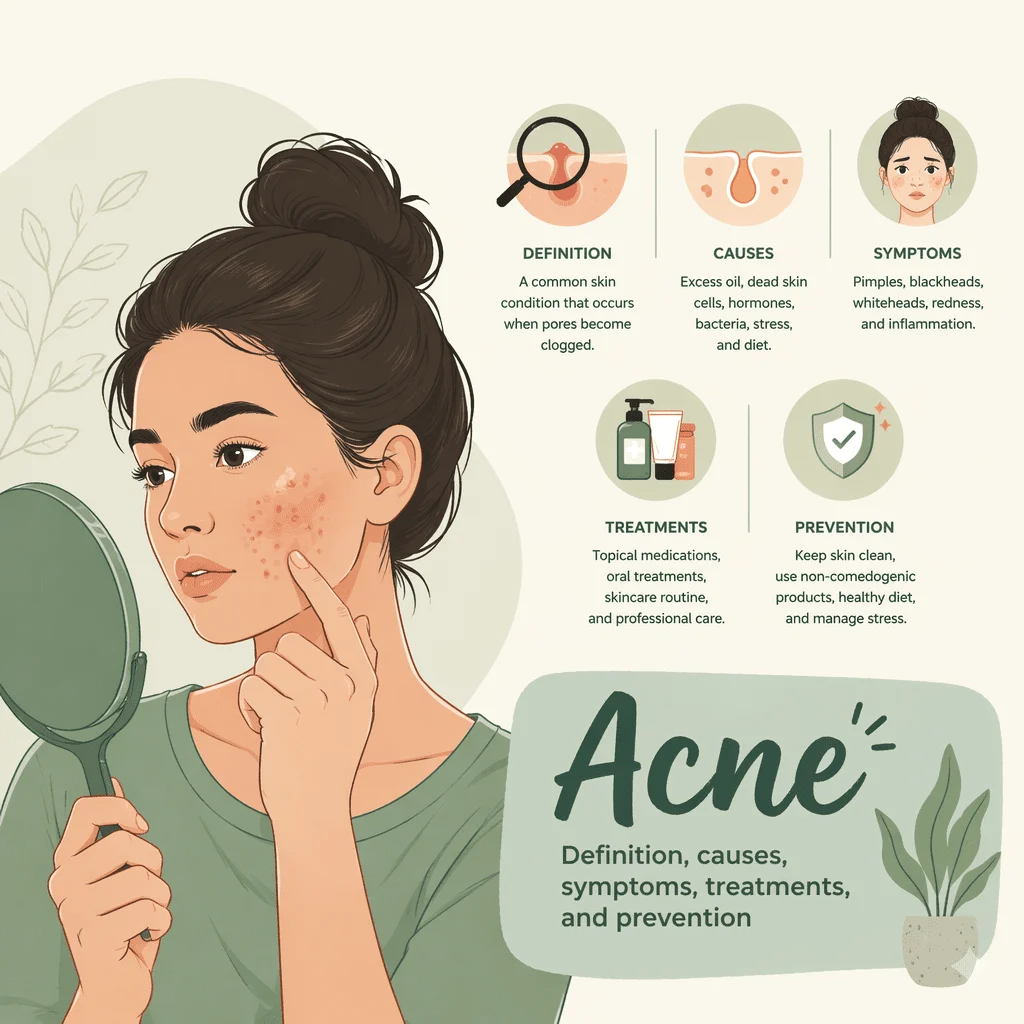
Acne is one of the most common skin conditions in the world, affecting most people at some point between the preteen years and adulthood. It develops when hair follicles, the tiny pores that anchor each hair, become blocked with oil and dead skin cells, producing blackheads, whiteheads, spots, and sometimes deeper, painful lumps. Acne is rarely dangerous, but it can affect confidence and, in more severe cases, leave lasting marks.
This guide explains what acne is, what causes it, the main types and grades, how it is diagnosed, and the treatments that actually work. It also answers a question many adults ask: when do hormonal blood tests help, and how do they fit alongside skin-focused care? In this article you will learn how to recognise your type of acne, what to try first, and what to discuss with a clinician.
What is acne?
Acne, known medically as acne vulgaris, is a long-lasting condition of the pilosebaceous unit, the combination of a hair follicle and its oil-producing (sebaceous) gland. When this unit works normally, sebum, the skin’s natural oil, travels up the follicle and spreads across the surface to keep skin supple. In acne, the follicle becomes blocked, sebum and dead cells build up, and lesions form.
Breakouts appear most often on the face, but they also affect the neck, chest, shoulders, and back, where oil glands are largest and most active. Acne is most common during puberty, when hormone levels rise, yet it is far from a teenage-only problem. Many adults, especially women, keep breaking out or develop acne for the first time in their twenties, thirties, or beyond.
What causes acne?
Dermatologists describe four factors that work together to produce a breakout: excess oil, blocked pores, bacteria, and inflammation. Most triggers make acne worse by feeding one or more of these steps.
Blocked pores and excess oil
Male-type hormones called androgens, which everyone produces, stimulate the sebaceous glands to make more sebum. When that extra oil mixes with dead skin cells, it can plug the follicle and form a comedone, the blocked pore that is the starting point of every breakout. A 2023 review of sebum biology concluded that androgen-driven oil production is essentially required for acne to develop, which helps explain why treatments that reduce oil often work best.
Bacteria and inflammation
A skin bacterium called Cutibacterium acnes (formerly Propionibacterium acnes) lives in the follicle. When oil builds up, it multiplies and activates the immune system, producing the redness, swelling, and tenderness of inflammatory pimples. Acne is therefore not caused by poor hygiene or dirt, and scrubbing hard usually irritates the skin and makes matters worse.
Hormones, genetics, and everyday triggers
Family history strongly shapes who develops acne and how severe it becomes. Hormonal shifts around periods, pregnancy, or polycystic ovary syndrome can also drive breakouts, especially along the lower face and jaw. Because acne can be fuelled by male-type hormones, a clinician may order a testosterone blood test. Ongoing stress raises cortisol, and some people choose to review a cortisol blood test. Diet can matter too: meals high in sugar and refined carbohydrates worsen breakouts for some people, and a routine lab report lists the blood glucose levels. Other everyday triggers include certain medications, pore-clogging cosmetics, and friction from equipment or face masks.
Types and grades of acne
Not all acne is the same. Recognising your type helps set realistic expectations and points towards the right treatment. Lesions fall into two broad families: non-inflammatory comedones and inflammatory lesions, which range from small red bumps to deep cysts.
| Type of acne | What it looks like | Typical first approach |
|---|---|---|
| Comedonal acne | Blackheads (open pores) and whiteheads (closed pores), with little or no redness | A topical retinoid plus gentle, non-comedogenic skin care |
| Inflammatory acne | Red, tender papules and pus-topped pustules | A topical retinoid with benzoyl peroxide, sometimes an antibiotic |
| Nodulocystic acne | Large, deep, painful nodules and cysts, with a high risk of scarring | Dermatologist-led care, often oral therapy such as isotretinoin |
Doctors also grade acne by severity. Mild acne is mostly comedones with a few inflamed spots; moderate acne shows more widespread papules and pustules; and severe acne includes numerous inflammatory lesions, nodules, or cysts, often with scarring. The grade guides how aggressively acne is treated and whether oral medicine is needed.
Symptoms and where acne appears
The visible signs of acne include blackheads, whiteheads, small red bumps (papules), pus-filled pimples (pustules), and, in severe cases, nodules and cysts. Lesions may be tender, and healing spots can leave temporary red or brown marks, or permanent scars if they were deep. Acne also carries an emotional weight, and feelings of self-consciousness, frustration, or low mood are common and valid reasons to seek care.
Because many bumps and rashes look alike, it is worth confirming that acne is truly the cause. Some people who assume they are breaking out actually have eczema, a dry and itchy inflammation of the skin. Persistent scaly, silvery patches may instead signal psoriasis. If spots are widespread, blistering, or paired with other symptoms, a clinician can assess any persistent skin rash.
Diagnosis and when hormonal blood tests help
Acne is diagnosed by examining the skin. There is no blood test that confirms ordinary acne, and most people never need laboratory tests. A clinician examines the type and spread of lesions, asks about your history and skin care, and rules out conditions that look similar.
Blood tests become useful when the pattern points to a hormonal cause. Warning signs include acne that starts or persists in adulthood, breakouts concentrated on the lower face and jaw, sudden severe acne, or acne alongside irregular periods, thinning scalp hair, or excess body hair (hirsutism). Acne is one of the signs clinicians look for when they investigate high testosterone in women. The adrenal glands also produce androgens, so a workup may check DHEA levels.
When cycles are irregular or weight changes appear, testing may reveal polycystic ovary syndrome, a common hormonal and metabolic condition. Rather than testing one hormone in isolation, a doctor may request a female hormone panel that reads several results together. Once results arrive, a companion guide can help you interpret your blood test results, because a single value outside the range rarely tells the whole story.
| Blood test | What it evaluates | When it may help |
|---|---|---|
| Total and free testosterone | Overall and biologically active male-type hormone levels | Persistent adult acne with irregular periods or excess hair growth |
| DHEA-S | An androgen produced by the adrenal glands | To check whether the adrenal glands are a source of excess hormones |
| PCOS-related panel (testosterone, LH, FSH, glucose) | Ovarian and metabolic contributors to acne | Acne with irregular cycles, weight changes, or fertility concerns |
When to see a dermatologist
Over-the-counter care helps many people, but some situations call for professional treatment. Consider seeing a dermatologist if:
- Your acne has not improved after about 8 to 12 weeks of consistent over-the-counter care.
- You have deep, painful cysts or nodules.
- You are developing scars or dark marks.
- Acne appears with irregular periods, excess hair growth, or other hormonal signs.
- Breakouts are affecting your confidence, mood, or daily life.
How acne is treated
Treatment is matched to severity, and almost every option needs time. Most therapies take 6 to 12 weeks to show their full effect, and stopping too early is a common reason care seems to fail. The 2024 acne guidelines from the American Academy of Dermatology set out an evidence-based menu, and combining treatments that work in different ways usually beats any single product.
Topical treatments
Applied to the skin, these are the foundation of acne care. Benzoyl peroxide reduces bacteria and helps prevent antibiotic resistance; topical retinoids such as adapalene, tretinoin, and the newer trifarotene unblock pores and calm inflammation; and azelaic acid or salicylic acid can help milder cases. Topical clascoterone is a newer cream that blocks hormonal effects directly in the skin. Trifarotene stands out because studies show it also improves acne on the chest and back, not just the face.
Oral treatments
For moderate to severe acne, a short course of an oral antibiotic such as doxycycline may be added, always paired with benzoyl peroxide or a retinoid and used for as short a time as possible to limit resistance. Combined oral contraceptive pills can help some women whose acne flares with their cycle.
Hormonal treatment for adults
Hormone-directed therapy is especially useful for adult women with jaw-line or premenstrual breakouts. A 2025 review reaffirmed spironolactone, a pill that blocks male-type hormone effects, as a first-line option for many women, and confirmed topical clascoterone as a safe choice for all genders. Reassuringly, routine potassium blood monitoring during spironolactone is often unnecessary unless you have specific risk factors.
Isotretinoin for severe acne
Isotretinoin, a powerful oral retinoid, is the standard treatment for severe, scarring, or treatment-resistant acne, and it can clear skin over the long term. It requires careful use, including strict pregnancy prevention because it causes serious birth defects. A 2025 practice update found that for most healthy patients, frequent blood-test monitoring is unnecessary, and that isotretinoin is unlikely to cause depression or inflammatory bowel disease.
In-clinic procedures
Dermatologists may add treatments such as comedo extraction, chemical peels, and laser or light therapy, whilst a cortisone injection can quickly calm a large cyst. For scar-prone acne, one 2024 analysis found that adding laser or light therapy to isotretinoin improved both active acne and scars without extra side effects, although the studies were small.
Preventing acne and caring for scars
Everyday prevention
Simple habits reduce breakouts and protect the skin barrier. Wash the face twice daily, and after sweating, with a gentle, non-foaming cleanser; choose products labelled non-comedogenic or oil-free; and resist the urge to pick or squeeze, which pushes inflammation deeper and raises the scar risk. Wash pillowcases and towels regularly, keep hair products off the face, and manage stress where you can.
Treating and preventing scars
The best way to avoid scars is to treat active acne early and never squeeze deep lesions. Once acne settles, flat dark marks (post-inflammatory hyperpigmentation) usually fade over months, helped by daily sun protection. True scars, which change the skin’s texture, can be improved with dermatological options such as chemical peels, microneedling, laser resurfacing, or injectable fillers, chosen according to the scar type.
Latest scientific advances
Acne research between 2023 and 2026 has focused on safer, more targeted, and more hormone-aware care. Here is what recent work means for everyday treatment, in plain terms.
National guidelines were refreshed
What was found: the American Academy of Dermatology updated its acne guidelines in 2024, reconfirming benzoyl peroxide, topical retinoids, and, for severe cases, isotretinoin as mainstays, whilst advising against using antibiotics on their own. What this means for you: there is a clear, evidence-based order to treatment, and pairing medicines beats single antibiotics, which also helps slow resistance.
Stronger options for adult hormonal acne
What was found: a 2025 review of hormone-based treatments reaffirmed spironolactone as a first-line choice for many adult women and highlighted clascoterone, a hormone-blocking cream, for all genders; it also noted that frequent potassium blood tests are usually unnecessary. What this means for you: adult, jaw-line acne now has genuine hormone-targeted options, often with fewer routine blood draws.
Rethinking isotretinoin monitoring
What was found: a 2025 practice update concluded that most healthy patients taking isotretinoin do not need frequent laboratory monitoring, and that the drug is unlikely to trigger depression or inflammatory bowel disease. What this means for you: fewer lab visits for many people and reassurance about long-debated risks, though pregnancy prevention remains essential.
A retinoid for body acne, and new tools
What was found: trifarotene, a newer prescription retinoid, was shown to improve acne on the chest and back, areas that are often harder to treat, and a 2024 overview highlighted emerging tools such as a 1726-nanometre laser that targets oil glands and antibiotic foams designed to limit resistance. What this means for you: more choices for stubborn or body acne, some of them avoiding long antibiotic courses.
Combining treatments for scars
What was found: a 2024 pooled analysis, a study that combines results from several trials, reported that adding laser or light therapy to isotretinoin improved both active acne and scarring without more side effects, though the individual studies were small and preliminary. What this means for you: if you are prone to scarring, combined care may help, but the timing should be planned with a specialist.
Glossary
| Term | Definition |
|---|---|
| Acne vulgaris | The medical name for common acne. |
| Comedone | A blocked pore; open comedones are blackheads and closed ones are whiteheads. |
| Sebum | The natural oil produced by the skin’s sebaceous glands. |
| Sebaceous gland | The oil-producing gland attached to each hair follicle. |
| Androgens | Male-type hormones, such as testosterone, present in all genders, that stimulate oil glands. |
| Cutibacterium acnes | A skin bacterium, formerly called Propionibacterium acnes, involved in acne inflammation. |
| Retinoid | A vitamin A-derived medicine that unblocks pores and speeds skin-cell turnover. |
| Isotretinoin | A strong oral retinoid used for severe or scarring acne. |
| Nodulocystic acne | Severe acne featuring deep, painful nodules and cysts. |
| DHEA-S | Dehydroepiandrosterone sulphate, an androgen produced by the adrenal glands. |
Frequently asked questions
Does diet affect acne?
For some people, yes. Research links high-sugar, high-glycaemic foods, and possibly skimmed milk, to more breakouts, though the effect varies from person to person and no single food causes acne. A balanced diet will not clear acne on its own, but cutting back on sugary, highly processed foods may help alongside proper skin care. If breakouts come with weight changes or irregular periods, blood sugar and hormones are worth checking with a clinician.
How can I get rid of acne scars?
True scars change the skin’s texture and do not fully disappear on their own, but several treatments improve them. Options include chemical peels, microneedling, laser resurfacing, and injectable fillers, matched to whether scars are pitted or raised. Flat brown or red marks left after a spot are not scars; they usually fade over weeks to months, and daily sunscreen speeds the process. Treating active acne early is the single best way to prevent scarring in the first place.
Does benzoyl peroxide really work for acne?
Yes. Benzoyl peroxide is one of the most studied acne treatments and a first-line option in dermatology guidelines. It reduces acne bacteria and helps clear blocked pores, and it lowers the risk of antibiotic resistance when combined with a topical or oral antibiotic. Start with a lower strength to limit dryness, apply it consistently, and expect several weeks before you see the full benefit. It can bleach fabric, so let it dry before getting dressed.
What is hormonal acne, and when is hormonal treatment used?
Hormonal acne describes breakouts driven by androgen activity, often appearing on the lower face and jaw and flaring with the menstrual cycle. It is common in adult women. When topical care is not enough, doctors may use hormone-directed treatment such as spironolactone or combined oral contraceptive pills, or a topical hormone-blocker like clascoterone. If tests suggest an underlying cause, treating that condition can improve the skin as well.
Is acne contagious?
No. Acne cannot be caught from or passed to another person. It develops from your own oil glands, pores, hormones, and skin bacteria, not from an infection that spreads by contact. Sharing this simple fact can help ease some of the stigma that still surrounds breakouts.
Can adults get acne?
Absolutely. Acne is increasingly common in adulthood, especially among women in their twenties, thirties, and forties. Adult acne often looks different from teenage acne, with deeper, tender spots along the jaw and chin, and it frequently has a hormonal component. Effective treatments exist, so persistent adult breakouts are worth discussing with a clinician rather than waiting them out.
Sources
- American Academy of Dermatology — Acne: overview — aad.org
- MedlinePlus, National Institutes of Health — Acne — medlineplus.gov
- Mayo Clinic — Acne: symptoms and causes — mayoclinic.org
- Reynolds RV, et al. — Guidelines of care for the management of acne vulgaris — Journal of the American Academy of Dermatology, 2024 — doi.org/10.1016/j.jaad.2023.12.017
- Smith CA, et al. — Hormonal therapies for acne: a comprehensive update for dermatologists — Dermatology and Therapy, 2025 — doi.org/10.1007/s13555-024-01324-8
- Keow S, et al. — Update to acne vulgaris treatment for Canadian practice — Canadian Family Physician, 2025 — doi.org/10.46747/cfp.710708455
- Wafae BGO, Barbieri JS — Innovations in acne — Dermatologic Clinics, 2024 — doi.org/10.1016/j.det.2024.08.002
- Del Rosso JQ, Kircik L — The primary role of sebum in the pathophysiology of acne vulgaris — Journal of Dermatological Treatment, 2023 — doi.org/10.1080/09546634.2023.2296855
- Tan J, et al. — Management of acne vulgaris with trifarotene — Journal of Cutaneous Medicine and Surgery, 2023 — doi.org/10.1177/12034754231163542
- He SX, et al. — Isotretinoin combined laser/light-based treatments versus isotretinoin alone: a meta-analysis — Journal of Cosmetic Dermatology, 2024 — doi.org/10.1111/jocd.16639
Further reading
- High testosterone in men: symptoms and causes
- CRP (C-reactive protein): understanding this inflammation marker
- Understanding sex hormone-binding globulin (SHBG) levels
- Estradiol: decoding this hormonal marker
- A1C conversion chart: turn your A1C into average glucose
Understand your lab results with AI DiagMe
Most acne is managed with skin care and time, but when breakouts are persistent, adult-onset, or clearly hormonal, blood tests such as testosterone or DHEA-S can help you and your doctor explore a possible cause. AI DiagMe turns those results into clear, plain-language explanations, so you understand what each value means before your appointment. It helps you understand your results; it does not diagnose acne or replace your doctor.
Get your results interpreted in minutes