










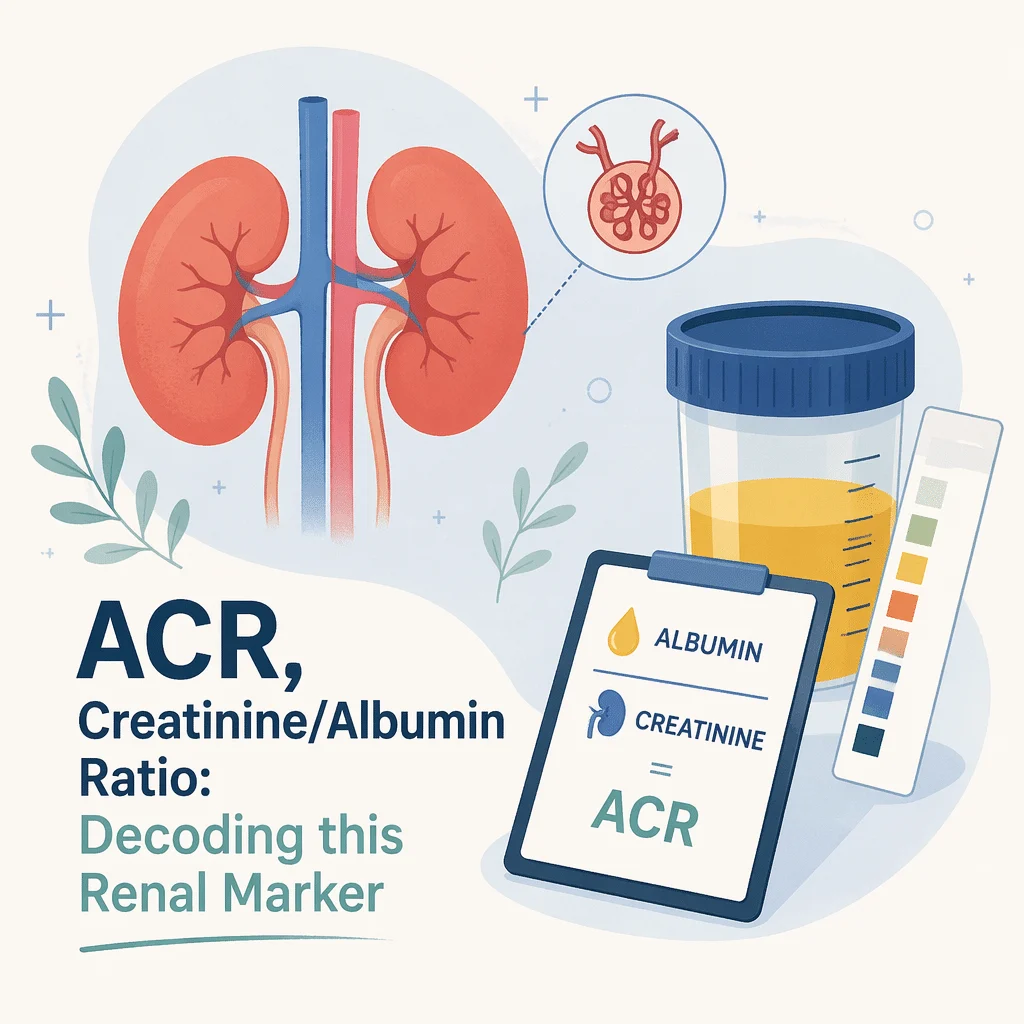
An ACR test measures the amount of albumin, a small protein, that leaks into your urine compared with creatinine, a waste product your kidneys normally filter out. It is one of the simplest ways to catch kidney damage before it causes any symptoms, and it is especially important if you live with diabetes or high blood pressure. In this article, you’ll learn how the urine albumin-to-creatinine ratio (UACR) is measured, what the KDIGO albuminuria categories (A1, A2, A3) mean, how this result relates to your eGFR for full kidney staging, and when it’s worth discussing your numbers with a doctor.
What an ACR test actually measures
Healthy kidneys filter waste from your blood whilst holding onto useful proteins like albumin. When the tiny filtering units inside the kidneys, called glomeruli, become damaged, they start letting small amounts of albumin slip into the urine. An ACR test compares the albumin concentration in a urine sample to the creatinine concentration in that same sample, which corrects for how diluted or concentrated your urine happens to be at that moment.
Because the ratio adjusts for hydration, a single spot urine sample, meaning one sample collected at any point in the day, gives a reasonably reliable estimate without needing a full 24-hour urine collection. This is what makes the test so practical for everyday screening in a doctor’s surgery or laboratory.
Before this ratio-based approach became standard, doctors relied on older dipstick urinalysis strips or cumbersome 24-hour urine collections to check for protein leakage. Dipstick tests are useful for catching larger amounts of protein but tend to miss the smaller, earlier increases in albumin that this measurement is specifically designed to detect. A 24-hour collection can be more precise for certain situations, but asking a patient to collect every drop of urine for a full day is impractical for routine screening. The spot-sample approach strikes a practical balance: it is sensitive enough to flag early kidney changes while remaining simple enough to repeat every year without disrupting daily life.
Why doctors order the urine albumin-to-creatinine ratio
Clinicians request this test primarily to look for early, silent kidney damage in people who have no symptoms at all. The kidneys have significant reserve capacity, so noticeable symptoms such as swelling or fatigue often appear only after substantial function has already been lost. Detecting albumin in the urine early opens the door to treatments that can slow or even stop further damage.
- Type 1 or type 2 diabetes, where annual screening is standard practice
- High blood pressure, which can gradually injure the small blood vessels in the kidneys
- A family history of kidney disease
- Cardiovascular disease, since albuminuria and heart risk are closely linked
- Monitoring known kidney disease or tracking how well a treatment is working
People managing diabetes or hypertension often review this result alongside a broader kidney function panel that includes several related blood and urine measurements.
The rationale behind screening at-risk groups rather than the general population comes down to where kidney damage is most likely to develop first. In diabetes, persistently high blood sugar can injure the small blood vessels inside the glomeruli over time, a process that often starts silently years before any change in how someone feels. In hypertension, sustained high pressure inside the delicate renal blood vessels produces a similar pattern of gradual injury. Because both conditions are common and both can quietly damage kidney tissue, professional guidelines consistently recommend that adults with either diagnosis have their albumin-to-creatinine ratio checked at least once a year, alongside a periodic eGFR check, so that any change can be caught whilst it is still manageable.
How the test is done and how to prepare
The process itself is quick and non-invasive. You provide a urine sample, typically a first-morning sample when possible, since it tends to be more concentrated and consistent than samples collected later in the day. There is no need to fast, and no needle is involved.
Tips for an accurate result
- Avoid intense exercise in the 24 hours before the test, as vigorous activity can temporarily raise albumin levels
- Mention any fever or urinary tract infection to your provider, as both can cause a temporarily elevated reading
- Try to avoid the test during a menstrual period if possible, since blood in the urine can skew results
- Stay reasonably hydrated but avoid drinking unusually large amounts of fluid right before the sample
Because several everyday factors can cause a temporary rise, a single elevated result is usually confirmed with a repeat test over the following weeks before any diagnosis is made. Most laboratories in the United Kingdom use an automated immunoassay method to measure albumin, which is sensitive enough to detect the small quantities relevant to early kidney changes. Results are typically available within a day or two, and many people receive them through an online patient portal well before their next appointment. If you’re also having blood taken on the same day, our guide on what to expect during a blood test covers what that part of the visit typically involves.
Understanding your ACR test results and KDIGO categories
Results are reported in milligrams of albumin per gram of creatinine (mg/g) in the United States, though other countries commonly use mg/mmol. The Kidney Disease: Improving Global Outcomes organisation (KDIGO), an international group that publishes widely used kidney disease guidelines, classifies results into three albuminuria categories known as A1, A2, and A3.
| KDIGO category | ACR range (mg/g) | Description | What it generally means |
|---|---|---|---|
| A1 | Below 30 | Normal to mildly increased | Typically considered a normal result, with lower numbers reflecting lower risk |
| A2 | 30 to 300 | Moderately increased | Often called microalbuminuria; an early signal that warrants follow-up and risk-factor management |
| A3 | Above 300 | Severely increased | Sometimes called macroalbuminuria; generally prompts closer monitoring and treatment discussion with a doctor |
Results in the A2 or A3 range don’t automatically mean you have significant kidney disease. Many things can temporarily raise albumin, which is why doctors usually look for a pattern across two or three tests rather than reacting to one number alone. For more detail on interpreting the moderately increased range specifically, our dedicated guide on microalbuminuria as a kidney marker covers that category in depth, and it’s a closely related read worth bookmarking alongside this one.
It’s worth noting that the exact numeric cutoffs above apply to the standard American reporting unit of milligrams per gram. If your lab report shows a result in milligrams per millimole instead, the same three categories still apply, but the cutoff numbers themselves will look different, so it helps to check which unit your lab used before comparing your result to a chart you find online. When in doubt, the category label itself, A1, A2, or A3, is usually printed directly on the report and is the most reliable reference point.
How ACR relates to eGFR for full kidney staging
The urine albumin-to-creatinine ratio tells only part of the kidney health story. The other essential piece is the estimated glomerular filtration rate, or eGFR, which is calculated from a blood creatinine measurement and estimates how efficiently your kidneys filter blood overall. KDIGO combines both values into a grid that assigns a G stage, based on eGFR, and an A category, based on albuminuria, to describe overall chronic kidney disease risk.
This paired approach matters because eGFR and this ratio can move independently of each other. Someone can have a normal eGFR but elevated albuminuria, or reduced eGFR with normal albumin levels, and each combination carries a different risk profile. Reviewing your eGFR test result alongside your ACR test gives a much fuller picture than either number alone, which is why both are usually ordered together for anyone with diabetes, hypertension, or other kidney risk factors.
Two additional markers often appear on the same lab panel and are worth understanding in context. Your blood creatinine level is the raw measurement used to calculate eGFR, whilst blood urea nitrogen (BUN) offers another window into how well waste products are being cleared. None of these tests replaces the others; together, they build a more complete assessment of kidney function.
Doctors sometimes describe this combined eGFR-and-albuminuria framework using a simple grid analogy: eGFR sits along one axis, moving from normal function down through progressively lower stages, whilst the A category sits along the other, moving from A1 through A3. A person’s overall position on this grid, rather than either single number, is what determines the recommended monitoring frequency and whether specific protective medications might be considered. This is also why a single urine result in isolation, without any eGFR context, generally can’t tell the full story on its own, and why both are typically requested together during a kidney health check.
What can cause a high or abnormal ACR test result
Several conditions and situations can raise albumin in the urine, ranging from harmless and temporary to more significant and persistent.
Temporary or benign causes
- Recent vigorous exercise
- Fever or acute illness
- Urinary tract infection
- Dehydration or, less commonly, very high fluid intake
- Pregnancy, where mild changes are common and monitored separately
Causes that may need medical follow-up
- Diabetes-related kidney changes, often called diabetic nephropathy
- Poorly controlled high blood pressure affecting the kidney’s small vessels
- Chronic kidney disease from other causes
- Certain autoimmune or glomerular diseases
- Cardiovascular disease, since albuminuria and heart and blood vessel risk are closely connected
If your result comes back elevated, your provider will typically consider your overall health picture, including your diabetes status or blood pressure control, before deciding on next steps. They may also review your recent medication list, since a small number of drugs can influence urine albumin readings, and ask about recent illness, hydration, and activity levels to help sort out a genuine change from a temporary blip.
When to see a doctor
An isolated, mildly elevated result is common and often resolves on repeat testing, so it rarely requires urgent action on its own. However, it’s worth reaching out to your healthcare provider in these situations:
- Your result falls in the A2 or A3 range on more than one occasion
- You have diabetes or high blood pressure and haven’t been screened for albuminuria in the past year
- You notice foamy or bubbly urine, unexplained swelling in your legs or around your eyes, or a significant unexplained change in how often you urinate
- You have a family history of kidney disease and have never had a baseline screening
- A previous normal result has become abnormal, suggesting a change worth investigating
None of these signs mean something is seriously wrong, but they are reasonable prompts to have a conversation with your doctor, who can interpret this ratio alongside your eGFR, blood pressure, and overall medical history. Bringing a written record of your recent results, or reviewing your lab portal together during the visit, can make that conversation more productive, especially if you’ve had the test done at more than one location over the years.
Recent scientific advances
According to PubMed and Consensus, several notable studies published in the last few years have refined how doctors think about the urine albumin-to-creatinine ratio, particularly around screening strategy and its role as a broader health signal, not just a kidney-specific one.
The KDIGO organisation released an updated clinical practice guideline in 2024 that reaffirmed and refined how eGFR and albuminuria results should be combined to classify chronic kidney disease risk (Stevens et al., 2024). What this means for you: the current staging grid used by your doctor reflects the latest expert consensus, so a category assigned today follows a globally recognised, regularly updated standard rather than an outdated one.
A large individual-participant meta-analysis, meaning a pooled re-analysis of raw data from many separate study populations rather than just their summary results, combined information from well over 100 research cohorts and confirmed that both lower eGFR and higher urine albumin values independently predicted a range of health outcomes, including cardiovascular events and hospitalisations, even at relatively mild levels of change (Grams et al., 2023). What this means for you: even a result that is only mildly above the normal range is a meaningful data point for your overall health, not just something to dismiss as a rounding error.
Separately, a large meta-analysis comparing the albumin-based ratio to an alternative urine protein measurement found that the albumin-to-creatinine ratio was more consistently associated with future kidney and cardiovascular outcomes across a wide range of patient groups (Heerspink et al., 2025). What this means for you: if your lab offers a choice of urine protein tests, the albumin-based version generally gives your doctor a clearer signal.
A real-world screening study called SALINE tested a home-based urine collection kit posted to patients with diabetes, hypertension, or cardiovascular disease, followed by laboratory measurement of the ratio (van Mil et al., 2025). Roughly 4 in 10 invited patients completed the home test, and among those with a confirmed elevated result, the large majority were found to have a newly identified or poorly controlled risk factor worth addressing. What this means for you: convenient, at-home collection methods are increasingly validated and may make it easier to stay current with recommended screening, especially if visiting a lab in person is inconvenient.
Finally, a 2026 review examined albuminuria in the context of heart failure specifically, noting that elevated urine albumin values are common in this condition and independently linked to worse outcomes, even though routine screening for it is not yet as standardised in heart failure care as it is in diabetes and kidney disease guidelines (Butler et al., 2026). What this means for you: your result may carry relevance for heart health as well as kidney health, which is one more reason not to overlook a persistently abnormal number.
Glossary
| Term | Definition |
|---|---|
| Albumin | A small protein normally kept in the blood by healthy kidneys. Its presence in urine can signal early kidney damage. |
| Creatinine | A waste product from normal muscle activity that healthy kidneys filter out at a fairly steady rate, making it useful for comparison in ratio-based tests. |
| Urine albumin-to-creatinine ratio (UACR) | The formal name for the ACR test; the ratio of albumin to creatinine measured in a urine sample, usually reported in milligrams per gram. |
| Albuminuria | The general term for having albumin present in the urine above expected levels, regardless of the exact cause. |
| Microalbuminuria | An older but still common term for the moderately increased KDIGO A2 category, generally 30 to 300 mg/g. |
| Estimated glomerular filtration rate (eGFR) | A calculated estimate of how well the kidneys filter blood, derived from a blood creatinine test along with age and sex. |
| Glomeruli | The tiny filtering units inside each kidney where blood is cleaned; damage here is often what allows albumin to leak into urine. |
| Chronic kidney disease (CKD) | A long-term reduction in kidney function or structure, staged using a combination of eGFR and albuminuria category. |
| KDIGO | Kidney Disease: Improving Global Outcomes, an international organisation that publishes widely followed clinical guidelines for kidney disease care. |
Frequently asked questions
Do I need to fast before an ACR test?
No fasting is required for a urine albumin-to-creatinine ratio test. You can eat and drink normally beforehand. If your doctor has also ordered blood tests on the same visit, such as a fasting glucose or lipid panel, follow whatever fasting instructions apply to those specific tests instead.
How do you calculate the albumin-to-creatinine ratio?
The laboratory divides the measured albumin concentration in your urine sample by the measured creatinine concentration in that same sample, then reports the result as milligrams of albumin per gram of creatinine. You don’t need to calculate anything yourself; the lab performs this automatically and your result appears as a single ratio value on your report.
Can I lower a high albumin-to-creatinine ratio?
In many cases, yes, particularly when the underlying cause is manageable. Better blood pressure control, improved blood sugar management in diabetes, reducing excess body weight, and certain medications commonly used for kidney and heart protection can all help reduce albumin in the urine over time. Your doctor is best placed to recommend an approach based on your specific result and health history.
Is a slightly high ACR test result always a sign of kidney disease?
Not necessarily. Many temporary factors, including recent exercise, a urinary tract infection, fever, or dehydration, can cause a one-time elevated reading without any underlying kidney disease. This is why doctors typically repeat the test before drawing firm conclusions, especially when the result is only mildly elevated.
How often should people with diabetes or high blood pressure get this test?
Annual screening is a common recommendation for adults with diabetes or hypertension, though your doctor may suggest a different frequency based on your individual risk factors, prior results, and whether you already have a diagnosed kidney condition. If you're unsure when you were last screened, it's a reasonable question to bring up at your next visit.
What's the difference between ACR and a standard urinalysis?
A standard urinalysis is a broader screening test that checks for many substances at once, including blood, glucose, and general protein, often using a dipstick method that isn't sensitive enough to catch small amounts of albumin. An ACR test is a more precise, targeted measurement specifically designed to detect even modest increases in albumin, which makes it the preferred tool for early kidney disease screening in at-risk patients. For more on interpreting a broader urine panel, see our urinalysis results interpretation guide.
Further reading
- Protein in urine: causes, symptoms, and risks
- Comprehensive metabolic panel: how to read your results
- Normal blood test ranges: a reference chart explained
- How to read your blood test results: a complete guide
- Abnormal blood test results: what they mean and what to do
Sources
- CDC — Testing for Chronic Kidney Disease — Chronic Kidney Disease, CDC — https://www.cdc.gov/kidney-disease/testing/index.html
- National Library of Medicine (NIH) — Microalbumin Creatinine Ratio — MedlinePlus Medical Test — https://medlineplus.gov/lab-tests/microalbumin-creatinine-ratio/
- Cleveland Clinic — What Is Urine Albumin-Creatinine Ratio? — Cleveland Clinic Health Library — https://my.clevelandclinic.org/health/diagnostics/urine-albumin-creatinine-ratio
- Stevens PE, Levin A, et al. — KDIGO 2024 Clinical Practice Guideline for the Evaluation and Management of Chronic Kidney Disease — Kidney International, 2024 — https://www.kidney-international.org/article/S0085-2538(23)00766-4/fulltext
- Grams ME, Coresh J, Matsushita K, et al. — Estimated Glomerular Filtration Rate, Albuminuria, and Adverse Outcomes: An Individual-Participant Data Meta-Analysis — JAMA, 2023 — https://pubmed.ncbi.nlm.nih.gov/37787795/
- Heerspink HJL, et al. — Proteinuria or Albuminuria as Markers of Kidney and Cardiovascular Disease Risk — Annals of Internal Medicine, 2025 — https://consensus.app/papers/details/a016f0e854eb53529c0f63ec60696319/
- van Mil D, et al. — Effectiveness of a systematic home-based albuminuria screening programme (SALINE) — eClinicalMedicine, 2025 — https://www.ncbi.nlm.nih.gov/pmc/articles/PMC12005226/
- Butler J, Jamil A, Cherney DZI, et al. — Albuminuria and heart failure — European Heart Journal, 2026 — https://pubmed.ncbi.nlm.nih.gov/42284132/
Understand your lab results with AI DiagMe
Making sense of an ACR test alongside eGFR, creatinine, and BUN can feel overwhelming when the numbers arrive without much context. Understanding how these kidney markers fit together helps you have a more informed conversation with your doctor about your results and what they might mean for your health. This kind of interpretation is meant to support your understanding, not to diagnose a condition or replace the advice of your healthcare provider.
Get your results interpreted in minutes