






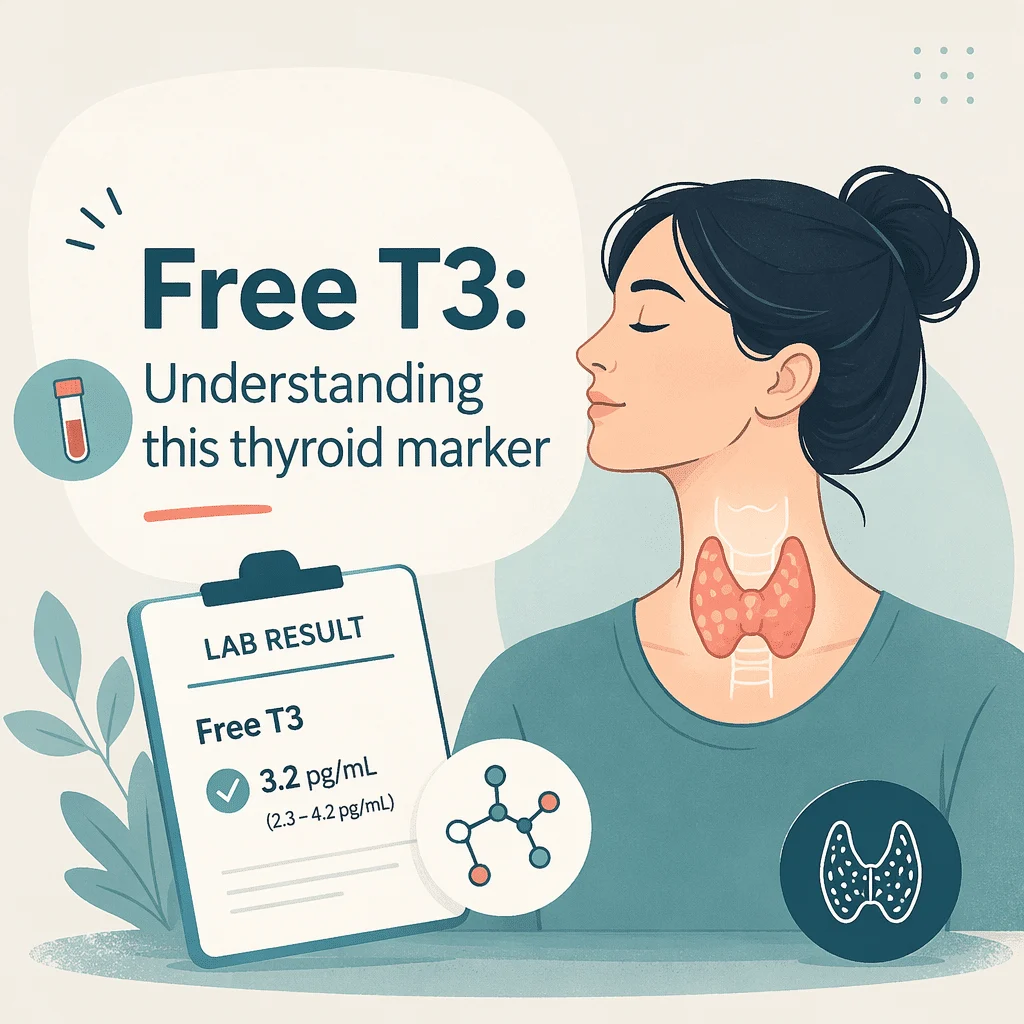
A T3 blood test measures triiodothyronine, the thyroid hormone that actually does the work inside your cells. If you have just found this line on your lab report, here is the short answer: T3 is rarely the first test a doctor looks at, and an unexpected value on its own rarely means your thyroid is failing. Doctors read it next to TSH and free T4, which carry most of the diagnostic weight. In this article you’ll learn what T3 is, how your body makes it from T4, how total and free T3 differ, what high and low results tend to mean, what can shift the number, and what current evidence says about reverse T3.
What T3 is and where it comes from
Your thyroid is a small butterfly-shaped gland at the base of your neck. It makes two hormones that regulate how fast your body burns energy: T4 (thyroxine) and T3 (triiodothyronine). The numbers are not a ranking — they count iodine atoms.
T3 is the active one. It enters your cells, binds to receptors and switches genes on or off, helping set your heart rate, body temperature, and how you handle fats and sugars. T4 is mostly a reserve: it circulates in far larger amounts but does little until converted.
Why most of your T3 is not made by your thyroid
Here is the part that explains almost everything else about this test. Your thyroid releases mainly T4 and only a little T3 directly. The bulk of the T3 in your blood — roughly four fifths — is produced elsewhere, when tissues such as the liver, kidneys and muscles strip one iodine atom off T4. That step is called deiodination.
This matters for two reasons. Your T3 level reflects your thyroid plus your body’s ability to convert. And your body can dial that conversion up or down on purpose: when you are ill, fasting or under heavy physical stress, tissues deliberately slow it to conserve energy. Your T3 falls, but your thyroid is working perfectly well. That single fact accounts for a large share of the confusing low T3 results people bring to their doctors.
Total T3 versus free T3: which one your lab measures
Once T3 is in your bloodstream, almost all of it hitches a ride on carrier proteins — mainly thyroxine-binding globulin, plus albumin and others. Bound hormone is parked and inactive. Only the tiny unbound fraction, well under one percent, can enter cells and act. That fraction is what “free T3” means.
- Total T3 measures everything in the sample: bound plus free. It moves whenever your carrier-protein levels move, even if your thyroid status has not changed.
- Free T3 estimates only the unbound, active portion, and is designed to be less sensitive to shifts in carrier proteins.
Pregnancy, oestrogen-containing medicines and some inherited variations raise carrier proteins, pushing total T3 up whilst the active fraction stays normal. Severe liver or kidney disease pushes carriers the other way. For the mechanics of that carrier system, you can also read our explainer on thyroxine-binding globulin.
UK laboratories report both. Free T3 is the more common request today because it resists carrier-protein effects, but total T3 has a long track record and is still preferred by some clinicians for confirming an overactive thyroid.
Why a T3 blood test is ordered, and why TSH and free T4 come first
Thyroid testing follows a deliberate order, and understanding it removes most of the anxiety around a stray T3 value.
TSH comes first. It is not a thyroid hormone — it is the signal your pituitary gland sends to tell the thyroid how hard to work. Because the pituitary reacts to very small changes, TSH shifts before T4 and T3 drift out of range. That sensitivity makes it the most informative first test, which is why nearly every thyroid work-up starts there. For the full picture, you can also read our guide to the TSH blood test.
Free T4 comes second. It shows how much raw material the thyroid is producing and separates a mild abnormality from a significant one. You can also read our article on the free T4 thyroid test.
T3 comes third, and only in specific situations — most often when TSH is clearly suppressed but free T4 comes back normal. That combination raises the question of whether T3 alone is elevated, and T3 is the only test that can answer it. Ordered routinely, it tends to produce results that are hard to act on.
How the three tests fit together
This grid shows the patterns doctors recognise. It is a map for reading your report, not a way to diagnose yourself: several patterns have more than one explanation, and only a doctor who knows your history can tell which applies to you.
| TSH | Free T4 | Free T3 | What doctors usually consider |
|---|---|---|---|
| Normal | Normal | Normal | Thyroid function is behaving normally; symptoms are usually explored elsewhere |
| Low | High | High | Overactive thyroid; the cause is then investigated |
| Very low | Normal | High | T3-toxicosis — the main situation where measuring T3 changes the answer |
| Low | Normal | Normal | Mild (subclinical) overactivity; often monitored rather than treated straight away |
| High | Low | Low or normal | Underactive thyroid; T3 adds little here and often stays normal |
| Normal or low | Normal or low | Low | Non-thyroidal illness during another medical problem; usually retested after recovery |
Notice the last two rows: T3 tends to be normal in a genuinely underactive thyroid and low when something outside the thyroid is going on — the opposite of what most people expect.
What a high T3 blood test result can mean
A raised T3 alongside a suppressed TSH points towards thyrotoxicosis: too much thyroid hormone reaching your tissues. Symptoms can include a racing or irregular heartbeat, weight loss despite a normal appetite, heat intolerance, tremor, anxiety and trouble sleeping. The common causes:
- Graves’ disease, an autoimmune condition in which antibodies push the thyroid to overproduce. It is the most frequent cause.
- A toxic nodule or toxic multinodular goitre, where part of the gland produces hormone on its own and ignores the TSH signal.
- The early phase of thyroiditis, when an inflamed gland leaks stored hormone. This phase is temporary and often settles by itself.
- Taking more thyroid hormone than your body needs, whether prescribed or from a supplement.
To sort between these, your doctor may add thyroid antibody tests, an ultrasound, or a scan showing how the gland takes up iodine. For the autoimmune side, you can also read our guide to anti-TPO thyroid antibodies, and if an ultrasound has been mentioned, our article on a heterogeneous thyroid gland.
T3-toxicosis: the reason this test exists
In a small number of people, the thyroid overproduces T3 whilst free T4 stays inside the reference range. TSH is deeply suppressed, free T4 looks reassuring, and only a T3 measurement reveals what is happening. This is T3-toxicosis, the situation where a T3 blood test genuinely changes management. It is uncommon — which explains why the test is valuable but not routine. Since a suppressed TSH is the trigger for looking further, you can also read our article on a low TSH level.
What a low T3 blood test result usually means
This is where most confusion arises, so let us state it plainly: a low T3 is usually not a thyroid problem.
In an underactive thyroid, T3 is often the last thing to fall: your body protects its active hormone, converting harder from a shrinking T4 supply. Someone can have clear hypothyroidism — high TSH, low free T4, real symptoms — whilst T3 sits comfortably in range. That is why T3 has limited value for diagnosing an underactive thyroid, and why guidelines do not recommend it for that purpose. You can also read our guide to hypothyroidism and our article on high TSH symptoms.
Non-thyroidal illness, also called low T3 syndrome
The most common reason for an isolated low T3 is that you are, or recently were, unwell with something else entirely: pneumonia, a heart attack, surgery, an inflammatory flare, kidney or liver disease, prolonged fasting, an eating disorder, or a stay in intensive care.
The mechanism is the one described earlier: your body slows T4-to-T3 conversion and diverts T4 towards reverse T3 instead. Clinicians call this non-thyroidal illness syndrome, or low T3 syndrome. Most researchers view it as an adaptation — the body throttling back its metabolic engine while it deals with a bigger problem — rather than thyroid disease.
Two consequences follow. Thyroid tests done during acute illness are hard to interpret and usually repeated after recovery. And treating the low T3 itself with thyroid hormone has not been shown to help people get better; the evidence points towards treating the underlying illness.
What else can change your T3 result
Before assuming a result reflects your thyroid, check the common explanations.
- Acute or chronic illness. The single biggest driver of a low T3, as described above.
- Pregnancy. Carrier proteins rise sharply, lifting total T3, so laboratories apply trimester-specific ranges. You can also read our guide to blood tests during pregnancy.
- Medicines. Amiodarone, high-dose corticosteroids, propranolol and some contrast agents reduce T4-to-T3 conversion. Oestrogen raises carrier proteins. Heparin can distort the measurement itself.
- Biotin. High-dose biotin supplements, common in hair, skin and nail products, interfere with the method used for many thyroid assays. They can make free T3 and free T4 look falsely high and TSH falsely low, mimicking an overactive thyroid in someone whose thyroid is fine. Most laboratories advise pausing biotin for a couple of days beforehand — tell whoever takes your blood if you are taking it.
- Fasting. Day-to-day variation in T3 is small, but a prolonged fast lowers it. You can also read our article on fasting before a blood test.
- Which laboratory ran it. Analysers use different methods and ranges, so a value from one lab is not interchangeable with another. For why those ranges differ, you can also read our overview of normal thyroid levels.
Reverse T3: what the evidence supports
Reverse T3 deserves a clear-eyed answer, because it is marketed heavily online.
The biology is real. When your body removes an iodine atom from T4, it can take it from either of two positions. One produces T3, the active hormone. The other produces reverse T3, a mirror-image molecule that does not activate thyroid receptors. During illness or fasting the balance tips towards reverse T3, so measuring it then only confirms what is already visible: your body has shifted into conservation mode.
The clinical claim is where the evidence stops. A widely promoted idea holds that a high reverse T3, or a particular free T3 to reverse T3 ratio, identifies a hidden thyroid problem in people whose TSH, free T4 and free T3 are all normal — and that T3-only therapy is the fix. Mainstream professional bodies, including the American Thyroid Association, do not recommend reverse T3 for routine clinical use: it rises in any significant illness, so it is not specific to a thyroid condition; assays are poorly standardised, so ratios are hard to compare; and no controlled trial has shown that treating people according to a reverse T3 result improves how they feel.
None of this means persistent symptoms are imagined — fatigue, weight change and brain fog are real and deserve a proper work-up. It is a reason to be cautious about paying out of pocket for a test the evidence does not support, and more cautious still about thyroid hormone prescribed on the strength of it, since too much carries genuine risks to heart rhythm and bone density. If you have been offered either, that is a conversation worth having with an endocrinologist.
When to see a doctor
A T3 result outside the reference range is a prompt to talk to your doctor, not an emergency in itself. Bring your full report — TSH and free T4 included, plus any previous results — since a single value in isolation is hard to interpret.
Seek advice promptly if a high T3 comes with a fast or irregular heartbeat, chest pain, breathlessness, or marked unintentional weight loss. A fever alongside severe agitation and confusion is rare but needs urgent care.
Book a routine appointment if your result is outside the range without those symptoms, if you feel persistently unwell despite normal thyroid tests, if you are pregnant or planning to be, if you take amiodarone or lithium, or if you take biotin that was not paused before your blood test.
Ask your doctor: do my TSH and free T4 support this T3 result? Was I unwell when the sample was taken? Should it simply be repeated? You can also read our guide to abnormal blood test results.
Latest scientific advances in T3 testing
Recent research has focused less on technology and more on a practical question: when does measuring T3 actually help? The direction of travel is towards using it selectively.
Free T3 is helpful in a limited number of cases
What was found: a US laboratory team reviewed several thousand paired thyroid results to see how often free T3 revealed something the other tests had missed. T3-toxicosis appeared in only a small minority, and virtually all newly diagnosed cases had a TSH that was profoundly suppressed rather than slightly low.
What this means for you: if your TSH is normal, or only mildly off, free T3 is unlikely to add much — which is why a normal-TSH panel without T3 is not incomplete.
Thyroid results are not interchangeable between laboratories
What was found: an expert panel commissioned by the American Thyroid Association reviewed thyroid testing worldwide. Despite fifty years of technical progress, routine assays for TSH, T4 and T3 still differ between manufacturers, remain vulnerable to interference producing misleading results, and are not standardised enough for values from different platforms to be treated as equivalent.
What this means for you: comparing your T3 against a range from another laboratory, or a figure found online, can mislead you. Use the range on your own report, and have repeat testing done by the same laboratory so that trends are meaningful.
Low T3 in serious illness signals severity, not thyroid disease
What was found: a study of nearly 1,800 intensive care patients examined whether low T3 independently predicts death. At first pass, patients with low T3 fared worse. Once researchers accounted for how ill people already were — ventilation, sepsis, kidney and liver failure — low T3 was no longer an independent predictor: it indicated severity rather than causing it. Other recent cohorts report a similar picture, though a few still find a residual association, so the field is not unanimous.
What this means for you: if your T3 dropped during a hospital admission or serious infection, it most likely reflected how unwell you were at the time, and retesting after recovery usually shows it returning to normal.
Reverse T3 moves with treatment, not with hidden disease
What was found: a 2025 study measured reverse T3 in nearly a thousand people treated for hypothyroidism who reported ongoing fatigue. It varied mainly with which medication they took — highest on T4 alone, lower on preparations containing T3. The authors noted that reverse T3 still guides treatment despite a thin peer-reviewed base, and their findings show the number largely reflects the T4 available for conversion.
What this means for you: a raised reverse T3 on T4 therapy is an expected consequence of the treatment, not evidence of a hidden problem, and does not by itself establish that you need a different prescription.
Glossary
| Term | Definition |
|---|---|
| Triiodothyronine (T3) | The active thyroid hormone, carrying three iodine atoms. It enters cells and regulates how fast the body uses energy. |
| Thyroxine (T4) | The main hormone the thyroid releases, carrying four iodine atoms. It acts largely as a reserve that the body converts into T3. |
| Deiodination | The removal of one iodine atom from T4 by enzymes in tissues such as the liver and kidneys, producing either T3 or reverse T3. |
| Free hormone | The small unbound fraction circulating in blood that can enter cells and act. Free T3 measures this portion. |
| Total hormone | Bound plus free hormone together. Total T3 shifts when carrier-protein levels shift. |
| Thyroxine-binding globulin | The main carrier protein that transports thyroid hormones in blood, keeping them inactive until released. |
| TSH | Thyroid-stimulating hormone, sent by the pituitary gland to tell the thyroid how much hormone to make. Usually the first thyroid test ordered. |
| T3-toxicosis | An uncommon form of overactive thyroid in which T3 is raised whilst free T4 stays within range and TSH is suppressed. |
| Non-thyroidal illness syndrome | Also called low T3 syndrome. A fall in T3 during illness, surgery or fasting, caused by reduced conversion rather than thyroid disease. |
| Reverse T3 (rT3) | An inactive mirror-image molecule made from T4. It rises during illness and fasting and is not recommended for routine testing. |
Frequently asked questions
What is a T3 blood test, in simple terms?
It is a blood test that measures triiodothyronine, the thyroid hormone that acts directly on your cells to set your metabolic pace. A small sample is taken from a vein in your arm, usually at the same time as TSH and free T4. Your laboratory may report it as total T3, free T3, or both. The test is mainly used to confirm and characterise an overactive thyroid, and it is ordered selectively rather than as part of every routine panel — most thyroid questions are answered by TSH and free T4 alone.
What does free T3 mean on a blood test?
Free T3 is the fraction of your T3 that is not attached to a carrier protein. Almost all thyroid hormone in your blood travels bound to proteins and is inactive whilst it is bound. Only the free portion — well under one per cent of the total — can enter cells and do anything. Measuring the free fraction gives a picture that is less distorted by changes in carrier proteins, which is why free T3 is requested more often than total T3 in the United Kingdom today. Both measure the same hormone; they simply frame it differently.
Do I need to fast before a T3 blood test?
Usually not. T3 varies only slightly through the day and fasting is not routinely required. Two caveats are worth knowing. A prolonged fast, well beyond an overnight one, does lower T3 through the same conversion-slowing mechanism that illness triggers. And your T3 may be taken alongside tests such as glucose or a lipid panel that do have fasting rules, so follow whatever instructions your laboratory gives for the panel as a whole.
What does a high free T3 result mean if my TSH is normal?
A truly high free T3 with a genuinely normal TSH is an unusual combination, because an excess of thyroid hormone almost always suppresses TSH. That pattern therefore prompts a check of the ordinary explanations first: recent biotin supplements, which can make free T3 look falsely high; laboratory interference; a recent dose of thyroid medication; or simply a value marginally outside a range that does not fit you. Your doctor will most often repeat the panel before drawing any conclusion. Rarer explanations exist and are investigated only once the common ones are excluded.
Is low T3 on a blood test always hypothyroidism?
No — and in fact it usually is not. In a genuinely underactive thyroid, T3 is often the last value to fall, and it can stay normal even when TSH is clearly high and free T4 is low. The far more common cause of an isolated low T3 is non-thyroidal illness: your body deliberately slows the conversion of T4 into T3 whilst you are ill, recovering from surgery, or fasting. Your thyroid is functioning normally. In that setting, doctors typically wait until you have recovered and then retest rather than treating the number.
Should I ask for a reverse T3 blood test?
For routine care, mainstream professional bodies including the American Thyroid Association do not recommend it. Reverse T3 rises in almost any significant illness or fasting state, so a raised value does not point to a specific thyroid diagnosis; the assays are not well standardised; and no controlled trial has shown that adjusting treatment based on reverse T3 makes people feel better. If persistent symptoms are the real issue, a review of your TSH, free T4 and free T3 with a doctor — and a look at causes outside the thyroid — is likely to be more productive than adding this test.
Sources
- MedlinePlus, National Library of Medicine — Triiodothyronine (T3) Tests — https://medlineplus.gov/lab-tests/triiodothyronine-t3-tests/
- American Thyroid Association — Thyroid Function Tests — https://www.thyroid.org/thyroid-function-tests/
- National Institute of Diabetes and Digestive and Kidney Diseases (NIDDK) — Hyperthyroidism (Overactive Thyroid) — https://www.niddk.nih.gov/health-information/endocrine-diseases/hyperthyroidism
- Lin Y, Riek AE, Gronowski AM, Farnsworth CW — Limited Utility of Free Triiodothyronine Testing — The Journal of Applied Laboratory Medicine, 2023 — https://pubmed.ncbi.nlm.nih.gov/37473430/
- Van Uytfanghe K, Ehrenkranz J, Halsall D, Hoff K, Loh TP, Spencer CA, Köhrle J — Thyroid Stimulating Hormone and Thyroid Hormones (Triiodothyronine and Thyroxine): An American Thyroid Association-Commissioned Review of Current Clinical and Laboratory Status — Thyroid, 2023 — https://pmc.ncbi.nlm.nih.gov/articles/PMC10517335/
- Krug N, Bercker S, Busch T, Friese S, Jahn N, Voelker MT — Non-thyroidal Illness Syndrome (NTIS) is no independent predictor for mortality in ICU patients — BMC Anesthesiology, 2023 — https://pmc.ncbi.nlm.nih.gov/articles/PMC10064728/
- Wilson JB, Hoang TD, Lee ML, Epstein M, Friedman TC — Reverse T3 in patients with hypothyroidism on different thyroid hormone replacement — PLOS One, 2025 — https://pmc.ncbi.nlm.nih.gov/articles/PMC12148341/
Further reading
- To understand the first-line thyroid marker in detail, read our guide to the TSH blood test
- To see how the reserve hormone is measured, read our article on the free T4 thyroid test
- To explore the autoimmune side of thyroid disease, read our guide to anti-TPO thyroid antibodies
- To find out why reference values differ from one report to another, read our overview of normal thyroid levels
- To learn what an underactive thyroid involves, read our guide to hypothyroidism
Understand your lab results with AI DiagMe
Thyroid reports rarely make sense one line at a time. Free T3, total T3, TSH, free T4 and thyroid antibodies only tell a story when they are read together, against the reference ranges your own laboratory used. AI DiagMe turns that panel into plain language you can actually follow, so you arrive at your appointment with better questions. It helps you understand your results — it does not diagnose you, and it does not replace your doctor.
Get your results interpreted in minutes