










A fibrinogen blood test measures a clotting protein made by your liver, and a result outside the reference range can raise questions about bleeding or clotting risk. Fibrinogen, also called factor I, is one of the proteins your body relies on to seal an injured blood vessel and stop bleeding. It is also an acute-phase reactant, meaning its level rises with inflammation, infection, or tissue injury, which is why this single test can point to two very different stories depending on the direction it moves. In this article you will learn what fibrinogen does, how to read your fibrinogen blood test result against the reference range, what a high or low value can mean, and when it is worth a conversation with your doctor.
What is fibrinogen and why is it tested?
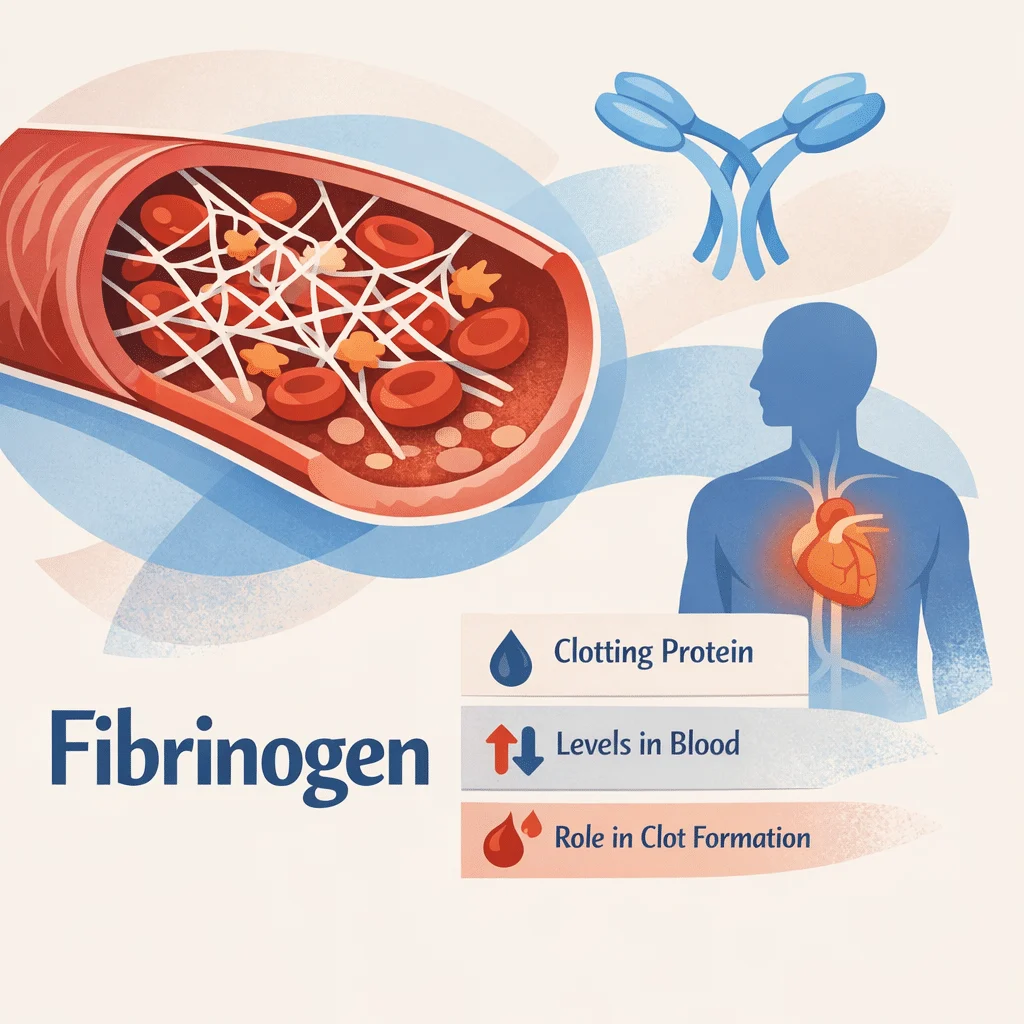
Fibrinogen is a protein made by the liver that circulates in your blood plasma at all times, ready to act. When a blood vessel is injured, an enzyme called thrombin converts fibrinogen into fibrin, a mesh of insoluble threads. This mesh traps platelets and other blood cells to form a stable clot that seals the injury and limits blood loss. Picture the liver as a factory that keeps this raw material stocked around the clock, so the body can respond within seconds whenever a vessel is damaged.
A doctor may order this test as part of a coagulation panel to check how well your blood clots, to investigate unexplained bleeding or bruising, or before a surgery. Because fibrinogen also rises during inflammation, it is sometimes checked alongside other inflammation markers when infection or an inflammatory condition is suspected. This dual identity, as both a building block for clots and a signal of inflammation, is what makes fibrinogen more informative than many single-purpose lab values.
Scientific understanding of fibrinogen has broadened considerably since it was first identified. What was once seen as a simple structural protein for clotting is now recognised as part of a wider network linking coagulation, wound healing, and the immune response. This is one reason a fibrinogen blood test rarely appears in isolation on a lab order; it is usually part of a bundle of tests chosen to answer a specific clinical question.
How the clotting process uses fibrinogen
Think of fibrinogen as raw material the liver keeps in constant supply. An injury triggers a chain reaction in the clotting cascade, and thrombin is the enzyme that finally converts fibrinogen into the fibrin strands that hold a clot together. Without enough functional fibrinogen, this final step cannot happen properly, and bleeding can be harder to control.
Fibrinogen blood test normal range and units
On a lab report, fibrinogen usually appears in the coagulation or haematology section, reported in grams per litre (g/L) or milligrams per decilitre (mg/dL). A typical adult reference range is about 200 to 400 mg/dL (2.0 to 4.0 g/L), though exact limits vary slightly between laboratories depending on their testing method.
A result printed as FIBRINOGEN: 4.2 g/L with a reference range of 2.0 to 4.0 g/L would be flagged high, often with an upward arrow, bold text, or an asterisk. It is important to compare your number only to the range printed on your own report, since two labs can list slightly different limits for the same test, a principle that applies across nearly every marker on a lab report and not just fibrinogen; our broader guide to normal blood test ranges across common lab panels explains why reference ranges shift between laboratories.
Mini-checklist for reading your result
A few quick questions can help you make sense of a fibrinogen result before your appointment:
- Is the value inside the lab’s own reference range, and if not, by how much?
- How does it compare with any earlier fibrinogen results you have had?
- Are other inflammation markers, such as C-reactive protein levels that signal active inflammation or the erythrocyte sedimentation rate, also abnormal?
- Has your erythrocyte sedimentation rate test also come back outside its range, another marker that tracks inflammation over a longer window than CRP?
- Do you have a personal or family history of a bleeding or clotting disorder?
- Could a temporary factor, such as a recent infection, pregnancy, or a new medication, be influencing the result?
Fibrinogen blood test: high versus low results
Fibrinogen can be too high or too low, and the two situations point in very different directions. The table below compares the two patterns at a glance before the detailed causes in the next section.
| Feature | High fibrinogen (hyperfibrinogenemia) | Low fibrinogen (hypofibrinogenemia) |
|---|---|---|
| Main risk | Excess clotting, higher cardiovascular risk | Excessive bleeding, poor clot formation |
| How common | Common, often reactive to inflammation | Less common, sometimes an emergency finding |
| Typical triggers | Infection, chronic inflammation, pregnancy, smoking | Liver disease, DIC, thrombolytic therapy, rare genetic disorders |
| Often checked with | CRP, ESR, lipid panel | Liver panel, platelet count, D-dimer, PT/aPTT |
What causes high fibrinogen (hyperfibrinogenemia)?
An elevated fibrinogen level most often reflects your body’s normal inflammatory response, but it can also occur for other reasons. Below are the most frequent explanations a doctor will consider when a fibrinogen blood test comes back high, ordered roughly from most to least common.
- Acute or chronic inflammation, very common: in response to infection or inflammation the liver simply increases its output of fibrinogen and other acute-phase proteins.
- Cardiovascular disease, common: higher fibrinogen raises blood viscosity and contributes to plaque formation, which is why it is often assessed alongside a lipid panel.
- Cancer, moderately common: some tumours release substances that stimulate the liver to make more fibrinogen.
- Pregnancy, common and expected: fibrinogen rises naturally as the body prepares for childbirth, so pregnancy-specific reference ranges apply.
- Smoking and obesity: both are linked to a chronic low-grade inflammatory state that can keep fibrinogen mildly elevated over time.
What causes low fibrinogen (hypofibrinogenemia)?
A fibrinogen level below the reference range is less common and can have more urgent implications, since it usually points to either reduced production or a process that is actively using up clotting factors faster than the body can replace them.
- Liver disorders, common: since the liver manufactures fibrinogen, significant liver disease such as cirrhosis can reduce its output.
- Disseminated intravascular coagulation, or DIC, uncommon but serious: clotting factors are consumed rapidly throughout the body, which can paradoxically cause severe bleeding.
- Congenital disorders, rare: inherited mutations can cause afibrinogenemia (no functional fibrinogen) or hypofibrinogenemia (very low levels).
- Thrombolytic therapy, treatment-related: medications used to dissolve an existing clot can also break down circulating fibrinogen, usually temporarily.
Fibrinogen and pregnancy
Fibrinogen levels normally rise throughout pregnancy as the body prepares to limit bleeding at delivery, so a value that would be flagged high outside pregnancy may be entirely expected on a prenatal panel. By the third trimester, fibrinogen commonly sits well above the standard adult range without indicating any problem. This is one reason lab reports use pregnancy-adjusted reference ranges rather than the standard adult range, and why a pregnant patient should not compare her fibrinogen blood test result to a chart written for the general population. If you want the fuller context on which tests are typically ordered at each stage, our guide on blood tests done throughout each trimester of pregnancy explains the full antenatal testing timeline.
Some inherited bleeding disorders complicate this picture. Women with von Willebrand disease, for example, may not increase their clotting factors enough during pregnancy and can need preventive treatment around delivery. Research on managing this condition around childbirth, discussed in our article on preventive treatment strategies for von Willebrand disease in pregnancy, shows why individualised monitoring matters even when coagulation factor targets are met.
How fibrinogen relates to your cardiovascular and immune systems
Fibrinogen does not act alone. Because it sits at the crossroads of clotting and inflammation, doctors read it together with other markers rather than in isolation. Persistently high levels are associated with an increased risk of blood clots that can obstruct blood flow and contribute to a heart attack or stroke, while a very low level impairs the body’s ability to form a clot at all, raising bleeding risk even from minor injuries.
This dual role also explains why fibrinogen results can influence medical decisions beyond a simple lab flag. A surgeon may postpone a non-urgent operation if fibrinogen is markedly abnormal, and a physician managing cardiovascular risk factors may use a persistently elevated level as one more reason to recommend closer monitoring. If you already have a coagulation panel in hand, our guide to interpreting a full coagulation panel including PT, PTT, and D-dimer shows how fibrinogen fits alongside the other clotting tests your doctor may review together.
Part of the reason fibrinogen draws attention from cardiologists is mechanical rather than purely biochemical. Higher fibrinogen thickens plasma slightly, which can make blood flow less smoothly through narrowed vessels, and it also plays a direct structural role in the plaques that build up inside artery walls over years. None of this means a single elevated result predicts a heart attack; it means fibrinogen is one thread in a much larger picture that includes blood pressure, cholesterol, blood sugar, and lifestyle factors your doctor will consider together.
When to see a doctor about your fibrinogen result
Most mildly abnormal fibrinogen results are not emergencies, and your doctor will interpret the number alongside your symptoms and history rather than acting on a single flagged value. Still, some situations call for more prompt attention than a routine follow-up appointment.
Contact your doctor promptly if any of the following apply to you:
- Your fibrinogen level is significantly above or below the reference range, not just marginally outside it.
- You have symptoms of bleeding, such as frequent nosebleeds, unusually heavy bruising, or blood in your urine or stool, alongside a low result.
- You have symptoms that could suggest a blood clot, such as swelling and pain in one leg, alongside a high result.
- Your fibrinogen level stays abnormal on repeat testing despite lifestyle changes.
- You have a personal or family history of a clotting or bleeding disorder that has not yet been evaluated.
Seek urgent or emergency care if you notice sudden shortness of breath, chest pain, one-sided weakness, or bleeding that will not stop, regardless of what a recent fibrinogen result showed. These signs need immediate evaluation on their own merit.
Practical tips for supporting a healthy fibrinogen level
If your fibrinogen level is abnormal, your doctor will first look for an underlying cause, since treating that cause is what matters most. Alongside that evaluation, everyday habits linked to lower chronic inflammation may help support a healthier level over time, particularly when the abnormality is mild and related to a low-grade inflammatory state rather than a specific disease.
- Favour anti-inflammatory foods: oily fish such as salmon and mackerel, nuts, seeds, olive oil, and a variety of colourful fruits and vegetables.
- Add anti-inflammatory spices: turmeric and ginger are commonly used for their anti-inflammatory properties.
- Limit pro-inflammatory foods: cut back on ultra-processed foods, refined sugar, and excessive red meat.
- Move regularly: moderate activity such as brisk walking supports cardiovascular health.
- Manage stress: chronic stress contributes to low-grade inflammation, so practices like slow breathing, yoga, or meditation may help.
- Avoid smoking: smoking is one of the most consistent lifestyle factors linked to higher fibrinogen levels.
- Maintain a healthy weight: excess body weight is associated with a more inflammatory internal state.
Latest scientific advances
Fibrinogen research has moved beyond viewing it as a simple clotting factor, and recent work has refined how useful it is for predicting future cardiovascular events.
A 2024 analysis pooling data from 11 studies and more than 14,000 people who had already had an ischaemic stroke found that higher fibrinogen levels were linked to a greater chance of a second stroke or other major cardiovascular event. What this means for you: if you have had a stroke, your fibrinogen level measured some time after the event, rather than in the first two weeks, may help your care team gauge your ongoing cardiovascular risk (a “major cardiovascular event” here means outcomes like a repeat stroke, heart attack, or cardiovascular death). Reliability caveat: this finding is still being confirmed, and the researchers noted that fibrinogen was more informative when measured several weeks after a stroke rather than immediately afterwards, so timing of the blood draw matters for how the result should be read.
Separately, work on cancer-related stroke has looked at whether fibrinogen can help distinguish a stroke caused by an underlying cancer from a stroke with a more typical cause. What this means for you: fibrinogen alone was not a reliable way to make this distinction across the studies reviewed, so if this question is relevant to your care, your doctor is likely to rely on other markers, such as D-dimer, alongside your full clinical picture rather than fibrinogen by itself. Reliability caveat: this is an evolving area of research, and no single blood marker currently replaces clinical judgement and imaging for this specific question.
Fibrinogen blood test: frequently asked questions
Can a fibrinogen blood test predict stroke risk even with normal cholesterol?
Research suggests fibrinogen can act as an independent marker of cardiovascular risk, meaning an elevated level may carry meaning even when cholesterol and blood pressure look normal. This does not mean fibrinogen replaces standard risk factors; it is generally considered one additional piece of information your doctor may weigh alongside your full cardiovascular risk profile, not a stand-alone predictor.
Do anticoagulant medications lower fibrinogen levels?
Standard anticoagulants such as warfarin or direct oral anticoagulants generally do not lower fibrinogen itself. They work at other steps of the clotting cascade to prevent new clots from forming, so your fibrinogen level can remain within its normal range whilst you are taking these medications. This is different from thrombolytic drugs, which actively dissolve clots and can temporarily reduce fibrinogen.
Does fibrinogen change during the day?
Yes, fibrinogen follows a mild daily pattern and tends to be highest in the morning, gradually decreasing later in the day. If you are having repeat tests to track a trend, having them taken at roughly the same time of day makes the comparison more meaningful.
What does a fibrinogen level over 400 mean?
A result above 400 mg/dL (4.0 g/L) is generally considered high fibrinogen, though the exact upper limit depends on your lab’s own reference range. On its own, this does not point to one specific condition; it is more often linked to inflammation, infection, pregnancy, or a cardiovascular risk factor, and your doctor will look at the broader picture, including other test results and your symptoms, before deciding whether further investigation is needed.
How can I treat high fibrinogen naturally?
There is no dedicated supplement or food that is proven to lower fibrinogen on its own, but habits that reduce chronic inflammation, such as an anti-inflammatory eating pattern, regular moderate exercise, stress management, and stopping smoking, are associated with lower average fibrinogen levels over time. These steps support overall cardiovascular health but do not replace medical evaluation of the underlying cause of an abnormal result.
Does eating before the test affect fibrinogen results?
A single meal shortly before the test does not meaningfully change your fibrinogen level, and fasting is not usually required for this test. Longer-term dietary patterns can influence low-grade inflammation and your baseline fibrinogen level over months, but what you eat the day before a single test is unlikely to skew the result.
Glossary
| Term | Definition |
|---|---|
| Acute-phase reactant | A protein whose blood level changes quickly in response to inflammation, infection, or tissue injury. |
| Coagulation cascade | The step-by-step chain of clotting factors that work together to form a blood clot after an injury. |
| DIC (disseminated intravascular coagulation) | A serious condition in which clotting factors are used up throughout the body, which can cause both clotting and severe bleeding at once. |
| Fibrin | The insoluble protein mesh formed when thrombin acts on fibrinogen; it is the structural basis of a blood clot. |
| Hyperfibrinogenaemia | A fibrinogen level above the normal reference range. |
| Hypofibrinogenaemia | A fibrinogen level below the normal reference range. |
| Reference range | The span of values considered typical for a healthy population, set by each laboratory. |
| Thrombin | An enzyme that converts soluble fibrinogen into insoluble fibrin strands during clot formation. |
Further reading
- Interpreting a full coagulation panel including PT, PTT, and D-dimer
- Understanding a D-dimer result and what it signals about clot activity
- How vitamin K status affects PT and INR clotting results
- A complete guide to reading your blood test results with confidence
- How to read your full blood count results panel by panel
A fibrinogen result rarely stands alone on a lab report, and it is often reviewed together with tests like a full blood count, a broader coagulation panel, or inflammation markers such as CRP to build a fuller picture of your health. Understanding what these values measure can help you prepare better questions for your doctor. A tool like AI DiagMe helps you understand your results, but it doesn’t diagnose you and it doesn’t replace your doctor.
Understand your lab results with AI DiagMe
Get your results interpreted in minutes
Sources
- Fibrinogen Test — Cleveland Clinic — https://my.clevelandclinic.org/health/diagnostics/22791-fibrinogen-test
- Fibrinogen Blood Test — MedlinePlus Medical Encyclopedia, U.S. National Library of Medicine (NIH) — https://medlineplus.gov/ency/article/003650.htm
- Deep Vein Thrombosis (DVT): Diagnosis and Treatment — Mayo Clinic — https://www.mayoclinic.org/diseases-conditions/deep-vein-thrombosis/diagnosis-treatment/drc-20352563
- J. McCabe et al. — Plasma fibrinogen and risk of vascular recurrence after ischaemic stroke: An individual participant and summary-level data meta-analysis of 11 prospective studies — European Stroke Journal, 2024 — https://consensus.app/papers/details/d903b6d3903c5f65b174c1b07dedbbba/?utm_source=claude_code
- Mai Erritzøe-Jervild et al. — Diagnosing cancer-associated ischemic stroke: A systematic review of hematological biomarkers — International Journal of Stroke, 2024 — https://consensus.app/papers/details/47534599afb1520fa945cd575e56de3e/?utm_source=claude_code