






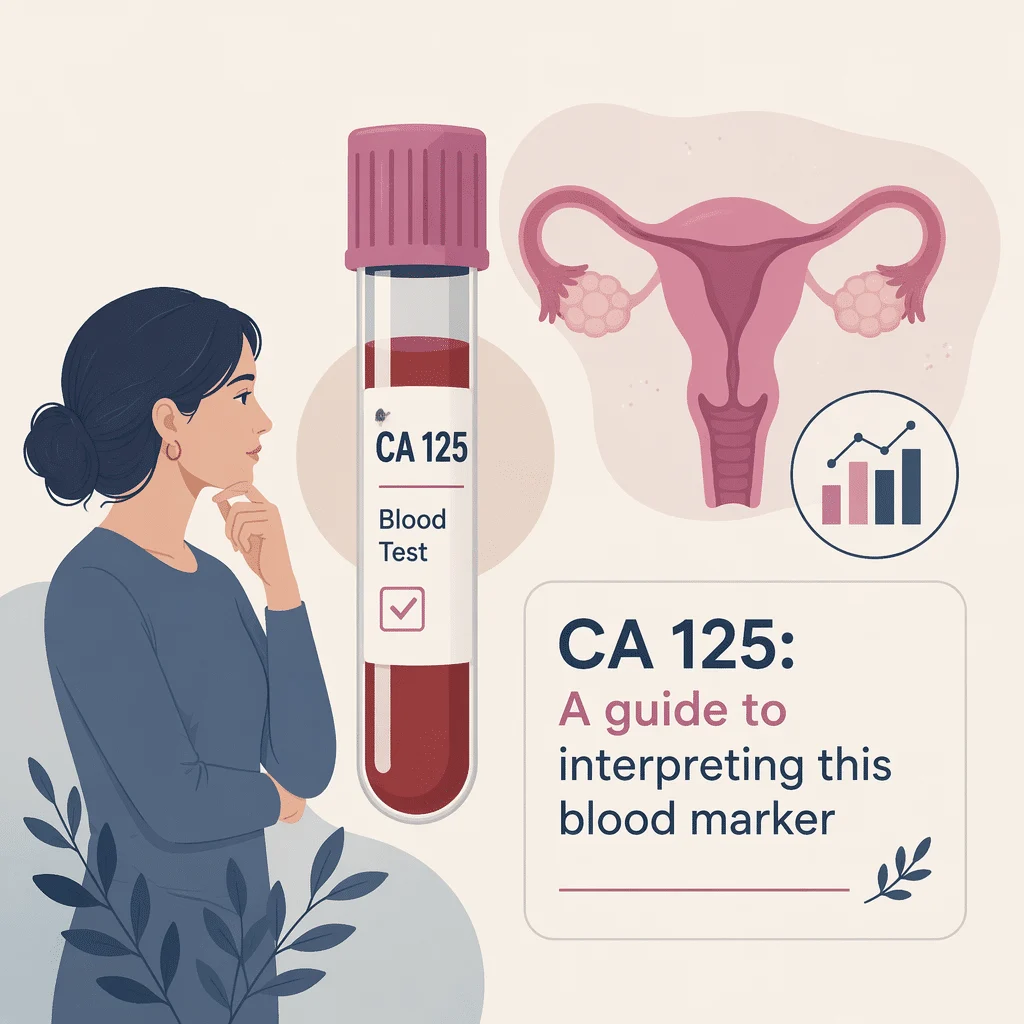
El análisis de sangre CA 125 mide una proteína que el tejido ovárico y pélvico libera cuando se irrita o inflama — y el cáncer es solo una de las muchas causas que pueden irritarlo. Si tu resultado salió por encima del rango habitual, lee esto primero: un CA 125 elevado no es un diagnóstico de cáncer. En mujeres que aún no han llegado a la menopausia, causas cotidianas como endometriosis, un quiste ovárico, fibromas o simplemente el momento del ciclo menstrual son mucho más frecuentes que el cáncer. Los médicos usan este estudio principalmente para ayudar a evaluar un nódulo ya detectado en un ultrasonido, para dar seguimiento a cómo está respondiendo un tratamiento y para vigilar si un cáncer regresa — no para revisar a mujeres sanas sin síntomas.
En este artículo aprenderás qué es el CA 125, por qué los médicos lo solicitan, las muchas razones inofensivas por las que el número sube, cómo se interpretan los resultados de forma diferente antes y después de la menopausia, qué desencadena realmente un resultado elevado, por qué un resultado normal no descarta el cáncer, y qué síntomas merecen una consulta médica sin importar cuál sea tu número.
Qué es el CA 125 y qué mide este análisis
CA 125 son las siglas de antígeno de cáncer 125 (cancer antigen 125). A pesar del nombre, no es una sustancia exclusiva del cáncer. Es una glucoproteína grande — una molécula formada por azúcar y proteína — producida por el epitelio celómico, el delgado revestimiento que cubre los ovarios, las trompas de Falopio, el interior del útero y el peritoneo (la membrana que envuelve los órganos dentro del abdomen).
El detalle importante es qué hace que estos tejidos lo liberen. Sueltan CA 125 al torrente sanguíneo cuando se estiran, se inflaman o se irritan. Un tumor que crece en un ovario puede provocar eso. También puede hacerlo un quiste, un foco de endometriosis, una infección o el desprendimiento mensual del revestimiento uterino. El análisis de sangre simplemente mide cuánta cantidad de esta proteína está circulando; no puede decirle a tu médico cuál de esas causas la puso ahí.
Los laboratorios reportan el resultado en unidades por mililitro (U/mL), y la mayoría usa 35 U/mL como límite superior del rango habitual. Ese número es una convención estadística, no una barrera biológica: se eligió porque aproximadamente 99 de cada 100 personas sanas se encuentran por debajo de él. Superarlo significa “vale la pena revisarlo”, no “algo está mal”.
Por qué los médicos solicitan un análisis de sangre de CA 125
El CA 125 tiene tres funciones bien establecidas, y las tres giran en torno a una pregunta que ya fue planteada por otra cosa: un estudio de imagen, un síntoma o un diagnóstico.
Ayudar a evaluar un nódulo que ya fue detectado
Si un ultrasonido ha mostrado una masa en el ovario o cerca de él (los médicos la llaman masa anexial), el CA 125 se convierte en uno de varios factores a considerar. Se evalúa junto con el aspecto de la masa en el estudio de imagen, tu edad y tu estado menopáusico. Nunca determina la respuesta por sí solo; solo el análisis del tejido bajo el microscopio puede confirmar qué es realmente esa masa.
Después del tratamiento
En alguien que ya tiene diagnóstico de cáncer de ovario, el CA 125 es verdaderamente útil. Niveles que bajan en análisis sucesivos generalmente indican que el tratamiento está funcionando. Niveles que se estancan o suben sugieren lo contrario. En este caso, el marcador está midiendo cambios en algo ya conocido, lo cual es una tarea mucho más sencilla que identificar algo desconocido.
Vigilar una posible recurrencia
Una vez que termina el tratamiento, una tendencia al alza en varias pruebas puede ser señal de que el cáncer está regresando, a veces antes de que aparezcan síntomas. Aquí también, lo importante es la dirección que toman los valores a lo largo del tiempo, no una sola lectura aislada.
Si quieres tener un panorama más amplio de cómo encajan entre sí marcadores como este, también puedes leer nuestra guía sobre marcadores tumorales en análisis de sangre. Nota lo que no aparece en esa lista de tres funciones: detectar cáncer de ovario en mujeres sanas.
Por qué el CA 125 no es un estudio de detección para mujeres sin factores de riesgo elevados
Este es el punto más importante de entender, y no es una cuestión de opinión. El Grupo de Trabajo de Servicios Preventivos de EE. UU. — el panel independiente de expertos que establece las guías de prevención en ese país — recomienda no realizar tamizaje de cáncer de ovario en mujeres sin síntomas que no tienen un síndrome hereditario de cáncer de alto riesgo conocido. Le asigna una calificación D, su designación para un servicio en el que existe al menos certeza moderada de que los daños superan los beneficios.
Eso merece una explicación.
Dos estudios muy grandes pusieron a prueba esta idea de forma rigurosa. En el Reino Unido, el ensayo UKCTOCS invitó a más de 200,000 mujeres posmenopáusicas y las sometió a tamizaje anual durante varios años, usando mediciones repetidas de CA 125 o ultrasonido. En Estados Unidos, el ensayo PLCO realizó un experimento comparable. El tamizaje sí detectó más cánceres en etapas más tempranas. Sin embargo, cuando los investigadores midieron lo que realmente importaba —cuántas mujeres murieron de cáncer de ovario—, los grupos con tamizaje no tuvieron mejores resultados que los grupos sin tamizaje.
Mientras tanto, el daño fue real y medible. Como el CA 125 puede elevarse por muchas razones inocentes, el tamizaje generó falsas alarmas, y una falsa alarma sobre un ovario no es algo menor. Lleva a más estudios de imagen, más angustia y, en algunos casos, a una cirugía para extirpar un ovario que resultó estar completamente sano. En el UKCTOCS, por cada cáncer detectado por el programa de CA 125, aproximadamente dos mujeres adicionales fueron operadas sin necesitarlo, como se comprobó después.
Entonces, la recomendación no dice que el cáncer de ovario no importa. Lo que dice es que esta prueba en particular, usada de esta manera en particular, tiene un costo mayor que su beneficio. Las mujeres con una condición hereditaria de alto riesgo conocida, o con antecedentes familiares importantes, son un caso completamente diferente y deben hablar sobre vigilancia con un especialista.
Las muchas razones benignas por las que el CA 125 puede estar elevado
El CA 125 tiene un problema de especificidad, especialmente antes de la menopausia. La especificidad se refiere a qué tan buena es una prueba para mantenerse en calma cuando la enfermedad no está presente, y en mujeres premenopáusicas, el CA 125 no es nada bueno para mantenerse en calma. La razón es sencilla: la pelvis de una mujer premenopáusica es un lugar muy activo. La ovulación, la menstruación, los quistes y el tejido estimulado por hormonas alteran exactamente los revestimientos que liberan esta proteína.
Las condiciones y situaciones que comúnmente elevan el CA 125 sin que haya ningún cáncer incluyen:
- Endometriosis, donde tejido similar al revestimiento uterino crece fuera del útero y provoca inflamación crónica
- Fibromas uterinos, especialmente los de mayor tamaño
- Quistes ováricos, incluidos los quistes funcionales comunes que aparecen y desaparecen con el ciclo
- Menstruación normal — el nivel puede subir un poco alrededor de tu período
- Embarazo, especialmente en el primer trimestre
- Enfermedad inflamatoria pélvica y otras infecciones pélvicas
- Enfermedad hepática, en particular cirrosis con líquido en el abdomen
- Pancreatitis, cirugía abdominal reciente o cualquier otra causa que irrite el peritoneo
- Insuficiencia cardíaca y algunas enfermedades pulmonares
Si vives con endometriosis, un CA 125 levemente elevado es casi lo esperado y no debe alarmarte; tu ginecóloga lo interpretará en ese contexto. Si tienes un quiste conocido, también puedes leer nuestro artículo sobre el tamaño de los quistes ováricos y lo que significan.
| Apunta hacia una explicación benigna | Requiere una evaluación más detallada |
|---|---|
| Aún no has llegado a la menopausia | Ya pasaste la menopausia |
| El aumento es leve y se mantiene estable al repetir el análisis | El nivel sube de forma constante en varios estudios |
| Tienes una causa conocida como endometriosis, fibromas o un quiste | No hay una explicación benigna evidente |
| El ultrasonido se ve normal o muestra un quiste simple y liso | El ultrasonido muestra una masa sólida o compleja, o líquido libre |
| Te sientes bien y no tienes síntomas persistentes | Distensión abdominal, dolor pélvico o sensación de llenura temprana que persisten durante semanas |
| El análisis se tomó alrededor de tu período | Tienes antecedentes familiares importantes de cáncer de ovario o de mama |
Cómo se interpretan los resultados antes y después de la menopausia
El mismo número puede tener dos significados muy distintos según el momento de tu vida, y esto es una de las cosas más útiles que debes entender sobre tu resultado.
Antes de la menopausia, la pelvis genera mucho "ruido de fondo". Un resultado de, digamos, 60 U/mL en una mujer de 34 años con períodos dolorosos tiene muchas más probabilidades de reflejar endometriosis o un quiste que algo preocupante. Los médicos, en consecuencia, no se alarman fácilmente y buscan primero la explicación más común. Si ese es tu caso, también puedes leer nuestra guía sobre endometriosis.
Después de la menopausia, los ovarios se calman, los períodos se detienen y la mayoría de las causas benignas de CA 125 desaparecen. El mismo resultado de 60 U/mL en una mujer de 63 años tiene, por lo tanto, más peso, simplemente porque quedan menos causas inocentes. Eso no lo convierte en un diagnóstico — los fibromas, la enfermedad hepática y las cicatrices quirúrgicas antiguas no desaparecen con la menopausia — pero sí reduce el umbral para investigar. Si no estás segura de tu situación, puedes leer nuestra guía sobre los síntomas de la menopausia. Para ver cómo los médicos confirman la menopausia con estudios de laboratorio, también puedes consultar nuestro artículo sobre el análisis de sangre de FSH.
Un solo resultado también es una fotografía, no una historia completa. Un número tomado una sola vez le dice mucho menos a tu médico que dos o tres tomados a lo largo de meses. Un nivel estable es tranquilizador de una manera que ningún valor aislado puede serlo; uno que sube de forma constante merece atención aunque cada resultado individual parezca sin importancia.
Qué pasa realmente después de un CA 125 elevado
Conocer los siguientes pasos ayuda mucho a reducir el miedo mientras los esperas. Un CA 125 elevado no manda a nadie directamente al quirófano. Da inicio a una serie de pasos.
- Tu médico revisa tu historial y tus síntomas, y analiza qué más podría explicarlo — tu ciclo, un quiste conocido, endometriosis, una enfermedad reciente
- Un ultrasonido pélvico o transvaginal observa directamente los ovarios. Los estudios de imagen tienen mucho más peso que el marcador, porque muestran si realmente hay algo presente
- Es posible que el análisis simplemente se repita después de algunas semanas. Muchas elevaciones pasajeras se normalizan solas
- Si se detecta una masa, una ginecóloga o ginecóloga oncóloga combina el ultrasonido, tu estado menopáusico y tus estudios de laboratorio en una evaluación de riesgo estructurada
- Solo si ese panorama combinado sugiere una preocupación real entra en discusión la cirugía, y es una decisión de un especialista
En esta etapa suelen aparecer dos herramientas. ROMA (el Algoritmo de Riesgo de Malignidad Ovárica) combina el CA 125 con un segundo marcador llamado HE4 y tu estado menopáusico. RMI (el Índice de Riesgo de Malignidad) combina el CA 125 con los hallazgos del ultrasonido y el estado menopáusico. Ambos existen por la misma razón: un solo número de forma aislada no es suficientemente confiable, pero combinar fuentes de información sí lo es. Los médicos también pueden buscar otras explicaciones, como una infección. Para entender esas pruebas, puedes leer nuestra guía sobre niveles elevados de PCR. También puedes consultar nuestra guía sobre la biometría hemática (BH).
Por qué un CA 125 normal no descarta el cáncer de ovario
Este punto funciona al revés.
Aproximadamente la mitad de los cánceres de ovario en etapa temprana no elevan el CA 125 en absoluto. Algunos tipos de tumor apenas producen la proteína sin importar la etapa. Por eso, un resultado dentro del rango normal es una buena noticia en contexto, pero no es un certificado de que todo está bien, y nunca debe usarse para ignorar síntomas que te están diciendo algo.
Esta es precisamente la razón por la que un CA 125 normal no puede usarse para convencer a nadie de dejar de investigar un problema persistente. Si tienes síntomas que no desaparecen, merecen ser evaluados por sus propios méritos — el marcador no es el árbitro. Una ecografía, una exploración física y un médico que te escuche valen más que cualquier número en una página.
Síntomas que merecen revisión sin importar lo que diga el número
El cáncer de ovario tiene fama de ser silencioso, lo cual solo es parcialmente justo. Con frecuencia sí produce síntomas; simplemente son vagos y fáciles de atribuir a otra cosa. El patrón que importa es la persistencia: síntomas que son nuevos para ti, que continúan durante varias semanas y que no se comportan como tus molestias digestivas habituales.
| Cuándo consultar a tu médico | Por qué vale la pena mencionarlo |
|---|---|
| Distensión abdominal que persiste la mayoría de los días durante tres semanas o más | La distensión abdominal persistente y constante se comporta de manera diferente a la hinchazón digestiva común |
| Sensación de llenura rápida o pérdida del apetito | La saciedad temprana es uno de los síntomas iniciales reportados con mayor consistencia |
| Dolor pélvico o abdominal que sigue regresando | El dolor continuo siempre merece una explicación, sea cual sea la causa |
| Necesidad de orinar con más frecuencia o con mayor urgencia | La presión en la pelvis puede afectar la vejiga |
| Un cambio en tu abdomen que puedes sentir o ver | Cualquier inflamación o cambio palpable siempre debe ser examinado |
| Cualquier sangrado después de la menopausia | El sangrado posmenopáusico nunca es normal y requiere revisión inmediata |
Ninguno de estos síntomas significa cáncer. En la gran mayoría de los casos, todos ellos tienen una causa benigna. Pero todos merecen una conversación con tu médico si persisten — y eso es válido sin importar si tu CA 125 estaba alto, bajo o nunca se midió. Para conocer con más detalle cómo se estudian estos síntomas, puedes leer nuestro artículo sobre los síntomas y estudios del cáncer de ovario.
Últimos avances científicos en los estudios de CA 125
Las investigaciones de los últimos años han confirmado en gran medida los límites del CA 125, al tiempo que han precisado cuál es su mejor uso. Esto es lo que encontraron los estudios recientes y qué significa para ti.
El ensayo de detección más grande jamás realizado no encontró vidas salvadas
Menon y sus colaboradores publicaron los resultados completos a largo plazo del UKCTOCS, un ensayo clínico aleatorizado controlado —un estudio en el que los participantes son asignados al azar a diferentes enfoques para poder comparar los grupos de manera justa. Se dio seguimiento a más de 200,000 mujeres posmenopáusicas durante una mediana de más de dieciséis años. El tamizaje anual de CA 125 sí logró detectar los cánceres en etapas más tempranas, pero no redujo las muertes por cáncer de ovario. Por cada cáncer detectado mediante el tamizaje, aproximadamente dos mujeres más se sometieron a una operación que resultó innecesaria.
Lo que esto significa para ti: si alguna clínica te ofrece un “chequeo de ovarios” con CA 125 y no tienes síntomas ni un riesgo elevado conocido, esta es la evidencia que explica por qué las guías médicas actuales no lo recomiendan. Detectar el cáncer antes solo ayuda si cambia el desenlace, y en este caso no fue así.
El problema parece ser biológico, no de frecuencia en los estudios
Lange y sus colaboradores reanalizaron los datos del UKCTOCS para entender por qué el tamizaje no funcionó. Al modelar la historia natural del cáncer de ovario seroso de alto grado —el subtipo más común y más agresivo—, estimaron que la ventana en la que el tamizaje con CA 125 podría detectarlo mientras aún era temprano era de menos de seis meses. Incluso con un tamizaje continuo, la diferencia habría sido modesta.
Lo que esto significa para ti: el fallo no se debió a que los estudios se hicieran con poca frecuencia. Este cáncer puede pasar de indetectable a avanzado más rápido de lo que cualquier estudio anual puede detectar. Para mejorar la detección se necesitarán pruebas genuinamente distintas, no más de la misma.
Hacer seguimiento del cambio a lo largo del tiempo funciona mejor que un solo umbral
Han y sus colaboradores reportaron 21 años del Estudio de Tamizaje de Ovario en Mujeres de Riesgo Normal, que dio seguimiento a casi 8,000 mujeres posmenopáusicas. En lugar de preguntar «¿el CA 125 está por encima de 35?», se monitoreó la tendencia individual de cada mujer y se identificaron aumentos significativos en relación con su valor de referencia personal. La mayoría de los cánceres detectados se encontraron en etapas tempranas y, cuando se activaba una alerta, ésta resultaba correcta aproximadamente la mitad de las veces —un resultado mucho mejor que el de un único punto de corte. El estudio no fue diseñado para demostrar si salva vidas.
Lo que esto significa para ti: este es el argumento más sólido de por qué a tu médico le importa más tu tendencia que tu número absoluto. Además, sigue siendo una estrategia de investigación, no una práctica clínica de rutina.
En la endometriosis, un CA 125 elevado es algo que se espera en gran medida
Arsalan y sus colaboradores revisaron la biología de los marcadores de endometriosis y explicaron por qué el CA 125 se comporta como lo hace: proviene de los mismos revestimientos celómicos que la endometriosis inflama, por lo que la enfermedad lo eleva casi por diseño. Su revisión también concluyó que aún no existe ningún marcador confiable para diagnosticar la endometriosis únicamente a partir de una muestra de sangre.
Lo que esto significa para ti: si tienes endometriosis y un CA 125 elevado, ambos encajan de manera directa. No es una señal oculta que haya pasado desapercibida.
Combinar estudios es mejor que depender de uno solo
Rani y sus colaboradores compararon distintas formas de evaluar masas anexiales en un grupo de mujeres que se preparaban para cirugía. Los enfoques que combinaban el CA 125 con el HE4 y el estado menopáusico (ROMA) o con los hallazgos de ultrasonido (RMI) superaron a cualquier medición individual, y los umbrales útiles del HE4 variaban según si las mujeres ya habían pasado la menopausia.
Lo que esto significa para ti: si tu médico solicita el HE4 junto con el CA 125, o calcula un puntaje ROMA, eso es un paso razonado hacia una respuesta más precisa — no una señal de que alguien sospeche lo peor.
Glosario
| Término | Definición |
|---|---|
| CA 125 | El antígeno cancerígeno 125, una proteína que liberan al torrente sanguíneo los revestimientos de los ovarios, el útero, las trompas de Falopio y el abdomen cuando están inflamados o alterados |
| Marcador tumoral | Una sustancia medible en sangre que puede elevarse con el cáncer, pero que habitualmente también aumenta por causas no cancerosas |
| Masa anexial | Un bulto que se encuentra en un ovario o en una trompa de Falopio, o junto a ellos; la mayoría de las veces es benigno |
| Especificidad | Qué tan bien un estudio da resultado negativo cuando la enfermedad está ausente. Una especificidad baja significa falsas alarmas frecuentes |
| HE4 | Proteína 4 del epidídimo humano, un segundo marcador que se mide frecuentemente junto con el CA 125 para mejorar la precisión diagnóstica |
| ROMA | Algoritmo de Riesgo de Malignidad Ovárica, un cálculo que combina el CA 125, el HE4 y el estado menopáusico |
| RMI | Índice de Riesgo de Malignidad, una puntuación que combina el CA 125, los hallazgos del ultrasonido y el estado menopáusico |
| Peritoneo | La membrana delgada que recubre la pared abdominal y cubre los órganos que se encuentran en su interior |
| Ultrasonido transvaginal | Estudio de imagen que utiliza una sonda pequeña colocada dentro de la vagina, lo que permite ver de cerca los ovarios y el útero |
| Recomendación grado D | Calificación del Grupo de Trabajo de Servicios Preventivos de EE. UU. que indica que una prueba o tratamiento no se recomienda porque sus riesgos superan sus beneficios |
Preguntas frecuentes
¿Qué muestra un análisis de sangre de CA 125?
Muestra cuánto antígeno cancerígeno 125 está circulando en tu sangre en el momento en que se tomó la muestra. Eso es todo lo que indica. No identifica qué elevó el nivel, ni puede distinguir un tumor de endometriosis, un quiste, una menstruación reciente o una inflamación abdominal. Su utilidad depende completamente del contexto: lo que muestra tu ultrasonido, si ya pasaste la menopausia, qué síntomas tienes y cómo cambia el número a lo largo de varias pruebas. Leído por sí solo, un resultado de CA 125 es casi imposible de interpretar, por eso tu médico siempre lo analiza junto con otra información y nunca reacciona únicamente a ese dato.
¿Cuál es el rango normal del CA 125 y quién lo determina?
La mayoría de los laboratorios considera que cualquier valor por debajo de 35 U/mL está dentro del rango habitual. Esa cifra proviene de estadísticas poblacionales: aproximadamente 99 de cada 100 personas sanas se encuentran por debajo de ese nivel. Es una convención, no un límite biológico, y originalmente se derivó en gran parte de mujeres posmenopáusicas, lo que explica en parte por qué no se ajusta bien a las mujeres premenopáusicas. Distintos laboratorios y diferentes equipos de análisis también pueden arrojar valores ligeramente distintos a partir de la misma muestra, por lo que comparar resultados entre laboratorios no es confiable. Si te están dando seguimiento a lo largo del tiempo, tu equipo médico intentará mantenerte en un mismo laboratorio precisamente por esta razón.
¿Puedo pedir un análisis de sangre de CA 125 sin receta médica?
Algunos servicios de venta directa al consumidor sí lo ofrecen, pero realmente vale la pena pensarlo bien antes de adquirirlo. Como el CA 125 puede elevarse por muchas razones inofensivas, un resultado alto que llega sin contexto clínico ni un ultrasonido de apoyo tiende a generar mucha preocupación y muy poca información. Este es el riesgo que el Grupo de Trabajo de Servicios Preventivos de EE. UU. consideró al desaconsejar el tamizaje de cáncer de ovario en mujeres sin síntomas. Si algo te preocupa, una consulta con un médico que pueda examinarte y solicitar un ultrasonido responderá tu pregunta mucho mejor que un marcador adquirido por tu cuenta.
¿Mi menstruación o un embarazo pueden alterar mi resultado de CA 125?
Sí, y ambas son explicaciones frecuentes. El CA 125 suele subir un poco durante la menstruación, porque el revestimiento uterino que se desprende libera la misma proteína. Si el análisis se hace cerca de tu período, un valor ligeramente elevado puede no significar nada más que eso. El embarazo también lo eleva, especialmente en el primer trimestre, a medida que el útero crece y los cambios hormonales se hacen presentes. Ninguna de las dos situaciones es motivo de preocupación, y tu médico puede simplemente repetir el estudio en un momento diferente de tu ciclo. Para entender los otros marcadores que se revisan en este momento, puedes leer nuestra guía de análisis de laboratorio durante el embarazo.
¿Los medicamentos o las hormonas afectan el CA 125?
Pueden hacerlo, aunque de forma leve. Los anticonceptivos orales combinados tienden a bajar un poco el CA 125, porque inhiben la ovulación y reducen la actividad del tejido que lo produce. Algunas terapias hormonales usadas después de la menopausia pueden subirlo ligeramente. Estos efectos son pequeños y no van a convertir un resultado normal en uno claramente anormal, pero igual vale la pena mencionarlos en tu consulta, junto con cualquier cirugía reciente, infección o problema hepático. Si quieres entender el aspecto hormonal de este panorama, también puedes consultar nuestro artículo sobre el análisis de sangre de estradiol.
¿Con qué frecuencia se revisa el CA 125 después del tratamiento de cáncer de ovario?
No existe un calendario único universal; tu equipo de oncología establecerá el tuyo según tu diagnóstico, tu tratamiento y cómo te estás sintiendo. Los estudios suelen ser más frecuentes en los primeros dos años después del tratamiento y se van espaciando con el tiempo. Lo que tu equipo observa es la tendencia, no un valor aislado, y cualquier aumento se confirma con un estudio repetido antes de sacar conclusiones. Si estás en seguimiento y tienes dudas sobre tu propio calendario, la persona indicada para preguntarle es tu enfermera especialista o tu oncólogo.
Fuentes
- Grupo de Trabajo de Servicios Preventivos de EE. UU. — Cáncer de ovario: tamizaje (declaración de recomendación grado D) — uspreventiveservicestaskforce.org
- MedlinePlus, Biblioteca Nacional de Medicina de EE. UU. — CA-125 Blood Test (Ovarian Cancer) — medlineplus.gov
- Instituto Nacional del Cáncer — Tamizaje de cánceres de ovario, trompa de Falopio y peritoneo primario (PDQ) — Versión para pacientes — cancer.gov
- Gandhi T, Bhatt H — Cancer Antigen 125 — StatPearls, NCBI Bookshelf — ncbi.nlm.nih.gov
- Menon U, Gentry-Maharaj A, Burnell M, et al. — Mortality impact, risks, and benefits of general population screening for ovarian cancer: the UKCTOCS randomised controlled trial — Health Technology Assessment, 2025 — doi.org/10.3310/BHBR5832
- Lange JM, Ahmad I, Dengos IJ, et al. — Can ovarian cancer screening work? A secondary analysis of the UK Collaborative Trial of Ovarian Cancer Screening — British Journal of Cancer, 2026 — doi.org/10.1038/s41416-026-03490-2
- Han CY, Lu KH, Corrigan G, et al. — Normal Risk Ovarian Screening Study: 21-Year Update — Journal of Clinical Oncology, 2024 — doi.org/10.1200/JCO.23.00141
- Arsalan HM, Mumtaz H, Lagana AS — Biomarkers of endometriosis — Advances in Clinical Chemistry, 2025 — doi.org/10.1016/bs.acc.2025.01.004
- Rani RS, Veena P, Durairaj J, Nandeesha H — Utilidad del HE4 en la evaluación de masas anexiales en mujeres premenopáusicas y posmenopáusicas — Indian Journal of Surgical Oncology, 2025 — doi.org/10.1007/s13193-024-02181-9
Lecturas recomendadas
- Para descifrar el marcador pancreático y digestivo, puedes leer nuestra guía sobre el análisis de sangre CA 19-9
- Para entender el marcador usado en el seguimiento del cáncer de colon, puedes leer nuestra guía sobre el análisis de sangre CEA
- Para conocer el marcador que se revisa en enfermedades del hígado y testiculares, puedes leer nuestra guía sobre el análisis de sangre de alfafetoproteína
- Para ver cómo se usa un marcador comparable en hombres, puedes leer nuestra guía sobre el análisis de sangre PSA
- Para revisar las hormonas que se evalúan junto con síntomas ginecológicos, puedes leer nuestra guía sobre el panel de hormonas femeninas
Entiende tus resultados de laboratorio con AI DiagMe
Los resultados de laboratorio rara vez se explican solos, y una línea como CA 125, HE4, PCR o una biometría hemática puede parecer mucho más alarmante de lo que realmente es. AI DiagMe convierte esos números en lenguaje sencillo, para que puedas ver qué mide cada marcador y qué es lo que normalmente lo altera. Te ayuda a entender tus resultados y a preparar mejores preguntas para tu médico; no te diagnostica ni reemplaza la consulta médica.
Obtén la lectura de tus resultados en minutos