





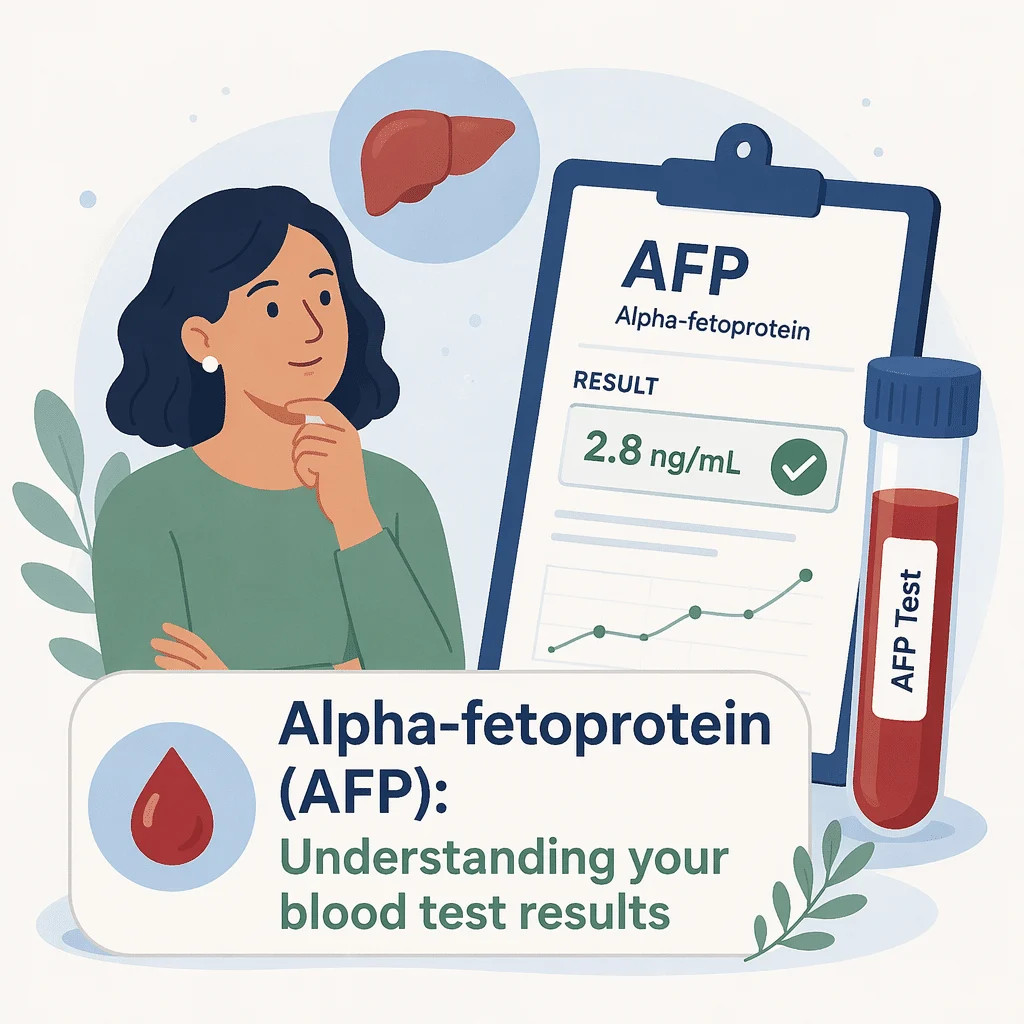
An AFP blood test measures alpha-fetoprotein, a protein your body produced in large amounts before you were born and makes only in traces once you are an adult. If your result came back above the reference range, take a breath first: a raised alpha-fetoprotein most often reflects a benign liver condition such as hepatitis or cirrhosis, not cancer. Doctors order this test in three quite different situations, and the meaning of the number changes completely depending on which one applies to you.
In this article you’ll learn what alpha-fetoprotein is and why adults still make a little of it. You’ll see the three reasons the test gets ordered — liver cancer surveillance, germ cell tumours of the testis or ovary, and prenatal screening — kept clearly apart. You’ll also learn why a normal result cannot rule out liver cancer, why the trend across several tests matters more than any single figure, and when it makes sense to speak to your doctor.
What alpha-fetoprotein actually is
Alpha-fetoprotein is a glycoprotein — a protein carrying sugar chains — made by the developing liver and the yolk sac during pregnancy. Before birth it is one of the most abundant proteins in fetal blood, where it helps transport hormones and fatty acids and helps regulate the fluid balance of the blood. Once a baby is born, production shuts down quickly. Levels fall steeply over the first year of life and settle at the low adult level.
In healthy adults, laboratories usually report AFP as under about 10 nanograms per millilitre (ng/mL), although every laboratory sets its own figures depending on the population it serves and the method it uses. If you want to understand how those intervals are built in general, you can consult our reference chart of normal blood test ranges.
Here is the part that explains almost everything about interpreting this test. Adult liver cells keep the genetic instructions for making alpha-fetoprotein, but normally hold them switched off. Two quite different things can switch them back on. The first is rapid regeneration of liver cells, which happens whenever the liver is inflamed or repairing itself. The second is certain cancers that arise from liver cells or from embryonic cells. In other words, AFP is a marker of liver cell activity that cancer happens to trigger — not a cancer detector. That is why benign explanations are so common, and why the test is never read on its own. Our overview of tumour markers and their limits explains the same principle across the whole family of these tests.
The three reasons an AFP blood test gets ordered
Readers arrive at this page from very different places, and the same word means three different things depending on the door you came through. Working out which context applies to you is the single most useful thing you can do before interpreting your number.
1. Liver cancer surveillance in people with chronic liver disease
People living with cirrhosis, or with long-standing hepatitis B, carry a higher-than-average risk of hepatocellular carcinoma — the most common primary liver cancer, meaning a cancer that starts in the liver rather than spreading there from elsewhere. For these defined groups, AFP is used as a repeated check, paired with an ultrasound scan, at regular intervals. It is a monitoring tool for people already known to be at risk.
2. Germ cell tumours of the testis or ovary
Some tumours that develop from germ cells — the cells that would become eggs or sperm — behave a little like embryonic tissue and make alpha-fetoprotein. Here AFP is measured together with beta-hCG and LDH, and it contributes to diagnosis, to staging, and to tracking how treatment is working.
3. Pregnancy screening — a different test with a different meaning
During the second trimester, alpha-fetoprotein can be measured in the mother’s blood as part of antenatal screening. It is combined with other markers and with ultrasound to estimate the chance of certain foetal conditions, such as neural tube defects or chromosomal differences. This has nothing whatsoever to do with the tumour-marker use above, and a result here says nothing about the mother’s own cancer risk.
Two things are worth holding onto. Antenatal AFP is a screen, not a diagnosis: it estimates a probability and identifies who might benefit from further tests, and a result outside the expected range calls for follow-up rather than alarm. And because this is genuinely a separate subject, we keep it separate here — if that is why you are reading, the right place to continue is our guide to blood tests during pregnancy. The rest of this article deals with the tumour-marker meaning.
How liver cancer surveillance actually works
Who is offered surveillance
The American Association for the Study of Liver Diseases (AASLD) recommends surveillance for liver cancer in adults with cirrhosis, and in selected adults with chronic hepatitis B who do not have cirrhosis, using abdominal ultrasound with or without AFP roughly every six months. The logic is straightforward: liver cancer found early can often be treated with the intention of curing it, while liver cancer found late usually cannot.
The equally important half of that statement is who is not offered it. An AFP blood test is not a general population cancer screening test. It is not designed to be handed to people with healthy livers and no risk factors, and using it that way produces far more false alarms than useful findings. If you have chronic hepatitis C and want to understand the marker that identifies it, we cover that in our article on the anti-HCV hepatitis C marker.
Why AFP never travels alone
Ultrasound and AFP fail in different directions, which is exactly why they are used as a pair. Ultrasound looks for a lump but can struggle in a scarred, nodular liver, or when body habitus makes the images harder to read. AFP looks for a chemical signal but stays quiet in the many tumours that never produce the protein. Put together, they catch more than either does alone. Neither, alone or together, is perfect — and your doctor knows that when reading your results.
Reading a raised AFP: benign causes come first
A raised alpha-fetoprotein is not a cancer diagnosis. It is a prompt to look further. In people with chronic liver disease, mild elevations are common and usually reflect the liver doing repair work: hepatitis of any cause, cirrhosis, and liver regeneration after injury all push the number up. This is why the same figure can be routine in one person and worth investigating in another.
| The situation | What it usually reflects | Usual next step |
|---|---|---|
| Slightly above the range, stable across repeat tests, in someone with known hepatitis or cirrhosis | Ongoing liver inflammation and cell regeneration — a very common benign pattern | Carry on with the usual surveillance schedule; the doctor compares against previous values |
| Raised for the first time, with no known liver disease | Often a liver condition that has not been diagnosed yet | Liver function tests, hepatitis testing and liver imaging to find the reason |
| Moderately raised and climbing steadily across several tests | A trend that deserves an explanation, whatever the cause turns out to be | Imaging and a specialist review, without waiting for the next routine test |
| Clearly raised in a young man with a testicular lump | Points towards a germ cell tumour rather than a liver cause | Prompt urology referral, scrotal ultrasound, and hCG and LDH measured alongside |
| Raised on prenatal screening during pregnancy | A screening signal about the pregnancy — not a statement about the mother’s cancer risk | Detailed ultrasound and a conversation with the obstetric team |
| Normal, in someone under liver surveillance | Reassuring, but not proof that nothing is there | The ultrasound half of surveillance still matters and still happens |
The trend matters more than any single number
Doctors reading an AFP result care less about where it sits today than about where it has been going. A number that has hovered gently above the range for two years in someone with cirrhosis tells a very different story from the same number reached after a year of normal results. A steady climb across successive tests is more meaningful than one isolated reading, which is part of why surveillance is repeated on a schedule rather than done once.
This is also why a single high value is rarely acted on immediately. A repeat test, imaging, and a look at the wider picture — including your liver function tests — usually come before any conclusion. Our general guide to abnormal blood test results explains why context beats any one figure on the page.
Why a normal AFP does not rule out liver cancer
This point deserves its own heading because it is the most common misunderstanding about the test. A substantial share of hepatocellular carcinomas never make alpha-fetoprotein at all. They are described as AFP-negative, and in those cases the blood test stays perfectly normal while the tumour is present. A reassuring AFP is genuinely reassuring in a limited sense — but it is not a clean bill of health for the liver.
That single fact is the reason surveillance is built the way it is. If AFP were reliable on its own, an ultrasound every six months would be unnecessary. It is not, so the scan does the work AFP cannot. If you are under surveillance and tempted to skip the ultrasound because your bloods came back fine, this is the paragraph to remember.
Other tumour markers behave the same way, and for the same reason: they measure a substance the cancer may or may not produce. The same caution applies to PSA and the prostate, to CEA, and to the CA 19-9 marker.
AFP in testicular and ovarian germ cell tumours
In germ cell tumours, AFP does something it cannot do in the liver: it helps say which kind of tumour is present. Certain subtypes — yolk sac tumours and embryonal carcinoma — produce alpha-fetoprotein, while pure seminoma essentially never does. A raised AFP therefore tells the team something specific about what they are dealing with, which in turn shapes treatment planning.
AFP is measured alongside two companions. Beta-hCG is a hormone made by some of these tumours, and LDH is an enzyme released when cells turn over quickly. Together the three are used at diagnosis, then again for staging, where the marker levels feed into internationally agreed risk categories, and then repeatedly during and after treatment to see whether the tumour is responding.
One nuance is worth knowing if you are watching your own numbers fall during treatment. Alpha-fetoprotein clears from the blood slowly — it has a half-life of several days — so levels come down gradually rather than dropping overnight. A slow decline is normal and expected, and the treating team interprets the speed of that fall against what they expect, not against how it feels. The reverse is also true: a level that starts rising again after treatment is a signal the team takes seriously and investigates.
Germ cell tumours of the ovary are much rarer than testicular ones and mostly affect younger women. If that is your situation, our article on ovarian cancer symptoms and testing gives the wider picture. Note too that a man who has both a testicular tumour and liver disease can have an AFP muddied by both causes at once — another reason the number is never read in isolation.
AFP-L3 and DCP: newer refinements
Because plain AFP is an imperfect tool, laboratories have developed ways to sharpen it. AFP-L3 measures the fraction of the total alpha-fetoprotein that carries a particular sugar pattern; that fraction is more characteristic of liver cancer than of a merely inflamed liver, so it helps separate the two. DCP, also called des-gamma-carboxy prothrombin or PIVKA-II, is a different protein altogether that liver tumours tend to release.
These are refinements rather than replacements, and their availability varies between countries and laboratories. They are most often used in combination — including in a scoring system called GALAD, which folds sex, age, AFP, AFP-L3 and DCP into a single figure.
When to see a doctor
Worth arranging a conversation
- Your AFP has risen across two or more successive tests, even if each individual value looks modest.
- You have a raised AFP and no known liver condition to explain it.
- You have cirrhosis or chronic hepatitis B and have fallen behind on your six-monthly surveillance.
- You notice a testicular lump, swelling or a persistent ache — with or without a blood test result.
- You have yellowing of the eyes or skin, unexplained weight loss, or new abdominal pain or swelling.
- You are pregnant and your screening result came back outside the expected range; ask for the follow-up conversation rather than searching for the answer alone.
A stable, mildly raised AFP in someone with known and monitored liver disease is usually handled within the routine schedule rather than urgently.
Latest scientific advances in AFP testing
Research over the last few years has focused less on replacing AFP than on being honest about what it can and cannot do, and on building better combinations around it.
Pairing AFP with ultrasound helps — and still misses cancers
What was found: a 2024 review of surveillance strategies concluded that combining ultrasound with AFP detects more early-stage liver cancers than ultrasound used alone, but that the pair together still fails to detect more than a third of liver cancers whilst they are still at an early stage.
What this means for you: this is the honest arithmetic behind your six-monthly appointments. It explains why attending every round matters — one normal result is a snapshot, not a guarantee — and why researchers are actively working on better options. It is also why symptoms are always worth reporting between appointments, even when your last surveillance was clear.
The GALAD score outperformed AFP alone in a large prospective study
What was found: a phase 3 validation study followed more than 1,500 people with cirrhosis across seven centres, with surveillance every six months. Researchers then checked, in blood samples stored before diagnosis, how well each approach flagged the cancers that later appeared. In the year before diagnosis, the GALAD score — which combines sex, age, AFP, AFP-L3 and DCP — identified appreciably more of those cancers than AFP alone did, at a comparable rate of false alarms.
What this means for you: combining markers works better than leaning on one. GALAD is not yet standard care everywhere and is still being tested in trials designed to show whether it changes outcomes rather than just detection. But it is the clearest sign that AFP’s future is as one ingredient among several rather than a solo test.
AFP-L3 and DCP added information AFP alone did not carry
What was found: a prospective study of people receiving a liver transplant for liver cancer measured AFP, AFP-L3 and DCP beforehand, then followed them for around three years. AFP-L3 and DCP each predicted which cancers would come back more accurately than AFP did, and the two together identified a small high-risk group.
What this means for you: these refined markers carry real information about tumour behaviour, not just tumour size. If your team measures AFP-L3 or DCP as well as AFP, this is why. If they do not, it does not mean your care is lacking — availability differs by country and by laboratory, and these tests are used for specific decisions rather than routinely.
In germ cell tumours, the classic markers have known blind spots
What was found: a 2024 review of biomarkers in testicular germ cell tumours set out plainly that the traditional trio of AFP, beta-hCG and LDH miss a considerable proportion of cases at first diagnosis, can be raised by benign conditions, and stay normal in early-stage disease and in certain tumour types such as seminoma and teratoma. A newer marker, a microRNA called miR-371a-3p, performed better in studies but is still being validated in trials.
What this means for you: normal markers do not close the question in testicular disease, which is exactly why imaging and examination remain central and why a lump is investigated regardless of what the blood tests say. It also explains why follow-up after treatment combines markers with scans rather than relying on blood tests alone.
Glossary
| Term | Definition |
|---|---|
| Alpha-fetoprotein (AFP) | A protein made in large amounts by the liver and yolk sac before birth, and only in traces by healthy adults. |
| Tumour marker | A substance measurable in blood that some cancers produce. Benign conditions can produce it too, so it supports a diagnosis rather than making one. |
| Hepatocellular carcinoma (HCC) | The most common cancer starting in the liver itself, as opposed to a cancer that spreads to the liver from elsewhere. |
| Cirrhosis | Long-term scarring of the liver caused by repeated injury, from alcohol, viral hepatitis, fatty liver disease or other causes. |
| Surveillance | Repeated testing on a fixed schedule in people already known to be at raised risk, aiming to catch a problem early. |
| Germ cell tumour | A tumour arising from the cells that would form eggs or sperm, most often in the testis or ovary. |
| AFP-negative | Describes a cancer that does not release alpha-fetoprotein, so the blood test stays normal despite the tumour being present. |
| AFP-L3 | The share of total AFP carrying a particular sugar pattern that is more typical of liver cancer than of liver inflammation. |
| DCP (PIVKA-II) | Des-gamma-carboxy prothrombin, a separate protein that liver tumours tend to release; used alongside AFP. |
| ng/mL | Nanograms per millilitre, the usual unit for reporting AFP. Some laboratories use kU/L instead. |
Frequently asked questions
Do you need to fast for an AFP blood test?
No. Alpha-fetoprotein is not affected by eating, so you do not normally need to fast before the sample is taken. What can complicate things is that AFP is frequently ordered as part of a wider set of tests — a liver panel or a metabolic panel, for instance — and some of those companion tests do require fasting. The instruction you receive is usually driven by them, not by the AFP. Follow whatever your laboratory or doctor tells you for the request as a whole, and if nothing was specified, it is entirely reasonable to phone and ask rather than guess.
What counts as a normal AFP range?
Most laboratories report adult AFP as normal below roughly 10 ng/mL, but there is no single universal figure. Each laboratory sets its own reference interval based on the method it uses and the population it serves, which is why you should always compare your result against the range printed on your own report rather than one you found online. Ranges also differ completely in pregnancy, where results are interpreted against the stage of the pregnancy rather than against an adult range. Our guide to reading blood test results explains how these intervals are constructed.
How long do AFP blood test results take?
Most laboratories return an AFP result within a few working days, and often sooner if the sample is processed on site rather than sent to a reference laboratory. If your result is part of a surveillance programme, your team may not contact you until they have both the blood result and the ultrasound report, since the two are read together — so a wait does not signal bad news. If you have not heard anything after a couple of weeks, it is reasonable to chase the result.
Can medications or supplements raise AFP?
No medication raises alpha-fetoprotein directly. However, anything that inflames or injures the liver can raise it indirectly, because a liver repairing itself makes more AFP. That includes some prescription medicines, some herbal preparations and high-dose supplements. This is a good reason to tell your doctor about everything you take, including things bought without a prescription, when an unexplained AFP result is being investigated. Do not stop a prescribed medication on your own — the conversation is the useful step, not the withdrawal.
My AFP is high but my scan was clear. What happens now?
This combination is common and usually ends well. The most frequent explanation is that a benign liver process is raising the number without any tumour being present. Your doctor will typically repeat the AFP after an interval to see whether it is stable, rising or settling, and may look more closely at your liver with additional imaging. A single raised value with clear imaging is watched rather than acted on dramatically; a value that keeps climbing across repeat tests is what prompts a closer look. The waiting is uncomfortable, but the repeat test is doing real work.
Is AFP included in a routine blood panel?
No. AFP is not part of a standard check-up and is not included in a routine comprehensive metabolic panel. It is ordered deliberately, for a reason: surveillance in someone with chronic liver disease, investigation of a suspected germ cell tumour, monitoring of a known cancer, or prenatal screening. Asking for it without one of those reasons is not recommended, because in people at average risk it generates far more false alarms and anxiety than useful information.
Sources
- National Cancer Institute — Tumor Markers in Common Use — cancer.gov
- MedlinePlus, U.S. National Library of Medicine — Alpha-fetoprotein (AFP) Tumor Marker Test — medlineplus.gov
- StatPearls, NCBI Bookshelf — Alpha-Fetoprotein Analysis — ncbi.nlm.nih.gov
- National Institute of Diabetes and Digestive and Kidney Diseases (NIDDK) — Cirrhosis — niddk.nih.gov
- Singal AG, Ng M, Kulkarni A — Advancing Surveillance Strategies for Hepatocellular Carcinoma: A New Era of Efficacy and Precision — Journal of Clinical and Experimental Hepatology, 2024 — doi.org/10.1016/j.jceh.2024.101448
- Marsh TL, Parikh ND, Roberts LR, Schwartz ME, Nguyen MH, Befeler A, Page-Lester S, Tayob N, Srivastava S, Rinaudo JA, Singal AG, Reddy KR, Marrero JA — A Phase 3 Biomarker Validation of GALAD for the Detection of Hepatocellular Carcinoma in Cirrhosis — Gastroenterology, 2025 — doi.org/10.1053/j.gastro.2024.09.008
- Norman JS, Li PJ, Kotwani P, Shui AM, Yao F, Mehta N — AFP-L3 and DCP strongly predict early hepatocellular carcinoma recurrence after liver transplantation — Journal of Hepatology, 2023 — doi.org/10.1016/j.jhep.2023.08.020
- Sykes J, Kaldany A, Jang TL — Current and Evolving Biomarkers in the Diagnosis and Management of Testicular Germ Cell Tumors — Journal of Clinical Medicine, 2024 — doi.org/10.3390/jcm13237448
Further reading
- To see how this family of tests behaves in general, read our overview of tumour markers and their limits
- To understand the panel most often ordered alongside AFP, read our guide to liver function tests
- If you came here for the pregnancy meaning of AFP, continue with our guide to blood tests during pregnancy
- For a marker that raises very similar questions about benign elevations, see our interpretation guide to the CA 125 blood marker
- To get more comfortable with your report as a whole, read our simple guide to reading blood test results
Understand your lab results with AI DiagMe
An AFP result rarely arrives on its own. It usually sits on a page beside liver function tests, ALT, bilirubin and other figures, each with its own range and its own arrows. AI DiagMe turns that page into plain language, so you can see what each line is measuring and arrive at your appointment with better questions. It helps you understand your results — it does not diagnose you, and it does not replace your doctor.
Get your results interpreted in minutes