



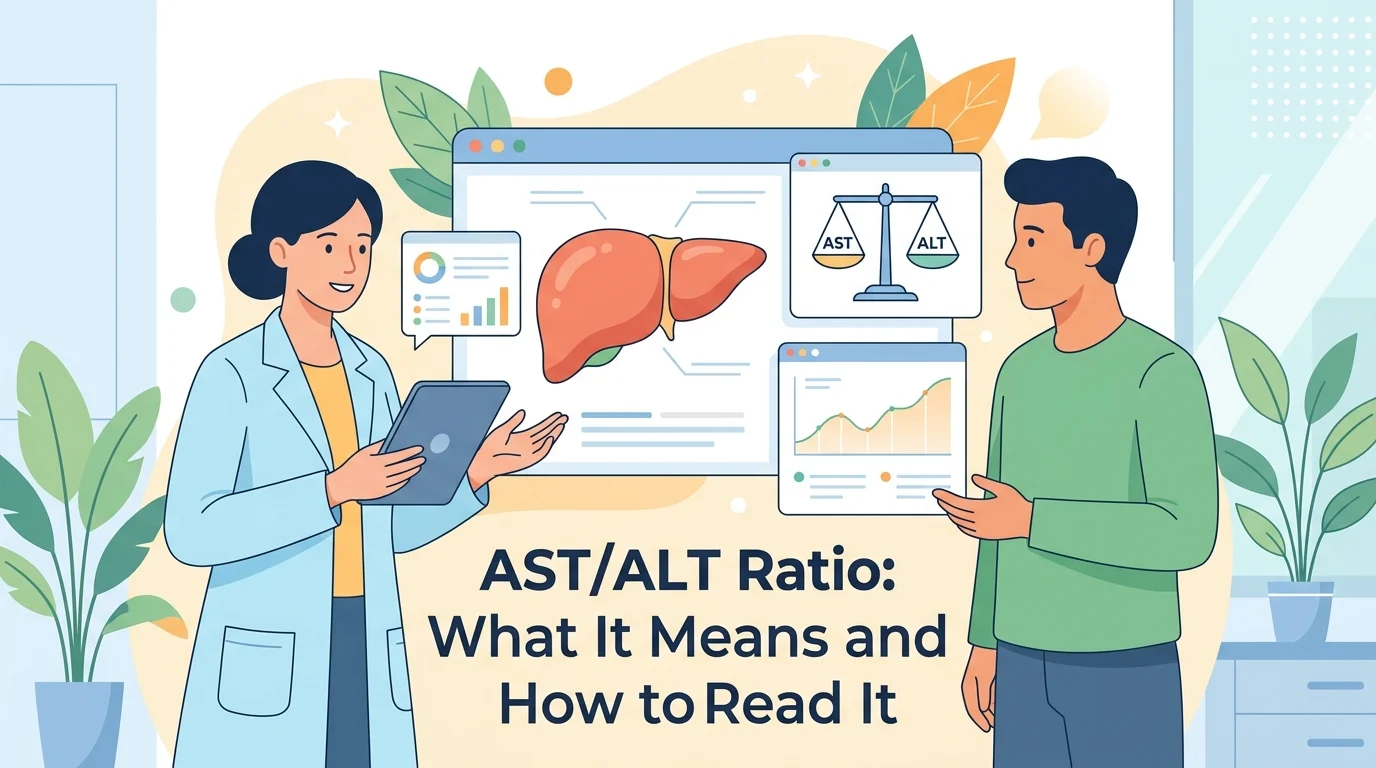
Das AST/ALT-Verhältnis vergleicht zwei Leberenzyme – Aspartat-Aminotransferase (AST) und Alanin-Aminotransferase (ALT) – und liefert damit einen Hinweis, den keiner der beiden Werte allein geben kann. Es wird als De-Ritis-Quotient bezeichnet, nach dem Forscher, der ihn beschrieben hat, und ergibt sich schlicht aus AST geteilt durch ALT. Das Muster dieses Quotienten deutet häufig auf eine wahrscheinliche Ursache einer Leberbelastung hin. Am aussagekräftigsten ist er, wenn mindestens eines der beiden Enzyme bereits erhöht ist; er wird stets zusammen mit den Einzelwerten und den übrigen Parametern eines Leberprofils beurteilt. In diesem Artikel erfahren Sie, wie man den Quotienten berechnet, was ein hoher oder niedriger Wert in der Regel bedeutet und wo seine Grenzen liegen.
Was ist das AST/ALT-Verhältnis?
AST und ALT sind Enzyme, die bei einer Schädigung von Leberzellen ins Blut freigesetzt werden. ALT befindet sich überwiegend in der Leber und ist daher relativ leberspezifisch, während AST auch in Muskel-, Herz- und roten Blutzellen vorkommt. Da beide Enzyme bei verschiedenen Erkrankungen in unterschiedlichem Ausmaß austreten, enthält ihr Verhältnis Informationen über den zugrunde liegenden Prozess. Informationen zu jedem Enzym einzeln finden Sie in unseren Ratgebern zur AST-Normalbereich und zu einem erhöhten ALT-Wert. Der Quotient ergänzt diese Werte – er ersetzt sie nicht.
So berechnen und lesen Sie Ihr AST/ALT-Verhältnis
Die Berechnung ist einfach: Teilen Sie Ihren AST-Wert durch Ihren ALT-Wert, wobei beide in derselben Einheit (U/l) angegeben sein müssen. Ein AST-Wert von 60 und ein ALT-Wert von 30 ergeben beispielsweise einen Quotienten von 2,0. Bei gesunden Menschen liegt der Quotient in der Regel knapp unter 1, häufig wird ein Wert von etwa 0,8 angegeben. Die folgende Tabelle zeigt die Muster, auf die Ärzte achten – sie dient jedoch als Orientierung und nicht als Diagnose.
| AST/ALT-Verhältnis | Möglicher Hinweis auf |
|---|---|
| Unter 1 (ca. 0,8) | Typische Fettleber (MASLD) oder frühe chronische Virushepatitis |
| Ungefähr 1 | Unspezifisch; zusammen mit den übrigen Leberwerten beurteilen |
| Über 1 | Mögliche Progression in Richtung fortgeschrittener Fibrose oder Zirrhose |
| 2 oder höher | Starker Hinweis auf alkoholbedingte Lebererkrankung, insbesondere bei erhöhtem GGT |
Ein Online-Rechner für das AST/ALT-Verhältnis führt dieselbe Division durch, sodass Sie den Wert direkt aus Ihrem Befund selbst überprüfen können. Die wichtigste Regel lautet: Der Quotient ist nur dann aussagekräftig, wenn mindestens ein Enzym erhöht ist. Teilt man zwei niedrig-normale Werte durcheinander, kann ein Ergebnis entstehen, das beunruhigend wirkt, aber wenig bedeutet.
Was ein erhöhtes AST/ALT-Verhältnis bedeutet
Ein Verhältnis von 2 oder höher ist ein klassisches Zeichen einer alkoholbedingten Lebererkrankung. Bei diesem Muster steigt der AST-Wert unverhältnismäßig stark im Vergleich zum ALT-Wert an – teilweise weil starker Alkoholkonsum ein Vitamin (B6) abbaut, auf das ALT angewiesen ist. Der Befund ist noch aussagekräftiger, wenn auch das Enzym GGT erhöht ist. Studien zur alkoholbedingten Lebererkrankung zeigen, dass das Verhältnis in der großen Mehrheit der Fälle über 1 und in den meisten fortgeschrittenen Fällen über 2 liegt.
Ein Verhältnis, das bei einer chronischen Lebererkrankung über 1 steigt, kann auch auf eine fortschreitende Vernarbung (Fibrose) hinweisen. Bei chronischer Hepatitis B oder C liegt das Verhältnis in der Regel anfangs unter 1 und überschreitet diesen Wert häufig, wenn die Erkrankung zur Leberzirrhose fortschreitet. Da AST auch in der Muskulatur vorkommt, kann ein erhöhtes Verhältnis gelegentlich auf eine Muskelverletzung statt auf die Leber hindeuten – ein Grund, warum dieser Wert nie isoliert betrachtet wird. Wenn Ihr ALT-Wert ebenfalls erhöht ist, finden Sie in unserem Ratgeber zu erhöhten ALT-Wert eine umfassendere Übersicht der möglichen Ursachen.
Was ein niedriges AST/ALT-Verhältnis bedeutet
Ein Verhältnis unter 1 ist das typische Bild bei der metabolisch assoziierten steatotischen Lebererkrankung (MASLD) – dem aktuellen Begriff für die meisten Formen der Fettleber –, bei der der ALT-Wert in der Regel höher ist als der AST-Wert. Es tritt auch häufig im Frühstadium einer chronischen Virushepatitis auf. Ein niedriges Verhältnis ist im Allgemeinen beruhigender als ein hohes, weist aber dennoch auf einen Leberprozess hin, den es zu verstehen gilt – insbesondere in Verbindung mit metabolischen Risikofaktoren wie Übergewicht oder Diabetes.
Ist das Verhältnis relevant, wenn AST und ALT normal sind?
Im klinischen Alltag wird das Verhältnis nur dann ausgewertet, wenn mindestens ein Enzymwert erhöht ist. Ein auffälliges Verhältnis aus zwei normalen Werten sollte daher in der Regel nicht überbewertet werden. Allerdings haben große Bevölkerungsstudien gezeigt, dass Menschen mit einem vergleichsweise höheren Verhältnis – selbst innerhalb des Normbereichs – tendenziell etwas schlechtere Langzeitergebnisse aufweisen. Dies ist ein aktives Forschungsgebiet und kein Grund zur Beunruhigung. Der praktische Rat lautet: Achten Sie zunächst darauf, ob AST oder ALT tatsächlich erhöht sind, und besprechen Sie jedes Grenzwertmuster gemeinsam mit Ihrem Arzt anhand des vollständigen Leberfunktionstests.
Neueste wissenschaftliche Fortschritte
Neuere Forschungen haben den De-Ritis-Quotienten weit über die Leber hinaus als umfassenderen Risikomarker etabliert. Hier erfahren Sie in verständlichen Worten, was er zusätzlich aussagt.
Eine Übersichtsarbeit aus dem Jahr 2022 fasste die Belege zusammen, die einen erhöhten AST/ALT-Quotienten mit Herz-Kreislauf-Erkrankungen in Verbindung bringen. Sie ergab, dass ein erhöhter Quotient mit einem langfristig höheren Risiko für Herzerkrankungen und Tod verbunden ist und möglicherweise auf zugrunde liegende Stoffwechselprobleme hinweist, die durch Standardrisikofaktoren nicht vollständig erfasst werden. Im Alltag ausgedrückt kann der Quotient ein frühes, indirektes Signal für eine kardiometabolische Belastung sein. Eine Studie aus dem Jahr 2025 mit mehr als 2.700 US-amerikanischen Erwachsenen mit chronischer Nierenerkrankung kam zu einem ähnlichen Ergebnis: Personen mit den höchsten Quotienten hatten ein deutlich höheres Sterberisiko – auch durch kardiovaskuläre Ursachen – als jene mit den niedrigsten Werten. Eine klinische Übersichtsarbeit aus dem Jahr 2024 fasste dies zusammen und beschrieb den Quotienten als einfachen, kostengünstigen Marker mit wachsendem prognostischem Wert bei Leber-, Herz- und Muskelerkrankungen, betonte jedoch, dass er noch einheitliche Referenzbereiche und eine sorgfältige Interpretation erfordert. Es handelt sich um Forschungsergebnisse, die weiter verfeinert werden; der Quotient bleibt ein ergänzender Hinweis und kein eigenständiger Test.
Glossar
- AST/ALT-Quotient: Aspartat-Aminotransferase dividiert durch Alanin-Aminotransferase, auch De-Ritis-Quotient genannt.
- AST (Aspartat-Aminotransferase): ein Leberenzym, das auch in Muskeln, Herz und roten Blutkörperchen vorkommt.
- ALT (Alanin-Aminotransferase): ein leberspezifischeres Enzym, auch als SGPT bekannt.
- De-Ritis-Quotient: die historische Bezeichnung für den AST/ALT-Quotienten.
- GGT: Gamma-Glutamyltransferase, ein Enzym, das zur Bestätigung einer alkoholbedingten Leberschädigung herangezogen wird.
- MASLD: metabolisch assoziierte steatotische Lebererkrankung, die aktuelle Bezeichnung für die meisten Formen der Fettleber.
- Leberzirrhose: fortgeschrittene Vernarbung der Leber.
Häufig gestellte Fragen
Was ist ein normaler AST/ALT-Quotient? Bei gesunden Menschen liegt er in der Regel etwas unter 1, häufig um 0,8. Der Quotient ist vor allem dann aussagekräftig, wenn mindestens eines der beiden Enzyme erhöht ist.
Was bedeutet ein AST/ALT-Quotient über 2? Er deutet stark auf eine alkoholbedingte Lebererkrankung hin, insbesondere wenn auch das Enzym GGT erhöht ist. Dies sollte mit Ihrem Arzt und den übrigen Leberwerten abgeklärt werden.
Was bedeutet ein Quotient unter 1? Dies ist das typische Muster bei Fettleber (MASLD) und früher chronischer Virushepatitis, bei denen die ALT in der Regel höher ist als die AST.
Wie berechne ich meinen AST/ALT-Quotienten? Teilen Sie Ihren AST-Wert durch Ihren ALT-Wert, jeweils in denselben Einheiten. Ein AST-Wert von 48 und ein ALT-Wert von 32 ergeben beispielsweise einen Quotienten von 1,5.
Warum ist AST bei Leberzirrhose höher als ALT? Mit fortschreitender Vernarbung baut die Leber AST weniger effizient ab, und die ALT-Produktion kann sinken. Daher steigt der Quotient häufig über 1, selbst wenn die Enzymwerte selbst nur mäßig erhöht sind.
Ist der Quotient relevant, wenn meine Enzymwerte normal sind? Für klinische Entscheidungen meist nicht. Ein Quotient aus zwei normalen Werten sollte nicht überbewertet werden, auch wenn die Forschung auf sehr subtile langfristige Zusammenhänge hindeutet.
Weiterführende Literatur
- AST-Normalwert verständlich erklärt
- Erhöhter ALT-Wert: Ursachen und Warnsignale
- ALT-Werte: Bedeutung und Normalbereiche
- Leberwerte im Überblick
- SGPT: der ALT-Enzymwert unter einem anderen Namen
Quellen
- Lala V, Zubair M, Minter DA. Liver Function Tests. StatPearls, NIH National Library of Medicine, 2023. https://www.ncbi.nlm.nih.gov/books/NBK482489/
- Cleveland Clinic. Alanine Transaminase (ALT) Blood Test. https://my.clevelandclinic.org/health/diagnostics/22028-alanine-transaminase-alt
- MedlinePlus, NIH National Library of Medicine. ALT Blood Test. https://medlineplus.gov/lab-tests/alt-blood-test/
- Ndrepepa G. De Ritis ratio and cardiovascular disease: evidence and underlying mechanisms. J Lab Precis Med, 2022. https://consensus.app/papers/details/e0f2d68b37d551fd9070630fc5ee6d38/
- Shaikh S, et al. Navigating Disease Management: A Comprehensive Review of the De Ritis Ratio in Clinical Medicine. Cureus, 2024. https://consensus.app/papers/details/74678c2339605ef998197abce7df99e6/
- Li Q, et al. Association between De-Ritis ratio (AST/ALT) and mortality in patients with chronic kidney disease. Scientific Reports, 2025. https://consensus.app/papers/details/5830a108a9d55ecbb12895401dd7fead/
Verstehen Sie Ihre Laborergebnisse mit AI DiagMe
Der AST/ALT-Quotient ergibt am meisten Sinn im Zusammenhang mit Ihren individuellen AST-, ALT-, GGT- und Bilirubinwerten. AI DiagMe liest Ihren hochgeladenen Laborbefund und erklärt in verständlicher Sprache, was Ihre Leberwerte – einschließlich des Quotienten – bedeuten könnten, damit Sie Ihrem Arzt die richtigen Fragen stellen können. Es hilft Ihnen, Ihre Ergebnisse zu verstehen; es stellt keine Diagnose und ersetzt keine ärztliche Behandlung.
Erhalten Sie Ihre Ergebnisse innerhalb weniger Minuten.