



































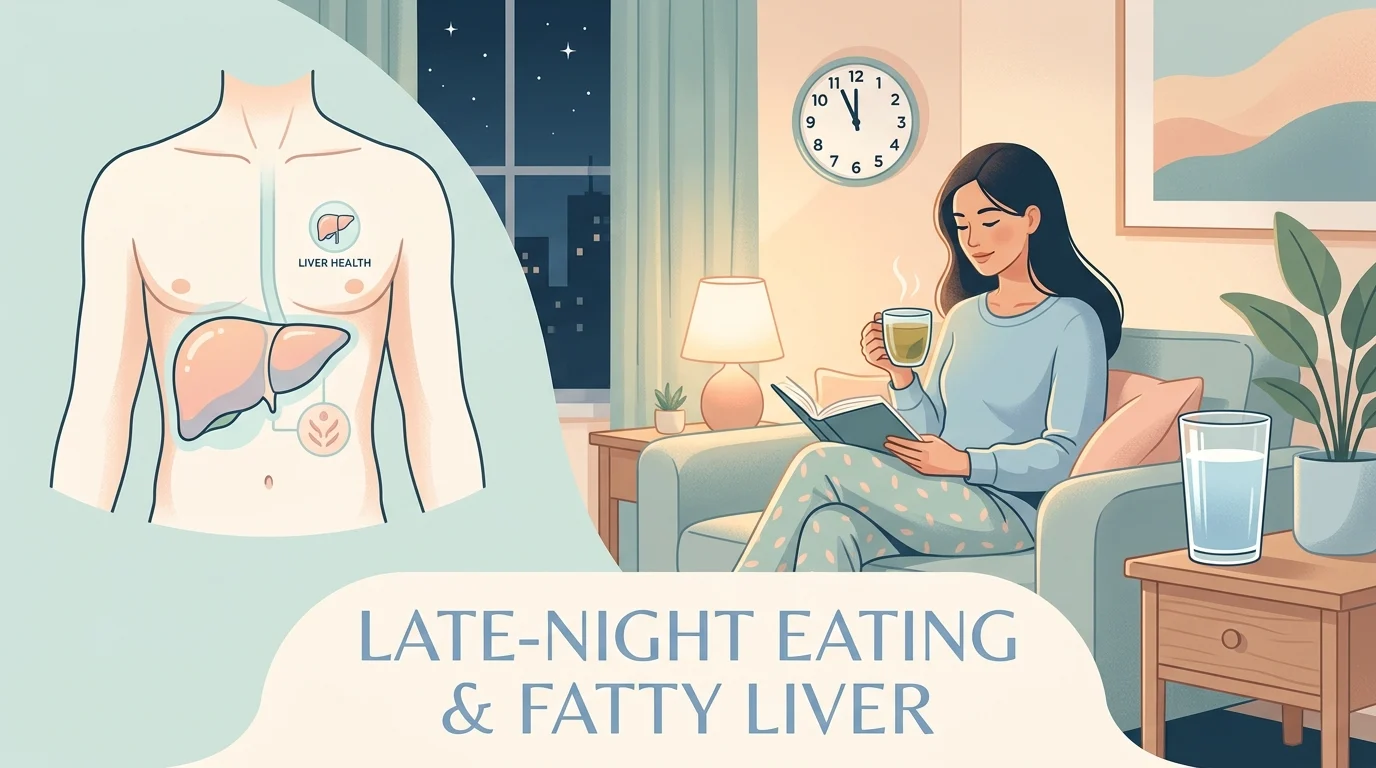
Late-night snacking has a new entry in the medical literature. On October 9, 2026, researchers from Oregon Health & Science University (OHSU) and Massachusetts General Hospital reported in Clinical Gastroenterology and Hepatology that people who reported late-night eating had higher rates of metabolic dysfunction-associated steatotic liver disease (MASLD, formerly called fatty liver disease) and of cirrhosis. The finding is an association, not proof of cause and effect, but it adds a timing question to the usual advice about what we eat. Here is what the study shows, what it cannot show, and which routine lab tests can help you keep an eye on your liver.
What the OHSU study found
The team analyzed data from large U.S. cohorts, including the Nurses’ Health Study and the Health Professionals Follow-up Study, covering nearly 200,000 participants according to press coverage of the paper. Participants reported their diet and lifestyle habits, and the researchers compared people who reported eating after dinner or after bedtime with people who did not.
According to the researchers, late-night eaters had roughly 20% to 30% higher rates of liver disease, including MASLD and cirrhosis, than people who did not report the habit. Media summaries do not spell out the exact statistic behind that range, so it is best read as an approximate signal rather than a precise personal risk figure.
Lead author Robert Wilechansky, a hepatologist at OHSU, described the work as among the first long-term analyses to explicitly connect late-night eating with fatty liver disease. Co-author Andrew McHill, a circadian physiologist, noted that the timing of behaviors such as sleeping, eating and exercising really matters.
What the study cannot tell us
Observational studies are good at spotting patterns, but they have clear limits. The table below separates what the data suggest from what is still open.
| السؤال | What the study suggests | Caveat |
|---|---|---|
| Is late-night eating linked to MASLD and cirrhosis? | Yes, an association of roughly 20% to 30% was reported | Observational design, so it cannot prove cause |
| Does eating late harm the liver directly? | Not tested | Body weight, diet quality and sleep may explain part of the link |
| Was the habit measured precisely? | لا | Habits were self-reported and broadly defined as eating after dinner or after bedtime |
| Will most late-night eaters develop cirrhosis? | لا | Only a small share of people with fatty liver progress to cirrhosis |
| Does eating earlier improve liver health? | Unknown | OHSU plans a study that monitors eating directly to test this |
Why meal timing might matter for the liver
The liver follows a daily rhythm. It handles sugars and fats differently depending on whether the body expects food or rest, and that rhythm is set partly by light, sleep and meal times. Animal research cited in coverage of the study suggests the liver is among the organs most sensitive to a mismatch between eating and sleeping.
Night-shift workers offer a real-world clue. Their body clocks are often out of step with their meals, and they tend to have higher rates of obesity and heart disease. Whether the same mismatch directly harms the liver in people who simply snack late is exactly what remains to be tested. Extra evening calories, weight gain and poorer sleep are all plausible stepping stones.
Latest scientific advances: what timing research says so far
Based on articles retrieved from PubMed, the new OHSU paper sits within a growing body of research on when we eat. A 2025 randomized trial in the Journal of Hepatology tested time-restricted eating, meaning keeping all meals inside a set daily window, in adults with overweight or obesity and MASLD. After 16 weeks, liver fat dropped clearly more than with usual care, and about as much as with a classic calorie-reduction plan. In plain terms, shortening the eating window worked, but it did not beat simply eating less.
A 2024 literature review in Nutrients reached a more cautious conclusion. Eating-window approaches may help with weight and fat loss, and liver benefits seem to come mostly through that weight loss, but the human studies available are still scarce and there is no conclusive evidence yet.
What this changes for you: the idea that a long overnight break from food could be good for your liver is plausible and actively studied, but it is not a proven treatment. Overall diet quality, physical activity, alcohol intake and body weight remain the best-supported levers.
What you can do with this information
Nothing in the study says you must never eat after dinner. Reasonable, low-risk steps include:
- Finishing your last substantial meal a few hours before bed when your schedule allows it, as the lead author suggested.
- Noticing whether evening snacks are driven by habit, hunger, stress or short sleep.
- Prioritizing the proven basics: a balanced diet, regular physical activity, limited alcohol and weight management if your doctor advises it.
- Keeping routine blood work up to date, since fatty liver usually causes no symptoms.
Which blood tests help track liver health
Fatty liver is often silent, so it is frequently suspected when liver test results come back abnormal. According to MedlinePlus, providers may combine liver function tests with imaging to detect liver fat and scarring. Our guide covers the fatty liver blood test and what it can catch.
| علامة | ما يعكسه | Keep in mind |
|---|---|---|
| ALT | Irritation of liver cells | Can be normal even when fat has built up |
| AST | Enzyme found in liver and muscle | The AST to ALT balance adds context |
| جي جي تي | Bile duct and alcohol-related stress | Rises with several unrelated causes |
| الدهون الثلاثية | Blood fats often raised in fatty liver | Recent meals can change the result |
| جلوكوز الصيام | ضبط مستوى السكر في الدم | Insulin resistance is a core driver of MASLD |
Our dedicated page explains high ALT levels and their causes. For a broader overview, read liver function tests and how to read the results. A related news article reviews how a prediabetes diet affects liver fat.
متى يجب عليك التحدث إلى طبيبك؟
- You have persistent tiredness or discomfort in the upper right abdomen.
- A recent blood test showed raised liver enzymes.
- You have type 2 diabetes, prediabetes, obesity, high triglycerides or high blood pressure and have never had your liver checked.
- You notice yellowing of the skin or eyes, swelling of the abdomen or legs, black stools or vomiting blood. These need urgent medical care.
Do not change medications or start a restrictive fasting plan without medical advice, especially if you have diabetes.
مسرد المصطلحات
- MASLD: metabolic dysfunction-associated steatotic liver disease, the current name for fat build-up in the liver linked to metabolic risk factors.
- تليّف الكبد: advanced scarring of the liver that disrupts its function.
- التنكس الدهني (Steatosis): the medical term for excess fat stored inside liver cells.
- ALT: alanine aminotransferase, a liver enzyme measured in a standard blood test.
- Time-restricted eating: limiting all meals to a fixed window of hours each day.
- Circadian rhythm: the roughly 24-hour internal clock that regulates sleep, hormones and metabolism.
الأسئلة الشائعة
Is late-night eating a proven cause of fatty liver?
No. The OHSU study reports an association based on self-reported habits. Weight, diet quality and sleep may explain part of the link, and a trial that monitors eating directly is still to come.
What counts as late-night eating in the study?
Coverage describes it as eating after dinner or after bedtime. No precise clock time has been reported in the summaries available.
هل يمكن لفحص الدم اكتشاف الكبد الدهني؟
Blood tests such as ALT and AST can raise suspicion, but they can be normal even when fat has built up. Imaging is often needed to confirm liver fat or scarring.
Should I stop eating after dinner?
The study does not justify a strict rule. Leaving a few hours between your last large meal and bedtime is a reasonable, low-risk habit, and your doctor can tailor advice to your situation.
Does time-restricted eating help fatty liver?
One 16-week randomized trial found it reduced liver fat about as much as cutting calories. Longer studies are needed, and it is not a substitute for medical care.
مصادر
- Literature retrieved from PubMed: Wilechansky RM et al., Late-Night Eating is Associated with MASLD and Cirrhosis, Clinical Gastroenterology and Hepatology, 2026. DOI 10.1016/j.cgh.2026.09.047
- Oh JH et al., Efficacy and safety of time-restricted eating in MASLD, Journal of Hepatology, 2025. DOI 10.1016/j.jhep.2025.06.005
- Mentzelou M et al., Chrononutrition in the Prevention and Management of Metabolic Disorders, Nutrients, 2024. DOI 10.3390/nu16050722
- NIDDK: Definition and facts of NAFLD and NASH
- MedlinePlus: Fatty liver disease
- News-Medical: Late-night snacking may affect liver health (October 9, 2026)
- Medical Economics: Is late-night eating hurting your liver? (October 12, 2026)
مقالات أخرى
- تحليل الدم للكشف عن الكبد الدهني: هل يمكنه اكتشاف MASLD؟
- GGT Test: Liver Enzyme Results Explained
- مستويات الدهون الثلاثية الطبيعية: النطاقات والمخاطر
- نظام غذائي لمقدمات السكري ودهون الكبد: تجربة جديدة
افهم نتائج تحاليل دمك بنفسك مع AI DiagMe
Liver enzymes, triglycerides and glucose are easier to put in context when you see them together. افهم نتائج مختبرك باستخدام AI DiagMe، ذكاء اصطناعي خاضع لمراجعة لجنة من الأطباء، مع استضافة البيانات في فرنسا.