













































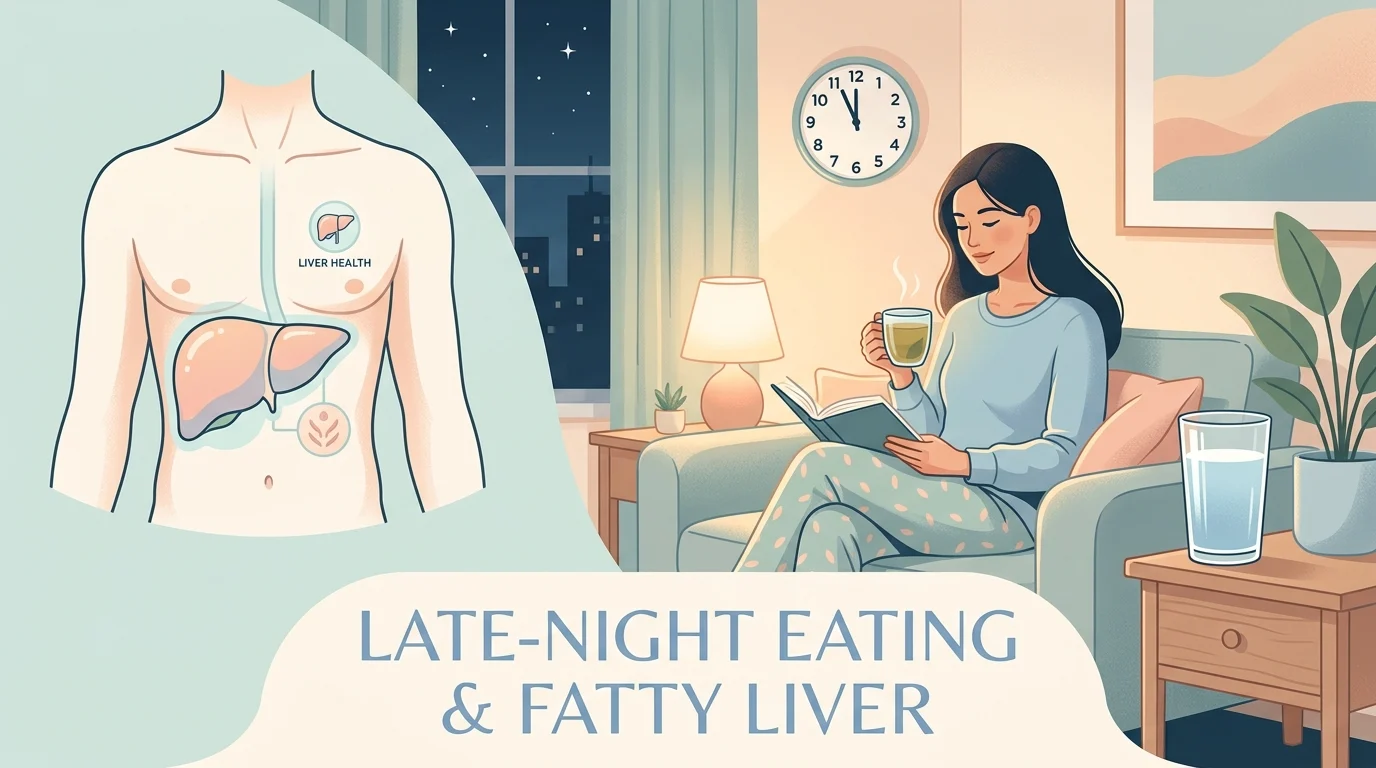
Do evening snacks matter for your liver? A new study suggests they might. On 9 October 2026, researchers from Oregon Health & Science University (OHSU) and Massachusetts General Hospital reported in Clinical Gastroenterology and Hepatology that people who said they ate late at night had higher rates of metabolic dysfunction-associated steatotic liver disease (MASLD, the condition the NHS still often calls non-alcoholic fatty liver disease or NAFLD) and of cirrhosis. It is an association rather than proof that late eating causes liver damage, but it brings meal timing into a conversation that usually focuses on what we eat. NICE estimates that MASLD affects around 30% of all adults, so the question is relevant to many people in the UK. Below we cover what the study found, its limits, and which tests, including those used in the NHS, can help you keep track of your liver.
What the OHSU study found
According to press coverage of the paper, the researchers drew on data from nearly 200,000 participants in large American cohorts, including the Nurses’ Health Study and the Health Professionals Follow-up Study. Participants described their diet and lifestyle, and the team compared those who reported eating after their evening meal or after going to bed with those who did not.
The researchers say late-night eaters had liver disease rates, covering MASLD and cirrhosis, about 20% to 30% higher than people without the habit. Media reports do not give the precise statistic behind this range, so it is best treated as a rough signal rather than a figure for your own risk.
Lead author Robert Wilechansky, a hepatologist at OHSU, described the analysis as among the first long-term studies to link late-night eating specifically with fatty liver disease. Co-author Andrew McHill, who studies circadian physiology, stressed that the timing of sleep, meals and exercise really does matter.
What the study cannot tell us
Observational research can reveal patterns, but it cannot settle cause and effect. The table sets out what the data point to and what remains uncertain.
| Question | What the data suggest | Caveat |
|---|---|---|
| Is eating late linked with MASLD and cirrhosis? | Yes, rates were roughly 20% to 30% higher | An observational design cannot prove causation |
| Does late eating itself damage the liver? | This was not tested | Weight, diet quality and sleep could account for some of the link |
| Was the habit measured accurately? | No | It was self-reported and loosely defined as eating after dinner or after bedtime |
| Will most people who snack late get cirrhosis? | No | Only a small proportion of people with fatty liver go on to develop cirrhosis |
| Would eating earlier help the liver? | Not known | OHSU is planning a study that tracks eating directly to find out |
Why meal timing could affect the liver
Your liver works to a daily rhythm. It processes sugars and fats differently depending on whether the body is expecting food or rest, and that rhythm is set partly by light, sleep and when you eat. Animal studies mentioned in coverage of the research suggest the liver is one of the organs most affected when eating and sleeping fall out of step.
Shift workers provide a real-world hint. Their internal clocks are often at odds with their mealtimes, and they tend to have higher rates of obesity and heart disease. Whether that mismatch harms the liver in people who simply snack late in the evening is precisely what still needs testing. Additional evening calories, gradual weight gain and poorer sleep are all plausible links in the chain.
Latest scientific advances: what timing research shows so far
Based on articles retrieved from PubMed, the OHSU paper joins a growing field of research into when we eat. A 2025 randomised trial in the Journal of Hepatology tested time-restricted eating, in which all meals are kept within a fixed daily window, in adults with overweight or obesity and MASLD. After 16 weeks, liver fat fell clearly more than with usual care and by a similar amount to a standard calorie-reduced diet. Put simply, a shorter eating window worked, but no better than just eating less.
A 2024 review in Nutrients was more cautious. It found that eating-window approaches may aid weight and fat loss, that any liver benefit appears to come mainly through that weight loss, and that human studies remain too few for firm conclusions.
What this means for you: a long overnight break from food may well be good for the liver and is being actively researched, but it is not an established treatment. The best-supported levers are still overall diet quality, physical activity, alcohol intake and body weight.
What you can do with this information
The study does not say you must never eat after your evening meal. Sensible, low-risk steps include:
- Having your last substantial meal a few hours before bed when your routine allows, as the lead author suggested.
- Noticing whether late snacks are driven by hunger, habit, stress or too little sleep.
- Focusing on the proven basics: a balanced diet, regular activity, keeping alcohol within the UK guideline of no more than 14 units a week spread over three or more days, and managing your weight if your GP advises it.
- Taking up your NHS Health Check if you are invited (it is offered every 5 years to eligible adults aged 40 to 74 and includes a cholesterol test and possibly a blood sugar test), and keeping other routine blood tests up to date, because fatty liver rarely causes symptoms.
Which tests help keep track of liver health
Fatty liver usually causes no symptoms, and the NHS notes that it is often picked up on blood tests or scans done for another reason. Your GP may then arrange further blood tests and sometimes an ultrasound scan of your tummy. NICE warns that routine liver blood tests should not be used to rule MASLD out, because they can be normal even when fat has built up. Once MASLD is diagnosed, NICE recommends testing for advanced liver fibrosis (scarring), and suggests the enhanced liver fibrosis (ELF) blood test for this, with a score of 10.51 or above leading to referral to a liver specialist. Our guide explains the fatty liver blood test and what it can detect.
| Test | What it reflects | Bear in mind |
|---|---|---|
| ALT | Stress or injury to liver cells | Often normal despite fat build-up |
| AST | An enzyme found in liver and muscle | The ratio of AST to ALT adds context |
| GGT | Bile duct strain and alcohol-related stress | Can rise for many unrelated reasons |
| Triglycerides (mmol/L) | Blood fats, often raised in fatty liver | A recent meal can affect the result |
| Fasting glucose (mmol/L) or HbA1c | Blood sugar control | Insulin resistance is a central driver of MASLD |
| ELF test | Markers of liver scarring, recommended by NICE once MASLD is diagnosed | Below 10.51, NICE advises retesting every 3 years in adults |
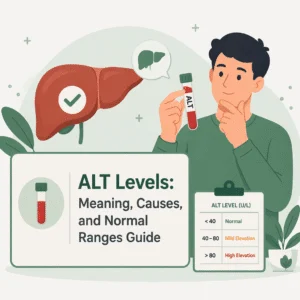
Our dedicated page covers high ALT levels and their causes. For the bigger picture, read liver function tests and how to read the results. A related news piece looks at how a prediabetes diet affects liver fat.
When to see your GP
- You have ongoing tiredness or discomfort under the right side of your ribs.
- A recent blood test showed raised liver enzymes.
- You have type 2 diabetes, prediabetes, obesity, raised triglycerides or high blood pressure and have never had your liver assessed. NICE notes that MASLD is more common in people with type 2 diabetes or metabolic syndrome.
- You notice yellowing of the skin or whites of the eyes, swelling of the tummy or legs, black stools or vomiting blood. These need urgent medical help. The NHS advises calling 999 or going to A&E if you vomit blood and also feel faint, dizzy or unwell or have black poo; otherwise get an urgent GP appointment or contact NHS 111.
Do not change your medicines or start a strict fasting plan without advice from your GP, particularly if you have diabetes.
Glossary
- MASLD: metabolic dysfunction-associated steatotic liver disease, the current name for fat build-up in the liver linked to metabolic risk factors, previously known as NAFLD.
- Cirrhosis: severe scarring of the liver that impairs how it works.
- Steatosis: the medical term for excess fat inside liver cells.
- ALT: alanine aminotransferase, a liver enzyme included in standard liver blood tests.
- ELF test: the enhanced liver fibrosis blood test, which NICE recommends to check for advanced scarring in people with MASLD.
- Time-restricted eating: confining all meals to a set number of hours each day.
- Circadian rhythm: the body’s roughly 24-hour clock, which governs sleep, hormones and metabolism.
FAQ
Has late-night eating been proven to cause fatty liver?
No. The OHSU study found an association using self-reported habits. Body weight, diet quality and sleep may explain part of it, and a study that measures eating directly has yet to be done.
What counted as late-night eating?
Reports describe it as eating after the evening meal or after going to bed. No exact clock time has appeared in the summaries published so far.
Can a blood test pick up fatty liver?
Liver blood tests such as ALT and AST can raise suspicion but are often normal even when fat has accumulated, which is why NICE says they should not be used to rule MASLD out. An ultrasound scan is often used to confirm liver fat, and the ELF test helps assess scarring.
Should I stop eating after my evening meal?
The study does not support a rigid rule. Leaving a few hours between your last large meal and bedtime is a reasonable, low-risk habit, and your GP can tailor advice to you.
Does time-restricted eating help fatty liver?
One 16-week randomised trial found it lowered liver fat by about as much as calorie restriction. Longer studies are needed, and it does not replace medical care.
Sources
- Retrieved via PubMed: Wilechansky RM et al., Late-Night Eating is Associated with MASLD and Cirrhosis, Clinical Gastroenterology and Hepatology, 2026. DOI 10.1016/j.cgh.2026.09.047
- Oh JH et al., Efficacy and safety of time-restricted eating in MASLD, Journal of Hepatology, 2025. DOI 10.1016/j.jhep.2025.06.005
- Mentzelou M et al., Chrononutrition in the Prevention and Management of Metabolic Disorders, Nutrients, 2024. DOI 10.3390/nu16050722
- NHS: Non-alcoholic fatty liver disease (NAFLD)
- NICE guideline NG49: MASLD, assessment and management
- NHS: Alcohol units
- NIDDK: Definition and facts of NAFLD and NASH
- MedlinePlus: Fatty liver disease
- News-Medical: Late-night snacking may affect liver health (9 October 2026)
- Medical Economics: Is late-night eating hurting your liver? (12 October 2026)
Other articles
- Fatty Liver Blood Test: Can It Catch MASLD?
- GGT Test: Liver Enzyme Results Explained
- Normal Triglyceride Levels: Ranges and Risks
- Prediabetes Diet and Liver Fat: New Trial
- Fat in the liver or a mildly high ALT? Read our full guide to fatty liver disease (MASLD): symptoms, tests and treatment.