Statiner är de mest förskrivna hjärt-kärlläkemedlen i världen, och muskelvärk är den vanligaste orsaken till att folk slutar ta dem. Den 1 augusti 2026 publicerade forskare vid McMaster University ett arbete som äntligen ger en förklaring till dessa symtom – och det är inte den förklaring de flesta läkare har lärt sig.
Fyndet är viktigt för alla som läser ett provsvar, eftersom det förändrar hur du bör tolka en specifik rad i det: kreatinkinas, som vanligtvis anges som CK eller CPK.
Vad den nya studien faktiskt visade
Forskargruppen, ledd av Jonathan Schertzer vid McMaster’s institution för biokemi och biomedicinska vetenskaper, rapporterade i Science Advances att statiner stör hur muskelceller producerar energi. Den metabola störningen aktiverar ett internt larmsystem kallat NLRP3-inflammasomen – i princip en immunbrytare som sitter inuti själva muskelcellen.
När den brytaren slås om börjar cellen skada sig själv. I muskelceller och hos möss förhindrade blockering av NLRP3-signalvägen det mesta av skadan. Att återställa en grupp molekyler kallade isoprenoiderna fungerade också. Att återställa kolesterol gjorde det inte.
Den sista detaljen är den viktiga. Den innebär att den signalväg som orsakar muskelsymtom är skild från den som sänker ditt kolesterol. I praktiken betyder det: muskelproblemet är inte priset du betalar för kolesterolnyttan. Det är två olika vägar som råkar börja med samma läkemedel.
Uppskattningsvis 7 till 29 procent av alla som tar statiner rapporterar muskelsymtom – smärta, svaghet, kramper eller att de helt enkelt inte kan träna som de brukade. Fram tills nu har förklaringen varit vag. Nu har det fått ett namn och en uppsättning molekylära mål.
Varför detta syns i ditt blodprov
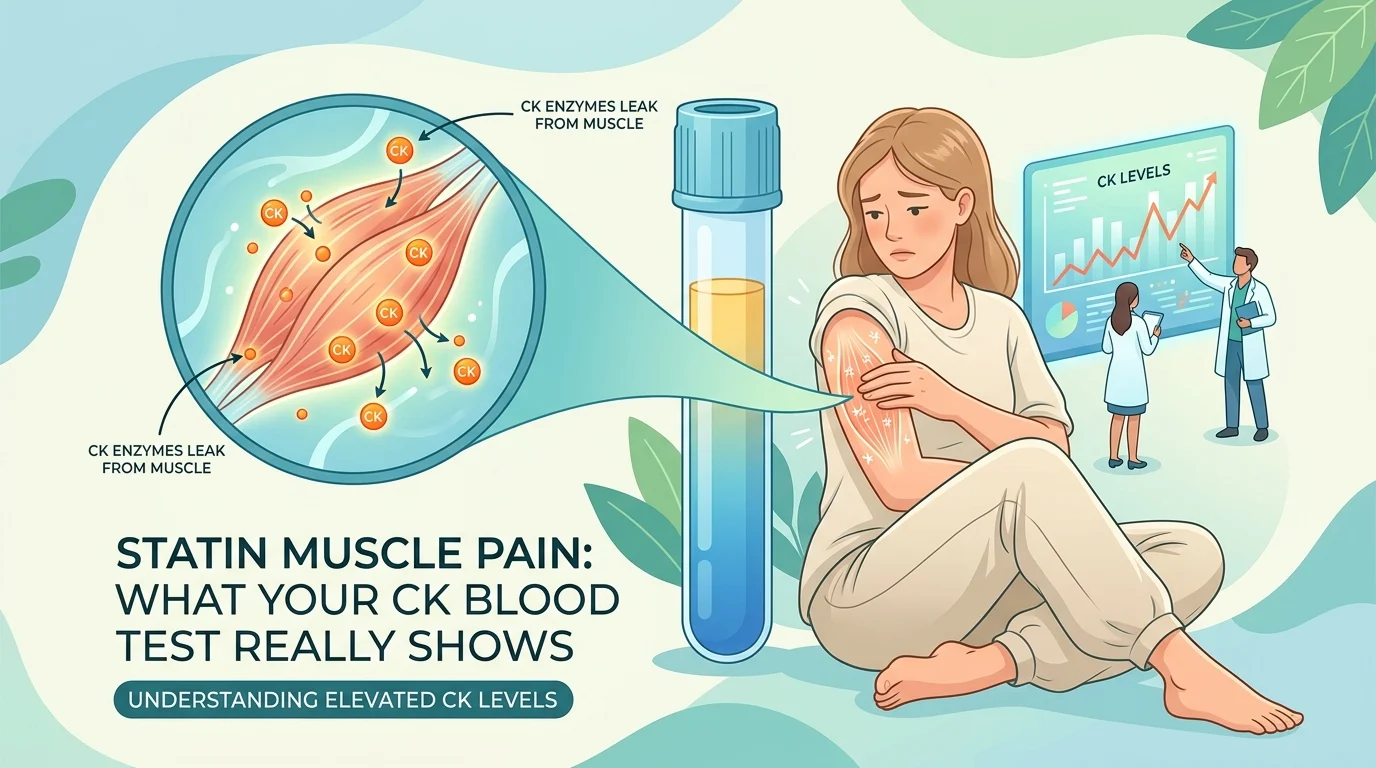
Kreatinkinas är ett enzym som finns inuti muskelfibrerna. När muskelceller utsätts för stress eller börjar brytas ned läcker CK ut i blodet och värdet i ditt provsvar stiger. Det gör det till standardprovet som en läkare beställer när muskelsymtom uppstår under statinbehandling. Vår fullständiga guide om CPK-blodprovet och vad högt kreatinkinas betyder täcker markören i detalj.
Det McMaster-forskningen tillför är en förklaring till varför CK beter sig så missvisande i just den här situationen. Skadan som beskrivs i studien är låggradig och cellautonom – muskelceller skadar sig tyst och stilla via en immunologisk mekanism. Den typen av skada leder inte nödvändigtvis till att tillräckligt mycket enzym läcker ut i blodet för att driva upp CK över ett laboratorietröskelvärde. Det är därför en stor andel av dem som verkligen har statinrelaterade muskelsymtom får ett CK-värde som ser helt normalt ut.
Ett normalt CK-värde betyder inte att dina symtom är inbillade. Det betyder att CK aldrig var utformat för att upptäcka det som händer i din kropp.
Hur du tolkar ett CK-värde under statinbehandling
Referensvärdena varierar mellan olika laboratorier, så resultaten tolkas vanligtvis som multipler av den övre normalgränsen, skrivet som ULN eller N. Tabellen nedan speglar hur kliniker i allmänhet läser av värdet.
| CK-värde | Vanlig tolkning | Vad som vanligtvis händer |
|---|---|---|
| Inom normalvärdet, symtom förekommer | Vanligt vid statinrelaterade muskelsymtom | Symtomen bedöms kliniskt, inte utifrån värdet |
| Lätt förhöjt, under 5x ULN | Ofta träning, skada eller individuell variation | Nytt prov efter vila; behandlingen fortsätts ofta |
| Över 5x ULN | Betydande muskelskada | Statinet pausas vanligtvis och orsaken utreds |
| Mycket högt, tiotusentals | Rabdomyolys | Akut vård; njurfunktionen kontrolleras omedelbart |
Två praktiska faktorer påverkar hur mycket ett enskilt CK-värde är värt. För det första är CK extremt känsligt för fysisk aktivitet – ett hårt träningspass, en lång vandring eller till och med en intramuskulär injektion kan höja värdet i flera dagar, vilket är anledningen till att blodprovet bör tas på god avstånd från intensiv träning. För det andra skiljer sig individuella basvärden enormt; en del friska personer har helt enkelt ett naturligt högt värde.
CK finns också i olika former. Den variant som speglar hjärtmuskeln är ett helt annat mätvärde, som förklaras på vår sida om CK-MB-provet och varför troponin ersatte det. När skelettmuskulatur bryts ned snabbt stiger ett annat protein parallellt med CK – det tar vi upp i vår guide om myoglobin som muskelmarkör.
Leverprovet som inte kommer från levern
Här är fällan som får folk att oroa sig i onödan. När muskler bryts ned i större mängd frisätts AST – ett enzym som de flesta känner till som en levermarkör – ut i blodet. Den som tar ett statin och ser ett förhöjt AST drar ofta slutsatsen att läkemedlet har skadat levern, när enzymet i själva verket kom från musklerna.
Mönstret är oftast igenkännbart: AST stiger tydligt medan ALT knappt rör sig, och CK är förhöjt samtidigt. Vår förklaring om att tolka AST/ALT-kvoten går igenom hur man skiljer dem åt. Vid kraftig muskelnedbrytning spelar även njurmarkörer roll – och det är där urinkreatinin som måttstock blir relevant.
När muskelsymtom inte är vanlig statinintolerans
De flesta muskelsymtom av statiner är lindriga, övergående och försvinner efter en dosjustering eller byte till ett annat statin. I ett litet antal fall rör det sig om något helt annat, och skillnaden fastställs i laboratoriet.
- Immunmedierad nekrotiserande myopati: en sällsynt autoimmun reaktion där CK förblir förhöjt även efter att statinet satts ut, med tilltagande muskelsvaghet. Diagnosen bekräftas med ett antikroppstest mot HMG-CoA-reduktas.
- Rabdomyolys: massiv muskelnedbrytning med svår smärta, muskelsvaghet och mörk urin. Fallrapporter dokumenterar CK-värden från ungefär 3 000 till över 47 000 U/L, ofta med akut njurskada.
- Läkemedelsinteraktioner: vissa läkemedel höjer statinnivåerna i blodet och mångdubblar muskelrisken. Dokumenterade exempel inkluderar vissa cancerbehandlingar, azolantimykotika och fibrater.
- Obehandlad hypotyreos, nedsatt njurfunktion och hög alkoholkonsumtion ökar alla känsligheten, vilket är anledningen till att sköldkörtel- och njurfunktion ofta kontrolleras tillsammans med CK.
De senaste vetenskapliga rönen – på vanlig svenska
Tre trådar från den senaste forskningen är värda att känna till – ingen av dem kräver att du läser en statistiktabell.
Den första är att specialister numera i stort sett är överens om att det inte finns något enskilt blodprov som bevisar att ett muskelsymtom orsakas av ett statin. Översikter av statinrelaterade muskelsymtom beskriver diagnostiken som en klinisk process – sätt ut, observera, återinsätt försiktigt, observera igen – där CK används som en säkerhetskontroll snarare än som ett bevis.
Det andra är att strukturerad återintroduktion fungerar oftare än vad folk förväntar sig. En stor andel av dem som slutar med statiner kan tolerera en lägre dos, ett annat statin eller ett varannan-dag-schema. Eftersom McMaster-forskningen tyder på att muskelvägen är skiljbar från kolesterolvägen, finns det nu en mekanism bakom detta resonemang.
Det tredje är att när ett statin verkligen inte tolereras finns det alternativ som har jämförts direkt mot varandra. En nätverks-metaanalys av mer än 100 000 patienter visade att vissa injicerbara kolesterolsänkande behandlingar gav färre nya muskelsymtom och färre episoder av kraftigt förhöjt CK än andra. Den jämförelsen är ett samtal att ha med din läkare – inte en anledning att ändra något på egen hand.
Vad du ska göra om detta gäller dig
Om muskelsymtom uppstod eller förvärrades efter att du börjat med ett statin eller ökat dosen, berätta det för din läkare i stället för att sluta med läkemedlet på egen hand. Att sluta abrupt tar bort ett bevisat skydd mot hjärtinfarkt och stroke, och den bakomliggande anledningen till att du fick det förskrivet har inte försvunnit – som vår översikt av högt kolesterol, målvärden och behandling beskriver.
Notera när symtomen började, vilka muskler som är inblandade och om du har börjat med något nytt läkemedel eller kosttillskott. Nämn eventuell intensiv träning dagarna innan ditt blodprov togs. Fråga om sköldkörtelfunktionen bör kontrolleras samtidigt. Och ta med dina fullständiga lipidpanel till samtalet, eftersom beslutet om vad som ska göras härnäst beror på hur mycket kardiovaskulär risk läkemedlet väger upp – en beräkning som nyligen förändrades, vilket vi tog upp i den nya LDL-kolesterolberäkningen på labbrapporter.
Mörk urin, svår svaghet eller smärta som hindrar dig från att röra dig normalt är något annat. Den kombinationen kräver akut läkarvård samma dag.
Vanliga frågor
Kan mitt CK vara normalt även om statinet orsakar mina symtom?
Ja, och det är det ofta. Den mekanism som McMaster-teamet beskriver ger en låggradig muskelskada som inte alltid frigör tillräckligt med enzym för att överstiga ett laboratorietröskelvärde. Ett normalt CK utesluter allvarlig muskelförstörelse – men det utesluter inte statinrelaterade muskelsymtom.
Bör jag kontrollera mitt CK innan jag börjar med ett statin?
Rutinmässig testning av alla inför behandling rekommenderas i allmänhet inte. Ett basvärde är användbart i specifika situationer: njurpåverkan, hypotyreos, personlig eller ärftlig historia av muskelsjukdom, tidigare muskelreaktion på ett statin eller fibrat, hög alkoholkonsumtion, eller hög ålder med ytterligare riskfaktorer.
Hur länge efter träning bör jag vänta innan ett CK-test?
Minst två dagar efter all intensiv muskelansträngning, och längre efter ovanlig eller excentrisk träning. Ett tydligt förhöjt värde kontrolleras vanligtvis om efter ungefär en vecka för att se om det sjunker.
Försvinner muskelvärken om jag slutar med statinet?
I de allra flesta fall försvinner symtomen efter att läkemedlet satts ut, men det kan ta veckor till månader innan de helt avtar. Symtom som kvarstår, eller ett CK som förblir högt efter utsättning, bör leda till att man söker en annan orsak, inklusive autoimmun myopati.
Betyder den här studien att en behandling är på väg?
Inte ännu. Att identifiera NLRP3-vägen ger läkemedelsutvecklare ett mål, och författarna är tydliga med att mer forskning behövs innan något av detta når patienter. Det omedelbara värdet är diagnostisk klarhet, inte ett nytt recept.
Ordlista
- Kreatinkinas (CK, CPK): ett enzym som finns inuti muskelceller och läcker ut i blodet när muskeln skadas.
- ULN: övre normalgräns, det högsta värdet i laboratoriets referensintervall. Resultat beskrivs ofta som multiplar av detta värde.
- NLRP3-inflammasom: ett proteinkomplex inuti celler som fungerar som ett larm och utlöser inflammation när det upptäcker farosignaler.
- Isoprenoider: molekyler som tillverkas längs samma produktionslinje som kolesterol och som behövs för att fästa vissa proteiner vid cellmembran.
- Statinrelaterade muskelsymtom (SAMS): samlingsterm för muskelvärk, muskelsvaghet, kramper eller ömhet som rapporteras under statinbehandling.
- Rabdomyolys: snabb och omfattande nedbrytning av muskelvävnad som kan överväldigande belasta njurarna.
- HMG-CoA-reduktas: det enzym som statiner blockerar för att sänka kolesterolproduktionen, och målet för den antikropp som hittas vid immunmedierad nekrotiserande myopati.
Förstå dina egna provsvar
Ett CK-värde betyder väldigt lite på egen hand. Det blir först användbart när det sätts i relation till dina transaminaser, dina njurmarkörer, dina sköldkörtelprover och de läkemedel du tar. AI DiagMe läser igenom hela din labbrapport och förklarar, rad för rad, vad varje värde betyder i just ditt sammanhang — inklusive vilka siffror som tyder på muskel- snarare än leverursprung. Ladda upp din rapport på aidiagme.com för att få en tydlig, lättförståelig förklaring innan ditt nästa läkarbesök.
Vidare läsning
- Utökad lipidpanel: vad den mäter och vem som behöver den
- Normala LDL-nivåer: varför det inte finns ett enda hälsosamt referensvärde
- Lipoprotein(a)-screening för alla vuxna
- Blodproven som avgör om du behöver blodtrycksmedicin
- Muskelförlust, eGFR och cystatin C-testet
Källor
- McMaster University. Scientists may have found a way to prevent statin muscle pain. ScienceDaily, 1 August 2026. sciencedaily.com
- Robin N, Barra NG, Foley KP, et al. Statins promote muscle metabolic danger and NLRP3-mediated myopathy via lower protein-prenylation and YAP. Science Advances. 2026;12(25):eadz3612. DOI — PubMed
- Cha J, et al. Diagnosis and Management of Statin-Associated Muscle Symptoms. Korean Circulation Journal. 2025. Referens
- Shah M, et al. Statin-associated muscle symptoms: a comprehensive exploration of epidemiology, pathophysiology, diagnosis, and clinical management strategies. International Journal of Rheumatic Diseases. 2024. Referens
- Li W, Sun Y, Yan J. PCSK9 inhibitors and inclisiran with or without statin therapy on incident muscle symptoms and creatine kinase: a systematic review and network meta-analysis. Frontiers in Cardiovascular Medicine. 2024. Referens
- Zhao C, Duffield A, Toz B. Anti-HMGCR immune-mediated necrotizing myopathy with subsequent diagnosis of mantle cell lymphoma. Cureus. 2026;18(5):e108086. DOI
- Nguyen M, et al. Delayed-onset rhabdomyolysis of bilateral lower extremities following statin therapy. American Journal of Case Reports. 2025;26:e948601. DOI
- João RB, Soares LR, Ragazzo PC, Freitas-Junior R. CDK4/6 inhibitor-statin interaction and rhabdomyolysis in breast cancer treatment: a case-based systematic review. Cancer Chemotherapy and Pharmacology. 2026;96(1). DOI