Dacă în analizele tale apare un nivel ridicat de VLDL, primul lucru important de știut este că această valoare aproape sigur nu a fost măsurată direct. Într-un profil lipidic standard, colesterolul VLDL este calculat pe baza trigliceridelor, cel mai adesea prin împărțirea lor la cinci. Acest detaliu schimbă semnificativ importanța pe care o acordăm acestei valori: în majoritatea cazurilor, un rezultat ridicat al VLDL este, de fapt, o altă exprimare a unui nivel ridicat de trigliceride, nu o constatare separată. În acest articol vei afla ce este lipoproteinele cu densitate foarte mică (VLDL), de ce există acest calcul și când nu mai este fiabil, ce anume crește această valoare, care sunt riscurile reale și când merită să discuți cu medicul tău despre acest rezultat. Tonul articolului este deliberat echilibrat, deoarece o singură valoare crescută pe un singur set de analize nu reprezintă un diagnostic.
De ce valoarea VLDL este un calcul, nu o măsurătoare
Mulți oameni presupun că fiecare valoare dintr-o analiză de sânge corespunde unui element numărat direct de un aparat. În cazul colesterolului VLDL, lucrurile nu stau așa. Pagina MedlinePlus a Bibliotecii Naționale de Medicină din SUA precizează clar că nu există o metodă directă de măsurare a VLDL în practica de rutină. Laboratoarele îl estimează în schimb, iar estimarea se bazează pe o valoare care a fost măsurată: trigliceridele tale.
Metoda simplificată: trigliceridele împărțite la cinci
Metoda clasică provine din ecuația Friedewald, elaborată în anii 1970 și încă utilizată pe scară largă. Aceasta presupune că, într-o probă recoltată pe nemâncate, colesterolul transportat în interiorul particulelor VLDL reprezintă aproximativ o cincime din valoarea totală a trigliceridelor, atunci când ambele sunt exprimate în mg/dL. Astfel, un rezultat al trigliceridelor de 150 mg/dL produce un VLDL raportat de aproximativ 30 mg/dL. Cleveland Clinic descrie aceeași relație din perspectivă inversă: trigliceridele sunt, în general, de aproximativ cinci ori mai mari decât valoarea VLDL.
Consecința practică merită spusă clar. Dacă trigliceridele tale sunt ridicate, VLDL-ul va fi raportat automat ca ridicat, prin calcul aritmetic. Cele două valori nu sunt dovezi independente. A le citi ca două anomalii separate exagerează ceea ce a arătat de fapt panoul lipidic. Echipa noastră explică panoul lipidic complet și ce măsoară fiecare valoare.
Când estimarea nu mai este fiabilă
Un raport fix este o simplificare, iar simplificările cedează la extreme. MedlinePlus menționează că estimarea devine inexactă atunci când trigliceridele depășesc aproximativ 400 mg/dL — tocmai situația în care oamenii au cel mai mult nevoie de un răspuns precis. Raportul presupune, de asemenea, că proba a fost recoltată à jeun. Dacă ai mâncat înainte de recoltare, trigliceridele cresc temporar, ceea ce umflă VLDL-ul calculat fără ca metabolismul tău de bază să se fi schimbat cu nimic.
De aceea, o singură valoare VLDL crescută — mai ales pe o probă non-à jeun — este rareori suficientă pentru a acționa. Repetarea panoului în condiții corecte este un pas următor de rutină și rezonabil. Acest ghid acoperă nivelurilor normale ale trigliceridelor și a intervalelor de referință.
Formule mai noi și măsurarea directă
Medicina de laborator nu a stat pe loc. Deoarece raportul fix de o cincime clasifică greșit pacienții, cercetătorii au dezvoltat ecuații care ajustează raportul în funcție de valorile proprii de trigliceride și non-HDL ale fiecărei persoane, în loc să aplice un singur număr pentru toți. Există și măsurarea directă a fracțiunilor lipoproteinice prin ultracentrifugare, dar este lentă și costisitoare, astfel că rămâne în mare parte în laboratoarele de cercetare și de referință. Echipa noastră acoperă și schimbarea recentă în modul în care laboratoarele calculează colesterolul LDL.
Ce este de fapt VLDL-ul și ce transportă
Lipoproteina cu densitate foarte mică este o particulă pe care ficatul tău o produce și o eliberează în sânge. Rolul ei este transportul. Grăsimile nu se dizolvă în sânge, așa că organismul le învelește într-o coajă de proteine și fosfolipide care poate circula în siguranță prin sistemul circulator. O particulă VLDL este formată în cea mai mare parte din trigliceride ca greutate, cu o cantitate mai mică de colesterol inclus.
Pe măsură ce VLDL-ul circulă, enzimele de pe pereții vaselor de sânge extrag trigliceridele din el pentru a furniza energie mușchilor și țesutului adipos. Particula se micșorează, pierde o mare parte din încărcătura de grăsimi și devine proporțional mai bogată în colesterol. Unele dintre aceste particule micșorate sunt eliminate de ficat. Altele continuă pe această cale și sunt în cele din urmă transformate în LDL.
Cum se compară VLDL-ul cu LDL și HDL
Cele trei particule sunt cel mai bine înțelese prin ceea ce transportă în principal și în ce direcție se deplasează. VLDL părăsește ficatul încărcat cu trigliceride. LDL este ceea ce rămâne mai departe pe același traseu, transportând în principal colesterol spre țesuturi. HDL merge în sens invers, colectând excesul de colesterol și returnându-l la ficat. Echipa noastră descrie niveluri normale ale LDL și intervale sănătoase, iar acest ghid explică cauzele și riscurile colesterolului HDL scăzut.
De ce contează particulele reziduale pentru arterele tale
Particulele VLDL parțial golite se numesc reziduuri, iar colesterolul pe care îl mai transportă se numește colesterol rezidual. Spre deosebire de o particulă VLDL de dimensiune normală, un reziduu este suficient de mic pentru a pătrunde în peretele arterial, iar odată ajuns acolo poate fi reținut în loc să fie eliminat. Particulele bogate în colesterol reținute declanșează inflamație și contribuie la placa care îngustează arterele în timp. Acesta este motivul biologic pentru care o valoare VLDL persistent crescută nu este pur și simplu un număr fără importanță pe un buletin de analize.
Ce cauzează niveluri ridicate de VLDL
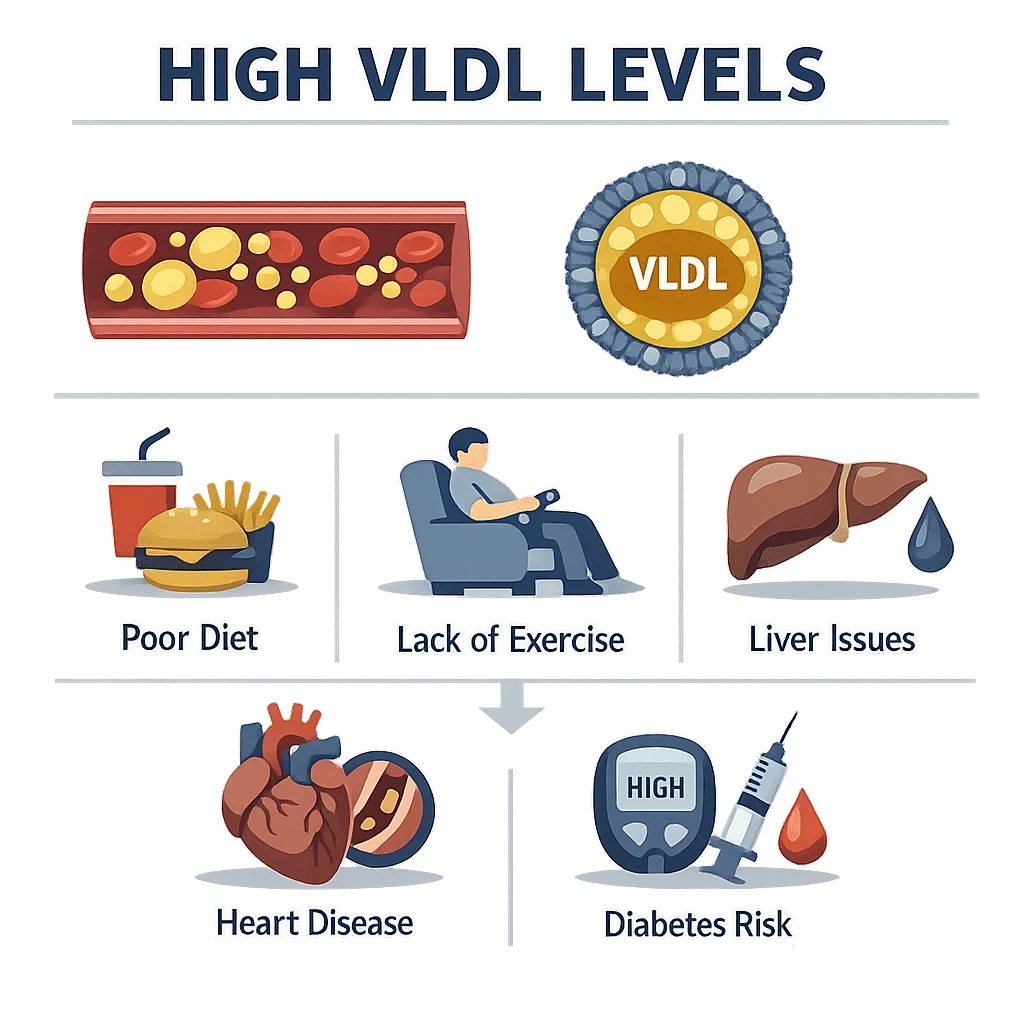
Deoarece valoarea raportată urmărește trigliceridele, orice crește trigliceridele crește și VLDL. Cauzele se încadrează în câteva grupuri ușor de recunoscut, iar mai mult de una se aplică adesea în același timp.
Cauze metabolice
- Rezistența la insulină, în care celulele răspund slab la insulină și ficatul produce mai multe particule bogate în trigliceride decât elimină
- Diabetul de tip 2 netratat sau insuficient controlat
- Excesul de greutate corporală, în special grăsimea acumulată în zona abdominală
- Sindromul metabolic, grupul format din tensiune arterială crescută, glicemie crescută, greutate abdominală și un profil lipidic nefavorabil
Acest grup explică majoritatea cazurilor întâlnite în practica medicală generală. Echipa noastră acoperă cauzele, simptomele și tratamentele diabetului, iar un alt ghid explică tabelul de conversie A1C și nivelurile medii de glucoză.
Alimentație, alcool și greutate corporală
Un consum foarte ridicat de carbohidrați rafinați și zaharuri adăugate determină ficatul să producă mai multe trigliceride, iar alcoolul face același lucru pe o cale separată. Ambele efecte pot fi semnificative și pot apărea în câteva zile, nu în ani. O masă copioasă recentă sau un weekend cu consum de alcool înainte de recoltarea sângelui poate modifica vizibil valoarea, ceea ce reprezintă un alt argument pentru a interpreta cu prudență un singur rezultat. Alimentația și activitatea fizică sunt domeniile pe care medicii le abordează cel mai frecvent primele, deși detaliile specifice aparțin unei discuții cu medicul tău.
Alte afecțiuni și medicamente
- Hipotiroidismul, în care o tiroidă hipoactivă încetinește eliminarea lipidelor circulante
- Boala cronică de rinichi și sindromul nefrotic
- Afecțiuni hepatice care influențează producerea și metabolizarea grăsimilor
- Sarcina, care crește trigliceridele în mod fiziologic
- Anumite medicamente, inclusiv unele steroizi, tratamente hormonale, imunosupresoare și antiretrovirale
- Tulburări lipidice ereditare, cum ar fi hiperlipidemia combinată familială, în care tiparul se transmite în familie și apare mai devreme în viață
Acest articol explică simptomele, diagnosticul și tratamentul hipotiroidismului. Nu opri și nu modifica niciodată un medicament prescris din cauza unui rezultat lipidic; dacă suspectezi că un medicament contribuie la această problemă, discută cu medicul prescriptor.
Simptomele nivelurilor ridicate de VLDL: răspunsul sincer
De obicei, nu există niciunul. Acesta este aspectul pe care majoritatea articolelor pe această temă îl tratează superficial și care merită o afirmație directă: VLDL crescut nu produce nicio senzație, nicio durere și nicio modificare vizibilă la marea majoritate a persoanelor. Este descoperit printr-un analize de sânge, nu simțit. Oricine caută simptome pentru a confirma sau exclude un rezultat ridicat nu va găsi o listă sigură, pentru că aceasta nu există.
Semne vizibile pot apărea, dar numai când trigliceridele ating niveluri extreme, mult peste pragurile la care VLDL este raportat pentru prima dată ca ridicat. Acestea includ xantoame eruptive — mici umflături gălbui care pot apărea pe pielea spatelui, feselor sau membrelor — și lipemia retinalis, un aspect lăptos al vaselor de sânge retiniene detectabil la examinarea oftalmologică. Durerea abdominală severă la o persoană cu trigliceride foarte ridicate este cu totul altceva și necesită evaluare urgentă, nu supraveghere.
Riscurile reale asociate nivelurilor ridicate de VLDL
Boala cardiovasculară aterosclerotică
Principala preocupare pe termen lung este ateroscleroza — acumularea treptată de plăci în pereții arteriali care stă la baza infarctului miocardic, accidentului vascular cerebral ischemic și bolii arteriale periferice. Cleveland Clinic menționează printre afecțiunile asociate cu VLDL crescut: boala coronariană, boala cerebrovasculară, boala arterială periferică și anevrismul aortic. Mecanismul implică particulele reziduale descrise anterior, nu VLDL în sine în forma sa completă.
Riscul este cumulativ și probabilistic, nu imediat. Un rezultat ridicat nu înseamnă că s-a produs deja o leziune; înseamnă că unul dintre factorii care contribuie la riscul pe termen lung este în prezent crescut. Medicii îl evaluează împreună cu tensiunea arterială, fumatul, glicemia, istoricul familial și restul profilului lipidic. Acoperim de asemenea panelul lipidic avansat și testarea ApoB.
Pancreatita la trigliceride foarte ridicate
Al doilea risc este mai acut și depinde de cât de mult cresc trigliceridele. MedlinePlus clasifică trigliceridele de 500 mg/dL și peste ca foarte ridicate, și tocmai în acest interval clinicienii încep să urmărească apariția pancreatitei acute, o inflamație bruscă și dureroasă a pancreasului. Aceasta este rară la niveluri moderat crescute și devine o preocupare reală la valori extreme. Echipa noastră explică simptomele și cauzele pancreatitei.
Cum să interpretezi rezultatul VLDL în context
Tabelul de mai jos reunește valorile pe care sursele americane publicate le asociază acestor limite. Tratează-le ca orientări pe care un clinician le interpretează în contextul întregii tale istorii medicale, nu ca un instrument de autodiagnosticare. Laboratoarele pot varia ușor și în intervalele pe care le afișează.
| Linie de laborator | Valoare în mg/dL | Ce indică în general |
|---|---|---|
| colesterolul VLDL | 2 până la 30 | Interval normal conform MedlinePlus; reține că această valoare este estimată, nu măsurată direct |
| colesterolul VLDL | 30 sau peste | Descris ca ridicat de Cleveland Clinic; în practică, aceasta corespunde unor trigliceride de aproximativ 150 sau mai mult |
| Trigliceride | Sub 150 | Interval sănătos conform MedlinePlus |
| Trigliceride | 150 până la 199 | La limita superioară |
| Trigliceride | 200 până la 499 | Crescută |
| Trigliceride | Peste 400 | MedlinePlus precizează că estimarea VLDL nu mai este exactă în acest interval |
| Trigliceride | 500 sau peste | Foarte ridicat; intervalul în care clinicienii urmăresc apariția pancreatitei |
Trei obiceiuri fac un buletin de analize lipidice mai ușor de citit. Verifică dacă recoltarea s-a făcut à jeun, deoarece o probă neluată pe stomacul gol crește trigliceridele și, implicit, VLDL. Uită-te mai întâi la linia trigliceridelor, deoarece valoarea VLDL este derivată din aceasta. Și compară cu propriile tale rezultate anterioare, nu cu o singură valoare izolată, pentru că o tendință în timp oferă mult mai multe informații decât un singur rezultat. Explicăm de asemenea cauzele, riscurile și gestionarea nivelurilor ridicate de trigliceride.
Când să mergi la medic
Programează o consultație de rutină pentru a discuta rezultatul dacă se aplică oricare dintre următoarele situații.
- Trigliceridele tale sunt în mod repetat peste 200 mg/dL pe probe recoltate à jeun
- Creșterea este nouă față de analizele tale anterioare
- Ai diabet, boală renală, boală tiroidiană sau antecedente familiale de boli cardiovasculare precoce
- Urmezi un medicament cunoscut că afectează lipidele
- Nu ești sigur(ă) dacă proba a fost recoltată à jeun și dorești repetarea analizei în condiții corecte
Mergi de urgență la medic dacă dezvolți o durere severă în abdomenul superior care poate iradia spre spate, mai ales însoțită de greață sau vărsături și cu un istoric cunoscut de trigliceride foarte ridicate. Această combinație necesită evaluare în aceeași zi.
Cele mai recente progrese științifice
Cercetările din ultimii trei ani au avansat pe două fronturi importante pentru oricine are în mână un buletin de analize lipidice: cât de precis sunt calculate aceste valori și cât de mult contribuie particulele din spatele lor la riscul cardiovascular. Conform PubMed, următoarele descoperiri sunt printre cele mai relevante.
O analiză sistematică din 2023 realizată de Johns Hopkins a comparat 23 de ecuații diferite pentru estimarea valorilor lipidice cu o metodă de referință de laborator, folosind date clinice de la peste cinci milioane de pacienți. Abordarea clasică Friedewald a plasat rezultatele în categoria corectă în aproximativ 83% din cazuri, în timp ce o ecuație mai nouă, care ajustează raportul pentru fiecare individ în parte, a atins aproximativ 90%. Ce înseamnă asta pentru tine: calculul tipărit pe buletinul tău de analize este o aproximare bună pentru majoritatea oamenilor, dar este cel mai puțin fiabil tocmai atunci când trigliceridele sunt crescute — adică exact atunci când apare o valoare ridicată a VLDL.
Un studiu din 2023 publicat în revista Atherosclerosis s-a concentrat specific pe estimarea colesterolului VLDL la persoanele cu o tulburare lipidică ereditară, comparând mai multe formule cu VLDL separat direct în laborator. Ecuațiile mai noi au urmărit valoarea reală mai îndeaproape decât cea veche, în special la persoanele cu trigliceride crescute. Ce înseamnă asta pentru tine: dacă trigliceridele tale sunt semnificativ crescute sau se suspectează un tipar familial, medicul tău s-ar putea să nu ia de bun cifra VLDL tipărită pe buletin și poate solicita investigații suplimentare.
O analiză din 2023 a UK Biobank — o cohortă de cercetare cu jumătate de milion de voluntari urmăriți în timp — a folosit variația genetică pentru a separa efectul particulelor reziduale de cel al LDL. Particulă cu particulă, resturile rămase în urma VLDL s-au dovedit semnificativ mai aterogene, adică mai capabile să contribuie la formarea plăcilor de aterom, decât particulele LDL. Ce înseamnă asta pentru tine: latura bogată în trigliceride a profilului lipidic nu este o notă de subsol minoră pe lângă LDL, chiar dacă LDL primește în continuare cea mai mare parte a atenției clinice.
O analiză din 2024 publicată în Frontiers in Endocrinology a sintetizat dovezile privind lipoproteinele bogate în trigliceride și bolile cardiovasculare, observând că riscul pe care îl prezintă este concentrat la persoanele cu obezitate, sindrom metabolic, diabet sau boală cronică de rinichi. Un studiu separat din 2024, publicat în Nature Communications, tot pe baza datelor din UK Biobank, a constatat că nivelurile crescute de colesterol rezidual și trigliceride erau asociate cu o probabilitate mai mare de a acumula mai mult de o afecțiune cardiometabolică în timp, cum ar fi apariția diabetului de tip 2 după o boală de inimă. Ce înseamnă asta pentru tine: aceste rezultate întăresc ideea că un nivel ridicat de VLDL ar trebui să fie un semnal pentru a privi tabloul metabolic în ansamblu, nu un singur număr izolat. Ambele rămân observații despre grupuri de persoane, nu predicții despre un individ anume.
Glosar
| Termen | Definiție |
|---|---|
| VLDL | Lipoproteină cu densitate foarte mică. O particulă produsă de ficat care transportă în principal trigliceride în sânge. |
| Trigliceride | Principalul tip de grăsime care circulă în sânge și este depozitată în țesutul adipos. Organismul le folosește ca sursă de energie. |
| Profil lipidic | Analizele de sânge de rutină care raportează colesterolul total, LDL, HDL, trigliceridele și, de obicei, un VLDL calculat. |
| Ecuația Friedewald | Formula introdusă în anii 1970 care estimează colesterolul VLDL ca trigliceride împărțite la cinci. |
| Colesterolul rezidual | Colesterolul rămas în particulele VLDL după ce acestea au eliberat cea mai mare parte a trigliceridelor transportate. |
| Ateroscleroză | Acumularea lentă a plăcilor de grăsime în pereții arterelor, care le îngustează și le rigidizează în decurs de ani. |
| Rezistență la insulină | O stare în care celulele răspund slab la insulină, astfel încât organismul produce mai multă insulină pentru a menține glicemia în limite normale. |
| Hipertrigliceridemie | Termenul medical pentru un nivel crescut de trigliceride în sânge. |
| Colesterol non-HDL | Colesterolul total minus HDL. Cuprinde toate particulele considerate a contribui la formarea plăcilor, inclusiv resturile de VLDL. |
| Pancreatită | Inflamația pancreasului. Forma acută provoacă dureri abdominale severe bruște și necesită îngrijire urgentă. |
Întrebări frecvente
Ce înseamnă dacă am colesterolul VLDL crescut?
În cele mai multe cazuri, înseamnă că trigliceridele tale erau ridicate în acea probă, deoarece valoarea VLDL dintr-un profil lipidic standard este calculată pe baza lor. Este un semnal despre modul în care organismul tău procesează grăsimile și zaharurile și este cel mai relevant atunci când se repetă în mai multe analize efectuate pe nemâncate. O singură valoare ridicată de VLDL, luată izolat, nu pune niciun diagnostic. Medicul tău o va interpreta alături de LDL, HDL, glicemie, tensiune arterială, greutate și istoricul familial înainte de a trage orice concluzie.
Care este intervalul normal pentru VLDL?
MedlinePlus indică un interval normal pentru colesterolul VLDL de aproximativ 2 până la 30 mg/dL, iar Cleveland Clinic descrie 30 mg/dL sau mai mult ca fiind ridicat. Laboratoarele afișează intervale ușor diferite în funcție de metodele utilizate, așa că citește întotdeauna intervalul de referință indicat pe propriul tău buletin de analize, nu o valoare găsită online. Deoarece valoarea este calculată pe baza trigliceridelor și nu măsurată direct, micile diferențe între laboratoare sunt frecvente și rareori au o semnificație în sine.
Colesterolul VLDL este bun sau rău?
VLDL în sine nu este nici bun, nici rău. Transportul trigliceridelor din ficat către țesuturile care au nevoie de energie este o funcție normală și necesară. Îngrijorarea apare atunci când cantitatea este prea mare și când apar efecte în aval: când circulă mult VLDL, se produc mai multe particule reziduale, iar acestea se pot depune în pereții arterelor. Prin urmare, întrebarea utilă nu este dacă VLDL este rău, ci dacă al tău este persistent crescut și de ce.
Se modifică VLDL odată cu vârsta?
Trigliceridele, și prin urmare VLDL-ul calculat, tind să crească ușor pe parcursul vieții adulte, în mare parte deoarece greutatea corporală, nivelul de activitate fizică și sensibilitatea la insulină se modifică odată cu vârsta. Nu există totuși o scală VLDL ajustată în funcție de vârstă utilizată în mod curent. Același interval de referință se aplică adulților, iar medicii îl interpretează în contextul riscului tău cardiovascular general, nu față de un obiectiv specific vârstei.
Trigliceridele și VLDL-ul meu sunt ambele crescute. Înseamnă că am două probleme?
Aproape întotdeauna este vorba de una singură. Într-un profil lipidic standard, valoarea VLDL se obține împărțind trigliceridele la cinci, astfel că cele două cresc și scad împreună prin construcție. Faptul că ambele sunt marcate ca anormale este rezultatul așteptat al unei singure constatări de bază, nu confirmarea a două anomalii separate. Concentrează discuția cu medicul tău pe valoarea trigliceridelor și pe ce o determină.
Trebuie să fiu pe nemâncate înainte de testul VLDL?
De obicei da, dacă valorile VLDL și trigliceridelor sunt relevante pentru decizia medicală. MedlinePlus menționează că este posibil să ți se ceară să nu mănânci și să nu bei nimic timp de 9 până la 12 ore înainte de recoltare. Mâncatul înainte de test crește temporar trigliceridele, ceea ce inflațează VLDL-ul calculat și poate face ca un metabolism normal să pară anormal. Respectă instrucțiunile specifice date de medicul tău și anunță laboratorul dacă nu ai fost pe nemâncate, pentru ca rezultatul să fie interpretat corect.
Surse
- National Library of Medicine — VLDL test — MedlinePlus Medical Encyclopedia, 2025 — medlineplus.gov
- National Library of Medicine — Triglycerides Test — MedlinePlus Medical Test, 2025 — medlineplus.gov
- Cleveland Clinic — What Is VLDL Cholesterol? — Cleveland Clinic Health Library, 2025 — my.clevelandclinic.org
- Centers for Disease Control and Prevention — About Cholesterol — CDC, 2024 — cdc.gov
- Samuel C, Park J, Sajja A, et al. — Accuracy of 23 Equations for Estimating LDL Cholesterol in a Clinical Laboratory Database of 5,051,467 Patients — Global Heart, 2023 — doi.org/10.5334/gh.1214
- Zubirán R, Vargas-Vazquez A, Del Razo Olvera F, et al. — Performance of the enhanced Sampson-NIH equation for VLDL-C and LDL-C in a population with familial combined hyperlipidemia — Atherosclerosis, 2023 — doi.org/10.1016/j.atherosclerosis.2023.117364
- Björnson E, Adiels M, Taskinen MR, et al. — Triglyceride-rich lipoprotein remnants, low-density lipoproteins, and risk of coronary heart disease: a UK Biobank study — European Heart Journal, 2023 — doi.org/10.1093/eurheartj/ehad337
- Xu D, Xie L, Cheng C, et al. — Triglyceride-rich lipoproteins and cardiovascular diseases — Frontiers in Endocrinology, 2024 — doi.org/10.3389/fendo.2024.1409653
- Zhao Y, Zhuang Z, Li Y, et al. — Elevated blood remnant cholesterol and triglycerides are causally related to the risks of cardiometabolic multimorbidity — Nature Communications, 2024 — doi.org/10.1038/s41467-024-46686-x
Lectură suplimentară
- Colesterol ridicat: înțelege, previne și acționează
- Raportul colesterolului explicat: semnificație și riscuri
- Testele funcției hepatice: cum să-ți citești analizele ficatului
- Panelul funcției renale: cum să citești analizele de sânge pentru rinichi
- Postul înainte de analize: reguli, timp de așteptare și ce este permis
Înțelege-ți rezultatele analizelor cu AI DiagMe
O valoare VLDL capătă mult mai mult sens atunci când o poți vedea în legătură cu trigliceridele, LDL, HDL și glicemia înscrise alături de ea. AI DiagMe îți citește buletinul de analize și îți explică fiecare rezultat pe înțelesul tău, inclusiv care valori sunt calculate din altele și care merită urmărite în timp. Este conceput să te ajute să înțelegi ce ai în față și să pregătești întrebări mai bune pentru consultație. Nu pune diagnostice și nu înlocuiește medicul tău.
Obține interpretarea rezultatelor în câteva minute