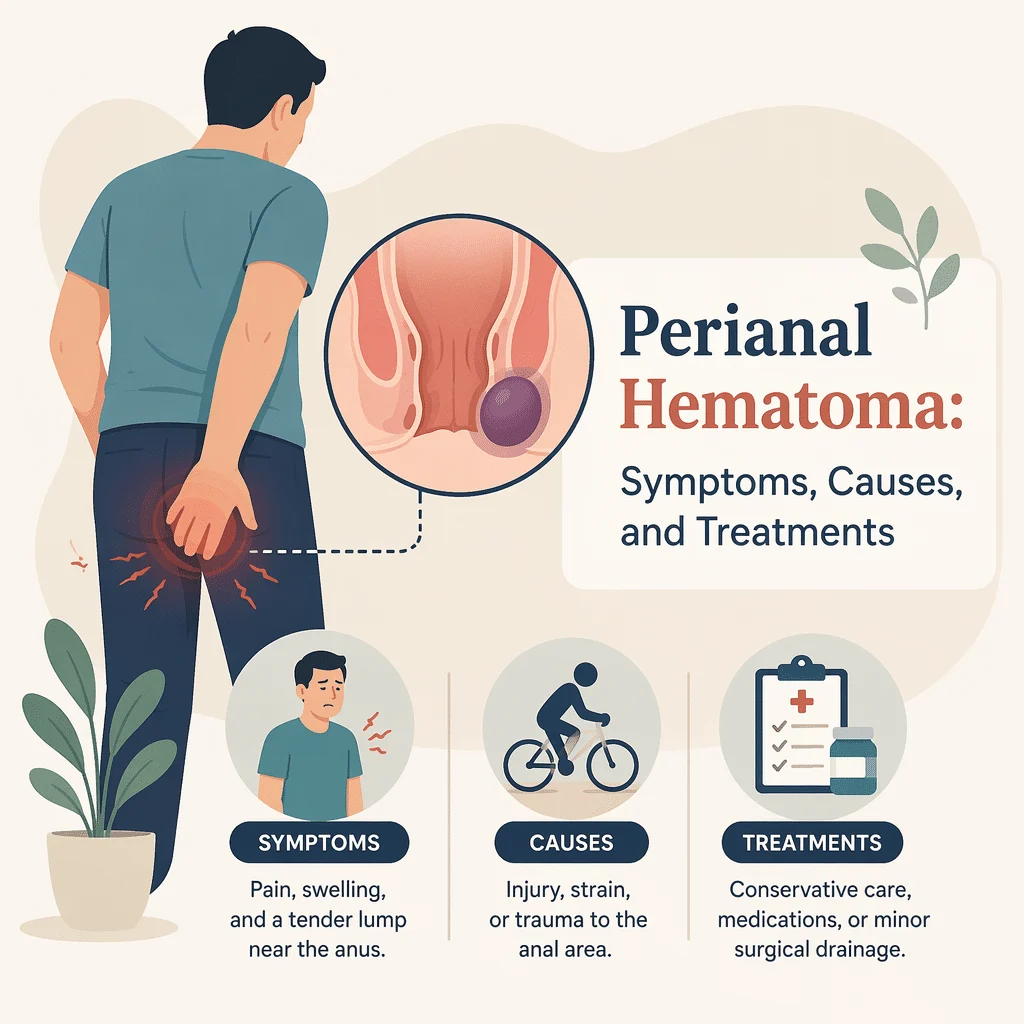
A perianal hematoma is a small blood clot that forms in a vein just under the skin at the edge of the anus, and it usually announces itself as a sudden, tender, blue-purple lump. It often appears within hours — after straining on the toilet, after heavy lifting, after childbirth, or during a bout of constipation or diarrhea — and it is at its most painful in the first two to three days.
If you are reading this feeling embarrassed, please put that down. Doctors, nurses and colorectal surgeons see this constantly. There is nothing unusual or shameful about it.
One thing needs saying first: a clinician has to look. The diagnosis is visual and takes seconds in person, and no web page can make it for you. In this article you will learn what a perianal hematoma is, why it happens, how the pain behaves over time, how it differs from hemorrhoids, fissures and abscesses, what doctors do, what you must never do yourself, and the warning signs that need urgent care.
What a perianal hematoma is, and what it feels like
Under the skin at the anal verge — the outer rim of the anal opening — sits a small network of veins. If one tears or becomes blocked, blood collects in the surrounding tissue and clots. That trapped blood is the perianal hematoma. From outside it looks like a firm, smooth, round or oval swelling, usually between the size of a pea and a grape, sitting at the anal margin rather than inside the anal canal.
The color is often the giveaway: dark blue, purple or almost black, because you are seeing clotted blood through thin skin. The lump is tender, and sitting, walking, coughing or passing a stool can all make it hurt more. Some people notice bright red blood on the toilet paper if the overlying skin splits. Others notice nothing but the lump and the pain.
Why the name is confusing
You will see three names for what is often the same thing: perianal hematoma, perianal thrombosis, and thrombosed external hemorrhoid. Clinicians use them interchangeably, and so do medical journals. Some specialists reserve perianal thrombosis for a clot in a small vein under the skin, and thrombosed external hemorrhoid for a clot inside an existing external hemorrhoidal cushion, but the two look alike, feel alike and are managed the same way. A 2025 review of anorectal problems in pregnancy noted that perianal thrombosis is often labeled a thrombosed external hemorrhoid. If your discharge letter uses a different word from this page, that is normal, and worth asking about rather than worrying about.
Why perianal hematomas happen
The common thread is a sudden rise in pressure in the small veins around the anus. Almost anything that spikes abdominal pressure can do it:
- Straining to pass a hard stool, or repeated straining during constipation
- A bout of diarrhea, with frequent forceful bowel movements
- Heavy lifting, weight training, or a prolonged cough
- Pregnancy and childbirth, especially the third trimester and the pushing stage
- Long periods sitting on the toilet, often with a phone in hand
- Prolonged sitting, long-haul travel, or cycling
Constipation is the most common trigger, which is why a doctor will ask so many questions about your bowels. To understand what a healthy bowel movement should look like, read our guide to stool consistency. Blood-thinning medication does not cause a perianal hematoma, but it can make bleeding around one more noticeable, so tell the clinician what you take.
The pain timeline: worst first, then easing
This is the most useful thing to know: it tells you what to expect, and it helps separate a perianal hematoma from other problems.
Pain builds fast over the first few hours, peaks somewhere in the first 48 to 72 hours, then begins to settle. By the end of the first week most people describe it as uncomfortable rather than severe. The lump shrinks more slowly than the pain does; it often takes one to two weeks to flatten and several weeks to disappear completely.
That trajectory matters. Because the pain is front-loaded, a procedure to remove the clot helps most while the pain is still at its worst. Once you are past the first few days you are on the downslope, and the balance tips toward letting it resolve. Pain that gets steadily worse after day three or four, rather than better, is not following the expected pattern and deserves a second look, because it may point to an abscess rather than a clot.
Perianal hematoma, hemorrhoid, fissure or abscess?
Anal lumps and anal pain have several common causes, and they behave differently. The table below sets out how each usually presents. Use it to describe your symptoms accurately, not to diagnose yourself: several can occur together, and telling them apart reliably needs an examination.
| Condition | What it feels like | What it looks like | Typical timing | Usual next step |
|---|---|---|---|---|
| Perianal hematoma (thrombosed external hemorrhoid) | Constant, throbbing soreness, worse when sitting | Firm blue-purple lump at the anal rim | Sudden onset, worst at 48 to 72 hours, eases over 1 to 2 weeks | Same-week review; comfort measures, or excision if seen early with severe pain |
| Internal hemorrhoid | Usually painless; itching, fullness, or something coming down | Nothing visible outside unless it prolapses | Intermittent, often over months | Examination including anoscopy; office procedures if symptoms persist |
| Anal fissure | Sharp, tearing pain during and after passing a stool | A small split in the skin, often with no lump at all | Pain tied to bowel movements, lasting minutes to hours after | Stool softening and topical treatment prescribed by a clinician |
| Perianal abscess | Escalating deep pain that keeps worsening, often with feeling unwell | Red, hot, spreading swelling; skin may look shiny | Worsens day after day rather than improving | Urgent assessment; usually needs surgical drainage |
Internal hemorrhoids are a different structure altogether. They sit above the dentate line, inside the anal canal, where there are very few pain nerves, which is why they bleed or prolapse but do not hurt. Another article on this site explains hemorrhoids. A rectal prolapse is different again: not a lump at the anal margin but a segment of bowel lining coming down through the anus, red, moist and ring-shaped, and it needs specialist assessment.
What a doctor actually does
The examination is short. A clinician looks at the skin around the anus, usually with you lying on your side, and gently feels the lump. That is usually enough: a tender, dark, well-defined swelling at the anal margin with a story of sudden onset is characteristic. Scans are rarely needed.
The American Gastroenterological Association, in its 2026 clinical practice update on hemorrhoids, states that hemorrhoids only cause significant pain when acutely thrombosed, and that sharp pain on defecation is more likely to be an anal fissure. The pain pattern itself carries diagnostic weight. The same update advises that anoscopy, a brief look inside the anal canal with a short scope, should be performed wherever possible in a new patient, so an internal cause is not missed.
Conservative management
For most people, and for almost everyone seen after the first few days, treatment is supportive. Clinicians commonly advise warm sitz baths, meaning sitting in a few inches of warm water; simple pain relief; keeping stools soft with fiber and fluids; and avoiding straining and long sessions on the toilet. The American Gastroenterological Association is candid that the data behind sitz baths is limited, even though they are widely recommended and many people find them soothing. Ask your clinician or pharmacist before starting any medicine, including topical creams, because the right choice depends on your other conditions and medications.
Excision, and why timing matters
When the pain is severe and the person is seen early, a clinician may offer to remove the clot under local anesthetic. The American Society of Colon and Rectal Surgeons publishes the main United States surgical guideline on hemorrhoid management, and practice built on it favors excision of an acutely thrombosed external hemorrhoid presenting early, in practice within roughly the first 72 hours, while the clot is firm and the pain is at its peak. The American Gastroenterological Association takes the same line in its 2026 update, advising that acute thrombosed hemorrhoids, often extremely painful, are best treated surgically.
Two points matter. Removing the whole thrombosed lump is generally preferred to nicking it and squeezing the clot out, because the clot is often multi-chambered and squeezing leaves some behind. And after the first few days the advantage shrinks, because the pain is already improving on its own.
What you should never do
Do not cut, lance, pierce, squeeze or drain a perianal hematoma yourself, and do not let anyone who is not a clinician do it for you. This is not squeamishness. The skin around the anus carries bowel bacteria, and an unsterile cut can seed an infection into tissue that drains poorly; perianal infections turn serious quickly. The area is richly supplied with blood vessels, so an uncontrolled cut can bleed considerably, and doing this without anesthetic is brutal. If the lump hurts enough that you are contemplating it, that is exactly when you should be seen the same day. A clinician can do the same thing safely and with anesthetic.
Healing, skin tags and recurrence
Left alone, the body breaks the clot down and reabsorbs it. The lump softens, the color fades from purple through brown and yellow, and the swelling flattens. Most resolve over one to two weeks, though the last trace can linger.
A common, harmless endpoint is a skin tag: once the stretched skin has emptied of clot, a small soft flap may remain. It is painless, it is not a hemorrhoid, and it needs no treatment unless it interferes with hygiene or bothers you. If it is persistently sore, itchy or changing in appearance, have it looked at rather than assuming.
Recurrence is possible if the original trigger is still there. Keeping stools soft, not straining, not lingering on the toilet, and treating constipation early are the practical levers. If your bowel habit is unpredictable, discuss that pattern with a doctor; a persistently altered bowel habit can reflect irritable bowel syndrome, and it can also reflect something that needs excluding.
Red flags: when to seek urgent care
Seek emergency or same-day medical care if you have any of these
- Fever or chills with severe anal pain or swelling, which may indicate an abscess needing urgent drainage
- Redness spreading outward from the lump, or skin that is hot, shiny or breaking down
- Inability to pass urine
- Heavy bleeding, bleeding that will not stop, or blood filling the bowl
- Feeling faint, dizzy, breathless or unusually weak
- Pain that keeps escalating after day three instead of easing
Book an assessment rather than assuming it is benign if you have
- A change in bowel habit lasting more than a few weeks
- Unexplained weight loss
- Blood mixed through the stool rather than sitting on its surface, or dark, tarry stool
- New rectal bleeding and you are over about 45 to 50
- A lump that is not settling after two to three weeks
One message deserves repeating, because this is where real harm happens. Anal or rectal bleeding must never be assumed to be just a hemorrhoid, not by you and not on the basis of a web page. Hemorrhoids and perianal hematomas are common, and for most people they are the likeliest explanation, but they are not the only one. The features in the second list should prompt assessment for colorectal causes rather than reassurance. Early symptoms can be unremarkable, which is exactly why doctors investigate colorectal cancer. For what different bleeding patterns mean and which tests follow, read our article on rectal bleeding. Dark, tarry stool needs assessment too, and a separate article covers black specks in stool.
Anorectal pain and lumps deserve specialist input rather than routine advice in anyone who has Crohn’s disease, because both the assessment and the treatment differ.
Latest scientific advances in treating perianal hematoma
Research over the past three years has concentrated on one practical question: remove the clot, or let it settle? Here is what the strongest recent evidence shows, in plain terms.
Surgery lowers the chance of recurrence, and does not increase bleeding
A 2025 systematic review and meta-analysis — a study that pools several earlier studies to get a clearer overall picture — brought together six studies covering 851 people with thrombosed external hemorrhoids, just under half of whom had surgery. What was found: those treated surgically were less likely to have the problem come back, while the risk of bleeding was similar in both groups. What this means for you: if recurrence is your main worry, that favors a procedure, and the fear that surgery will make you bleed more is not borne out. Reliability nuance: the studies varied in how they were run, so the size of the benefit is less certain than its direction.
The pain advantage of a procedure is real, but front-loaded
A separate 2025 meta-analysis pooled seven studies covering 760 people. What was found: surgery produced more complete symptom resolution and clearly better pain scores in the first few days, but by around ten days the two groups had converged. Bleeding afterward and difficulty passing urine did not differ meaningfully. What this means for you: a procedure buys a faster exit from the worst of the pain, not a different final outcome. If you are already past the worst, waiting is a legitimate choice rather than a failure to treat.
National guidance has been updated
In 2026 the American Gastroenterological Association issued a clinical practice update on the diagnosis and treatment of hemorrhoids. What was found: the panel advises that acute thrombosed hemorrhoids are often extremely painful and are best treated surgically; that diagnosis rests on history and examination; that anoscopy should be performed wherever possible; and that anyone having a hemorrhoid procedure should be warned about the small risk of pelvic sepsis, a serious deep infection, and told to go to an emergency department if signs appear.
What this means for you: your clinician should examine you rather than treat a lump sight unseen, and you should leave with clear instructions on what counts as an emergency. Reliability nuance: this is an expert review rather than a formal systematic review, so it carries the weight of expert consensus rather than graded evidence.
In pregnancy, relief comes faster with a procedure, and it appears safe
A study published in 2023 followed 53 pregnant women with thrombosed external hemorrhoids, 26 treated conservatively and 22 with surgery, including a randomized comparison of two surgical techniques. What was found: both approaches improved pain and quality-of-life scores, but the surgical group had faster pain relief by day three and better physical and mental health scores by day ten, with no complications in mothers or babies. Removing the whole thrombosed lump worked clearly better than extracting the clot alone, which was followed by a repeat clot far more often.
What this means for you: if you are pregnant and in severe pain, a procedure is not automatically off the table, and it is worth discussing rather than assuming it is unsafe. Reliability nuance: a single-center study of modest size, with the randomized part stopped early on ethical grounds once one technique looked clearly better.
Pregnancy and the weeks after birth remain the highest-risk window
A 2025 review of anorectal conditions in pregnancy reported that these problems affect between 45% and 68% of pregnancies, that constipation affects more than 60% of pregnant women, and that perianal thrombosis typically appears in the third trimester or shortly after delivery. What this means for you: if this happened late in pregnancy or in the weeks after giving birth, you are in the most common group of all, and conservative treatment with good pain control is usually enough. Reliability nuance: a narrative review summarizing other work rather than new primary research.
Glossary
| Term | Definition |
|---|---|
| Perianal hematoma | A clot of blood trapped in a small vein under the skin at the edge of the anus, felt as a firm, tender lump. |
| Perianal thrombosis | Another name for the same condition, used interchangeably by many clinicians. |
| Thrombosed external hemorrhoid | A clot inside an external hemorrhoidal cushion. It looks and behaves like a perianal hematoma and is managed the same way. |
| Anal verge | The outer rim of the anal opening, where skin meets the anal canal. |
| Dentate line | The border inside the anal canal above which there are very few pain nerves, which is why internal hemorrhoids rarely hurt. |
| Anoscopy | A brief examination in which a clinician inspects the anal canal with a short, smooth scope. |
| Excision | Surgical removal of the whole thrombosed lump, rather than simply opening it to release the clot. |
| Sitz bath | Sitting in a few inches of warm water to ease anal discomfort and keep the area clean. |
| Skin tag | A small, soft, painless flap of skin that can remain after the clot has been reabsorbed. |
| Anal fissure | A small tear in the lining of the anus, typically causing sharp pain during and after a bowel movement. |
Frequently asked questions
Will a perianal hematoma go away on its own?
Usually, yes. The body gradually breaks down and reabsorbs the trapped clot without any procedure. Most settle over one to two weeks, with the pain easing well before the lump does. Some people are left with a small painless skin tag, which is harmless. Letting it resolve is a perfectly reasonable plan, especially once you are past the first few days, when a procedure no longer shortens things much. What it does not do is diagnose itself: a clinician should still confirm that the lump is what you think it is.
Should I pop or drain it myself?
No. Absolutely not, and this is the one instruction in this article with no exceptions. The skin around the anus carries bowel bacteria, and cutting or piercing it without sterile conditions can introduce an infection into tissue that drains badly. Perianal infections can escalate fast. The area also bleeds readily, and without local anesthetic the pain is severe. If it hurts enough that you are considering it, that is a reason to be seen the same day, not a reason to reach for a needle. A clinician can do the same thing safely.
Piercings elsewhere on the body carry the same risk: see what causes belly button bleeding and when to worry.
How do I know it isn’t something serious?
You cannot know from a web page, and neither can we. What you can do is notice the pattern. A perianal hematoma appears suddenly, hurts most in the first two to three days, then improves. Pain that keeps escalating, fever, spreading redness or feeling unwell point toward an abscess and need urgent care. Separately, blood mixed through the stool, a lasting change in bowel habit, unexplained weight loss, or new rectal bleeding over about 45 to 50 need assessment for bowel causes. Booking an examination is the only way to settle it.
How long does a perianal hematoma take to heal?
Pain typically peaks within 48 to 72 hours and is much better by the end of the first week. The lump lags behind: it usually flattens over one to two weeks and may take a few weeks more to vanish entirely. Recent pooled research found that the pain advantage of having the clot removed had largely disappeared by around ten days, which fits that natural timeline. If your lump is not settling after two to three weeks, or is getting bigger, have it reassessed rather than waiting it out.
Can a perianal hematoma bleed?
It can. If the skin stretched over the clot splits, you may see a small amount of dark or bright red blood on the toilet paper or on your underwear, often with a sudden drop in pressure and pain. A modest, brief bleed of this kind is common and usually settles. Heavy bleeding, bleeding that will not stop, or feeling faint is different and needs emergency care. And a bleed should never be filed away as explained without someone looking, because bleeding has other causes.
Do creams or home remedies help?
Over-the-counter creams and ointments may take the edge off discomfort, but nothing applied to the skin dissolves a clot, so they will not shorten the episode. National guidance notes that the evidence behind topical treatments for hemorrhoidal symptoms is thin, and that topical steroids in particular should not be used for extended periods. Warm sitz baths, softer stools, adequate fluids and not straining are the measures clinicians most often suggest. Ask your pharmacist or doctor before starting anything, because suitability depends on your other medicines and conditions.
Sources
- MedlinePlus, National Library of Medicine. Hemorrhoids. https://medlineplus.gov/hemorrhoids.html
- National Institute of Diabetes and Digestive and Kidney Diseases. Hemorrhoids. https://www.niddk.nih.gov/health-information/digestive-diseases/hemorrhoids
- Fontem RF, Eyvazzadeh D. Internal Hemorrhoid. StatPearls, NCBI Bookshelf, National Library of Medicine. https://www.ncbi.nlm.nih.gov/books/NBK537182/
- Qureshi W, Hoang S, Frye J, Rao SSC. AGA Clinical Practice Update on Diagnosis and Treatment of Hemorrhoids: Expert Review. Clinical Gastroenterology and Hepatology. 2026;24(7):1773-1781. https://doi.org/10.1016/j.cgh.2026.04.008
- Martins MAB, Almeida LFC, Cappellaro AP, Rocha LFR, Nobrega Oliveira REN. Operative versus nonoperative treatment of thrombosed external hemorrhoids: a systematic review and meta-analysis. Updates in Surgery. 2025;78(1):169-175. https://doi.org/10.1007/s13304-025-02302-1
- Quan L, Bai X, Cheng F, Chen J, Ma H, Wang P, Yao L, Bei S, Jia X. Comparison of efficacy and safety between surgical and conservative treatments for hemorrhoids: a meta-analysis. BMC Gastroenterology. 2025;25(1):492. https://doi.org/10.1186/s12876-025-04089-2
- Medkova Y, Tulina I, Novikov I, Nikonov A, Ischenko A, Aleksandrov L, Altomare DF, Dezi A, Picciariello A, Tsarkov P. Thrombosed external hemorrhoids during pregnancy: surgery versus conservative treatment. Updates in Surgery. 2023;76(2):539-545. https://doi.org/10.1007/s13304-023-01741-y
- Schmuck RB, Roblick M. Incidence, Diagnosis, and Management of Proctological Conditions during Pregnancy. Visceral Medicine. 2025;42(1):38-44. https://doi.org/10.1159/000545793
- Davis BR, Lee-Kong SA, Migaly J, Feingold DL, Steele SR. The American Society of Colon and Rectal Surgeons Clinical Practice Guidelines for the Management of Hemorrhoids. Diseases of the Colon and Rectum. 2018;61(3):284-292. https://doi.org/10.1097/DCR.0000000000001030
Further reading
- Hemorrhoids: symptoms, causes and treatment
- Rectal bleeding: causes, symptoms and when to seek help
- Colorectal cancer: symptoms, screening and tests
- Stool consistency: understanding normal and abnormal changes
- Complete blood count: how to read your results
Understand your lab results with AI DiagMe
A blood test cannot diagnose a perianal hematoma. That diagnosis is made by looking, in person, in seconds. What blood tests can do is answer a different question: if you have been bleeding for a while, or bleeding heavily, a doctor may check a complete blood count or iron studies to see whether the blood loss has left a mark, and those results sometimes reveal low ferritin. AI DiagMe helps you understand numbers like these in plain language. It does not examine you, it does not diagnose you, and it does not replace the clinician who needs to look.
Get your results interpreted in minutes