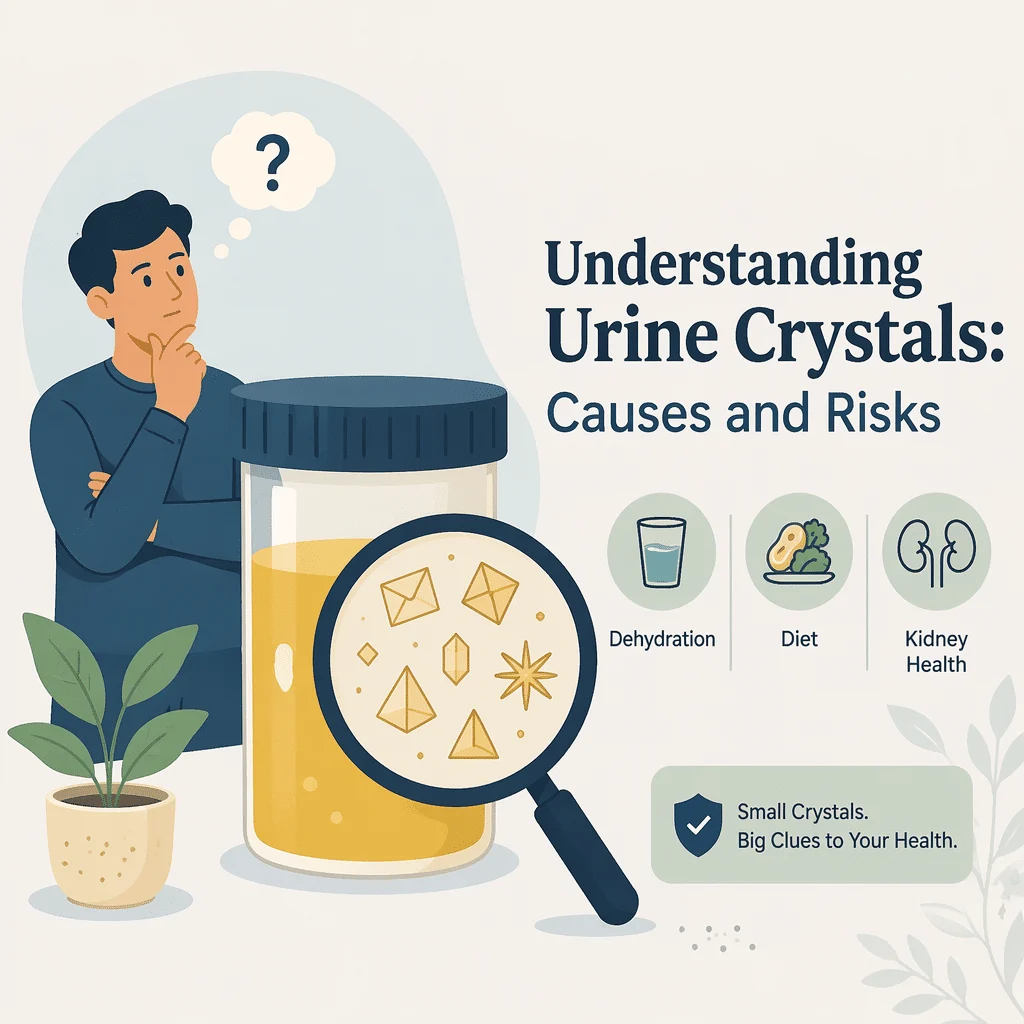
Seeing “crystals in urine” on a laboratory report is unsettling, and it is also one of the most over-interpreted lines in a urinalysis. For most people it means very little. Crystals are tiny mineral particles that a laboratory technologist or an automated analyzer sees when urine is examined under a microscope, and plenty of entirely healthy people have them. More surprising still: many of these crystals were never inside your bladder at all. They formed in the collection tube, after the sample left your body.
In this article you’ll learn what crystals in urine really are, why the specimen itself so often manufactures them, which types are essentially always harmless, which rare types genuinely need attention, and how crystals relate to kidney stones. You’ll also see what a clinician looks at alongside the finding, and the symptoms that would change the picture.
What crystals in urine actually are
Urine is a concentrated solution of salts, acids and waste products. Like any concentrated solution, it can only hold so much dissolved material before some of it comes out of solution and forms a solid. That solid is a crystal.
Whether crystals appear depends on three physical variables: how concentrated the urine is, how acidic or alkaline it is, and what temperature it is at. None of these three is a disease. They are simply chemistry. A well-hydrated person who drank a large glass of water an hour before the test produces dilute urine that rarely crystallizes. Someone who gave a first-morning sample after eight hours without fluids produces concentrated urine that often does.
Crystals are reported alongside the other things seen in the microscopic part of a urinalysis: red and white blood cells, epithelial cells, bacteria and urinary casts. Most laboratories report them as a rough amount — few, moderate, many — rather than a precise count, which is itself a signal that the finding is not meant to be read as a measurement.
Why the sample itself often creates the crystals
This is the single most useful fact on this page, and it is almost never explained to patients. Crystals found on a report are frequently an artifact of how the sample was handled rather than a reflection of what was happening in your kidneys.
Temperature and delay
Urine leaves the body at around body temperature. The moment it sits in a container on a bench, or goes into a refrigerator to await transport to a laboratory, it cools. Solubility falls as temperature falls, so dissolved salts that were comfortably in solution inside your bladder precipitate out in the tube. The longer the delay between passing the sample and examining it, the more crystals form.
The effect is not subtle. Laboratory studies that deliberately chill urine specimens find that samples showing almost no crystals at room temperature develop abundant crystals after cooling. In other words, a refrigerated or delayed specimen can produce a crystal report describing something that did not exist in your body at any point.
Urine pH
Each crystal type has a chemistry that favors either acidic or alkaline conditions. Urine pH also drifts while a sample sits: bacteria that are harmless skin or genital contaminants can break down urea and push the pH upward over several hours. An alkaline-shifted sample tends to grow phosphate crystals that were never present when the urine was fresh.
Collection method and container
Even the collection device matters. Comparisons of vacuum tube systems against standard containers have found measurable differences in the crystals reported from the same patients. This is a reminder that a crystal result reflects a physical process in a plastic tube as much as anything biological.
The practical consequence is simple. Clinicians treat isolated crystals on a delayed or refrigerated specimen as weak information, and a repeat test on a promptly examined fresh sample often shows nothing at all.
The common crystal types and what each usually suggests
Most crystals belong to a small handful of familiar types. Their names sound clinical, but the great majority are benign.
Calcium oxalate is by far the commonest. Under the microscope it appears as small envelopes or dumbbells. It is associated with oxalate-rich foods such as spinach, rhubarb, nuts, beetroot, chocolate and tea, but it is also present in the urine of large numbers of healthy people who will never form a stone.
Amorphous urates and amorphous phosphates are shapeless granular deposits rather than true geometric crystals. They are essentially always benign and are among the clearest examples of precipitation artifacts, appearing readily in cooled or standing samples.
Triple phosphate, also called struvite, forms coffin-lid shapes in alkaline urine. Alkaline urine has many innocent causes, including a vegetarian diet and simple standing time. However, struvite can also be associated with infection by urea-splitting bacteria, so a clinician will read it alongside symptoms and infection markers such as nitrites and leukocytes in urine rather than in isolation.
Uric acid crystals appear as diamonds or rosettes in acidic urine. They can be seen in gout, in conditions with high cell turnover, and in people who are simply dehydrated. On their own they are not a diagnosis, though a doctor may look at a blood uric acid level if there is a clinical reason to.
| Crystal type | Typical urine pH | What it usually means | Does it need action? |
|---|---|---|---|
| Calcium oxalate | Any pH | Commonest type; seen in many healthy people and with oxalate-rich meals | Usually not on its own |
| Amorphous urates | Acidic | A precipitation artifact of cooled or standing urine | No |
| Amorphous phosphates | Alkaline | A precipitation artifact; no clinical meaning by itself | No |
| Uric acid | Acidic | Concentrated urine, gout, or states of high cell turnover | Only if symptoms or blood results suggest a reason |
| Triple phosphate (struvite) | Alkaline | Often harmless; may accompany infection with urea-splitting bacteria | Reviewed alongside urinary symptoms and infection markers |
| Calcium phosphate | Alkaline | Common and usually incidental | Usually not on its own |
| Cystine | Acidic | Always abnormal; indicates cystinuria, an inherited stone-forming disorder | Yes — always needs medical assessment |
| Drug crystals | Varies by drug | Linked to specific medicines; may point to crystal nephropathy | Yes — tell the prescribing doctor |
The crystal types that always matter
Two categories break the reassuring pattern. They are rare, which is exactly why they are worth naming clearly.
Cystine crystals
Cystine crystals are flat, hexagonal plates, and they are never a normal finding. Their presence indicates cystinuria, an inherited condition in which the kidney tubules fail to reabsorb the amino acid cystine. Cystine dissolves poorly at normal urine acidity, so it precipitates and forms stones, often starting in childhood or early adulthood and recurring throughout life. Cystinuria affects roughly one person in ten thousand.
If a report mentions cystine crystals, that warrants a conversation with a doctor regardless of how you feel. Confirming the diagnosis and starting long-term follow-up early is what protects kidney function over decades.
Drug crystals and crystal nephropathy
Some medicines are poorly soluble in urine and can crystallize inside the kidney tubules. Sulfonamide antibiotics, aciclovir, indinavir, atazanavir, methotrexate and high-dose vitamin C are recognized examples. When this happens the crystals can obstruct tubules and injure the kidney, a process called crystal nephropathy.
Drug crystals therefore carry a different weight from ordinary calcium oxalate. If you are taking one of these medicines and crystals are reported, tell the prescribing doctor. They may check your creatinine and review hydration or dosing. Rarer inherited disorders such as adenine phosphoribosyltransferase deficiency also produce distinctive crystals and are identified in the same way.
Crystals in urine and kidney stones: what the finding does and does not predict
Crystals are not stones. A stone is a solid mass that has grown over weeks to years inside the urinary tract; a crystal is a microscopic particle that may exist for minutes. Seeing crystals on a report does not mean you have a stone, and it does not mean you will develop one.
The relationship is real but modest, and it runs in a specific direction. People who have already formed kidney stones repeatedly do tend to show crystalluria more often than people who never have. Among stone formers, the crystal type is genuinely useful because it hints at what a stone is likely to be made of, which shapes the investigation and the follow-up plan.
The distinction matters for how you read your own result. If you have never had a stone and have no symptoms, crystals on a routine urinalysis are a weak signal that a doctor will most likely note and move past. If you are a recurrent stone former, the same finding carries information your urologist or nephrologist will actively use.
What a doctor actually does with crystals on your report
In most cases, nothing on the strength of the crystals alone. Clinicians read the crystal line in context, and the context includes several other things.
They look at whether you have symptoms: flank pain, painful urination, urgency, fever. They check the urine pH, because a crystal type that fits the pH is usually just chemistry behaving predictably. They look for blood in the urine, which is far more meaningful than crystals. They check infection markers, and they consider how the sample was collected and how long it waited. They may also glance at urine color and concentration as a rough guide to hydration, or at other urine findings such as foamy urine if protein is present.
Blood tests come next if there is a reason. A kidney function panel showing altered BUN and creatinine, or an abnormal calcium level, shifts the picture from incidental to worth investigating. If stones are genuinely suspected, imaging with ultrasound or a low-dose CT scan answers the question directly, and a metabolic workup including a 24-hour urine collection may follow for people with recurrent stones.
What a doctor will not usually do is prescribe a diet on the basis of crystals alone. Dietary advice for stone prevention is individualized and follows a confirmed stone diagnosis and a metabolic assessment. One point is worth stating plainly because the opposite belief is common and harmful: restricting dietary calcium is not a general remedy for calcium oxalate crystals, and cutting calcium intake can actually raise the risk of forming stones. Any change to your diet, fluid intake or supplements should be decided with your doctor, not from a laboratory report.
When crystals in urine matter more
Two situations raise the significance of the finding. The first is symptoms. Crystals accompanied by flank pain, visible blood in the urine, fever or painful urination are no longer an incidental result; they are part of a clinical picture that needs assessment, often for a stone or a urinary tract infection. The second is reduced kidney function. If your kidney numbers are already abnormal, crystals — particularly drug crystals — deserve closer attention.
Seek urgent medical care if you have any of the following:
- Severe pain in the flank or back that radiates toward the groin, which may indicate a stone. With fever, this can mean an obstructed and infected kidney, which is a medical emergency.
- Visible blood in your urine.
- Fever or chills together with urinary symptoms.
- Inability to pass urine.
- A clear drop in how much urine you are producing.
Latest scientific advances in urine crystal analysis
Recent laboratory research has focused less on what crystals mean in the body and more on how reliably we detect them in the first place. Four themes stand out.
Japanese researchers deliberately cooled urine samples from people who had formed kidney stones and compared what appeared before and after. Very few samples showed crystals at ambient temperature, while the large majority did once cooled — and one specific crystal, brushite (a calcium phosphate), was noticeably more frequent in people whose stones had recurred quickly. What this means for you: it is direct evidence that cooling a specimen creates crystals that were not there, and also a hint that controlled cooling might one day become a deliberate test rather than an accident of transport.
A clinical laboratory case report described a patient whose urine uric acid measurement came back falsely low because refrigeration had caused urate to crystallize out of solution; adjusting the pH to redissolve the crystals restored the correct value. What this means for you: crystallization in the tube does not only add a line to the microscopy report, it can distort other numbers on the same sample. Prompt testing matters.
Canadian investigators systematically tested how urine dipstick and chemistry results hold up over time at room temperature and in the fridge. Most parameters were stable within defined windows, but pH was among those that drifted. What this means for you: since pH is what determines which crystals can form, a drifting pH in a delayed sample helps explain why crystal reports and pH readings sometimes look mismatched.
Belgian and Dutch teams trained a deep learning model to classify particles in urine sediment from digital microscope images and then tested it prospectively in a working hospital laboratory. Accuracy was high on the original dataset but fell when the system met real, unselected samples. What this means for you: automated sediment analysis is improving quickly and will make crystal reporting more consistent, but human review still matters, which is part of why a single crystal result is not treated as definitive.
Finally, a clinical review of cystinuria in children set out how the condition is diagnosed and managed, emphasizing that treatment aims to keep cystine dissolved in the urine and that care continues for life. What this means for you: cystine crystals are the one common-report finding that always changes management, and identifying them early is what makes long-term kidney protection possible. Guidance on diagnosis and treatment comes from clinicians; the MedlinePlus Genetics entry on cystinuria from the US National Library of Medicine is a reliable plain-language starting point.
Frequently asked questions
Are crystals in urine serious?
Usually not. In most people they are an incidental finding with no clinical consequence, and a substantial proportion of them formed in the specimen container rather than in the body. The common types — calcium oxalate, amorphous urates and phosphates, calcium phosphate — do not by themselves indicate disease. The exceptions are cystine crystals, which are always abnormal, and crystals linked to specific medicines. Crystals also become more meaningful when they appear alongside symptoms such as flank pain, fever or visible blood in the urine, or when kidney function is already reduced. Your doctor is the right person to place the finding in context.
Do crystals mean I have kidney stones?
No. Crystals are microscopic particles; stones are solid masses that take months or years to grow. Having crystals on a report does not mean a stone is present, and it does not predict that one will form. The link exists in the other direction: people who form stones repeatedly show crystals more often than people who never have. If you have never had a stone and have no symptoms, crystals are weak information. If you are a recurrent stone former, the crystal type helps guide your workup. Imaging, not microscopy, is what actually confirms or excludes a stone.
Should I change my diet because of crystals in my urine?
Not on your own. Dietary changes for stone prevention are decided after a confirmed stone diagnosis and a metabolic assessment, and they are tailored to the individual. One misconception is worth correcting: many people assume that calcium oxalate crystals mean they should cut calcium from their diet. Clinicians generally advise the opposite, because reducing dietary calcium can increase the amount of oxalate absorbed from food and raise stone risk. Clinicians commonly discuss fluid intake, sodium and protein as well, but the specifics depend on your test results. Bring the report to your doctor and decide together.
Why did my report mention crystals when I feel completely fine?
Because crystals and symptoms are largely unrelated. Crystal formation is governed by concentration, acidity and temperature, and none of those has to cause any sensation. A first-morning sample from a well person is concentrated and acidic, which is ideal conditions for crystals to form. If the sample then sat for a few hours or was refrigerated before analysis, more crystals appeared during the wait. Feeling well while a report mentions crystals is the expected combination, not a contradiction.
Can medicines cause crystals in urine?
Yes. Several medicines are poorly soluble in urine and can crystallize, including sulfonamide antibiotics, aciclovir, indinavir, atazanavir and methotrexate, as well as very high doses of vitamin C. These crystals matter more than ordinary ones because they can lodge in the kidney tubules and cause injury, a condition called crystal nephropathy. If you take any of these and crystals appear on a report, tell the doctor who prescribed them. Never stop a prescribed medicine on the basis of a urinalysis; the decision to adjust a dose, change hydration or switch drugs belongs to your prescriber.
Will repeating the test give a different answer?
Often, yes — and that is informative rather than alarming. If the first sample was refrigerated or waited several hours before microscopy, a fresh sample analyzed promptly may show far fewer crystals or none at all. Some laboratories will suggest a repeat for exactly this reason. If crystals persist on a properly handled fresh specimen, or if the type is one that always matters such as cystine, your doctor will look further rather than repeat indefinitely.
Glossary
| Term | Definition |
|---|---|
| Crystalluria | The medical term for crystals present in urine. |
| Urine sediment | The solid material that settles out of a urine sample and is examined under a microscope. |
| Pre-analytical phase | Everything that happens to a sample between collection and analysis, including transport, delay and temperature. |
| Urine pH | A measure of how acidic or alkaline urine is, which determines which crystals can form. |
| Cystinuria | An inherited condition in which cystine is not reabsorbed by the kidneys, causing cystine crystals and recurring stones. |
| Struvite | A magnesium ammonium phosphate crystal that forms in alkaline urine, sometimes linked to urea-splitting bacteria. |
| Crystal nephropathy | Kidney injury caused by crystals depositing inside the kidney tubules, most often drug-related. |
| Supersaturation | A state in which urine holds more dissolved substance than it can stably keep in solution. |
| Amorphous deposit | Shapeless granular material in urine, without a defined crystal form and generally without clinical meaning. |
| Metabolic workup | A set of blood and 24-hour urine tests used to find why someone forms kidney stones. |
Sources
- MedlinePlus, US National Library of Medicine. Crystals in Urine. https://medlineplus.gov/lab-tests/crystals-in-urine/
- National Institute of Diabetes and Digestive and Kidney Diseases (NIDDK), National Institutes of Health. Kidney Stones. https://www.niddk.nih.gov/health-information/urologic-diseases/kidney-stones
- Simhadri PK, Rout P, Leslie SW. Urinary Crystals Identification and Analysis. StatPearls, NCBI Bookshelf, National Library of Medicine. https://www.ncbi.nlm.nih.gov/books/NBK606103/
- MedlinePlus Genetics, US National Library of Medicine. Cystinuria. https://medlineplus.gov/genetics/condition/cystinuria/
- Tanaka Y, Tsujino I, Yoshikawa HY, et al. Cooling-induced brushite crystallization in urine as a predictive risk marker for calcium kidney stone recurrence. Urolithiasis, 2025. Retrieved via PubMed. https://doi.org/10.1007/s00240-025-01820-2
- Han J, Jiang Y. Urine Uric Acid Pseudodeficiency from Urate Crystallization: a Pre-Analytical Laboratory Pitfall. Clinical Laboratory, 2025. Retrieved via PubMed. https://doi.org/10.7754/Clin.Lab.2025.250415
- Bohn MK, Fabros A, Di Meo A. Evaluation of pre-analytical factors impacting urine test strip and chemistry results. Clinical Chemistry and Laboratory Medicine, 2025. Retrieved via PubMed. https://doi.org/10.1515/cclm-2024-1233
- Mouslech SG, Wijnants S, van der Schagt AL, et al. Towards Clinical Integration of Deep Learning-Based Classification of Urinary Sediment Particles from Digital Microscopy Images: A Prospective Study. Clinical Chemistry, 2026. Retrieved via PubMed. https://doi.org/10.1093/clinchem/hvaf182
- Gökçe Mİ, Karaburun MC. Cystinuria in children: diagnosis and treatment. World Journal of Urology, 2025. Retrieved via PubMed. https://doi.org/10.1007/s00345-025-05604-6
- Korkmaz B, Kural A, Başman A, et al. Effect of vacuum and non-vacuum urine collection systems on urinalysis. Scandinavian Journal of Clinical and Laboratory Investigation, 2025. Retrieved via PubMed. https://doi.org/10.1080/00365513.2025.2524850
Further reading
- Urinalysis results: a full interpretation guide
- Kidney stones: causes, symptoms and treatments
- Normal urine pH levels: causes and meaning
- Hematuria: blood in urine, causes and symptoms
- Foamy urine explained: causes and risks
A urinalysis rarely stands alone. Crystals in urine make far more sense when you can see them next to your urine pH, your creatinine and your calcium on the same report. AI DiagMe reads your laboratory results and explains each line in plain language, so you arrive at your appointment with better questions. It helps you understand your results; it does not diagnose anything and does not replace your doctor.
Understand your lab results with AI DiagMe
Get your results interpreted in minutes