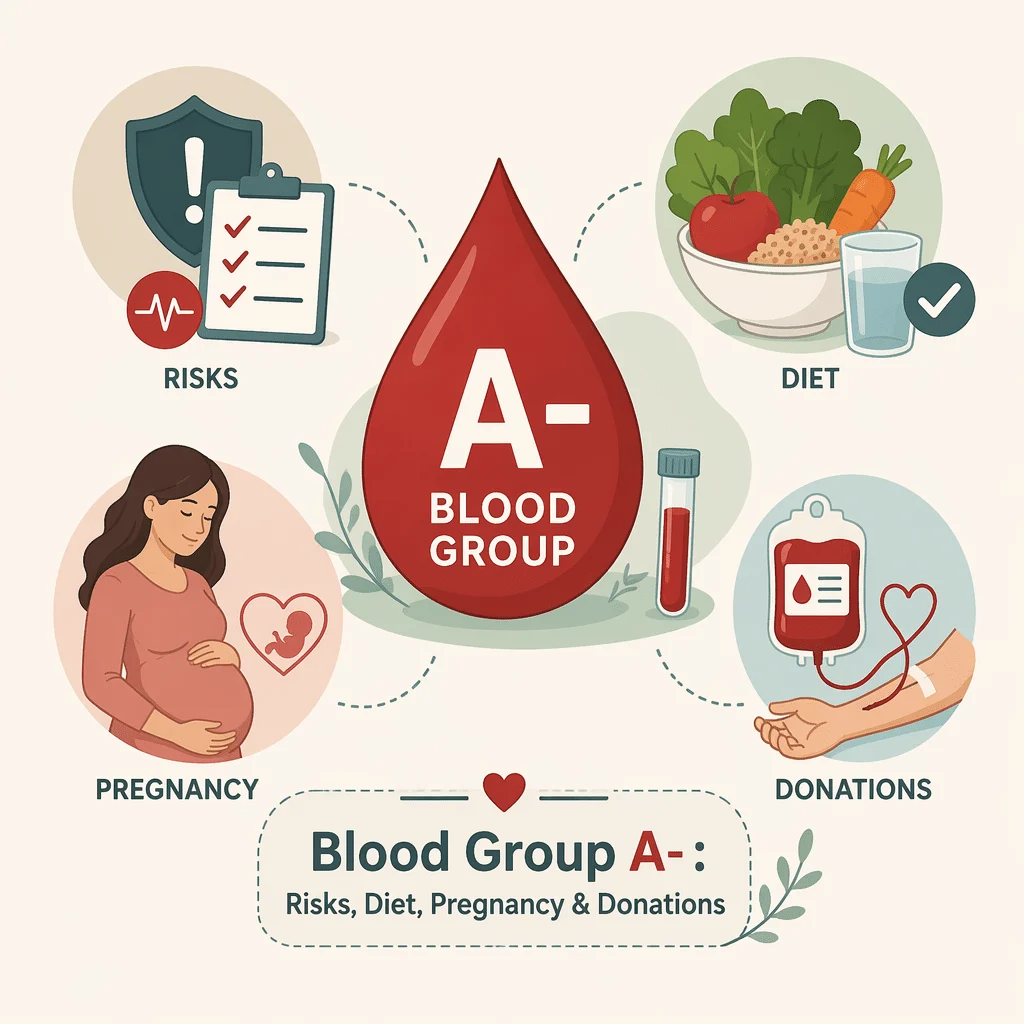
Blood group A negative, often written A−, means your red blood cells carry the A antigen but lack the Rh D protein. It is the same ABO type as A positive, with one key difference: the negative Rh status. That single detail rarely affects daily life, yet it becomes very important during pregnancy and before any transfusion. This guide focuses on what the negative part adds, in plain language: how A negative is inherited, how uncommon it is, why it matters so much in pregnancy, who you can give blood to and receive from, and when to flag your type to your care team. For the ABO basics that A negative shares with A positive, such as how the A antigen forms and its links to clotting or cancer, see our companion guide to blood group A.
What blood group A negative (A−) means
Blood group A negative combines two separate blood systems. From the ABO system, your red cells carry the A antigen, a surface marker, and your plasma carries anti-B antibodies. From the Rh system, you lack the Rh D protein, which is what the minus sign records.
One point sets Rh apart from ABO. You are born with anti-B antibodies, but you are not born with anti-Rh (anti-D) antibodies. An Rh-negative person makes anti-D only after being exposed to Rh-positive red cells, usually through a transfusion or a pregnancy. This is exactly why A negative needs special attention in those two situations and almost nowhere else.
In short, A negative is a common ABO type (A) paired with a less common Rh status (negative). The A part shapes how the type behaves chemically, while the negative part drives the practical rules covered below.
How uncommon is A negative blood?
A negative is a minority blood type. According to the American Red Cross, it accounts for roughly 6% of people in the United States. It is more frequent among people of European ancestry and much rarer in many Asian and African populations, where Rh-negative blood overall is uncommon.
Because Rh-negative units are harder to find than common types like O positive or A positive, blood centers manage them carefully. Compared with other ABO groups such as type B, the scarcity of Rh-negative blood is what makes A negative both valuable to donate and worth knowing for your own care. Blood services track local supply so that Rh-negative patients and emergencies can be covered. Among the eight main blood types, A negative sits in the less common half, which is useful context when you hear hospitals appeal for Rh-negative donations.
How you inherit A negative
Your A negative result comes from two independent genes you inherit from your parents. The ABO part is controlled by a gene on chromosome 9, and you can read how A is passed down in our companion guide to blood group A. The Rh part is controlled by a different gene (RHD) on chromosome 1.
The Rh side follows a clear pattern. Being Rh-positive is dominant, and being Rh-negative is recessive. That means you are Rh-negative only when you inherit a non-functional Rh copy from both parents.
This explains a common surprise. Two Rh-positive parents can have an Rh-negative child if each parent secretly carries one negative copy. So an A negative baby can be born to parents who are A positive, O positive, or other Rh-positive combinations, as long as the right ABO and Rh copies line up. The visible blood type does not tell the whole genetic story.
Pregnancy and A negative: the Rh factor that matters most
For most people with A negative, pregnancy is where the type matters most. The issue is not the A antigen but the negative Rh status, and it is well understood and highly manageable with routine prenatal care.
A potential problem arises only in one specific situation: when an Rh-negative person is pregnant with an Rh-positive baby. The baby can inherit Rh-positive blood from an Rh-positive father. Because your prenatal panel records your ABO and Rh status early, your care team plans for this from the start. Our overview of blood tests during pregnancy shows where blood typing fits among the other checks.
Whether the baby is Rh-positive depends on the other parent. If the father is Rh-negative, the baby will be Rh-negative as well, and Rh incompatibility cannot happen. If the father is Rh-positive, the baby may be either Rh-positive or Rh-negative, depending on the gene copies the father carries. Since that is hard to predict from the outside, prenatal care treats every Rh-negative pregnancy as if the baby could be Rh-positive until testing shows otherwise.
Sensitization and hemolytic disease
During pregnancy you do not normally share blood with your baby, but a small amount of fetal blood can cross into your circulation, especially at delivery. If those cells are Rh-positive, your immune system may start making anti-D antibodies, a process called Rh sensitization.
A first Rh-positive pregnancy is usually unaffected, because the antibodies take time to build. The concern is a later Rh-positive pregnancy, when existing anti-D antibodies can cross the placenta and attack the baby’s red cells. This is hemolytic disease of the fetus and newborn, which can cause anemia and jaundice and, in severe cases, more serious complications. The whole point of modern Rh care is to stop sensitization before it ever begins.
Rh immune globulin: prevention that works
The preventive treatment is an injection of Rh immune globulin (also known as anti-D, or by the brand RhoGAM). It stops your body from forming anti-D antibodies, and it only works if you have not already been sensitized. Your provider checks this with an antibody screen.
| When Rh immune globulin is typically given | Why |
|---|---|
| Around week 28 of pregnancy | A routine dose to prevent sensitization later in pregnancy |
| Within 72 hours after delivering an Rh-positive baby | Prevents antibodies from forming after delivery |
| After bleeding, abdominal trauma, miscarriage, or procedures such as amniocentesis | Blood can mix during these events and trigger sensitization |
If your baby is born Rh-negative, the after-delivery dose is not needed. Increasingly, providers can check the father’s Rh status or test fetal Rh from a sample of the mother’s blood, which helps target treatment. The takeaway is reassuring: with timely care, the vast majority of A negative pregnancies are completely healthy.
If antibodies have already formed
If an earlier pregnancy or transfusion has already sensitized you, an Rh immune globulin shot can no longer undo it, so care shifts to close monitoring instead. Specialists track the level of anti-D antibodies in your blood and may use a painless ultrasound of the baby’s blood flow, called a middle cerebral artery Doppler, to look for early signs of anemia. Most affected pregnancies are still managed successfully with this watchful approach. In the small number of severe cases, treatments such as a blood transfusion given to the baby before birth are available in specialized centers. This is one more reason early prenatal testing matters so much for anyone who is A negative.
Transfusion and donation for blood group A negative
Blood typing is the backbone of safe transfusion, and being Rh-negative tightens the rules in two directions. Because you lack the Rh D protein, you should receive only Rh-negative red cells, so your options as a recipient are narrower than for an Rh-positive person.
| Red cell direction | Blood group A negative (A−) |
|---|---|
| Can receive red cells from | A−, O− only |
| Can donate red cells to | A+, A−, AB+, AB− |
A few points make these rules clearer. As a recipient, your safe red cell sources are A negative and O negative only, since adding the A or B antigen, or any Rh-positive cells, could trigger a reaction. As a donor, your red cells can help a wide range of recipients, including A positive and AB patients, which is part of why A negative donations are in demand.
Two more facts are worth knowing. In a true emergency, when there is no time to confirm a type, O negative red cells are used because they are the universal red cell donor. And before any transfusion, the laboratory performs a crossmatch and antibody screen to confirm compatibility, the same type-and-screen step included in routine blood work before surgery. Plasma and platelet rules differ from red cell rules, so each component is matched separately.
There is also a supply reason behind these rules. Because Rh-negative blood is scarce, hospitals try to reserve it for Rh-negative patients, and they are especially careful with Rh-negative girls and women who could become pregnant. Receiving Rh-positive blood could sensitize them and complicate a future pregnancy. This careful stewardship is part of why donating A negative blood has an outsized impact, since each unit can be hard to replace.
Does A negative change your health risks?
This is where it helps to separate the two halves of your type. The disease associations people read about for blood type A, such as a modest difference in clotting tendency or in stomach and pancreatic cancer risk, come from the A antigen in the ABO system, not from the Rh sign. A negative and A positive therefore share the same ABO-linked tendencies, and you can read the balanced detail in our guide to blood group A.
Being Rh-negative by itself is not linked to disease. Its significance is transfusion safety and pregnancy, not your everyday health. The popular idea that you should eat a special diet for your blood type is not supported by evidence, and that applies to A negative just as it does to every other group.
In practice, your health is shaped far more by age, family history, blood pressure, diet, activity, and other lab markers than by any blood-type label. A negative is not a diagnosis and not a reason for worry.
Living with A negative blood
Knowing you are A negative is genuinely useful, mostly for emergencies and pregnancy. A few simple habits make the most of it.
Keep a record of your type. Carry a blood-type card or add A negative to the medical ID on your phone, which can speed decisions if you ever need urgent care. Note that a routine complete blood count does not reveal your ABO and Rh type, because it counts cells rather than identifying antigens, so your type has to be confirmed with a dedicated blood typing test. You can see what that involves in our overview of the blood test process.
Consider donating. Rh-negative donors are consistently needed, and A negative red cells help many recipients. If you are pregnant or planning a pregnancy, make sure your prenatal team knows you are Rh-negative so they can schedule antibody screening and Rh immune globulin if appropriate. When traveling, it can help to know that Rh-negative units may be less available in some regions.
When A negative matters to your care
For day-to-day life, A negative requires no special treatment and no lifestyle changes. Your type becomes important in a handful of clear situations, and knowing them helps you act at the right time.
Tell your care team you are A negative, or Rh-negative, before any planned surgery or transfusion and at your first prenatal visit. During pregnancy, contact your provider promptly after any vaginal bleeding, abdominal injury, or pregnancy loss, because a dose of Rh immune globulin may be needed within about 72 hours to prevent sensitization. Some symptoms always warrant urgent attention regardless of blood type, such as heavy bleeding in pregnancy or reduced fetal movement. Outside these moments, the best step is the same for everyone: focus on the proven factors that protect your health, and let your care team combine your blood type with your full medical picture.
Glossary
| Term | Definition |
|---|---|
| Anti-D (Rh immune globulin) | An injection that prevents an Rh-negative person from making antibodies against Rh-positive blood. |
| Antibody screen | A blood test that checks whether you have already formed antibodies, including anti-D. |
| Crossmatch | A laboratory test that mixes donor and recipient blood to confirm they are compatible. |
| Hemolytic disease of the fetus and newborn | A condition in which maternal antibodies attack a baby’s red cells, causing anemia or jaundice. |
| Rh D antigen | The protein on red cells whose absence makes blood Rh-negative, such as in A negative. |
| Rh sensitization | The process by which an Rh-negative person forms anti-D antibodies after exposure to Rh-positive blood. |
| RHD gene | The gene on chromosome 1 that controls whether you make the Rh D protein. |
| Type-and-screen | Routine pre-transfusion testing that confirms your ABO and Rh type and checks for antibodies. |
Frequently asked questions
Is A negative the rarest blood type?
No. A negative is uncommon, at roughly 6% of people in the United States, but it is far from the rarest. AB negative is less common, and truly rare types such as Rhnull occur in only a handful of people worldwide. What makes A negative notable is not extreme rarity but the fact that Rh-negative blood overall is in shorter supply than Rh-positive blood. That scarcity is why hospitals manage Rh-negative units carefully and why A negative donors are valued, even though the type itself is reasonably widespread in some populations.
Can two Rh-positive parents have an A negative child?
Yes. Rh-negative status is recessive, which means a child is Rh-negative only after inheriting a non-functional Rh copy from both parents. Two Rh-positive parents can each carry one hidden negative copy without being Rh-negative themselves, and they can pass both copies to a child. Combined with the right ABO genes, that child can be A negative. So an A negative result in a baby is perfectly normal even when neither parent is Rh-negative, because the visible blood type does not show the copies a parent carries silently.
Will I always need the anti-D injection if I am A negative and pregnant?
Not always, but often. Rh immune globulin is recommended when you are Rh-negative, have not already formed anti-D antibodies, and your baby may be Rh-positive. It is typically given around week 28 and again within 72 hours of delivery if the baby is Rh-positive, plus after events like bleeding or certain procedures. If your baby is confirmed Rh-negative, the after-delivery dose is not needed. Your provider uses an antibody screen, and sometimes fetal Rh testing, to decide what you need, so this is always tailored to your pregnancy.
Can an A negative person receive A positive blood?
In routine care, no. Because A negative blood lacks the Rh D protein, receiving Rh-positive red cells could prompt your immune system to form anti-D antibodies, which matters for future transfusions and pregnancies. A negative recipients are normally given A negative or O negative red cells. In a rare, life-threatening emergency with no Rh-negative blood available, a medical team may have to weigh other options, but the standard rule is to keep Rh-negative recipients on Rh-negative red cells whenever possible.
Is having A negative blood bad for my health?
No. Being Rh-negative is not an illness and does not affect your everyday health. Its importance is limited to transfusion safety and pregnancy. Any modest health associations you may have read about for type A come from the ABO part of your type, not the Rh sign, and they apply equally to A positive. There is nothing about A negative that you need to treat, and no special diet is required. The most useful focus is on proven health factors such as activity, diet, and managing any existing conditions.
Why should I keep a record of my A negative blood type?
Because it can speed up safe care. If you ever need an urgent transfusion, your team must use compatible Rh-negative blood, and knowing your type in advance helps. Your A negative status also matters before surgery and throughout pregnancy. Carrying a blood-type card or adding it to your phone’s medical ID makes the information available when it counts. Even so, hospitals will confirm your type from a fresh sample before transfusing, because the consequences of a mismatch are serious.
Sources
- American Red Cross — Blood Types Explained: A, B, AB and O
- Mayo Clinic — Rh Factor Blood Test
- Cleveland Clinic — Rh Factor: Incompatibility, Complications and Pregnancy
Further reading
- Blood Group A: Traits, Health Risks, and What Your Type Means
- Blood Groups Explained: Types, Risks, and Testing
- Understanding the Rh System: Causes and Risks
- Blood Type O: Meaning, Risks and Benefits
- Blood Tests During Pregnancy: What Is Checked
Understand your lab results with AI DiagMe
Your blood type is just one line on a lab report, and the rest can feel just as puzzling. If your results list things like your ABO and Rh type, an antibody screen, or a complete blood count, AI DiagMe can translate them into plain language and clear next steps. The tool helps you understand what your numbers mean so you can have a more confident conversation with your doctor. It supports your understanding and does not replace your physician’s judgment or provide a diagnosis.
➡️ Get your results interpreted in minutes