





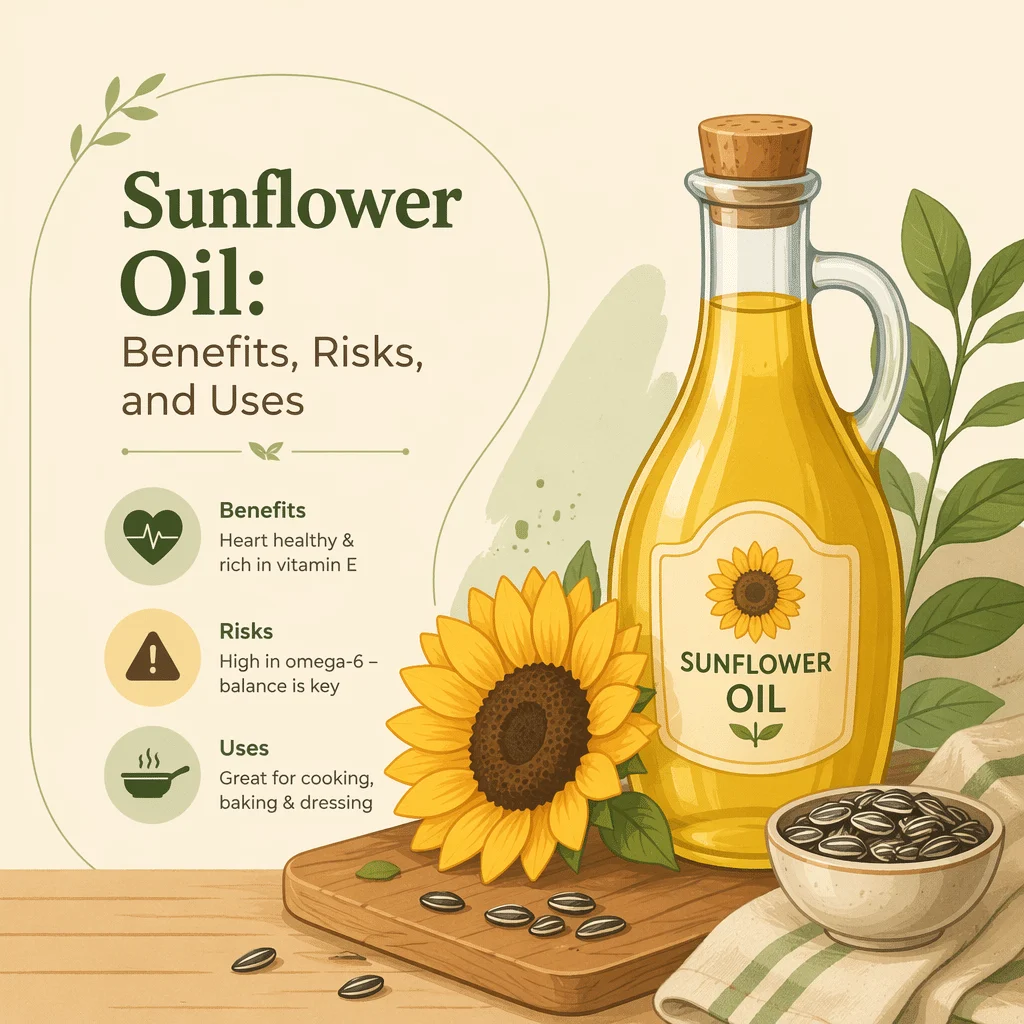
Few kitchen staples generate as much online argument as this one. Search for sunflower oil benefits and you will find pages promising better skin, a healthier heart and lower inflammation, sitting alongside videos calling the same bottle a toxic seed oil. Both registers overstate what the evidence shows. Sunflower oil is a widely used cooking fat with an interesting nutritional profile and some real limitations. It is also not one product: the bottle labeled sunflower oil in your cupboard may have a fat composition very different from the one your neighbor bought. In this article you will learn what separates the main types, which sunflower oil benefits current research supports, how the oil interacts with your cholesterol and triglyceride results, and where the omega-6 debate honestly stands.
What sunflower oil is, and why it is not one single product
Sunflower oil is pressed from the seeds of Helianthus annuus, the common sunflower. Over several decades, plant breeders deliberately altered the crop’s fatty-acid composition to make the oil more stable for cooking and for industrial food production. The result is that several genuinely different oils now reach store shelves under the same three words on the label, and most discussion of sunflower oil benefits ignores that fact entirely.
The fat in any vegetable oil is a mixture of saturated, monounsaturated and polyunsaturated fatty acids. In sunflower oil, two dominate. Linoleic acid is a polyunsaturated omega-6 fat the body cannot make on its own. Oleic acid is a monounsaturated fat, the same one that makes up most of olive oil. What changes between cultivars is the ratio between the two: traditional sunflower oil is rich in linoleic acid, newer high-oleic varieties reverse that balance almost completely, and mid-oleic sits between them. Sunflower oil is also one of the more concentrated dietary sources of vitamin E.
Refined and cold-pressed are not the same thing
Most supermarket sunflower oil is refined. Refining removes free fatty acids, pigments and aroma compounds, producing a neutral-tasting, pale oil that tolerates heat better and keeps longer. Cold-pressed or virgin sunflower oil is extracted mechanically without high heat or chemical solvents, so it keeps more of the seed’s flavor and color. It is also less stable, better suited to dressings than a hot pan. Refining is not a mark of poor quality but a processing choice with trade-offs.
High-linoleic, mid-oleic and high-oleic: the difference that matters most
The type of sunflower oil you buy changes its fatty-acid profile far more than any other variable, including price, brand or origin. The table below summarizes what differs.
| Type | Dominant fat | Best suited to | What it means for you |
|---|---|---|---|
| Traditional (high-linoleic) | Linoleic acid, an omega-6 polyunsaturated fat | Dressings, baking, light sauteing | The most polyunsaturated option, and the one most prone to oxidizing under prolonged heat |
| Mid-oleic (often sold as NuSun) | Oleic acid, with a substantial share of linoleic acid | General home cooking, commercial frying | A compromise profile bred mainly for food manufacturers rather than for shoppers |
| High-oleic | Oleic acid, a monounsaturated fat | Frying, roasting, products needing a long shelf life | The only sunflower oil that can carry the FDA qualified health claim for oleic acid |
| Cold-pressed (any cultivar) | Depends on the seed variety used | Dressings, dips, finishing a dish | Keeps flavor and color, but tolerates heat and long storage less well |
The label rarely spells this out. In the United States, high-oleic sunflower oil is usually identified as such, because manufacturers choose it deliberately and want the shelf-life advantage on record. A bottle that simply says sunflower oil is more likely to be a traditional high-linoleic or mid-oleic product. When it matters to you, the ingredient panel and the manufacturer’s product page are more reliable than the front label.
Sunflower oil benefits the evidence actually supports
Strip away the superfood language and the sunflower oil benefits that survive scrutiny come down to three defensible points.
The first is substitution. Sunflower oil is a practical way to use less saturated fat in cooking, and that swap, not the oil itself, is where the measurable effect sits. MedlinePlus, the patient-information service of the National Library of Medicine, names sunflower oil among the common sources of polyunsaturated fat and makes the emphasis explicit: eliminating saturated fats is roughly twice as effective at lowering blood cholesterol as simply adding more polyunsaturated fat. Adding sunflower oil on top of an unchanged diet is not the intervention that has been studied.
The second is vitamin E, covered in its own section below, where sunflower oil is a genuinely notable dietary contributor.
The third applies only to one type. The US Food and Drug Administration has reviewed a qualified health claim for oils high in oleic acid, including high-oleic sunflower oil, relating a daily intake of about one and a half tablespoons, or roughly 20 grams, to a possible reduction in coronary heart disease risk when it replaces fats higher in saturated fat. Two conditions matter: the oil must contain at least 70 percent oleic acid per serving, which excludes traditional sunflower oil entirely, and the FDA classifies the evidence as supportive but not conclusive, a deliberately lower tier than its standard for full scientific agreement. That is a real finding stated modestly, and it should be repeated modestly.
A large 2023 systematic review and dose-response meta-analysis in Critical Reviews in Food Science and Nutrition, pooling data from 165 cohorts and trials, struck a similar tone: the evidence, taken as a whole, gives modest support to current recommendations to replace saturated fats with polyunsaturated fats. Modest support is not a promise, and no single bottle of oil delivers it.
What sunflower oil does to your lipid panel
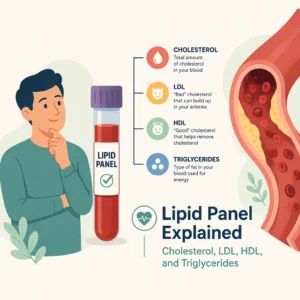
This is where a cooking-oil question becomes a laboratory question. If you want to see the effect of any dietary fat change, the blood test that shows it is one most people already have on file. AI DiagMe publishes a full explainer covering the standard lipid panel.
The most consistent finding across nutrition research is that replacing saturated fat with polyunsaturated fat tends to lower LDL cholesterol, the fraction most closely tied to arterial plaque. The size of that shift depends on what is being replaced and by how much, not on the oil having special properties. A separate article details the normal LDL cholesterol ranges, and another explains the causes of low HDL cholesterol.
A randomized trial published in Atherosclerosis in 2024 is unusually relevant here, because its linoleic-acid arm used sunflower oil specifically. Across 118 men, diets enriched in either plant omega-3 or omega-6 fat both lowered lipoprotein(a) modestly, but moved other lipid measures in different directions, including LDL cholesterol, non-HDL cholesterol and apolipoprotein B. Oils are not interchangeable levers, and a single number rarely captures what a dietary change did. A dedicated article covers the normal triglyceride ranges, and another explains the cholesterol ratio.
Two cautions belong here. Triglycerides respond far more to alcohol, refined carbohydrate and total calories than to which oil is in the pan, so blaming or crediting sunflower oil for a triglyceride result is usually misplaced. And because cholesterol travels on particles rather than dissolved freely, some clinicians prefer a particle count. A separate guide explains the ApoB blood test.
Is sunflower oil inflammatory? What the omega-6 debate is really about
The concern runs like this: linoleic acid can be converted in the body into arachidonic acid, a precursor to several signaling molecules involved in inflammation. Therefore, the argument goes, eating more omega-6 fat should raise inflammation. It is a mechanistically reasonable hypothesis, and exactly the kind that has to be tested.
When it has been tested directly, the prediction has largely not held. A 2024 perspective in the British Journal of Nutrition, written by a group of lipid researchers reviewing the trial evidence, concluded that raising omega-6 polyunsaturated fat intake does not increase markers of inflammation or oxidative stress in controlled clinical trials. That is the most direct answer available to the question people are asking.
The picture is not uniformly reassuring, though. A 2025 analysis in the European Journal of Preventive Cardiology, combining individual-level data from three large long-term cohorts with an updated meta-analysis, found that circulating linoleic acid was associated with lower stroke risk, while several downstream omega-6 fatty acids derived from it pointed the other way for coronary heart disease. In other words, omega-6 is not one substance behaving one way, and blood levels reflect the body’s own processing, not just what was eaten.
Two practical consequences follow. The popular omega-6 to omega-3 ratio framing is shakier than its confidence suggests; most major reviews emphasize getting enough omega-3 rather than avoiding omega-6. And if inflammation worries you, it can be measured rather than inferred from a shopping list. To see how that is done in practice, read the guide to C-reactive protein.
Vitamin E: the nutrient sunflower oil genuinely delivers
Here the claim survives scrutiny. According to the National Institutes of Health Office of Dietary Supplements, the recommended dietary allowance for vitamin E is 15 milligrams a day for everyone aged 14 and over, and alpha-tocopherol is the only form recognized as meeting human requirements. One tablespoon of sunflower oil supplies about 5.6 milligrams, placing it among the more substantial everyday food sources.
Context keeps this in proportion. The same NIH source notes that outright vitamin E deficiency is rare, and that overt deficiency symptoms have not been observed in otherwise healthy people who get relatively little vitamin E from their diets. Clinically meaningful deficiency shows up mainly in conditions that impair fat absorption, such as cystic fibrosis or Crohn’s disease, because vitamin E needs dietary fat to be absorbed at all. Status is assessed by measuring serum alpha-tocopherol, and AI DiagMe publishes a guide to the vitamin E blood test.
None of this makes vitamin E a reason to drink sunflower oil by the spoonful. Higher intakes from food are not associated with benefit in healthy people, and high-dose supplementation is a separate question with its own risks.
Cooking with sunflower oil: heat, reuse and storage
Every oil has a temperature at which it starts to break down and smoke, and that point depends on the fatty-acid profile, the degree of refining and how much the oil has already been used. Refined sunflower oil tolerates heat better than cold-pressed, and high-oleic better than high-linoleic, because monounsaturated fats are less chemically reactive than polyunsaturated ones. That ordering is more useful than any single published temperature, since real figures vary between batches and testing methods.
What matters in a home kitchen is simpler than smoke-point charts suggest. Heating any oil until it smokes degrades it and produces compounds you would rather not eat, so the practical rule is to keep the pan below that point. Repeatedly reusing frying oil accelerates the same degradation; oil that has darkened, thickened or developed a sharp, paint-like smell should be discarded rather than strained and reused. And because polyunsaturated oils oxidize on contact with air, light and warmth, sunflower oil keeps best sealed, in a cool cupboard rather than beside the stove.
Risks, allergy, and when to talk to a clinician
Sunflower oil is not a high-risk food, but a few points deserve accurate treatment rather than blanket reassurance, and they belong in any honest account of sunflower oil benefits and drawbacks.
Allergy is rare and real. Sunflower seed allergy is documented, and while highly refined oils contain very little residual seed protein, unrefined oils retain more. Anyone with a known sunflower seed allergy should treat unrefined sunflower oil with caution and raise it with an allergist rather than experimenting. A clinician can order an allergy blood test when the history is unclear.
Calorie density applies here as it does to every oil. All culinary oils are pure fat and among the most energy-dense things in a kitchen, which is why cooking method often matters more than oil choice.
The pancreas deserves a mention too. Very high triglyceride levels can trigger pancreatitis, and anyone with that history is usually given specific dietary fat guidance rather than general advice. If that applies to you, it helps to understand the meaning of lipase levels before your next appointment.
Consider raising fat intake with a doctor or registered dietitian if any of the following describes you:
- You have been diagnosed with high cholesterol, high triglycerides or another lipid disorder, or take a lipid-lowering medication.
- You have established cardiovascular disease, diabetes or chronic kidney disease.
- You have a personal or family history of pancreatitis, or a previously recorded very high triglyceride level.
- You have a condition affecting fat absorption, such as cystic fibrosis or Crohn’s disease.
- You have a known seed or nut allergy and are unsure which oils are safe for you.
- You are planning a substantial change to how you eat and want the before-and-after measured properly.
Latest scientific advances
Research on cooking oils moved noticeably between 2023 and 2026, largely in response to the public seed-oil argument. Here is what changed for anyone weighing sunflower oil benefits against the warnings, in plain terms.
Researchers took the seed-oil accusation seriously enough to review it formally. A 2025 narrative review in Nutrition Reviews asked whether seed oils are responsible for cardiometabolic and chronic disease and found no support for the strong version of the claim, while noting that much of the underlying research is observational and that public discussion has run well ahead of the evidence. What this means for you: the confident online verdicts, in both directions, are not backed by a settled literature.
The overall quality of the evidence was graded rather than assumed. A 2024 umbrella review in Advances in Nutrition pulled together 48 studies covering more than 200 meta-analyses of edible vegetable oils and assessed how trustworthy each conclusion was. Its central message: the certainty of the evidence on cooking oils ranges from moderate down to very low, depending on the outcome. What this means for you: anyone quoting a single dramatic figure about any cooking oil is almost certainly quoting from the weaker end of that range.
The omega-6 question got a more careful answer. The 2025 European Journal of Preventive Cardiology analysis described earlier found that higher circulating linoleic acid tracked with lower stroke risk, while several fatty acids the body makes from it pointed in a less favorable direction for coronary heart disease. What this means for you: treating all omega-6 fats as a single villain, or a single hero, does not match the measurements.
Finally, sunflower oil itself was tested in a controlled setting. The 2024 Atherosclerosis trial fed sunflower oil as the omega-6 arm and found a modest reduction in lipoprotein(a), a partly inherited cardiovascular risk marker, alongside mixed movement in other lipid measures. What this means for you: dietary fat changes shift several lab values at once, in different directions, which is why reading a full panel beats fixating on one line of it.
None of these findings establishes that any cooking oil prevents or treats disease, and none replaces individual medical advice.
Glossary
| Term | Definition |
|---|---|
| Linoleic acid | The main omega-6 polyunsaturated fatty acid in traditional sunflower oil. The body cannot make it, so it has to come from food. |
| Oleic acid | A monounsaturated fatty acid that dominates olive oil and high-oleic sunflower oil. It is more heat-stable than linoleic acid. |
| Polyunsaturated fat | A fat with several double bonds in its chain. It stays liquid when cold and oxidizes more easily than other fats. |
| Monounsaturated fat | A fat with a single double bond. It is generally more stable during cooking and storage. |
| High-oleic sunflower oil | A cultivar bred so that oleic acid replaces most of the linoleic acid, giving a longer shelf life and better heat tolerance. |
| Alpha-tocopherol | The form of vitamin E recognized as meeting human requirements, and the one measured in a blood test. |
| Smoke point | The temperature at which an oil visibly smokes and begins breaking down. It falls as an oil is reused. |
| Rancidity | The spoilage that happens when fat reacts with oxygen, light or heat, producing off smells and flavors. |
| Apolipoprotein B (ApoB) | A protein found on each cholesterol-carrying particle that can enter an artery wall, so it reflects particle number. |
| Lipoprotein(a) | A cholesterol-carrying particle whose level is largely inherited and which is measured as an extra cardiovascular risk marker. |
Frequently asked questions
Is sunflower oil healthier than olive oil?
There is no evidence that would justify a clean verdict either way for everyday cooking. Extra-virgin olive oil has been studied more extensively, particularly within Mediterranean dietary patterns, and it carries plant compounds that refined oils lose. High-oleic sunflower oil has a fatty-acid profile closer to olive oil than traditional sunflower oil does. In practice, both are reasonable choices, and what you are replacing matters more than which of the two you pick.
Which sunflower oil is best for frying?
High-oleic sunflower oil is the more stable option at frying temperatures, because monounsaturated fats resist heat-driven breakdown better than polyunsaturated fats do. Refined oil also outperforms cold-pressed here. Whichever you use, keeping the oil below the smoking point and not reusing it repeatedly matters more than the label.
Does sunflower oil raise cholesterol?
Used as a replacement for fats higher in saturated fat, sunflower oil is more likely to be associated with a small reduction in LDL cholesterol than an increase. Used in addition to an otherwise unchanged diet, it mainly adds calories. No cooking oil changes a lipid panel on its own, and a single blood test taken after a few days of dietary change will not show a reliable trend.
How much vitamin E does sunflower oil provide?
The National Institutes of Health lists one tablespoon of sunflower oil as providing about 5.6 milligrams of vitamin E, against a recommended dietary allowance of 15 milligrams a day for adults. That makes it a meaningful contributor to daily intake rather than a complete source, and it does not mean more oil is better.
Can sunflower oil cause an allergic reaction?
Yes, though it is uncommon. Sunflower seed allergy exists and has been documented in medical literature. Highly refined oils contain very little residual seed protein, so they are less likely to trigger a reaction than cold-pressed or unrefined oils. Anyone with a known sunflower seed allergy should ask an allergist which forms are safe rather than testing it at home.
Should I avoid sunflower oil if my triglycerides are high?
Not necessarily, and not on its own. Triglyceride levels respond most strongly to alcohol, refined carbohydrate, total calorie intake and body weight, with the type of cooking oil playing a smaller role. If your triglycerides are high, the useful step is a conversation with your doctor about your overall pattern of eating, not swapping one bottle for another.
Sources
- US Food and Drug Administration — FDA Completes Review of Qualified Health Claim Petition for Oleic Acid and the Risk of Coronary Heart Disease, 2018 — fda.gov
- National Institutes of Health, Office of Dietary Supplements — Vitamin E: Fact Sheet for Health Professionals, 2021 — ods.od.nih.gov
- MedlinePlus, US National Library of Medicine — Facts about polyunsaturated fats, 2024 — medlineplus.gov
- Jayedi A, et al. — Dietary intake, biomarkers and supplementation of fatty acids and risk of coronary events: a systematic review and dose-response meta-analysis of randomized controlled trials and prospective observational studies — Critical Reviews in Food Science and Nutrition, 2023 — doi.org/10.1080/10408398.2023.2251583
- Petersen KS, Maki KC, Calder PC, et al. — Perspective on the health effects of unsaturated fatty acids and commonly consumed plant oils high in unsaturated fat — British Journal of Nutrition, 2024 — doi.org/10.1017/S0007114524002459
- Shi F, et al. — Association of circulating fatty acids with cardiovascular disease risk: analysis of individual-level data in three large prospective cohorts and updated meta-analysis — European Journal of Preventive Cardiology, 2025 — doi.org/10.1093/eurjpc/zwae315
- Lee K, Kurniawan K. — Are Seed Oils the Culprit in Cardiometabolic and Chronic Diseases? A Narrative Review — Nutrition Reviews, 2025 — doi.org/10.1093/nutrit/nuae205
- Nuotio P, et al. — Dietary n-3 alpha-linolenic and n-6 linoleic acids modestly lower serum lipoprotein(a) concentration but differentially influence other atherogenic lipoprotein traits: a randomized trial — Atherosclerosis, 2024 — doi.org/10.1016/j.atherosclerosis.2024.117562
- Voon PT, et al. — Health Effects of Various Edible Vegetable Oil: An Umbrella Review — Advances in Nutrition, 2024 — doi.org/10.1016/j.advnut.2024.100276
Further reading
- High cholesterol: understand, prevent, act
- High triglycerides: causes, risks and management
- The advanced lipid panel and who needs it
- How to read your blood test results
- Fasting before a blood test: rules and timing
Understand your lab results with AI DiagMe
Changing the oil in your kitchen is easy. Knowing whether it changed anything is the harder part, and that answer lives in your blood work rather than on a label. A lipid panel showing total cholesterol, LDL, HDL and triglycerides, a vitamin E level and an inflammation marker such as C-reactive protein together give a far more useful picture than any dietary rule of thumb. AI DiagMe helps you understand what those values mean in plain language; it does not diagnose you and it does not replace your doctor.
Get your results interpreted in minutes